
Explore 1,001 illustrated backgammon facts, from historic boards and remarkable players to rules, strategy and dice. Browse six subjects below, or enjoy rotating facts under Learn & Help → Factoids in TrigammonX.
Jump to: History & Objects · Art & Culture · Around the World · Championships & Players · Rules & Strategy · Dice & Technology
Select a fact title to read more. Historical tables games do not always use modern backgammon rules. Sources and image credits accompany each entry.
History & Objects
147 facts in this subject.
A royal book of games from 1283
In 1283, a book associated with King Alfonso X of Castile recorded chess, dice, and tables games. This colourful page shows a game called todas tablas. Its board and round pieces look familiar because it belongs to the same broad family of games as backgammon.
The picture is a window into medieval play, rather than proof that people were using all of today’s backgammon rules. The modern doubling cube, for example, came centuries later.
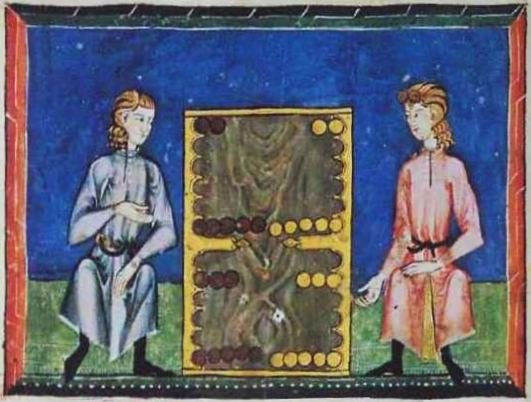
Image credit: Medieval manuscript artists; commissioned under Alfonso X. Public domain (PD-Art). Source: https://commons.wikimedia.org/wiki/File:Alfonso-todas-tablas.jpg. Licence: https://creativecommons.org/publicdomain/mark/1.0/. Display, thumbnail and enlargement resized without cropping and JPEG encoded; EXIF orientation applied. Enlargement limited to 1400 pixels on its longest side, or source size if smaller. No AI edits.

A checker that belongs in a museum
Some medieval gaming pieces were tiny works of art. This carved ivory tableman is described as coming from Cologne around 1150 and is held at the Victoria and Albert Museum in London. Its design depicts Ophiuchus, the serpent-bearer constellation.
A tableman is a playing piece for the tables family of games, which includes backgammon. This surviving piece shows how much care could go into an object meant to be moved around a game board.
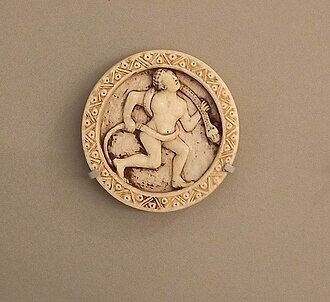
Image credit: SpeakingArch. CC BY-SA 4.0. Source: https://commons.wikimedia.org/wiki/File:Backgammon_Tableman%2C_elephant_ivory%2C_depicting_Ophiuchus%2C_the_13th_of_the_zodiacal_constellations%2C_Cologne%2C_ca._1150_CE%2C_V%26A_Museum%2C_London.jpg. Licence: https://creativecommons.org/licenses/by-sa/4.0/. Display, thumbnail and enlargement resized without cropping and JPEG encoded; EXIF orientation applied. Enlargement limited to 1400 pixels on its longest side, or source size if smaller. No AI edits.

One beautiful box, two different games
This late-19th-century game box was made for playing backgammon or chess. It is thought to come from Syria or Egypt and combines wood, bone, and mother-of-pearl inlay. The decoration makes the box as interesting to look at as the games are to play.
The example is held at the Royal Ontario Museum in Toronto. It shows that a game set can be both a practical object and a display of skilled craftsmanship.
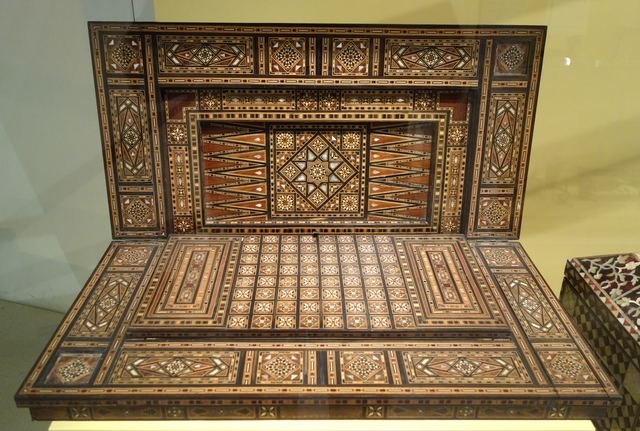
Image credit: Daderot. CC0 1.0. Source: https://commons.wikimedia.org/wiki/File:Box_for_playing_backgammon_or_chess%2C_probably_Syria_or_Egypt%2C_late_19th_century%2C_wood%2C_wood_veneers%2C_bone%2C_and_mother_of_pearl_inlay_-_Royal_Ontario_Museum_-_DSC04771.JPG. Licence: https://creativecommons.org/publicdomain/zero/1.0/. Display, thumbnail and enlargement resized without cropping and JPEG encoded; EXIF orientation applied. Enlargement limited to 1400 pixels on its longest side, or source size if smaller. No AI edits.

The cube is a newcomer—and you do not roll it
The doubling cube arrived in backgammon in the 1920s, and its inventor is still unknown. It added a new strategic question: when should you offer to raise the value of the game? Your opponent must decide whether to accept or concede at the current value.
Despite looking like a die, the cube is not rolled. Its faces show 2, 4, 8, 16, 32, and 64 to help track the game’s value.
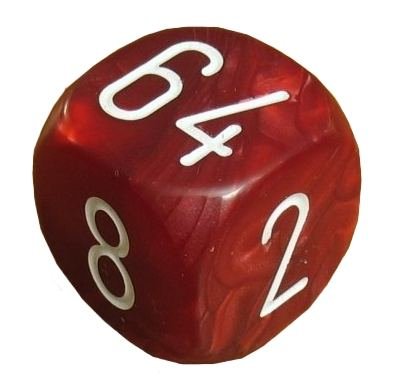
Image credit: Ptkfgs / Chris Roddy; source image has a digitally removed background. Public domain (author dedication). Source: https://commons.wikimedia.org/wiki/File:Backgammon_DoublingCube.jpg. Licence: https://creativecommons.org/publicdomain/mark/1.0/. Display, thumbnail and enlargement resized without cropping and JPEG encoded; EXIF orientation applied. Enlargement limited to 1400 pixels on its longest side, or source size if smaller. No AI edits.
Sources and licence: Source 1 · Source 2 · Source 3 · Source 4

Backgammon lessons before the internet
Long before video tutorials, players could study backgammon in a printed guide. This title page comes from a 1753 edition of Edmond Hoyle’s A Short Treatise on the Game of Back-Gammon. It promises rules, advice for beginners, and calculations about the odds.
The page shows that people were already treating backgammon as something to learn and improve at. The spelling may look old-fashioned, but the interest in making better decisions is very familiar.

Image credit: Edmond Hoyle; scan via Wikimedia Commons. Public domain (PD-Art). Source: https://commons.wikimedia.org/wiki/File:Hoyle-backgammon.png. Licence: https://creativecommons.org/publicdomain/mark/1.0/. Display, thumbnail and enlargement resized without cropping and JPEG encoded; EXIF orientation applied. Enlargement limited to 1400 pixels on its longest side, or source size if smaller. No AI edits.

A game board rescued from a shipwreck
A wooden tables-game board was recovered from the Swedish warship Vasa, which sank in 1628. Its rows of long triangles still look familiar to anyone who has opened a backgammon set.
The surviving board is evidence of gaming equipment aboard the ship. It does not mean the sailors followed every modern backgammon rule: the Swedish tables tradition had games of its own.
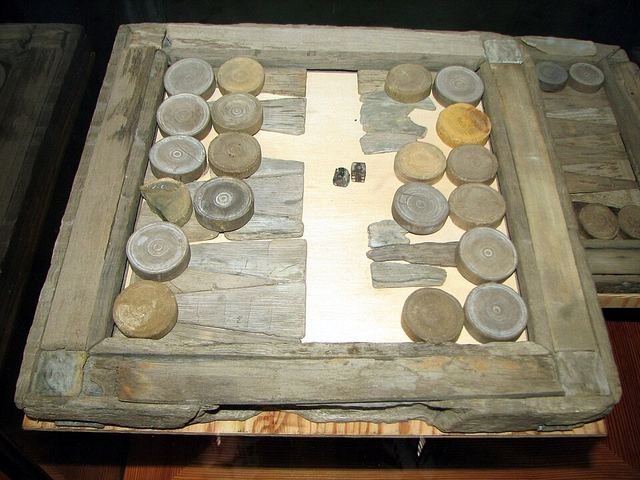
Image credit: Chris 73 / Wikimedia Commons. CC BY-SA 3.0. Source: https://commons.wikimedia.org/wiki/File:Old_Backgammon_Vasa.jpg. Licence: https://creativecommons.org/licenses/by-sa/3.0/. Display, thumbnail and enlargement resized without cropping and JPEG encoded; EXIF orientation applied. Enlargement limited to 1400 pixels on its longest side, or source size if smaller. No AI edits.

A backgammon board can be furniture
Not every backgammon set folds into a carrying case. This modern table, designed by Alois Scheicher, has a pearwood structure and a playing surface made with leather inlay.
Inlay means fitting pieces of material into a surface to create a design. Here the familiar triangles are part of a piece of furniture, turning the board into a permanent place to play.

Image credit: Roland Scheicher; table designed by Alois Scheicher. Public domain (author dedication). Source: https://commons.wikimedia.org/wiki/File:Backgammontisch.jpg. Licence: https://creativecommons.org/publicdomain/mark/1.0/. Display, thumbnail and enlargement resized without cropping and JPEG encoded; EXIF orientation applied. Enlargement limited to 1400 pixels on its longest side, or source size if smaller. No AI edits.

Japan’s sugoroku name covers different games
This 1910 illustration shows people playing travelling sugoroku on a printed sheet. Players move through pictured spaces using a die, making it a different game from backgammon.
The accompanying book also describes an older, tables-style sugoroku that it compares with backgammon. One name covered two different kinds of game: the pictured travelling game and a board game from the broader tables family.

Image credit: Unknown illustrator; published 1910. Public domain. Source: https://commons.wikimedia.org/wiki/File:SUGOROKU._%281910%29_-_illustration_-_page_309.png. Licence: https://creativecommons.org/publicdomain/mark/1.0/. Display, thumbnail and enlargement resized without cropping and JPEG encoded; EXIF orientation applied. Enlargement limited to 1400 pixels on its longest side, or source size if smaller. No AI edits.

Medieval players appear in a book of poetry
A colourful page in the Codex Manesse shows Herr Goeli with a board from the tables family of games. The miniature dates from about 1305–1315, more than seven centuries ago.
The manuscript is held by Heidelberg University Library. Its recognisable board links the picture to backgammon’s wider history, although the image alone cannot establish that the players followed today’s rules.
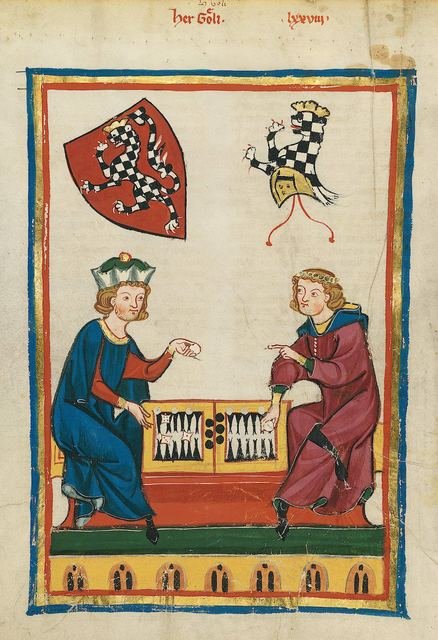
Image credit: Master of the Codex Manesse. Public domain. Source: https://commons.wikimedia.org/wiki/File:Codex_Manesse_262v_Herr_Goeli.jpg. Licence: https://creativecommons.org/publicdomain/mark/1.0/. Display, thumbnail and enlargement resized without cropping and JPEG encoded; EXIF orientation applied. Enlargement limited to 1400 pixels on its longest side, or source size if smaller. No AI edits.

An older terrace scene beside a game board
Willem van de Poll photographed men gathered around a board game on a terrace in Tiberias in 1948–1949. The image survives in the Dutch National Archives.
The archive description calls it a board game, and the visible equipment resembles a tables board. That makes it useful historical context, while the exact game and rules remain uncertain.

Image credit: Willem van de Poll / Dutch National Archives. CC BY-SA 3.0. Source: https://commons.wikimedia.org/wiki/File:Terras_in_een_straat_met_mannen_die_zich_met_een_gezelschapsspel_vermaken._Isra%C3%ABl%2C_Tiberias._1948-1949.jpg. Licence: https://creativecommons.org/licenses/by-sa/3.0/. Display, thumbnail and enlargement resized without cropping and JPEG encoded; EXIF orientation applied. Enlargement limited to 1400 pixels on its longest side, or source size if smaller. No AI edits.

Clubs helped standardise the rules in 1931
In 1931, Wheaton Vaughan of New York’s Racquet and Tennis Club brought interested clubs together to prepare a shared set of backgammon laws. The resulting rules were widely adopted in the United States.
The published laws included the doubling cube, which was still a fairly recent addition. They helped players from different clubs agree on how a game should be played and scored.
Image credit: Ptkfgs / Chris Roddy; source image has a digitally removed background. Public domain (author dedication). Source: https://commons.wikimedia.org/wiki/File:Backgammon_DoublingCube.jpg. Licence: https://creativecommons.org/publicdomain/mark/1.0/. Display, thumbnail and enlargement resized without cropping and JPEG encoded; EXIF orientation applied. Enlargement limited to 1400 pixels on its longest side, or source size if smaller. No AI edits.
A games handbook included backgammon in 1674
The Compleat Gamester, first published in 1674 and later attributed to Charles Cotton, included instructions for backgammon alongside card games, chess and billiards. It was a guide to many pastimes, rather than a book about one game.
The accompanying image is its historical frontispiece: the illustrated page near the beginning of the book. The spelling “gamester” meant a person who played games.
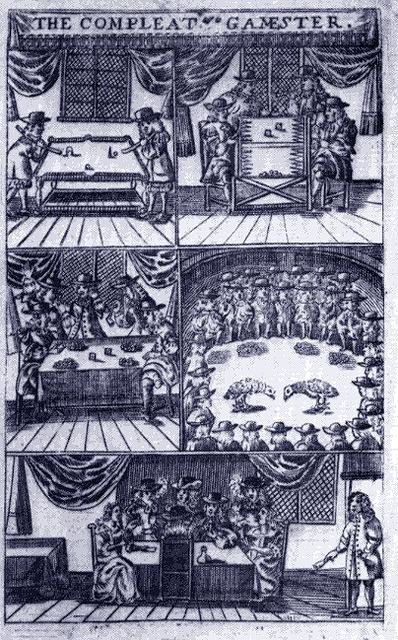
Image credit: Unknown historical illustrator; scan via Wikimedia Commons. Public domain (PD-Art). Source: https://commons.wikimedia.org/wiki/File:The_complete_gamester.gif. Licence: https://creativecommons.org/publicdomain/mark/1.0/. Display, thumbnail and enlargement resized without cropping and JPEG encoded; EXIF orientation applied. Enlargement limited to 1400 pixels on its longest side, or source size if smaller. No AI edits.

A medieval board can be a work of craftsmanship
This photograph shows an ornate gaming board with carved figures and a row of round playing pieces. Its Wikimedia Commons description identifies it as a board from fourteenth-century Venice, in what is now Italy.
A beautiful old board tells us about craftsmanship, but it does not prove that players used today’s rules. Historical games in the tables family shared equipment while differing in how pieces moved and scored.
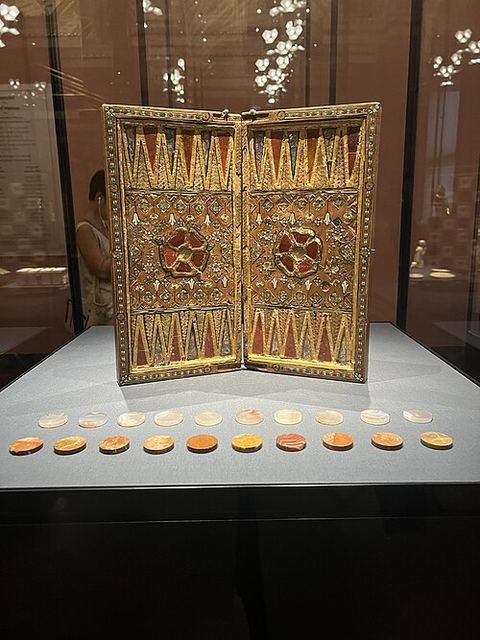
Image credit: Van Der Meulen Christofle. CC0 1.0. Source: https://commons.wikimedia.org/wiki/File:Backgammon_(1)_(Venise,_XIVe_siecle).jpg. Licence: https://creativecommons.org/publicdomain/zero/1.0/. Display, thumbnail and enlargement resized without cropping and JPEG encoded; EXIF orientation applied. Enlargement limited to 1400 pixels on its longest side, or source size if smaller. No AI edits.

Tudor sailors took a tables game to sea
A wooden gaming set was recovered from the Mary Rose, Henry VIII’s warship that sank in 1545. The set is associated with the ship’s master carpenter, whose belongings included tools and personal possessions.
It belongs to the older tables-game tradition that led to modern backgammon. Calling it a modern backgammon set would hide an important detail: sailors in Tudor times played with earlier rules.
Image credit: Chris 73 / Wikimedia Commons. CC BY-SA 3.0. Source: https://commons.wikimedia.org/wiki/File:Old_Backgammon_Vasa.jpg. Licence: https://creativecommons.org/licenses/by-sa/3.0/. Display, thumbnail and enlargement resized without cropping and JPEG encoded; EXIF orientation applied. Enlargement limited to 1400 pixels on its longest side, or source size if smaller. No AI edits.
Sources and licence: Source 1 · Source 2 · Source 3 · Source 4
Backgammon problems appeared in a woman’s 1895 guide
Alice Howard Cady’s Backgammon was published in New York in 1895 by the American Sports Publishing Company. Its pages included board positions for readers to study, with explanations of which player had the stronger game.
The attached image comes from a section of problems credited to Berkeley. It is a genuine historical book illustration: players were studying positions on paper long before computer analysis became available.

Image credit: Historical illustration in Alice Howard Cady’s 1895 book; scan via Internet Archive Book Images. Public domain; source marked no known copyright restrictions. Source: https://commons.wikimedia.org/wiki/File:Backgammon_(1895)_(14596242107).jpg. Licence: https://www.flickr.com/commons/usage/. Display, thumbnail and enlargement resized without cropping and JPEG encoded; EXIF orientation applied. Enlargement limited to 1400 pixels on its longest side, or source size if smaller. No AI edits.

An Icelandic tables game circles the board
The old game published as Chasing the Girls uses six checkers per player. Pieces circle the board and opposing checkers are removed when hit. Most mixed rolls use only ones and sixes. This is a different tables game, not a historical rule that applies to standard backgammon. Its exact earliest origins remain uncertain.

Image credit: Sascha Kohlmann. CC BY-SA 3.0. Source: https://commons.wikimedia.org/wiki/File:Playing_Backgammon_Athens_Greece_%28113613901%29.jpeg. Licence: https://creativecommons.org/licenses/by-sa/3.0/. Display, thumbnail and enlargement resized without cropping and JPEG encoded; EXIF orientation applied. Enlargement limited to 1400 pixels on its longest side, or source size if smaller. No AI edits.

Doublets asks players to unstack and restack
Doublets is an old tables game described as a game of luck. Players begin with six pairs of checkers, unstack them by rolling the corresponding point numbers, then restack them before bearing off. A double gives another roll. Its changing tasks make the same board serve a very different game.
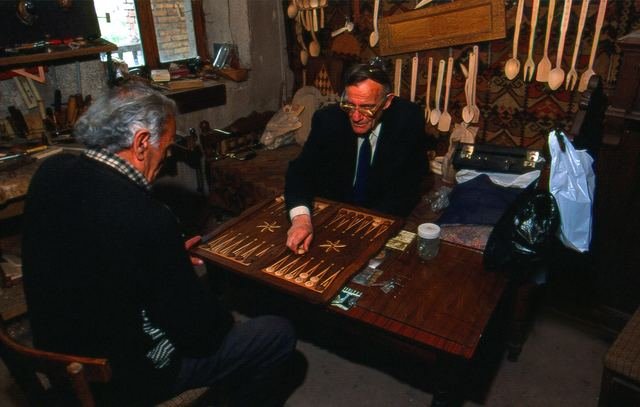
Image credit: Peace Corps. Public domain. Source: https://commons.wikimedia.org/wiki/File:Nardy_players_in_Armenia.jpg. Licence: https://creativecommons.org/publicdomain/mark/1.0/. Display, thumbnail and enlargement resized without cropping and JPEG encoded; EXIF orientation applied. Enlargement limited to 1400 pixels on its longest side, or source size if smaller. No AI edits.

Fayles uses three dice and a harsh penalty
Fayles is a historical tables game with three dice. In the cited reconstruction, a player who cannot use all three rolled numbers loses the game. Doubles have no special four-move bonus. This strict rule makes blocking especially serious. It should not be confused with modern standard backgammon.

Image credit: Bryan Doane. CC BY 2.0. Source: https://commons.wikimedia.org/wiki/File:Backgammon-playwers-netanya-street-july-2013.jpg. Licence: https://creativecommons.org/licenses/by/2.0/. Display, thumbnail and enlargement resized without cropping and JPEG encoded; EXIF orientation applied. Enlargement limited to 1400 pixels on its longest side, or source size if smaller. No AI edits.

Irish doubles are played only once each
In the published rules of the historical game Irish, doubles are used like an ordinary roll: two moves rather than four. Players also cannot completely close an opponent out when a checker is on the bar. These differences help distinguish an older tables game from present-day standard backgammon.

Image credit: Stig Nygaard. CC BY 2.0. Source: https://commons.wikimedia.org/wiki/File:Nacala_-_Bay_Diving_(2767931598).jpg. Licence: https://creativecommons.org/licenses/by/2.0/. Display, thumbnail and enlargement resized without cropping and JPEG encoded; EXIF orientation applied. Enlargement limited to 1400 pixels on its longest side, or source size if smaller. No AI edits.

Roman Tabula adds a third die
The published reconstruction of Tabula uses three dice, with one move for each number. There is no standard backgammon doubles bonus. Both players enter into the same starting area and travel in the same direction. These rules describe a historical relative of backgammon, not proof that modern backgammon already existed in ancient Rome.

Image credit: Onceinawhile. CC BY-SA 4.0. Source: https://commons.wikimedia.org/wiki/File:Damascene-style_inlaid_Backgammon_board,_Cairo,_Khan_el-Khalili.jpg. Licence: https://creativecommons.org/licenses/by-sa/4.0/deed.en. Display, thumbnail and enlargement resized without cropping and JPEG encoded; EXIF orientation applied. Enlargement limited to 1400 pixels on its longest side, or source size if smaller. No AI edits.

Tourne-case hits across the board
In Tourne-case, a player can hit an opposing checker by landing on the point directly opposite it across the board. Each side has only three checkers, and they must remain in their order of entry. This historical French game uses the familiar board in a surprisingly different way.

Image credit: madras91. CC BY 2.0. Source: https://commons.wikimedia.org/wiki/File:%E1%83%A5%E1%83%90%E1%83%A0%E1%83%97%E1%83%95%E1%83%94%E1%83%9A%E1%83%94%E1%83%91%E1%83%98_%E1%83%9C%E1%83%90%E1%83%A0%E1%83%93%E1%83%98%E1%83%A1_%E1%83%97%E1%83%90%E1%83%9B%E1%83%90%E1%83%A8%E1%83%9D%E1%83%91%E1%83%94%E1%83%9C_(48397852796).jpg. Licence: https://creativecommons.org/licenses/by/2.0/deed.en. Display, thumbnail and enlargement resized without cropping and JPEG encoded; EXIF orientation applied. Enlargement limited to 1400 pixels on its longest side, or source size if smaller. No AI edits.

Trictrac rewards positions rather than just finishing
Grand Trictrac is more than a French label for ordinary backgammon. Players score for particular arrangements and possible plays; the race is only part of the game. Its published match system groups twelve points into a trou, or hole, and twelve trous into a match. Extra scoring equipment reflects that different goal.
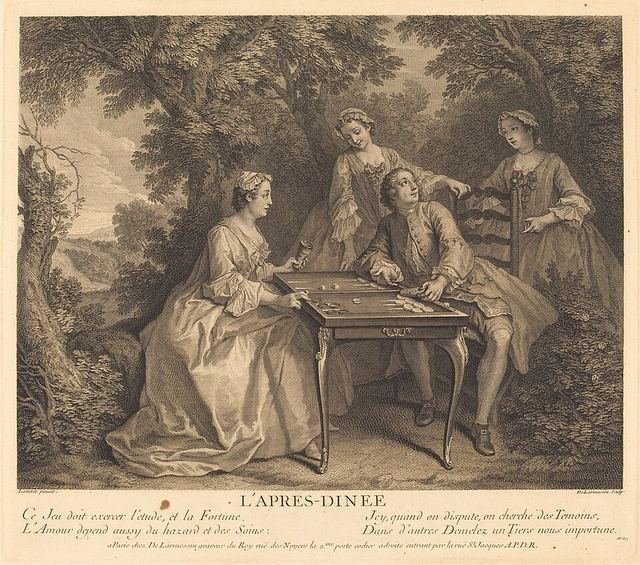
Image credit: Nicolas de Larmessin IV after Nicolas Lancret; National Gallery of Art. CC0 1.0. Source: https://commons.wikimedia.org/wiki/File:Nicolas_de_Larmessin_IV_after_Nicolas_Lancret,_L%27apres-diner,_1741,_NGA_2745.jpg. Licence: https://creativecommons.org/publicdomain/zero/1.0/. Display, thumbnail and enlargement resized without cropping and JPEG encoded; EXIF orientation applied. Enlargement limited to 1400 pixels on its longest side, or source size if smaller. No AI edits.

Ludus Lumbardorum uses only half the board
The historical game published as Ludus Lumbardorum uses six points on each side, rather than the full twenty-four-point route. Each player starts with fifteen checkers on one point and bears off across the bar. Doubles have no four-move bonus. A familiar board can therefore host a much shorter playing track.

Image credit: Niko Kitsakis. CC BY 4.0. Source: https://commons.wikimedia.org/wiki/File:Tavli_Board_without_slots_%28traditional%29_B.jpg. Licence: https://creativecommons.org/licenses/by/4.0/. Display, thumbnail and enlargement resized without cropping and JPEG encoded; EXIF orientation applied. Enlargement limited to 1400 pixels on its longest side, or source size if smaller. No AI edits.

A checker portrait was built from pieces of wood
This seventeenth-century playing piece in Birmingham’s collection uses relief marquetry known as Eger work. Small pieces of wood were glued together, then carved to form the raised portrait. The round base is sycamore. It belongs to a recorded group of twenty-eight pieces, showing that a checker could also be a carefully crafted miniature.
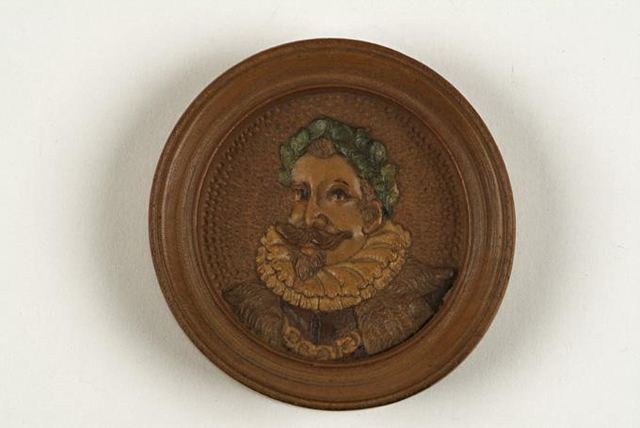
Image credit: Unknown seventeenth-century maker; photograph by Birmingham Museums and Art Gallery. CC BY 3.0. Source: https://commons.wikimedia.org/wiki/File:Backgammon_draught_in_Birmingham_Museums_and_Art_Gallery_1-obverse.jpg. Licence: https://creativecommons.org/licenses/by/3.0/deed.en. Display, thumbnail and enlargement resized without cropping and JPEG encoded; EXIF orientation applied. Enlargement limited to 1400 pixels on its longest side, or source size if smaller. No AI edits.

Some old checkers had writing on the reverse
The reverse of this carved wooden tables piece bears an ink inscription. Birmingham’s catalogue describes the historic pieces using both relief work and ink. The front and back therefore carry different information: a raised portrait on one side and written identification on the other. A modern photograph can reveal both parts of the object’s design.

Image credit: Unknown seventeenth-century maker; photograph by Birmingham Museums and Art Gallery. CC BY 3.0. Source: https://commons.wikimedia.org/wiki/File:Backgammon_draught_in_Birmingham_Museums_and_Art_Gallery_2-reverse.jpg. Licence: https://creativecommons.org/licenses/by/3.0/deed.en. Display, thumbnail and enlargement resized without cropping and JPEG encoded; EXIF orientation applied. Enlargement limited to 1400 pixels on its longest side, or source size if smaller. No AI edits.

The Met preserves a probable sixteenth-century game board
The Metropolitan Museum of Art catalogues this chess-and-backgammon board as probably Italian and probably sixteenth century. It is made of wood and ivory. Both probably labels are important: the museum does not claim a certain place or date. Its survival offers a view of historical game equipment rather than a complete set of contemporary rules.

Image credit: Unknown historical maker; Metropolitan Museum of Art Open Access. CC0 1.0. Source: https://commons.wikimedia.org/wiki/File:Chess_and_backgammon_board_MET_3668.jpg. Licence: https://creativecommons.org/publicdomain/zero/1.0/. Display, thumbnail and enlargement resized without cropping and JPEG encoded; EXIF orientation applied. Enlargement limited to 1400 pixels on its longest side, or source size if smaller. No AI edits.

An Indian board served chess and backgammon
This wooden Indian chess-and-backgammon board in the Metropolitan Museum of Art is dated to about 1830. It measures roughly 47 centimetres square. The combined object shows that one piece of equipment could serve different games. The museum identifies it as a dual-purpose board, even when a particular photograph shows only one surface.
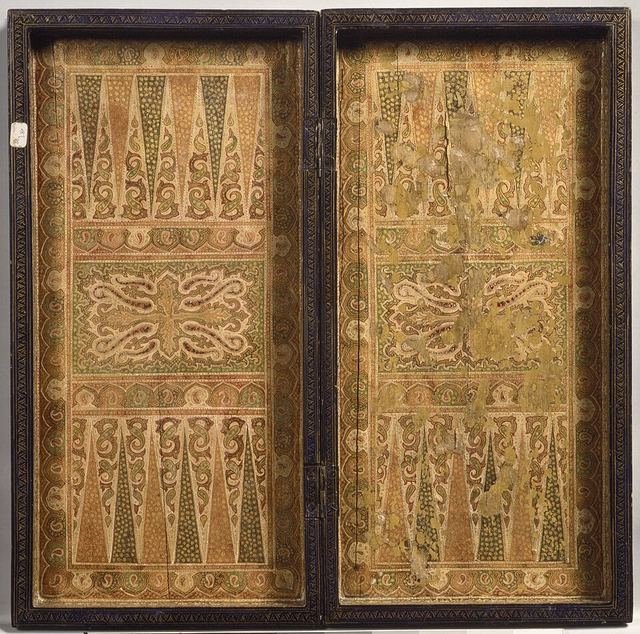
Image credit: Unknown historical maker; Metropolitan Museum of Art Open Access. CC0 1.0. Source: https://commons.wikimedia.org/wiki/File:Chess_and_backgammon_board_MET_ES4615.jpg. Licence: https://creativecommons.org/publicdomain/zero/1.0/. Display, thumbnail and enlargement resized without cropping and JPEG encoded; EXIF orientation applied. Enlargement limited to 1400 pixels on its longest side, or source size if smaller. No AI edits.

An amber board turned a game into a luxury object
The Metropolitan Museum of Art preserves a chess-and-backgammon board made with amber, ivory, brass and ebony. Amber is especially striking here: the open board glows in warm reddish and golden colours. The historical object combines two games with elaborate craftsmanship, making it as much a luxury furnishing as a playing surface.

Image credit: Unknown historical maker; Metropolitan Museum of Art Open Access. CC0 1.0. Source: https://commons.wikimedia.org/wiki/File:Chess_and_backgammon_board_MET_LC-48_174_41-003.jpg. Licence: https://creativecommons.org/publicdomain/zero/1.0/. Display, thumbnail and enlargement resized without cropping and JPEG encoded; EXIF orientation applied. Enlargement limited to 1400 pixels on its longest side, or source size if smaller. No AI edits.

A Spanish box-board came with thirty counters
The Met’s Spanish Draughtsmen and Box-board includes thirty playing counters. The museum dates it probably to the middle of the nineteenth century and records leather as a material. The pictured folding interior has a tables-game layout. Its catalogue even puts a question mark after gold, reminding us that material identifications can also carry uncertainty.
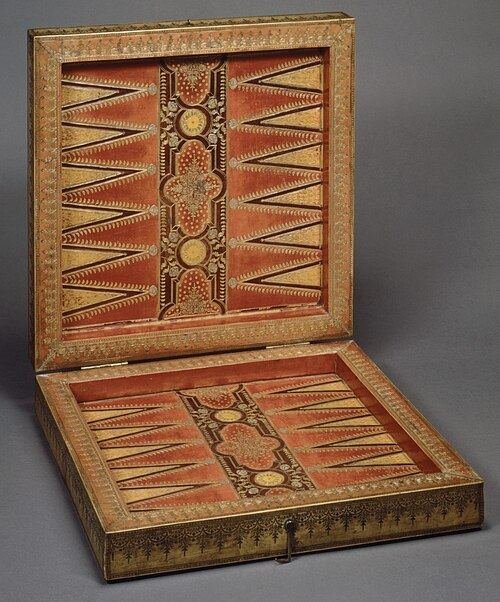
Image credit: Unknown historical maker; Metropolitan Museum of Art Open Access. CC0 1.0. Source: https://commons.wikimedia.org/wiki/File:Draughtsmen_(30)_and_box-board_MET_ES5231.jpg. Licence: https://creativecommons.org/publicdomain/zero/1.0/. Display, thumbnail and enlargement resized without cropping and JPEG encoded; EXIF orientation applied. Enlargement limited to 1400 pixels on its longest side, or source size if smaller. No AI edits.

A folding Indian board survives in Dallas
A folding backgammon board displayed at the Dallas Museum of Art is identified in the photograph’s record as Indian, from the Mughal period in the nineteenth century. The listed materials include wood, ivory and cord. The picture shows an actual museum object. Its photograph was taken in 2017, long after the board was made.
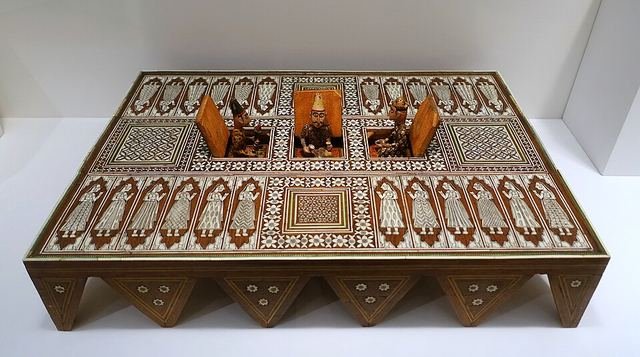
Image credit: Daderot. CC0 1.0. Source: https://commons.wikimedia.org/wiki/File:Folding_backgammon_board,_India,_Mughal_period,_1800s_AD,_wood,_ivory,_cord_-_Dallas_Museum_of_Art_-_DSC04968.jpg. Licence: https://creativecommons.org/publicdomain/zero/1.0/. Display, thumbnail and enlargement resized without cropping and JPEG encoded; EXIF orientation applied. Enlargement limited to 1400 pixels on its longest side, or source size if smaller. No AI edits.

The Vatican Museums display a German tables set
This visitor photograph records a German backgammon set described as sixteenth century in the Vatican Museums. The open board and separate pieces are displayed together. The photograph dates to 2019; the age assigned to the set is much older. This entry follows the photograph’s object identification without adding an undocumented maker or owner.
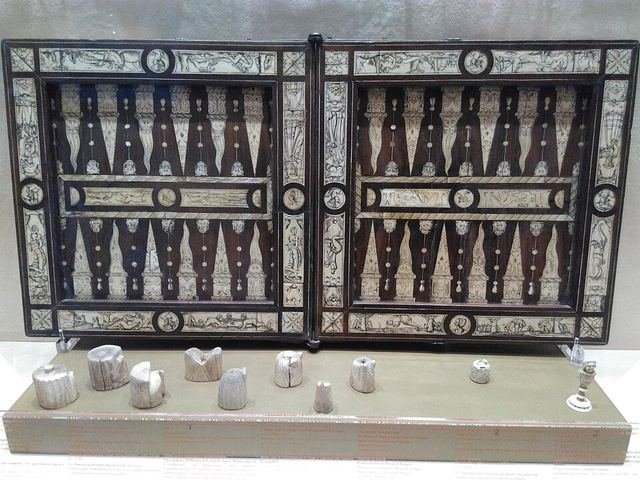
Image credit: G41rn8. CC BY-SA 4.0. Source: https://commons.wikimedia.org/wiki/File:German_16c_Backgammon_Set_in_Vatican_Museums.jpg. Licence: https://creativecommons.org/licenses/by-sa/4.0/deed.en. Display, thumbnail and enlargement resized without cropping and JPEG encoded; EXIF orientation applied. Enlargement limited to 1400 pixels on its longest side, or source size if smaller. No AI edits.

A German tables set was decorated behind glass
This sixteenth-century German trictrac set is described as using reverse glass painting. The photograph records it on display in Dresden’s Residenzschloss. Its decoration includes portrait heads on the pieces. The board’s playing layout and elaborate surface design show how historical gaming equipment could be made for display as well as play.
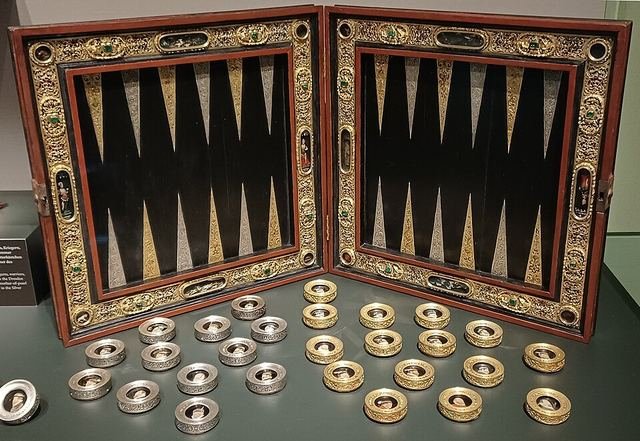
Image credit: Pitschul. CC BY-SA 4.0. Source: https://commons.wikimedia.org/wiki/File:TricTrac_Hinterglasmalerei_16tesJh_(1).jpg. Licence: https://creativecommons.org/licenses/by-sa/4.0/deed.en. Display, thumbnail and enlargement resized without cropping and JPEG encoded; EXIF orientation applied. Enlargement limited to 1400 pixels on its longest side, or source size if smaller. No AI edits.

A Persian backgammon board has a decorated chess back
Nikos Kitsakis photographed the reverse of a Persian backgammon board in 2024. The record identifies its decoration as khatam work, and the visible reverse has a chess grid within a patterned border. The picture therefore shows the back of the backgammon board, not its playing interior. One object can combine practical use with elaborate decoration.
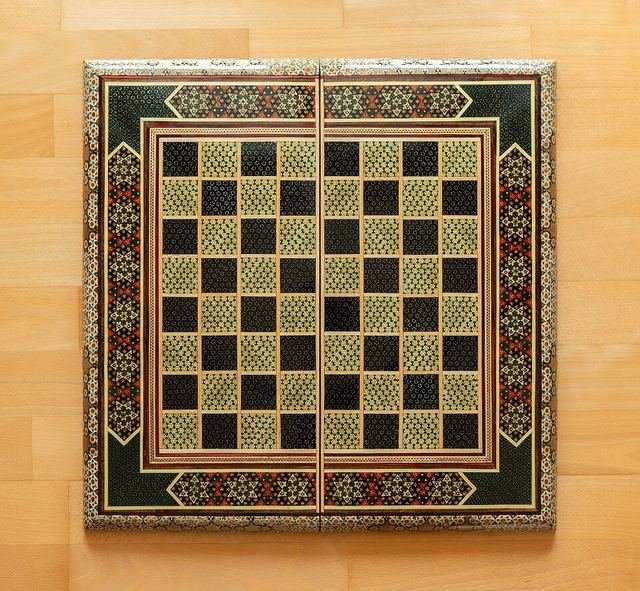
Image credit: Nikos Kitsakis. CC BY 4.0. Source: https://commons.wikimedia.org/wiki/File:Persian_Backgammon_board_made_in_Khatam_technique_%E2%80%93_Back.jpg. Licence: https://creativecommons.org/licenses/by/4.0/deed.en. Display, thumbnail and enlargement resized without cropping and JPEG encoded; EXIF orientation applied. Enlargement limited to 1400 pixels on its longest side, or source size if smaller. No AI edits.

A 1936 photograph records an older Japanese board
This black-and-white catalogue image records a Japanese Western Sugoroku board with lacquer and mother-of-pearl decoration. The source identifies the object as a seventeenth-century work and the photograph as published in 1936. The two dates describe different things. The historical image preserves a view of the board’s decorated surfaces.
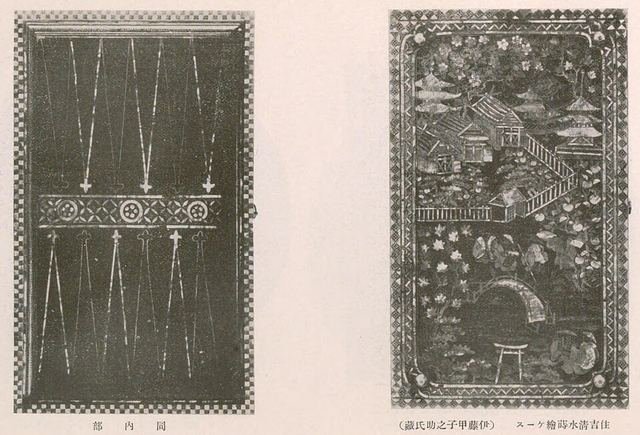
Image credit: Unknown historical photographer; Imperial Museum catalogue, 1936; scan uploaded and angle adjusted by 雪野滾滾. Public domain (expired historical photograph). Source: https://commons.wikimedia.org/wiki/File:Western_Sugoroku_board_with_Kiyomizu_and_Sumiyoshi_design_in_makie_lacquer_and_mother-of-pearl_inlay.jpg. Licence: https://commons.wikimedia.org/wiki/Template:PD-Japan-oldphoto. Display, thumbnail and enlargement resized without cropping and JPEG encoded; EXIF orientation applied. Enlargement limited to 1400 pixels on its longest side, or source size if smaller. No AI edits.

A Union soldier’s backgammon set was preserved
This backgammon set belonged to a Union soldier and is preserved in the Gettysburg National Military Park collection. The National Park Service photograph shows its hinged cardboard box, playing surface, counters and dice cups. A surviving personal game set gives a more direct connection to Civil War life than a later illustration.

Image credit: National Park Service, Gettysburg National Military Park. Public domain (U.S. federal government work). Source: https://commons.wikimedia.org/wiki/File:Backgammon-set_from_American_civil_war.jpeg. Licence: https://commons.wikimedia.org/wiki/Template:PD-USGov-NPS. Display, thumbnail and enlargement resized without cropping and JPEG encoded; EXIF orientation applied. Enlargement limited to 1400 pixels on its longest side, or source size if smaller. No AI edits.

One colonial table offered cards, chess and backgammon
A New York gaming table made about 1760–90 had three usable surfaces. Its upper top carried inlaid backgammon and chess boards, while the lower surface was covered with baize for cards. One piece of furniture could therefore support three popular home entertainments without taking up three tables.

Image credit: Unknown American maker; image courtesy The Metropolitan Museum of Art. CC0 1.0. Source: https://www.metmuseum.org/art/collection/search/1425. Licence: https://creativecommons.org/publicdomain/zero/1.0/. Display, thumbnail and enlargement resized without cropping and JPEG encoded; EXIF orientation applied. The packaged enlargement is 1200 × 941 pixels. No AI edits.
An 1848 guide compared earlier authorities
Roy Reuben published Roy’s Game of Backgammon in London in 1848. Its long title promised that the game’s principles would be explained and the directions of leading players and authorities compared and revised. Even then, publishers sold a guide by claiming it had reconciled older advice for modern readers.
Image credit: Edmond Hoyle; scan via Wikimedia Commons. Public domain (PD-Art). Source: https://commons.wikimedia.org/wiki/File:Hoyle-backgammon.png. Licence: https://creativecommons.org/publicdomain/mark/1.0/. Display, thumbnail and enlargement resized without cropping and JPEG encoded; EXIF orientation applied. Enlargement limited to 1400 pixels on its longest side, or source size if smaller. No AI edits.
A tiny rock-crystal piece still has an uncertain game
A rock-crystal gaming piece at The Met is only 2.5 centimetres high and dates to the tenth or eleventh century, or later. Its catalogue cautiously calls it a chess pawn or backgammon piece. That uncertainty shows why archaeologists should not assign a small game object too confidently.
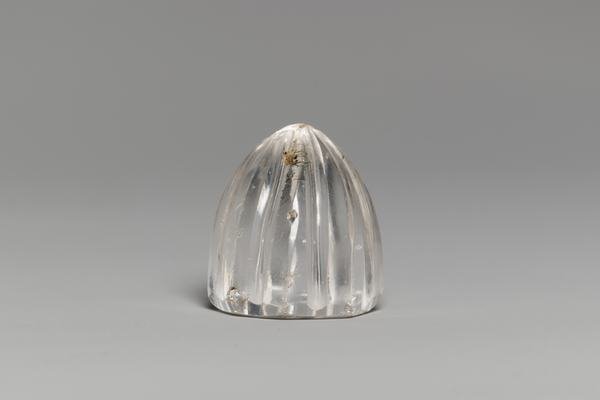
Image credit: Unknown maker from the Western Islamic lands; image courtesy The Metropolitan Museum of Art. CC0 1.0. Source: https://www.metmuseum.org/art/collection/search/452342. Licence: https://creativecommons.org/publicdomain/zero/1.0/. Display, thumbnail and enlargement resized without cropping and JPEG encoded; EXIF orientation applied. The packaged enlargement is 1200 × 800 pixels. No AI edits.
A fifteenth-century Venetian board folded for travel
A fifteenth-century Venetian game board at The Met has chess squares on one side and backgammon markings on the reverse. It also folds for storage and transport. Bone, horn, gilding, wood and metal mounts made this portable two-game board much more elaborate than a plain wooden case.

Image credit: Unknown Venetian maker; image courtesy The Metropolitan Museum of Art. CC0 1.0. Source: https://www.metmuseum.org/art/collection/search/469715. Licence: https://creativecommons.org/publicdomain/zero/1.0/. Display, thumbnail and enlargement resized without cropping and JPEG encoded; EXIF orientation applied. The packaged enlargement is 1200 × 900 pixels. No AI edits.
Pardon’s 1844 backgammon book began with history
George Frederick Pardon’s 1844 Backgammon: Its History and Practice devoted its opening chapters to the game’s history before explaining play. The 79-page book then covered chances, technical terms and laws. Its structure shows that Victorian readers were offered cultural background as well as rules and gambling mathematics.
Image credit: Historical illustration in Alice Howard Cady’s 1895 book; scan via Internet Archive Book Images. Public domain; source marked no known copyright restrictions. Source: https://commons.wikimedia.org/wiki/File:Backgammon_(1895)_(14596242107).jpg. Licence: https://www.flickr.com/commons/usage/. Display, thumbnail and enlargement resized without cropping and JPEG encoded; EXIF orientation applied. Enlargement limited to 1400 pixels on its longest side, or source size if smaller. No AI edits.
Pardon expanded his guide from 79 pages to 110
Pardon returned to the subject in 1858 with Backgammon: Its Theory and Practice. The new book ran to 110 pages, compared with 79 pages in his 1844 volume. Its contents added detailed sections on combinations, positions, laws and several named styles of play.
Image credit: Historical illustration in Alice Howard Cady’s 1895 book; scan via Internet Archive Book Images. Public domain; source marked no known copyright restrictions. Source: https://commons.wikimedia.org/wiki/File:Backgammon_(1895)_(14596242107).jpg. Licence: https://www.flickr.com/commons/usage/. Display, thumbnail and enlargement resized without cropping and JPEG encoded; EXIF orientation applied. Enlargement limited to 1400 pixels on its longest side, or source size if smaller. No AI edits.
Sources and licence: Source 1 · Source 2 · Source 3 · Source 4
A 95-page handbook gave backgammon only twenty pages
Pardon’s 1862 Handbook of Draughts, with a Chapter on Backgammon contained 95 pages, but only 20 covered backgammon. Those pages still ranged from setup and laws to probabilities, back games and a problem called a critical case. Compact treatment did not mean rules alone.
Image credit: Historical illustration in Alice Howard Cady’s 1895 book; scan via Internet Archive Book Images. Public domain; source marked no known copyright restrictions. Source: https://commons.wikimedia.org/wiki/File:Backgammon_(1895)_(14596242107).jpg. Licence: https://www.flickr.com/commons/usage/. Display, thumbnail and enlargement resized without cropping and JPEG encoded; EXIF orientation applied. Enlargement limited to 1400 pixels on its longest side, or source size if smaller. No AI edits.
A Victorian editor put beginner lessons before betting odds
The preface to an 1888 Pardon handbook complained that older writers began with dice chances and betting odds while assuming readers already knew the game. This edition promised preliminary instructions first. It also said games once played for heavy stakes were increasingly played simply for amusement.
Image credit: Historical illustration in Alice Howard Cady’s 1895 book; scan via Internet Archive Book Images. Public domain; source marked no known copyright restrictions. Source: https://commons.wikimedia.org/wiki/File:Backgammon_(1895)_(14596242107).jpg. Licence: https://www.flickr.com/commons/usage/. Display, thumbnail and enlargement resized without cropping and JPEG encoded; EXIF orientation applied. Enlargement limited to 1400 pixels on its longest side, or source size if smaller. No AI edits.
Victorian draught boards often hid backgammon inside
An 1888 handbook said that almost all folding draught boards contained a backgammon board inside. The claim explains why the two games so often shared book titles and physical equipment. A checkered outer surface could open to reveal points, letting one portable case serve two different games.
Image credit: Daderot. CC0 1.0. Source: https://commons.wikimedia.org/wiki/File:Box_for_playing_backgammon_or_chess%2C_probably_Syria_or_Egypt%2C_late_19th_century%2C_wood%2C_wood_veneers%2C_bone%2C_and_mother_of_pearl_inlay_-_Royal_Ontario_Museum_-_DSC04771.JPG. Licence: https://creativecommons.org/publicdomain/zero/1.0/. Display, thumbnail and enlargement resized without cropping and JPEG encoded; EXIF orientation applied. Enlargement limited to 1400 pixels on its longest side, or source size if smaller. No AI edits.
The Polite Gamester mixed play with life-expectancy tables
A 1761 edition of The Polite Gamester placed backgammon beside quadrille, whist, piquet and chess. It also included an introduction to probability and tables about annuities and human life. The book treated games, odds and practical money calculations as parts of one mathematical subject.
Image credit: Edmond Hoyle; scan via Wikimedia Commons. Public domain (PD-Art). Source: https://commons.wikimedia.org/wiki/File:Hoyle-backgammon.png. Licence: https://creativecommons.org/publicdomain/mark/1.0/. Display, thumbnail and enlargement resized without cropping and JPEG encoded; EXIF orientation applied. Enlargement limited to 1400 pixels on its longest side, or source size if smaller. No AI edits.
Marache wrote for readers who had never seen the board
N. Marache’s 1866 manual criticised game books that rushed into technical words and betting odds. Its backgammon chapter first explained the board and setup for complete beginners. That teaching choice made the book usable without an experienced player standing nearby to translate the jargon.
Image credit: Historical illustration in Alice Howard Cady’s 1895 book; scan via Internet Archive Book Images. Public domain; source marked no known copyright restrictions. Source: https://commons.wikimedia.org/wiki/File:Backgammon_(1895)_(14596242107).jpg. Licence: https://www.flickr.com/commons/usage/. Display, thumbnail and enlargement resized without cropping and JPEG encoded; EXIF orientation applied. Enlargement limited to 1400 pixels on its longest side, or source size if smaller. No AI edits.
The 1819 Backgammon Teacher promised a new code of laws
William Green’s 1819 Backgammon Teacher advertised itself as new and original throughout. Its long title also promised a familiar explanation of calculating chances, a new table of odds and a new code of laws. The wording shows how authors marketed both mathematical help and updated rule authority.
Image credit: Edmond Hoyle; scan via Wikimedia Commons. Public domain (PD-Art). Source: https://commons.wikimedia.org/wiki/File:Hoyle-backgammon.png. Licence: https://creativecommons.org/publicdomain/mark/1.0/. Display, thumbnail and enlargement resized without cropping and JPEG encoded; EXIF orientation applied. Enlargement limited to 1400 pixels on its longest side, or source size if smaller. No AI edits.
One strategy example priced danger in shillings
The Polite Gamester worked through a position by assuming an 18-shilling stake. It calculated that a particular chance of being hit would make 11 shillings of the total value belong to the opponent. The example turned board risk into money, showing how closely strategy teaching and wagering could be connected.
Image credit: Edmond Hoyle; scan via Wikimedia Commons. Public domain (PD-Art). Source: https://commons.wikimedia.org/wiki/File:Hoyle-backgammon.png. Licence: https://creativecommons.org/publicdomain/mark/1.0/. Display, thumbnail and enlargement resized without cropping and JPEG encoded; EXIF orientation applied. Enlargement limited to 1400 pixels on its longest side, or source size if smaller. No AI edits.
A 1798 guide promised calculations and complete games
H. D. Symonds published Backgammon: Rules and Directions for Playing the Game in London in 1798. Its title promised calculations, critical cases and complete games, plus instructions on Russian Backgammon. The menu shows that readers wanted probability, examples and variants in one practical guide.
Image credit: Edmond Hoyle; scan via Wikimedia Commons. Public domain (PD-Art). Source: https://commons.wikimedia.org/wiki/File:Hoyle-backgammon.png. Licence: https://creativecommons.org/publicdomain/mark/1.0/. Display, thumbnail and enlargement resized without cropping and JPEG encoded; EXIF orientation applied. Enlargement limited to 1400 pixels on its longest side, or source size if smaller. No AI edits.
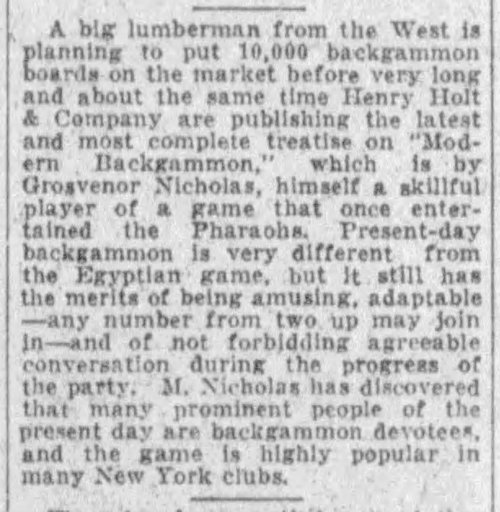
A lumberman planned 10,000 boards before the boom
The Nashville Banner reported on March 25, 1928 that a western lumberman planned to put 10,000 backgammon boards on the market. The notice appeared before Grosvenor Nicholas’s new book was published, showing that at least one manufacturer expected a revival well before the flood of publicity in 1930.
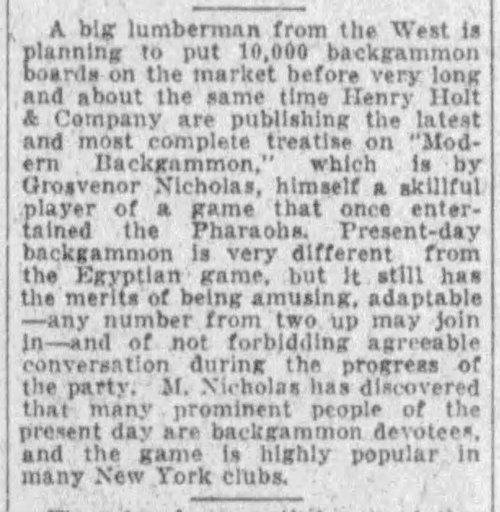
Image credit: The Nashville Banner; writer and scan creator unidentified. Public domain in the United States (newspaper item published in 1928). Source: https://nebackgammon.org/index.php/1930s_chronology/. Licence: https://creativecommons.org/publicdomain/mark/1.0/. Display, thumbnail and enlargement resized without cropping and JPEG encoded; EXIF orientation applied. The packaged enlargement is 500 × 512 pixels. No AI edits.
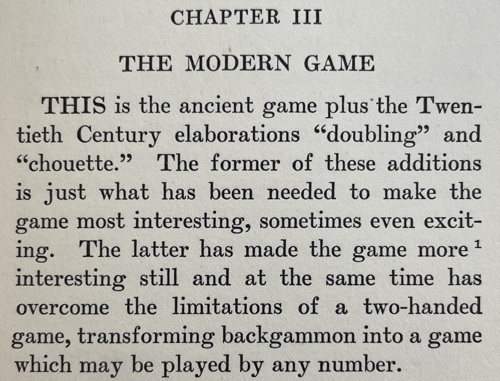
Nicholas published a modern backgammon book in 1928
Henry Holt published Grosvenor Nicholas’s Modern Backgammon in New York in 1928. Its contents included two recent social innovations: optional doubling and multi-player chouette. The book arrived before the 1930 publishing flood and gave the coming boom a dedicated modern manual.

Image credit: Grosvenor Nicholas; scan hosted by the New England Backgammon Club. Public domain in the United States (book page published in 1928). Source: https://nebackgammon.org/index.php/1930s_chronology/. Licence: https://creativecommons.org/publicdomain/mark/1.0/. Display, thumbnail and enlargement resized without cropping and JPEG encoded; EXIF orientation applied. The packaged enlargement is 500 × 381 pixels. No AI edits.
Sources and licence: Source 1 · Source 2 · Source 3 · Source 4
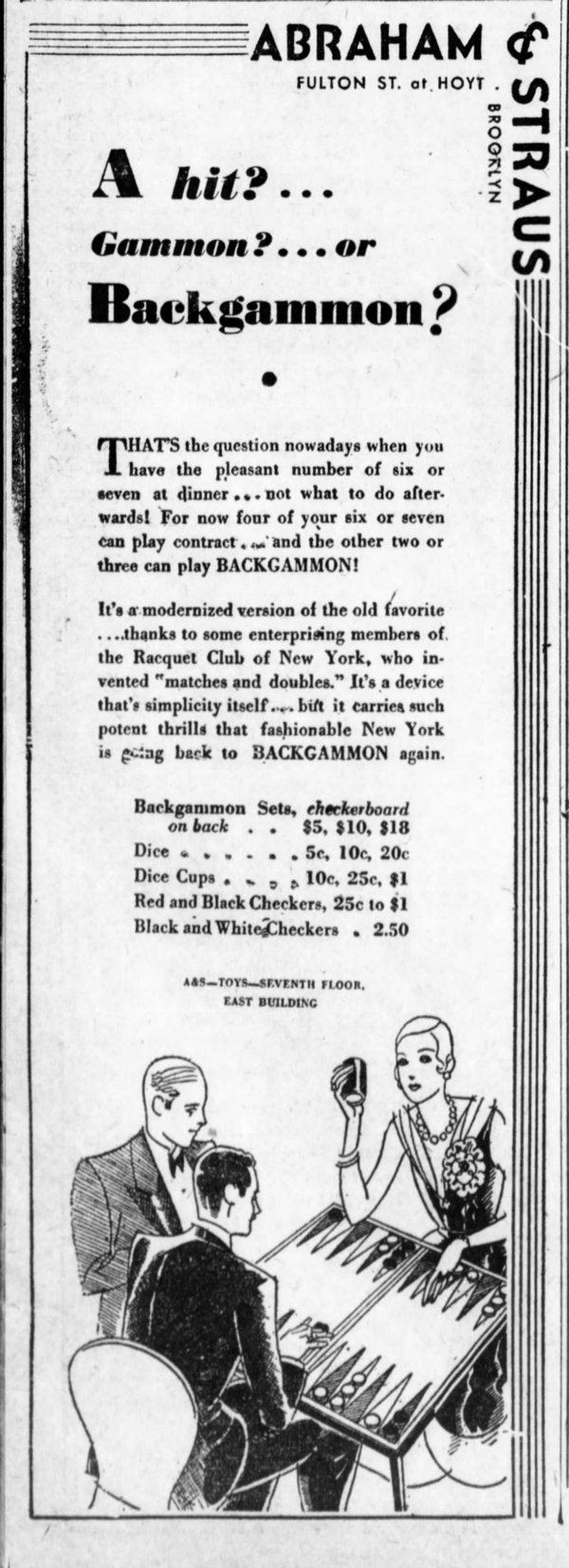
A 1929 store ad offered boards at three prices
The Abraham & Straus advertisement published by the Brooklyn Daily Eagle on October 2, 1929 listed backgammon sets at $5, $10 and $18. It separately offered dice, cups and checkers. That price ladder shows the craze created a market for both complete boards and replacement accessories.

Image credit: Abraham & Straus; advertisement artist unidentified. Public domain in the United States (newspaper advertisement published in 1929). Source: https://nebackgammon.org/index.php/1930s_chronology/. Licence: https://creativecommons.org/publicdomain/mark/1.0/. Display, thumbnail and enlargement resized without cropping and JPEG encoded; EXIF orientation applied. The packaged enlargement is 435 × 1200 pixels. No AI edits.
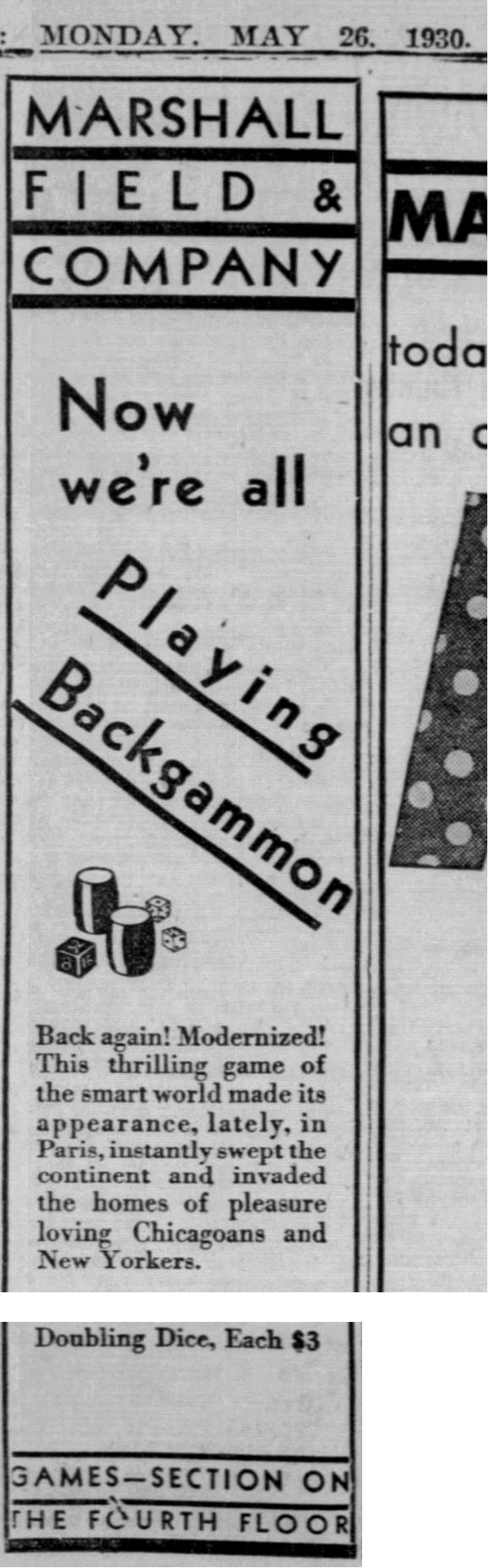
A doubling cube cost three dollars in 1930
Marshall Field & Company advertised doubling dice for $3 each in the Chicago Tribune on May 26, 1930. The item was what players now call a doubling cube. Listing it separately from the board shows that early adopters could add modern doubling equipment to a set they already owned.

Image credit: Marshall Field & Company; advertisement artist unidentified. Public domain in the United States (newspaper advertisement published in 1930). Source: https://nebackgammon.org/index.php/early-doublers/. Licence: https://creativecommons.org/publicdomain/mark/1.0/. Display, thumbnail and enlargement resized without cropping and JPEG encoded; EXIF orientation applied. The packaged enlargement is 374 × 1200 pixels. No AI edits.
Vanity Fair ran a three-part course for experienced players
Vanity Fair published three Grosvenor Nicholas articles in June, July and August 1930. Instead of beginning with basic movement rules, the series moved into opening plays, major game types and back-game strategy. That editorial choice suggests the magazine expected many readers to know the game already.

Image credit: Vanity Fair and Grosvenor Nicholas. Public domain in the United States (magazine material published in 1930). Source: https://nebackgammon.org/index.php/1930s_chronology/. Licence: https://creativecommons.org/publicdomain/mark/1.0/. Display, thumbnail and enlargement resized without cropping and JPEG encoded; EXIF orientation applied. The packaged enlargement is 400 × 507 pixels. No AI edits.
A Chicago primer packed modern backgammon into 45 pages
Ralph A. Bond self-published A Primer on Modern Backgammon in Chicago in 1930. The book contained only 45 pages. Its short length and local Bond Games imprint show how quickly small publishers joined the rush to explain modern play during the opening year of the boom.
Image credit: Edmond Hoyle; scan via Wikimedia Commons. Public domain (PD-Art). Source: https://commons.wikimedia.org/wiki/File:Hoyle-backgammon.png. Licence: https://creativecommons.org/publicdomain/mark/1.0/. Display, thumbnail and enlargement resized without cropping and JPEG encoded; EXIF orientation applied. Enlargement limited to 1400 pixels on its longest side, or source size if smaller. No AI edits.
A beginner’s book reached five printings in five weeks
Harold Thorne’s Backgammon in 20 Minutes appeared on August 22, 1930. By September 30 it had reached a fifth printing and a revised edition; a seventh printing followed in November, with two more in December. That unusually quick sequence is strong evidence of demand for beginner instruction.
Image credit: Edmond Hoyle; scan via Wikimedia Commons. Public domain (PD-Art). Source: https://commons.wikimedia.org/wiki/File:Hoyle-backgammon.png. Licence: https://creativecommons.org/publicdomain/mark/1.0/. Display, thumbnail and enlargement resized without cropping and JPEG encoded; EXIF orientation applied. Enlargement limited to 1400 pixels on its longest side, or source size if smaller. No AI edits.
One 1930 booklet mixed Victorian and modern backgammon
How to Play Modern Backgammon, copyrighted September 20, 1930 by J. S. Ogilvie, combined old Hoyle material with optional doubling and chouette rules. Its sixteen pages even used the older term hit for a single win while reviving a nineteenth-century method of counting pips.
Image credit: Edmond Hoyle; scan via Wikimedia Commons. Public domain (PD-Art). Source: https://commons.wikimedia.org/wiki/File:Hoyle-backgammon.png. Licence: https://creativecommons.org/publicdomain/mark/1.0/. Display, thumbnail and enlargement resized without cropping and JPEG encoded; EXIF orientation applied. Enlargement limited to 1400 pixels on its longest side, or source size if smaller. No AI edits.
One table changed from backgammon to bridge
The Indianapolis Times reported on September 22, 1930 that shops offered a Chinese-red leather table whose backgammon board could be lifted out and turned over to make a bridge table. Convertible furniture let households serve two leading game fashions without finding room for two separate tables.

Image credit: A. G. Spalding photograph supplied to NEA Service; individual photographer unidentified. Public domain in the United States (newspaper photograph published in 1930). Source: https://nebackgammon.org/index.php/1930s_chronology/. Licence: https://creativecommons.org/publicdomain/mark/1.0/. Display, thumbnail and enlargement resized without cropping and JPEG encoded; EXIF orientation applied. The packaged enlargement is 690 × 1032 pixels. No AI edits.
Boyden updated her newspaper lessons after her book
Elizabeth Clark Boyden wrote a fourteen-part syndicated series called How to Play Today’s Backgammon in September and October 1930. Its eleventh instalment described the newly arrived doubling cube, even though her July book had used matches. Newspaper publication let her update readers within months.

Image credit: Elizabeth Clark Boyden; newspaper scan. Public domain in the United States (newspaper series published in 1930). Source: https://nebackgammon.org/index.php/1930s_chronology/. Licence: https://creativecommons.org/publicdomain/mark/1.0/. Display, thumbnail and enlargement resized without cropping and JPEG encoded; EXIF orientation applied. The packaged enlargement is 215 × 400 pixels. No AI edits.
Five-minute lessons travelled as far as Honolulu
J. Van Cleft Cooper’s six-part Learn Backgammon in 5 Minutes a Day series began appearing in American newspapers in October 1930. Papers carrying it ranged as far as the Honolulu Star-Bulletin. A syndicated course could spread the same beginner lesson thousands of kilometres from New York.

Image credit: J. Van Cleft Cooper; newspaper scan. Public domain in the United States (newspaper series published in 1930). Source: https://nebackgammon.org/index.php/1930s_chronology/. Licence: https://creativecommons.org/publicdomain/mark/1.0/. Display, thumbnail and enlargement resized without cropping and JPEG encoded; EXIF orientation applied. The packaged enlargement is 500 × 821 pixels. No AI edits.
A flip-book taught openings directly on a fold-out board
Winning Backgammon at Sight appeared on October 15, 1930 in a flip-book format modelled on Contract Bridge at Sight. It included a fold-out board chart with opening moves printed on the playing field for study. Readers supplied their own checkers while the page acted as both lesson and board.
Image credit: Edmond Hoyle; scan via Wikimedia Commons. Public domain (PD-Art). Source: https://commons.wikimedia.org/wiki/File:Hoyle-backgammon.png. Licence: https://creativecommons.org/publicdomain/mark/1.0/. Display, thumbnail and enlargement resized without cropping and JPEG encoded; EXIF orientation applied. Enlargement limited to 1400 pixels on its longest side, or source size if smaller. No AI edits.
Los Angeles stores sold cubes from thirty-five cents to two dollars
Bullock’s Wilshire advertisements in the Los Angeles Times on November 6, 11 and 27 and December 18, 1930 promoted backgammon lectures and equipment. Their doubling dice ranged from 35 cents to $2, and the illustrations included unusual octagonal checkers alongside conventional boards.
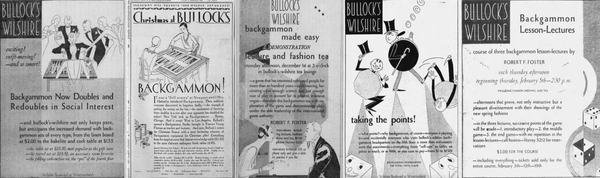
Image credit: Bullock’s Wilshire; advertisement artists unidentified. Public domain in the United States (newspaper advertisements published in 1930). Source: https://nebackgammon.org/index.php/1930s_chronology/. Licence: https://creativecommons.org/publicdomain/mark/1.0/. Display, thumbnail and enlargement resized without cropping and JPEG encoded; EXIF orientation applied. The packaged enlargement is 1200 × 357 pixels. No AI edits.
A sailor’s board could roll up with the kit
The U.S. Naval History and Heritage Command preserves an Acey-Deucey board printed on canvas between about 1900 and 1925. Canvas made practical sense aboard ship: the board, dice and pieces could be packed away more easily than a heavy wooden case.

Image credit: Naval History & Heritage Command. CC BY 2.0. Source: https://commons.wikimedia.org/wiki/File:Acey-Duecey_Board_(22870733353).jpg. Licence: https://creativecommons.org/licenses/by/2.0/. Display, thumbnail and enlargement resized without cropping and JPEG encoded; EXIF orientation applied. The packaged enlargement is 1200 × 925 pixels. No AI edits.

A resort ordered 150 backgammon sets
Sports Illustrated reported that the Grand Bahama Development Company bought 150 backgammon sets from a Brooklyn gaming shop for the 1964 tournament. The bill was nearly US$2,000 including shipping, showing that staging the new event required a serious equipment order.
Image credit: Daderot. CC0 1.0. Source: https://commons.wikimedia.org/wiki/File:Box_for_playing_backgammon_or_chess%2C_probably_Syria_or_Egypt%2C_late_19th_century%2C_wood%2C_wood_veneers%2C_bone%2C_and_mother_of_pearl_inlay_-_Royal_Ontario_Museum_-_DSC04771.JPG. Licence: https://creativecommons.org/publicdomain/zero/1.0/. Display, thumbnail and enlargement resized without cropping and JPEG encoded; EXIF orientation applied. Enlargement limited to 1400 pixels on its longest side, or source size if smaller. No AI edits.
Holland’s books helped teach the 1970s boom
Tim Holland followed his tournament success with three popular books: Beginning Backgammon in 1973, Better Backgammon in 1974 and Backgammon for People Who Hate to Lose in 1977. The U.S. Backgammon Federation credits these guides with helping fuel the decade’s boom.
Image credit: Edmond Hoyle; scan via Wikimedia Commons. Public domain (PD-Art). Source: https://commons.wikimedia.org/wiki/File:Hoyle-backgammon.png. Licence: https://creativecommons.org/publicdomain/mark/1.0/. Display, thumbnail and enlargement resized without cropping and JPEG encoded; EXIF orientation applied. Enlargement limited to 1400 pixels on its longest side, or source size if smaller. No AI edits.
Backgammon gained its first analytic book in 1970
The U.S. Backgammon Federation describes The Backgammon Book, published by Oswald Jacoby and John R. Crawford in 1970, as the game’s first analytic book. That label marks a shift from short rule summaries and social guides toward serious study of positions, decisions and strategy.
Image credit: Edmond Hoyle; scan via Wikimedia Commons. Public domain (PD-Art). Source: https://commons.wikimedia.org/wiki/File:Hoyle-backgammon.png. Licence: https://creativecommons.org/publicdomain/mark/1.0/. Display, thumbnail and enlargement resized without cropping and JPEG encoded; EXIF orientation applied. Enlargement limited to 1400 pixels on its longest side, or source size if smaller. No AI edits.
Hefner built a table for two games at once
Deyong recalled that Hugh Hefner ordered a special table with two backgammon boards set side by side. His chouette could play both simultaneously. Hefner later installed a similar table in his private jet, turning group play into custom furniture.
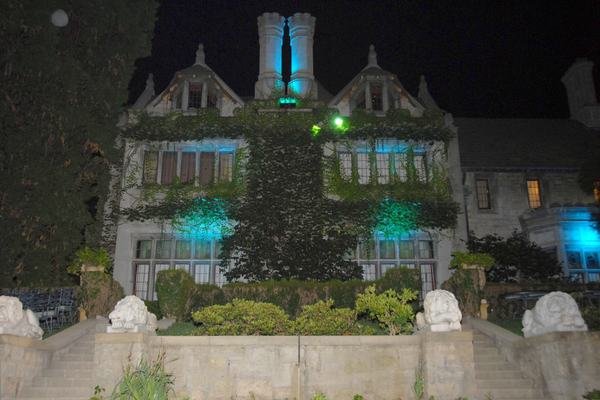
Image credit: Glenn Francis (User:Toglenn), www.PacificProDigital.com. CC BY-SA 3.0. Source: https://commons.wikimedia.org/wiki/File:Playboy_Mansion_North_Side_2007.jpg. Licence: https://creativecommons.org/licenses/by-sa/3.0/. Display, thumbnail and enlargement resized without cropping and JPEG encoded; EXIF orientation applied. The packaged enlargement is 1200 × 800 pixels. No AI edits.

Magriel’s 1976 book reached a national book club
Paul Magriel’s Backgammon appeared in December 1976 from Quadrangle and The New York Times Book Company. A 1980 player profile reported that it became a Book of the Month Club selection and reached a third printing, evidence that serious instruction had found readers far beyond private clubs.

Image credit: flipchip / LasVegasVegas.com. CC BY-SA 3.0. Source: https://commons.wikimedia.org/wiki/File:PaulMagriel.jpg. Licence: https://creativecommons.org/licenses/by-sa/3.0/. Display, thumbnail and enlargement resized without cropping and JPEG encoded; EXIF orientation applied. Enlargement limited to 1400 pixels on its longest side, or source size if smaller. No AI edits.

A travel set rolls out instead of opening
Ilker Bicakci photographed a Melia Games travel backgammon set unrolled across a table in 2019. Unlike a rigid hinged case, its playing surface can be rolled for transport. The photograph records a modern design answer to an old practical problem: carrying a full board, checkers and dice between games.
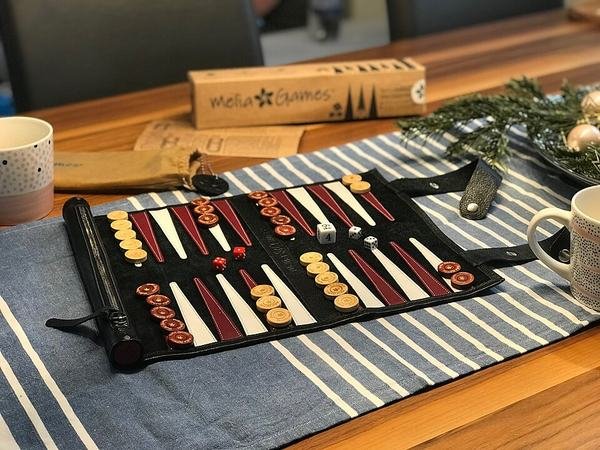
Image credit: Ilker Bicakci. CC BY-SA 4.0. Source: https://commons.wikimedia.org/wiki/File:Melia_Games_Backgammon.jpg. Licence: https://creativecommons.org/licenses/by-sa/4.0/deed.en. Display, thumbnail and enlargement resized without cropping and JPEG encoded; EXIF orientation applied. The packaged enlargement is 960 × 720 pixels. No AI edits.

A New Mexico hotel kept a leather board
Sheila Sund photographed an old leather backgammon board in a New Mexico hotel in 2013. Her description specifically notes the material and setting. The close view of worn checkers and surface turns an ordinary hotel game into a record of use, age and the tactile appeal of a well-played set.

Image credit: Sheila Sund from Salem, United States. CC BY 2.0. Source: https://commons.wikimedia.org/wiki/File:Backgammon_(30484111843).jpg. Licence: https://creativecommons.org/licenses/by/2.0/deed.en. Display, thumbnail and enlargement resized without cropping and JPEG encoded; EXIF orientation applied. The packaged enlargement is 960 × 960 pixels. No AI edits.

A Greek board can be photographed before the pieces arrive
Nikos Kitsakis photographed this traditional Greek tavli board in 2024 without stones on its playing field. The empty view makes the long points, central bar and woodwork easy to compare. Tavli names a Greek tradition containing several tables games, so the object is broader than a single backgammon position.
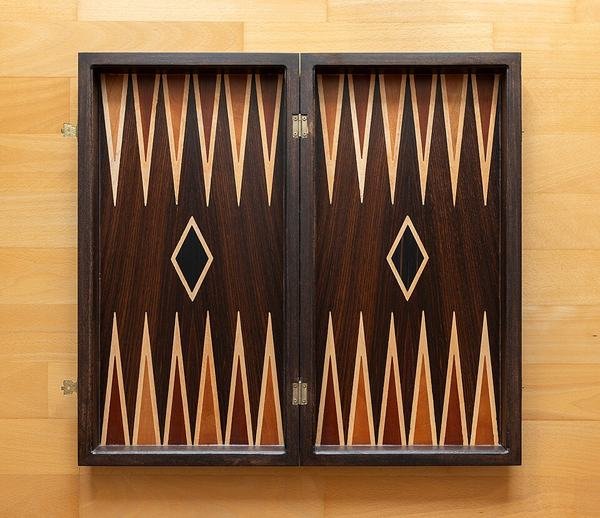
Image credit: Nikos Kitsakis. CC BY 4.0. Source: https://commons.wikimedia.org/wiki/File:Tavli_Board_without_slots_(traditional)_B_No_Stones.jpg. Licence: https://creativecommons.org/licenses/by/4.0/deed.en. Display, thumbnail and enlargement resized without cropping and JPEG encoded; EXIF orientation applied. The packaged enlargement is 960 × 828 pixels. No AI edits.

Fifteen checkers form a verquere single crown
This 2026 photograph documents the single-crown arrangement in verquere: three checkers stand on each of the last five tongues, numbered 20 through 24. The position belongs to a Swedish tables-game tradition. Its familiar board shape should not hide the fact that verquere has its own named formations and rules.
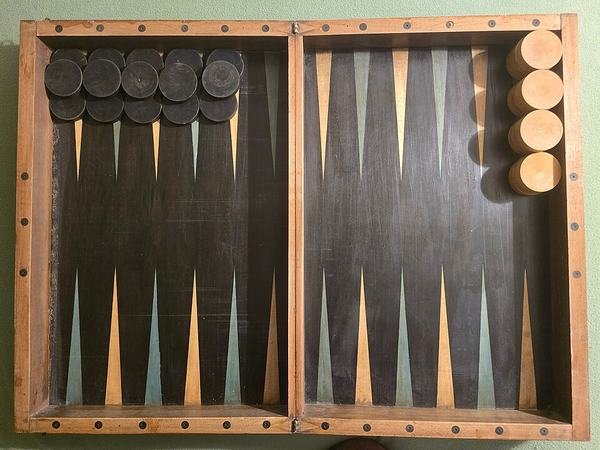
Image credit: Edward Werner. CC BY-SA 4.0. Source: https://commons.wikimedia.org/wiki/File:Verquere_single_crown.jpg. Licence: https://creativecommons.org/licenses/by-sa/4.0/deed.en. Display, thumbnail and enlargement resized without cropping and JPEG encoded; EXIF orientation applied. The packaged enlargement is 960 × 720 pixels. No AI edits.

A 1688 table survives in a Finnish museum
This backgammon table is dated 1688 and photographed in Finland's National Museum. Its hinged wooden top and supporting base show that tables games could be built into furniture rather than stored only in portable cases. The object documents historical craftsmanship, while its date does not by itself identify the exact rules played.
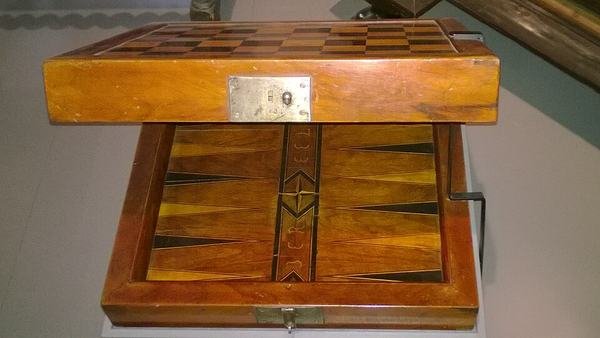
Image credit: Photographer not identified; uploaded by Commons user Vet. Public domain. Source: https://commons.wikimedia.org/wiki/File:Backgammon_table_y1688.jpg. Licence: https://creativecommons.org/publicdomain/mark/1.0/. Display, thumbnail and enlargement resized without cropping and JPEG encoded; EXIF orientation applied. The packaged enlargement is 960 × 541 pixels. No AI edits.

A 1960s tavli board carries its decade with it
Nikos Kitsakis identifies this traditional Greek tavli board as a piece from the 1960s. His 2024 photograph records the open board with checkers and dice. The image separates the object's age from the photograph's date, and it documents tavli equipment without claiming which of the Greek games was underway.

Image credit: Nikos Kitsakis. CC BY 4.0. Source: https://commons.wikimedia.org/wiki/File:Tavli_Board_without_slots_(traditional)_1960s.jpg. Licence: https://creativecommons.org/licenses/by/4.0/deed.en. Display, thumbnail and enlargement resized without cropping and JPEG encoded; EXIF orientation applied. The packaged enlargement is 960 × 839 pixels. No AI edits.

Galalith checkers sit inside slotted rails
This Greek tavli board has storage slots and a set of Galalith checkers. Galalith is a historic casein-based plastic, so the photograph records more than the wooden playing surface. The rails, dice and manufactured stones show how a traditional board design can incorporate twentieth-century materials and built-in organisation.

Image credit: Nikos Kitsakis. CC BY 4.0. Source: https://commons.wikimedia.org/wiki/File:Tavli_Board_with_slots.jpg. Licence: https://creativecommons.org/licenses/by/4.0/deed.en. Display, thumbnail and enlargement resized without cropping and JPEG encoded; EXIF orientation applied. The packaged enlargement is 960 × 687 pixels. No AI edits.

An official Japanese board uses a cool grey palette
Takasaki001's 2011 photograph identifies this as an official Japanese backgammon board. Grey and white points, black and white checkers, dice cups and a doubling cube form a restrained tournament-style set. The image records one national design choice without suggesting that all Japanese boards share the same appearance.

Image credit: Takasaki001. CC BY-SA 3.0. Source: https://commons.wikimedia.org/wiki/File:Backgammon_001.jpg. Licence: https://creativecommons.org/licenses/by-sa/3.0/deed.en. Display, thumbnail and enlargement resized without cropping and JPEG encoded; EXIF orientation applied. The packaged enlargement is 640 × 480 pixels. No AI edits.

Three hinged panels can close into one box
An early-nineteenth-century playing surface in the Khalili Collections is built from three hinged wooden panels with lobed feet. The panels fold and interlock into a rectangular box. That engineering makes the lavishly decorated object portable and self-protecting, joining practical game design with the skills of Islamic lacquer work.

Image credit: Khalili Collections. CC BY-SA 3.0. Source: https://commons.wikimedia.org/wiki/File:Khalili_Collection_Islamic_Art_laq_0284.13.jpg. Licence: https://creativecommons.org/licenses/by-sa/3.0/igo/deed.en. Display, thumbnail and enlargement resized without cropping and JPEG encoded; EXIF orientation applied. The packaged enlargement is 960 × 640 pixels. No AI edits.

Joao Gumes owned a nineteenth-century board
Andre Koehne photographed a late-nineteenth-century backgammon board that belonged to Brazilian writer Joao Gumes. The source describes its style as medieval but says the cup, dice and pieces now shown with it are modern. That distinction separates the historical wooden object from the later accessories arranged for display.

Image credit: André Koehne. CC BY-SA 4.0. Source: https://commons.wikimedia.org/wiki/File:Tabuleiro_de_gam%C3%A3o_antigo.jpg. Licence: https://creativecommons.org/licenses/by-sa/4.0/deed.en. Display, thumbnail and enlargement resized without cropping and JPEG encoded; EXIF orientation applied. The packaged enlargement is 960 × 582 pixels. No AI edits.

An empty tavli board foregrounds its joinery
A 2024 photograph shows a traditional Greek tavli board with no stones in place. With the pieces removed, the contrasting points, diamond inlays, hinges and central division become the subject. The object can host several tavli games; the empty surface does not specify which rules a later player will choose.
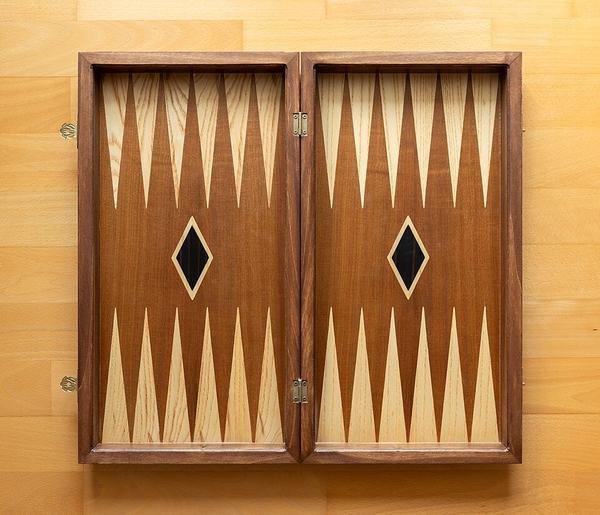
Image credit: Nikos Kitsakis. CC BY 4.0. Source: https://commons.wikimedia.org/wiki/File:Tavli_Board_without_slots_(traditional)_C_No_Stones.jpg. Licence: https://creativecommons.org/licenses/by/4.0/deed.en. Display, thumbnail and enlargement resized without cropping and JPEG encoded; EXIF orientation applied. The packaged enlargement is 960 × 824 pixels. No AI edits.

An isolated board makes storage slots easy to see
Nikos Kitsakis isolated this Greek tavli board against a transparent background in 2024. The treatment removes its surroundings and makes the side slots, Galalith checkers and playing points easy to inspect. It is an object-study image rather than a record of a live match or a particular tavli variant.
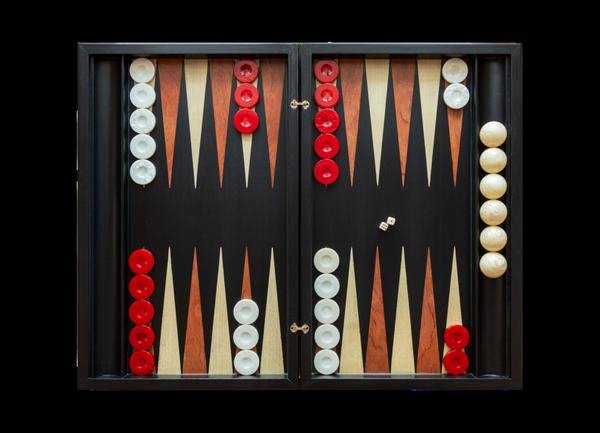
Image credit: Nikos Kitsakis. CC BY 4.0. Source: https://commons.wikimedia.org/wiki/File:Tavli_Board_with_slots_C_%E2%80%93_Isolated.png. Licence: https://creativecommons.org/licenses/by/4.0/deed.en. Display, thumbnail and enlargement resized without cropping and JPEG encoded; EXIF orientation applied. The packaged enlargement is 960 × 692 pixels. No AI edits.

A miniature nardy set keeps the full board pattern
StatisksExpert photographed a reduced-size nardy set in 2015. Although compact, the open case retains opposing rows of points, dice and two colours of round pieces. The image shows how a tables board can be miniaturised for storage or travel while remaining recognisable as equipment for the nardy family.

Image credit: StatisksExpert. CC BY-SA 4.0. Source: https://commons.wikimedia.org/wiki/File:%D0%9D%D0%B0%D1%80%D0%B4%D1%8B_%D0%B2_%D1%83%D0%BC%D0%B5%D0%BD%D1%8C%D1%88%D0%B5%D0%BD%D0%BD%D0%BE%D0%BC_%D1%84%D0%BE%D1%80%D0%BC%D0%B0%D1%82%D0%B5.jpg. Licence: https://creativecommons.org/licenses/by-sa/4.0/deed.en. Display, thumbnail and enlargement resized without cropping and JPEG encoded; EXIF orientation applied. The packaged enlargement is 960 × 720 pixels. No AI edits.

A decorated box hides the playing surface inside
Mervat Salman's 2017 photograph shows a closed wooden backgammon box with geometric inlay. The Arabic description identifies it as a box for playing table dice. Its decorated exterior reminds viewers that many sets are designed to look finished when shut, protecting the board while also serving as a display object.
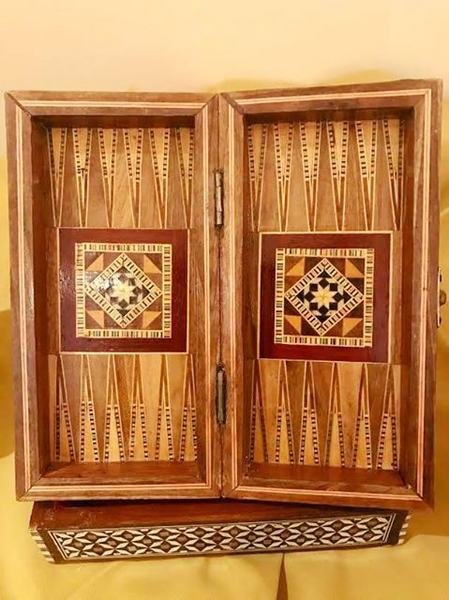
Image credit: Mervat Salman. CC BY-SA 4.0. Source: https://commons.wikimedia.org/wiki/File:Backgammon_Board.jpg. Licence: https://creativecommons.org/licenses/by-sa/4.0/deed.en. Display, thumbnail and enlargement resized without cropping and JPEG encoded; EXIF orientation applied. The packaged enlargement is 479 × 640 pixels. No AI edits.

One seventeenth-century box served three board games
Cologne City Museum displayed a seventeenth-century German games box with fields for trictrac, chess and draughts. The exhibit also included 33 wooden counters based on medals by Philipp Heinrich Muller from about 1700. One crafted object could therefore support several games and carry portrait-like imagery on its pieces.

Image credit: Raimond Spekking. CC BY-SA 4.0. Source: https://commons.wikimedia.org/wiki/File:Bretter,_die_die_Welt_bedeuten._Spielend_durch_2000_Jahre_K%C3%B6ln_-0683.jpg. Licence: https://creativecommons.org/licenses/by-sa/4.0/deed.en. Display, thumbnail and enlargement resized without cropping and JPEG encoded; EXIF orientation applied. The packaged enlargement is 960 × 640 pixels. No AI edits.

An 1894 diagram starts with an empty board
Professor Hoffmann's 1894 publication included this empty backgammon board diagram. With no checkers or dice, the black-and-white image presents the board as a numbered structure ready for explanation. Removing the playing position lets a printed rule book introduce the equipment before asking readers to follow any moves.

Image credit: Professor Hoffmann. Public domain. Source: https://commons.wikimedia.org/wiki/File:Emptybackgammon.png. Licence: https://creativecommons.org/publicdomain/mark/1.0/. Display, thumbnail and enlargement resized without cropping and JPEG encoded; EXIF orientation applied. The packaged enlargement is 607 × 401 pixels. No AI edits.

An Iraqi board combines wood, shell and thirty stones
Usamasaad's 2019 record describes an Iraqi wooden tables board decorated with shell or valuable woods such as ebony. It notes fifteen stones of each colour and two six-sided dice. These details document the physical set; they do not settle which of the Middle East's related tables-game rules its owners preferred.

Image credit: Usamasaad. CC BY-SA 4.0. Source: https://commons.wikimedia.org/wiki/File:%D9%84%D8%B9%D8%A8%D8%A9_%D9%86%D8%B1%D8%AF_%D8%A7%D9%84%D8%B7%D8%A7%D9%88%D9%84%D8%A9_03.jpg. Licence: https://creativecommons.org/licenses/by-sa/4.0/deed.en. Display, thumbnail and enlargement resized without cropping and JPEG encoded; EXIF orientation applied. The packaged enlargement is 500 × 667 pixels. No AI edits.

Five-by-three makes a verquere double crown
Edward Werner's 2026 photograph labels a verquere double crown: five checkers occupy each of the final three tongues, numbered 22 to 24. The neat fifteen-checker formation is a named ending pattern from Swedish tables. It resembles a constructed study position, not the standard starting arrangement of modern backgammon.

Image credit: Edward Werner. CC BY-SA 4.0. Source: https://commons.wikimedia.org/wiki/File:Verquere_double_crown.jpg. Licence: https://creativecommons.org/licenses/by-sa/4.0/deed.en. Display, thumbnail and enlargement resized without cropping and JPEG encoded; EXIF orientation applied. The packaged enlargement is 960 × 720 pixels. No AI edits.

A compact set becomes a blue-lined carrying case
Martina Grosty photographed this compact backgammon set in 2016. The playing field folds into a dark case lined with blue fabric, while the pieces remain visible inside. The image documents portability through hinges, shallow storage and a protective shell rather than through a roll-up mat or full furniture table.

Image credit: Martina Grosty. CC BY 2.0. Source: https://commons.wikimedia.org/wiki/File:Backgammon-P1090549_(Kopie)_(31742957373).jpg. Licence: https://creativecommons.org/licenses/by/2.0/deed.en. Display, thumbnail and enlargement resized without cropping and JPEG encoded; EXIF orientation applied. The packaged enlargement is 960 × 720 pixels. No AI edits.

Galalith pieces bring colour to a traditional board
A traditional Greek tavli board photographed by Nikos Kitsakis holds red, blue-grey and white Galalith checkers. Their manufactured colour contrasts with the warm wood and inlay. The source identifies the material and equipment, while the arrangement should not be read as a diagram of one specific tavli game's opening.
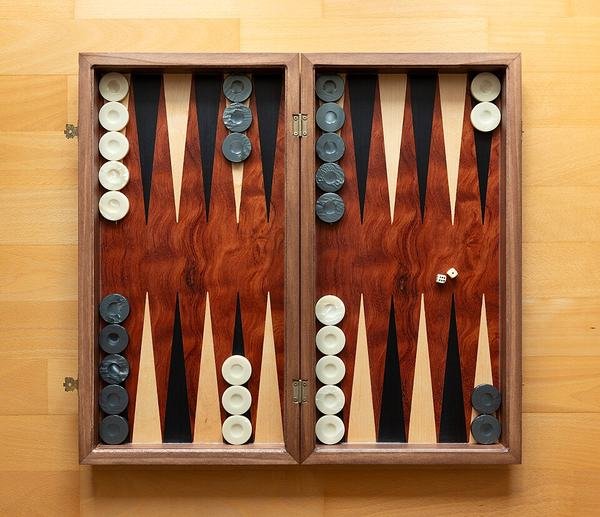
Image credit: Nikos Kitsakis. CC BY 4.0. Source: https://commons.wikimedia.org/wiki/File:Tavli_Board_without_slots_(traditional).jpg. Licence: https://creativecommons.org/licenses/by/4.0/deed.en. Display, thumbnail and enlargement resized without cropping and JPEG encoded; EXIF orientation applied. The packaged enlargement is 960 × 827 pixels. No AI edits.

A cave floor in Maharashtra carries a gameboard
SpeakingArch photographed a gameboard cut into the floor of the Pandu Leni caves in Maharashtra in June 2026. The source labels it for backgammon, but the photograph alone cannot date the carving or recover its rules. Its value is the physical evidence of a tables-like layout fixed into stone.

Image credit: SpeakingArch. CC BY-SA 4.0. Source: https://commons.wikimedia.org/wiki/File:Gameboard_for_Backgammon,_Pandu_Leni_Cave_Floor,_Maharashtra.jpg. Licence: https://creativecommons.org/licenses/by-sa/4.0/deed.en. Display, thumbnail and enlargement resized without cropping and JPEG encoded; EXIF orientation applied. The packaged enlargement is 960 × 991 pixels. No AI edits.

A modern set gives each player separate dice
Clint Budd's 2023 photograph shows two pairs of playing dice beside a larger doubling die. The caption explains that each player has a pair. This is modern backgammon equipment: the larger cube tracks stakes or game value and is not rolled to determine checker movement like the ordinary dice.

Image credit: Clint Budd from About 15 miles North of Swansea, Wales. CC BY 2.0. Source: https://commons.wikimedia.org/wiki/File:Backgammon_(52600594028).jpg. Licence: https://creativecommons.org/licenses/by/2.0/deed.en. Display, thumbnail and enlargement resized without cropping and JPEG encoded; EXIF orientation applied. The packaged enlargement is 960 × 640 pixels. No AI edits.

An Icelandic layout starts Chasing the Girls
This 2023 diagram records the starting layout of the Icelandic tables game Ad elta stelpur, translated as Chasing the Girls. Naming the position matters because a familiar pointed board can host very different games. The image is evidence for that variant's setup, not for the standard backgammon opening.
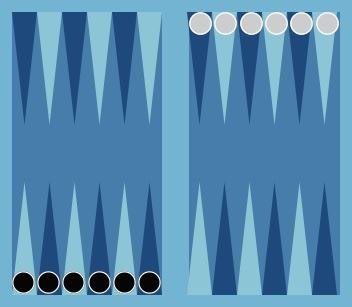
Image credit: DeeEsDee. CC BY-SA 4.0. Source: https://commons.wikimedia.org/wiki/File:Ad_Elta_Stelpur.jpg. Licence: https://creativecommons.org/licenses/by-sa/4.0/deed.en. Display, thumbnail and enlargement resized without cropping and JPEG encoded; EXIF orientation applied. The packaged enlargement is 352 × 307 pixels. No AI edits.

Meersburg Castle preserves a carved tables board
A visitor photograph from Meersburg Castle shows a wooden board identified for Wurfzabel or backgammon. The interior has long points and carved headings, while the lid carries printed labels. Listing both names is appropriately cautious: one historical object could be associated with related tables games rather than one fixed modern ruleset.
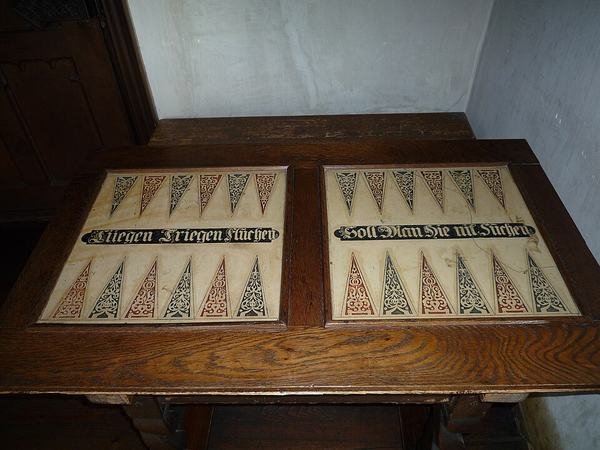
Image credit: Flominator ( talk ). CC BY-SA 3.0. Source: https://commons.wikimedia.org/wiki/File:Burg_Meersburg_April_2010_1010844.jpg. Licence: https://creativecommons.org/licenses/by-sa/3.0/deed.en. Display, thumbnail and enlargement resized without cropping and JPEG encoded; EXIF orientation applied. The packaged enlargement is 960 × 720 pixels. No AI edits.

Intarsia decorates the outside of a tavli board
The closed exterior of this traditional Greek tavli board carries floral intarsia in contrasting woods. Nikos Kitsakis photographed it in 2024. Because the playing field is hidden, the image draws attention to cabinetmaking and portability: the board becomes a decorated box when the game is put away.

Image credit: Nikos Kitsakis. CC BY 4.0. Source: https://commons.wikimedia.org/wiki/File:Tavli_Board_without_slots_(traditional)_C_Closed.jpg. Licence: https://creativecommons.org/licenses/by/4.0/deed.en. Display, thumbnail and enlargement resized without cropping and JPEG encoded; EXIF orientation applied. The packaged enlargement is 960 × 556 pixels. No AI edits.

A walrus-ivory checker carries a rider over a sea monster
A photograph from the Louvre shows a late-twelfth-century trictrac piece carved from walrus ivory. The catalogue description places its origin in Norway or Cologne and identifies a mitred figure riding a sea monster. The tiny scene turns one gaming counter into a miniature sculpture, although its exact original game remains uncertain.
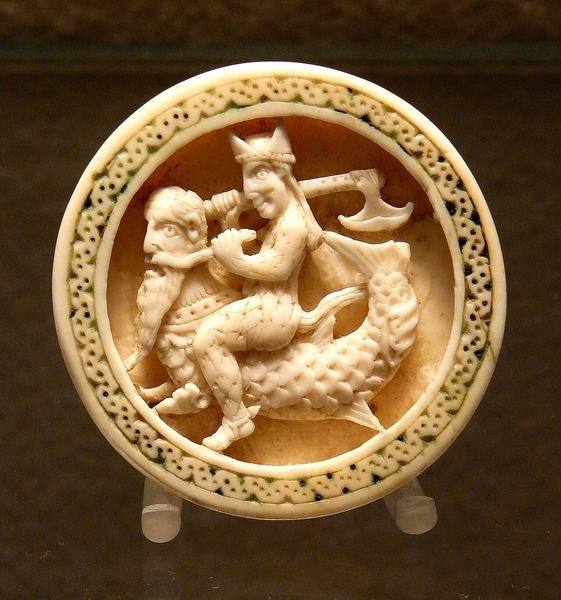
Image credit: Siren-Com. CC BY-SA 3.0. Source: https://commons.wikimedia.org/wiki/File:Pion_de_tric-trac_1.jpg. Licence: https://creativecommons.org/licenses/by-sa/3.0/. Display, thumbnail and enlargement resized without cropping and JPEG encoded; EXIF orientation applied. The packaged enlargement is 1122 × 1200 pixels. No AI edits.

An Edo-period ban-sugoroku board survives
Ayasesaya photographed a ban-sugoroku board identified as dating from Japan's Edo period. Long points, dice and paired groups of round pieces make its tables-game function visible. Ban-sugoroku is historically related to backgammon, but the museum object should keep its Japanese name rather than be treated as a modern set.

Image credit: Ayasesaya. CC BY-SA 3.0. Source: https://commons.wikimedia.org/wiki/File:%E7%9B%A4%E5%8F%8C%E5%85%AD.JPG. Licence: https://creativecommons.org/licenses/by-sa/3.0/deed.en. Display, thumbnail and enlargement resized without cropping and JPEG encoded; EXIF orientation applied. The packaged enlargement is 960 × 540 pixels. No AI edits.

A mid-century jacquet board was not built for trictrac
Edward Werner identifies this board as a jacquet board from the 1950s or 1960s and explicitly notes that it is not useful for playing trictrac. The turquoise field, racks of pieces and cups show shared tables-game equipment, while the source warning prevents two French games from being casually merged.

Image credit: Edward Werner. CC0 1.0. Source: https://commons.wikimedia.org/wiki/File:Tablier_de_jacquet.jpg. Licence: https://creativecommons.org/publicdomain/zero/1.0/deed.en. Display, thumbnail and enlargement resized without cropping and JPEG encoded; EXIF orientation applied. The packaged enlargement is 960 × 753 pixels. No AI edits.

Oranienburg displays a gaming table as furniture
Thomas Quine photographed this medieval-style gaming table at Schloss Oranienburg in 2014. The object appears as a small decorated table with a board built into its top. The photograph records a museum display and its setting; it does not claim that the modern visitors' label reconstructs every original rule.

Image credit: Thomas Quine. CC BY 2.0. Source: https://commons.wikimedia.org/wiki/File:Medieval_gaming_table_(23855949744).jpg. Licence: https://creativecommons.org/licenses/by/2.0/deed.en. Display, thumbnail and enlargement resized without cropping and JPEG encoded; EXIF orientation applied. The packaged enlargement is 500 × 750 pixels. No AI edits.

Aphrodisias preserves a twelve-line stone board
A stone board near the agora at Aphrodisias is identified as the Roman Game of Twelve Lines and dated to the second century CE. Its rows of cup-like marks survive outdoors. The Roman game belongs to tables history, but calling it identical to modern backgammon would go beyond what the photographed board alone proves.

Image credit: wneuheisel. CC BY 2.0. Source: https://commons.wikimedia.org/wiki/File:Roman_Game_of_12_Lines_Board_-_Aphrodisias.jpg. Licence: https://creativecommons.org/licenses/by/2.0/deed.en. Display, thumbnail and enlargement resized without cropping and JPEG encoded; EXIF orientation applied. The packaged enlargement is 960 × 640 pixels. No AI edits.

Fantastic animals fight on a medieval trictrac piece
Another Louvre trictrac piece, probably made in Cologne near the end of the twelfth century, shows fantastic animals locked in combat. The relief is carved into walrus ivory. Decorated counters like this were useful game equipment, but they also displayed stories and skilled carving whenever the pieces were laid out.

Image credit: Siren-Com. CC BY-SA 3.0. Source: https://commons.wikimedia.org/wiki/File:Pion_de_tric-trac_2.jpg. Licence: https://creativecommons.org/licenses/by-sa/3.0/. Display, thumbnail and enlargement resized without cropping and JPEG encoded; EXIF orientation applied. The packaged enlargement is 1200 × 1129 pixels. No AI edits.

A recreation kit appears among Guantanamo comfort items
A 2006 U.S. Army photograph shows sample comfort items issued to detainees in Camp 4 at Guantanamo Bay. Dominoes and a small tables-game set appear beside packaged goods. The official caption explains the communal recreation context; it does not show anyone playing or identify a precise backgammon variant.

Image credit: US Army Sergeant Sara Wood. Public domain. Source: https://commons.wikimedia.org/wiki/File:Comfort_items_5.jpg. Licence: https://creativecommons.org/publicdomain/mark/1.0/. Display, thumbnail and enlargement resized without cropping and JPEG encoded; EXIF orientation applied. The packaged enlargement is 500 × 762 pixels. No AI edits.

Soldiers played during a Beirut lull in 1982
Yaakov Saar photographed members of a 155 mm mobile gun crew playing backgammon outside Beirut during a lull on 10 August 1982. The official caption places recreation inside Operation Peace for Galilee. The image documents a specific pause and unit setting; it does not make the game itself a military activity.

Image credit: Yaakov Saar / Government Press Office. CC BY-SA 3.0. Source: https://commons.wikimedia.org/wiki/File:Flickr_-_Government_Press_Office_(GPO)_-_Backgammon_in_Beirut.jpg. Licence: https://creativecommons.org/licenses/by-sa/3.0/deed.en. Display, thumbnail and enlargement resized without cropping and JPEG encoded; EXIF orientation applied. The packaged enlargement is 960 × 630 pixels. No AI edits.

Khachapuri has a photographed starting formation
Zextremo's 2019 diagram labels the starting arrangement Khachapuri. Checkers are massed in distinct groups on a familiar pointed board. The image documents a named setup from the nardy tradition; without a full rule source, it should not be expanded into claims about movement, scoring or its relationship to standard backgammon.

Image credit: User:Zextremo. CC BY-SA 4.0. Source: https://commons.wikimedia.org/wiki/File:%D0%A5%D0%B0%D1%87%D0%B0%D0%BF%D1%83%D1%80%D0%B8.jpg. Licence: https://creativecommons.org/licenses/by-sa/4.0/deed.en. Display, thumbnail and enlargement resized without cropping and JPEG encoded; EXIF orientation applied. The packaged enlargement is 422 × 300 pixels. No AI edits.

A nardy diagram records a position called Draw
Zextremo's 2019 diagram carries the Russian title Nichya, meaning Draw. It preserves a named nardy position on a digital board with dice and checker stacks. The image documents the terminology and visual arrangement; the short source description does not justify adding an unsupported explanation of how the draw was reached.

Image credit: User:Zextremo. CC BY-SA 4.0. Source: https://commons.wikimedia.org/wiki/File:%D0%9D%D0%B8%D1%87%D1%8C%D1%8F.jpg. Licence: https://creativecommons.org/licenses/by-sa/4.0/deed.en. Display, thumbnail and enlargement resized without cropping and JPEG encoded; EXIF orientation applied. The packaged enlargement is 351 × 250 pixels. No AI edits.

A diagram names the home mars result
This 2019 Russian-language diagram is titled Home Mars. It shows checker stacks arranged on a stylised nardy board and belongs to a set of explanatory images by Zextremo. The picture establishes the named position, but its brief metadata does not support treating mars as identical to the modern backgammon scoring term.
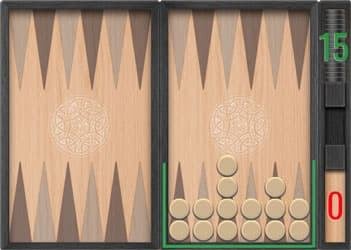
Image credit: User:Zextremo. CC BY-SA 4.0. Source: https://commons.wikimedia.org/wiki/File:%D0%94%D0%BE%D0%BC%D0%B0%D1%88%D0%BD%D0%B8%D0%B9_%D0%BC%D0%B0%D1%80%D1%81.jpg. Licence: https://creativecommons.org/licenses/by-sa/4.0/deed.en. Display, thumbnail and enlargement resized without cropping and JPEG encoded; EXIF orientation applied. The packaged enlargement is 351 × 250 pixels. No AI edits.

Swedish tables illustrates making jan
Feynman's 2022 photograph illustrates how to make jan in Swedish tables. The marked board and pieces record a named formation from that game's vocabulary. Swedish tables has special wins and exceptions of its own, so the image should remain attached to that tradition rather than being recaptioned as standard backgammon.

Image credit: Feynman~svwiki. CC BY-SA 4.0. Source: https://commons.wikimedia.org/wiki/File:BradeJan.JPG. Licence: https://creativecommons.org/licenses/by-sa/4.0/deed.en. Display, thumbnail and enlargement resized without cropping and JPEG encoded; EXIF orientation applied. The packaged enlargement is 945 × 554 pixels. No AI edits.

Verquere gives the blocked player a name
Edward Werner's 2026 example says Black has become Junker: three men are on the bar, only two can re-enter, and the turn must be passed. The photographed position documents a named verquere condition. It should not be applied to standard backgammon, whose entry and forfeiture rules work differently.
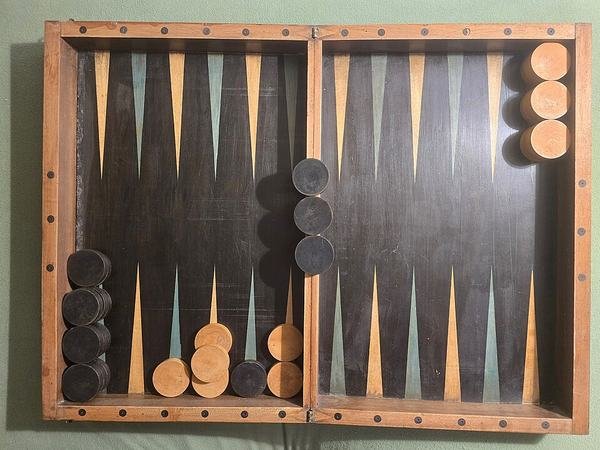
Image credit: Edward Werner. CC BY-SA 4.0. Source: https://commons.wikimedia.org/wiki/File:Verquere_Junker.jpg. Licence: https://creativecommons.org/licenses/by-sa/4.0/deed.en. Display, thumbnail and enlargement resized without cropping and JPEG encoded; EXIF orientation applied. The packaged enlargement is 960 × 720 pixels. No AI edits.

A Swedish board records the sprängjan formation
This 2022 photograph is captioned as the position for sprängjan in Swedish tables. Checkers and point markings preserve the arrangement visually, even for readers who do not know the Swedish term. The source identifies a named formation, not a standard backgammon opening or a universal rule across tables games.

Image credit: Feynman~svwiki. CC BY-SA 4.0. Source: https://commons.wikimedia.org/wiki/File:BradeSprangJan.JPG. Licence: https://creativecommons.org/licenses/by-sa/4.0/deed.en. Display, thumbnail and enlargement resized without cropping and JPEG encoded; EXIF orientation applied. The packaged enlargement is 843 × 518 pixels. No AI edits.

The Snake has its own nardy setup
Zextremo's 2019 diagram labels a nardy variation called Zmeyka, or Snake. Red and white checkers form a distinctive opening pattern on the digital board. The image provides evidence for the name and setup, while the brief metadata does not support inventing movement or scoring rules beyond what is shown.

Image credit: Zextremo. CC BY-SA 4.0. Source: https://commons.wikimedia.org/wiki/File:%D0%9D%D0%B0%D1%80%D0%B4%D1%8B-%D0%97%D0%BC%D0%B5%D0%B9%D0%BA%D0%B0.jpg. Licence: https://creativecommons.org/licenses/by-sa/4.0/deed.en. Display, thumbnail and enlargement resized without cropping and JPEG encoded; EXIF orientation applied. The packaged enlargement is 351 × 250 pixels. No AI edits.

Four barred checkers create a verquere John
Edward Werner's 2026 photograph explains that Black has been Johned in verquere: four hit men remain on the bar, but no more than three can ever re-enter, so White wins by John. This striking loss condition belongs to verquere and has no direct equivalent in standard modern backgammon.
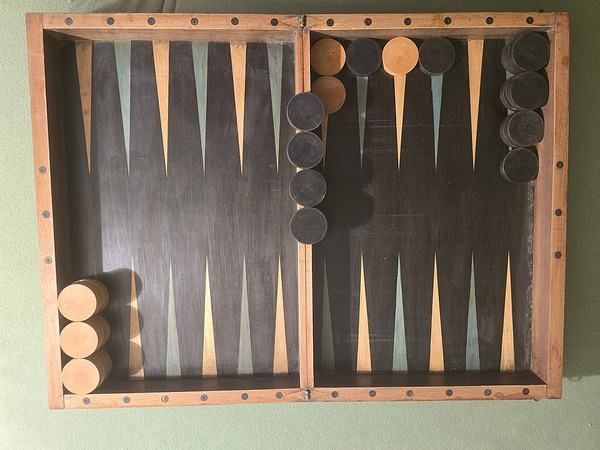
Image credit: Edward Werner. CC BY-SA 4.0. Source: https://commons.wikimedia.org/wiki/File:Verquere_John.jpg. Licence: https://creativecommons.org/licenses/by-sa/4.0/deed.en. Display, thumbnail and enlargement resized without cropping and JPEG encoded; EXIF orientation applied. The packaged enlargement is 960 × 720 pixels. No AI edits.

A backgammon rules committee also codified chouette
The published 1931 chouette rules were prepared by the same committee that produced the 1931 Laws of Backgammon. The source says chouette had become popular in the United States only a few years earlier. Group play therefore entered formal rulemaking soon after its American rise.
Image credit: Ptkfgs / Chris Roddy; source image has a digitally removed background. Public domain (author dedication). Source: https://commons.wikimedia.org/wiki/File:Backgammon_DoublingCube.jpg. Licence: https://creativecommons.org/publicdomain/mark/1.0/. Display, thumbnail and enlargement resized without cropping and JPEG encoded; EXIF orientation applied. Enlargement limited to 1400 pixels on its longest side, or source size if smaller. No AI edits.
Most dice numbers vanish in Chasing the Girls
Chasing the Girls normally uses only doubles and mixed rolls containing a one or six. On a mixed roll, every other number is ignored. Six-six is played twice, while other doubles are played once. The dice therefore have a very different rhythm from modern backgammon.

Image credit: Ptkfgs. Public domain (author dedication). Source: https://commons.wikimedia.org/wiki/File:Backgammon_PrecisionDice.jpg. Licence: https://creativecommons.org/publicdomain/mark/1.0/. Display, thumbnail and enlargement resized without cropping and JPEG encoded; EXIF orientation applied. Enlargement limited to 1400 pixels on its longest side, or source size if smaller. No AI edits.

Friendly checkers cannot share ordinary points
The cited Chasing the Girls rules allow only one checker on an ordinary point. If a move would land on a friendly checker, the moving checker goes forward to the next available point. Opposing checkers are removed when hit, so crowding and capture work unlike standard backgammon.

Image credit: Robertgombos. CC BY-SA 4.0. Source: https://commons.wikimedia.org/wiki/File:Backgammon_table.jpg. Licence: https://creativecommons.org/licenses/by-sa/4.0/. Display, thumbnail and enlargement resized without cropping and JPEG encoded; EXIF orientation applied. Enlargement limited to 1400 pixels on its longest side, or source size if smaller. No AI edits.

The last checker becomes a corner-rattler
When only one checker remains in Chasing the Girls, it becomes a “corner-rattler.” It may land only on points 1, 6, 7 and 12, with ones and sixes moving it between corners. If both players reach this stage, the source warns that a long chase can follow.
Image credit: Robertgombos. CC BY-SA 4.0. Source: https://commons.wikimedia.org/wiki/File:Backgammon_table.jpg. Licence: https://creativecommons.org/licenses/by-sa/4.0/. Display, thumbnail and enlargement resized without cropping and JPEG encoded; EXIF orientation applied. Enlargement limited to 1400 pixels on its longest side, or source size if smaller. No AI edits.
The 1931 chouette used one shared cube
The 1931 chouette rules used one shared doubling cube, yet each team member could answer the box’s double separately. One player might accept and keep playing while another paid and withdrew. The same board could therefore continue with a smaller team after a single offer raised the stakes.
Image credit: Ptkfgs / Chris Roddy; source image has a digitally removed background. Public domain (author dedication). Source: https://commons.wikimedia.org/wiki/File:Backgammon_DoublingCube.jpg. Licence: https://creativecommons.org/publicdomain/mark/1.0/. Display, thumbnail and enlargement resized without cropping and JPEG encoded; EXIF orientation applied. Enlargement limited to 1400 pixels on its longest side, or source size if smaller. No AI edits.
Twenty-four clubs approved the 1931 laws
The printed 1931 Laws of Backgammon list twenty-four approving clubs, including organisations in New York, Boston, Chicago, Philadelphia, Pittsburgh, St Louis and San Francisco. The list shows how a New York committee sought broad club support before its rules became widely accepted.
Image credit: Ptkfgs / Chris Roddy; source image has a digitally removed background. Public domain (author dedication). Source: https://commons.wikimedia.org/wiki/File:Backgammon_DoublingCube.jpg. Licence: https://creativecommons.org/publicdomain/mark/1.0/. Display, thumbnail and enlargement resized without cropping and JPEG encoded; EXIF orientation applied. Enlargement limited to 1400 pixels on its longest side, or source size if smaller. No AI edits.
The 1931 laws expected dice cups
The 1931 laws said both dice were to be shaken in a cup and cast together. They also required the dice to land flat in the player’s right-hand table. A cocked die meant a rethrow, revealing how much formal attention early club rules gave to physical dice handling.
Image credit: Ptkfgs / Chris Roddy; source image has a digitally removed background. Public domain (author dedication). Source: https://commons.wikimedia.org/wiki/File:Backgammon_DoublingCube.jpg. Licence: https://creativecommons.org/publicdomain/mark/1.0/. Display, thumbnail and enlargement resized without cropping and JPEG encoded; EXIF orientation applied. Enlargement limited to 1400 pixels on its longest side, or source size if smaller. No AI edits.
The cube already followed alternating ownership
In the 1931 rules, either player could offer the first voluntary double before rolling. After acceptance, the right to redouble belonged to the player who had accepted the last double. This familiar ownership principle was therefore written into the game’s earliest widely accepted cube laws.
Image credit: Ptkfgs / Chris Roddy; source image has a digitally removed background. Public domain (author dedication). Source: https://commons.wikimedia.org/wiki/File:Backgammon_DoublingCube.jpg. Licence: https://creativecommons.org/publicdomain/mark/1.0/. Display, thumbnail and enlargement resized without cropping and JPEG encoded; EXIF orientation applied. Enlargement limited to 1400 pixels on its longest side, or source size if smaller. No AI edits.
The 1969 update served Bahamas and Las Vegas events
International Backgammon Association rules published in 1969 were used at annual tournaments on Grand Bahama Island and in Las Vegas. They updated the 1931 laws as the game’s popularity returned, while keeping the main structure of checker movement, scoring and doubling.
Image credit: Ptkfgs / Chris Roddy; source image has a digitally removed background. Public domain (author dedication). Source: https://commons.wikimedia.org/wiki/File:Backgammon_DoublingCube.jpg. Licence: https://creativecommons.org/publicdomain/mark/1.0/. Display, thumbnail and enlargement resized without cropping and JPEG encoded; EXIF orientation applied. Enlargement limited to 1400 pixels on its longest side, or source size if smaller. No AI edits.
Backgammon language changed with the 1969 rules
The 1969 revision modernised several terms: “throwing off” became “bearing off,” an “inner table” became a “home board,” and “doublets” became “doubles.” The rules changed little mechanically, but the vocabulary moved much closer to the words used by players today.
Image credit: Ptkfgs / Chris Roddy; source image has a digitally removed background. Public domain (author dedication). Source: https://commons.wikimedia.org/wiki/File:Backgammon_DoublingCube.jpg. Licence: https://creativecommons.org/publicdomain/mark/1.0/. Display, thumbnail and enlargement resized without cropping and JPEG encoded; EXIF orientation applied. Enlargement limited to 1400 pixels on its longest side, or source size if smaller. No AI edits.
Four dice could be mixed and chosen in turn
The 1969 laws let either player request fresh dice selection before a later game. All four dice were shaken and rolled from one cup; the opponent chose first, then the roller, then the opponent again, leaving the last die for the roller.
Image credit: Ptkfgs / Chris Roddy; source image has a digitally removed background. Public domain (author dedication). Source: https://commons.wikimedia.org/wiki/File:Backgammon_DoublingCube.jpg. Licence: https://creativecommons.org/publicdomain/mark/1.0/. Display, thumbnail and enlargement resized without cropping and JPEG encoded; EXIF orientation applied. Enlargement limited to 1400 pixels on its longest side, or source size if smaller. No AI edits.
The 1970 laws allowed replaying an illegal move
The 1970 rules said an incorrectly moved checker had to be corrected before the next throw, but the player could replay the entire move. That was more flexible than repairing only the single checker, although later tournament rules placed the decision to accept or correct with the opponent.
Image credit: Ptkfgs / Chris Roddy; source image has a digitally removed background. Public domain (author dedication). Source: https://commons.wikimedia.org/wiki/File:Backgammon_DoublingCube.jpg. Licence: https://creativecommons.org/publicdomain/mark/1.0/. Display, thumbnail and enlargement resized without cropping and JPEG encoded; EXIF orientation applied. Enlargement limited to 1400 pixels on its longest side, or source size if smaller. No AI edits.
Bearing off did not require maximum pip use
The 1970 rules made clear that a player did not have to maximise pips while bearing off. As long as both dice were legally used, either could be played first. The published example used a one before a six to avoid leaving a checker exposed.
Image credit: Ptkfgs / Chris Roddy; source image has a digitally removed background. Public domain (author dedication). Source: https://commons.wikimedia.org/wiki/File:Backgammon_DoublingCube.jpg. Licence: https://creativecommons.org/publicdomain/mark/1.0/. Display, thumbnail and enlargement resized without cropping and JPEG encoded; EXIF orientation applied. Enlargement limited to 1400 pixels on its longest side, or source size if smaller. No AI edits.
Jacoby and beavers were still outside the 1970 laws
Backgammon Galore’s notes compare the 1970 laws with later money play. The printed rules did not yet include the Jacoby rule or beavers, although both became widespread. This shows how important customs can become normal practice before they enter a formal rules document.
Image credit: Ptkfgs / Chris Roddy; source image has a digitally removed background. Public domain (author dedication). Source: https://commons.wikimedia.org/wiki/File:Backgammon_DoublingCube.jpg. Licence: https://creativecommons.org/publicdomain/mark/1.0/. Display, thumbnail and enlargement resized without cropping and JPEG encoded; EXIF orientation applied. Enlargement limited to 1400 pixels on its longest side, or source size if smaller. No AI edits.
Fayles crossed from medieval Spain to England
The cited history says Fayles, also spelled Fails, was played in Spain and England from the thirteenth through seventeenth centuries. That four-century range places its unusual three-die rules inside a long European tables tradition, rather than treating it as a modern invented variant.
Image credit: Robertgombos. CC BY-SA 4.0. Source: https://commons.wikimedia.org/wiki/File:Backgammon_table.jpg. Licence: https://creativecommons.org/licenses/by-sa/4.0/. Display, thumbnail and enlargement resized without cropping and JPEG encoded; EXIF orientation applied. Enlargement limited to 1400 pixels on its longest side, or source size if smaller. No AI edits.
The Lombards’ Game had a Spanish second name
Descriptions of Ludus Lumbardorum date to the thirteenth and fourteenth centuries. The source translates its name as the Lombards’ Game and records another name, El Medio Emperador. Those labels connect the half-board game with more than one medieval language and region.
Image credit: Robertgombos. CC BY-SA 4.0. Source: https://commons.wikimedia.org/wiki/File:Backgammon_table.jpg. Licence: https://creativecommons.org/licenses/by-sa/4.0/. Display, thumbnail and enlargement resized without cropping and JPEG encoded; EXIF orientation applied. Enlargement limited to 1400 pixels on its longest side, or source size if smaller. No AI edits.
Tourne-case scores an unentered checker twice
Tourne-case awards one point only when the loser has entered all three checkers and has none on the bar. If any checker remains unentered or barred, the loss is worth two. The small three-checker game therefore judges defeat by whether the whole team reached the board safely.
Image credit: Robertgombos. CC BY-SA 4.0. Source: https://commons.wikimedia.org/wiki/File:Backgammon_table.jpg. Licence: https://creativecommons.org/licenses/by-sa/4.0/. Display, thumbnail and enlargement resized without cropping and JPEG encoded; EXIF orientation applied. Enlargement limited to 1400 pixels on its longest side, or source size if smaller. No AI edits.
Irish used the familiar fifteen-checker setup
The historical game called Irish used the same fifteen-checker starting arrangement now familiar in backgammon. The source describes it as a likely direct ancestor, played under different names in several European countries from the sixteenth century, while noting several important rule differences.
Image credit: Robertgombos. CC BY-SA 4.0. Source: https://commons.wikimedia.org/wiki/File:Backgammon_table.jpg. Licence: https://creativecommons.org/licenses/by-sa/4.0/. Display, thumbnail and enlargement resized without cropping and JPEG encoded; EXIF orientation applied. Enlargement limited to 1400 pixels on its longest side, or source size if smaller. No AI edits.
Irish could not seal every re-entry point
The published Irish rules forbid completely closing a home board while the opponent has a checker on the bar. The player must leave at least one entry point open. Modern backgammon allows a six-point closed board, so the older restriction limits long periods of total exclusion.
Image credit: Robertgombos. CC BY-SA 4.0. Source: https://commons.wikimedia.org/wiki/File:Backgammon_table.jpg. Licence: https://creativecommons.org/licenses/by-sa/4.0/. Display, thumbnail and enlargement resized without cropping and JPEG encoded; EXIF orientation applied. Enlargement limited to 1400 pixels on its longest side, or source size if smaller. No AI edits.
Irish had no gammons, backgammons or cube
Irish scores every completed game as one point, regardless of whether the loser bore off a checker. The cited reconstruction has neither gammons, backgammons nor a doubling cube. Winning speed still matters, but the final margin does not multiply the value.
Image credit: Robertgombos. CC BY-SA 4.0. Source: https://commons.wikimedia.org/wiki/File:Backgammon_table.jpg. Licence: https://creativecommons.org/licenses/by-sa/4.0/. Display, thumbnail and enlargement resized without cropping and JPEG encoded; EXIF orientation applied. Enlargement limited to 1400 pixels on its longest side, or source size if smaller. No AI edits.
Old English Backgammon starts in two tall stacks
The published Old English setup places all fifteen checkers on the board: five on the midpoint and ten on the opponent’s one-point. The familiar modern starting spread is absent, but the players still travel in opposite directions and aim to bear off first.
Image credit: Robertgombos. CC BY-SA 4.0. Source: https://commons.wikimedia.org/wiki/File:Backgammon_table.jpg. Licence: https://creativecommons.org/licenses/by-sa/4.0/. Display, thumbnail and enlargement resized without cropping and JPEG encoded; EXIF orientation applied. Enlargement limited to 1400 pixels on its longest side, or source size if smaller. No AI edits.
Old English doubles use only two moves
Doubles in Old English Backgammon are played once, giving two moves rather than four. That matches several historical tables games and sharply reduces the power of double six. The cited reconstruction also omits gammons, backgammons and the doubling cube.
Image credit: Ptkfgs. Public domain (author dedication). Source: https://commons.wikimedia.org/wiki/File:Backgammon_PrecisionDice.jpg. Licence: https://creativecommons.org/publicdomain/mark/1.0/. Display, thumbnail and enlargement resized without cropping and JPEG encoded; EXIF orientation applied. Enlargement limited to 1400 pixels on its longest side, or source size if smaller. No AI edits.
Old English rules protected one entry point
A player in Old English Backgammon could not close every point in the home board while an opposing checker waited on the bar. At least one entry point had to remain open, limiting the total shutout that is legal in present-day standard backgammon.
Image credit: Robertgombos. CC BY-SA 4.0. Source: https://commons.wikimedia.org/wiki/File:Backgammon_table.jpg. Licence: https://creativecommons.org/licenses/by-sa/4.0/. Display, thumbnail and enlargement resized without cropping and JPEG encoded; EXIF orientation applied. Enlargement limited to 1400 pixels on its longest side, or source size if smaller. No AI edits.
Trictrac doubles count once and nobody is hit
Grand Trictrac uses fifteen checkers and two dice, but doubles are played only once and checkers are not hit. Touching a checker can still matter: the opponent may require that touched checker to be played. Its discipline differs from both modern backgammon and casual undo rules.
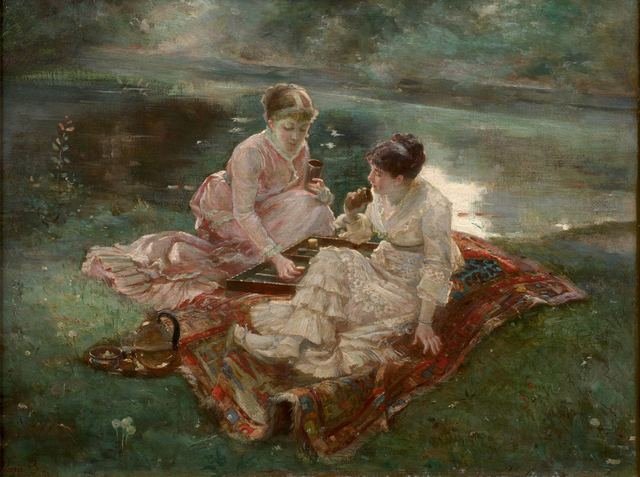
Image credit: Marie Bracquemond; reproduction via Artcurial / Wikimedia Commons. Public domain (PD-Art). Source: https://commons.wikimedia.org/wiki/File:Marie_Bracquemond_-_Les_joueuses_de_jacquet%2C_dit_aussi_%27La_Partie_de_jacquet%27.jpg. Licence: https://creativecommons.org/publicdomain/mark/1.0/. Display, thumbnail and enlargement resized without cropping and JPEG encoded; EXIF orientation applied. Enlargement limited to 1400 pixels on its longest side, or source size if smaller. No AI edits.

Trictrac can score a hit that never happens
Grand Trictrac has no actual hitting, yet a roll that could have hit an opposing checker can score points. The possibility matters more than the capture. This neatly shows why racing to bear off is only a small part of the game’s positional scoring system.
Image credit: Marie Bracquemond; reproduction via Artcurial / Wikimedia Commons. Public domain (PD-Art). Source: https://commons.wikimedia.org/wiki/File:Marie_Bracquemond_-_Les_joueuses_de_jacquet%2C_dit_aussi_%27La_Partie_de_jacquet%27.jpg. Licence: https://creativecommons.org/publicdomain/mark/1.0/. Display, thumbnail and enlargement resized without cropping and JPEG encoded; EXIF orientation applied. Enlargement limited to 1400 pixels on its longest side, or source size if smaller. No AI edits.
A filled Trictrac table must be preserved
When a Grand Trictrac player places at least two checkers on every point of a six-point table, the table is filled. If a roll can complete it, the player must do so, and once completed it must be preserved as long as legally possible.
Image credit: Marie Bracquemond; reproduction via Artcurial / Wikimedia Commons. Public domain (PD-Art). Source: https://commons.wikimedia.org/wiki/File:Marie_Bracquemond_-_Les_joueuses_de_jacquet%2C_dit_aussi_%27La_Partie_de_jacquet%27.jpg. Licence: https://creativecommons.org/publicdomain/mark/1.0/. Display, thumbnail and enlargement resized without cropping and JPEG encoded; EXIF orientation applied. Enlargement limited to 1400 pixels on its longest side, or source size if smaller. No AI edits.
Doublets survived in Iceland into the twentieth century
The cited rules page calls Doublets a very old game of pure luck and says it was still played in Iceland at the beginning of the twentieth century. Its references include R. C. Bell and board-game historian H. J. R. Murray, connecting a surviving pastime with later historical research.
Image credit: Robertgombos. CC BY-SA 4.0. Source: https://commons.wikimedia.org/wiki/File:Backgammon_table.jpg. Licence: https://creativecommons.org/licenses/by-sa/4.0/. Display, thumbnail and enlargement resized without cropping and JPEG encoded; EXIF orientation applied. Enlargement limited to 1400 pixels on its longest side, or source size if smaller. No AI edits.
Duplicate backgammon returned after a fifty-year gap
According to the cited history, Duplicate Backgammon was first tried in the late 1920s as duplicate bridge became popular. Players experimented with it again during backgammon’s 1970s revival. The repeated attempts show an enduring wish to compare skill under shared rolls, even though games can quickly diverge.

Image credit: Liz Cooke. CC BY-SA 3.0. Source: https://commons.wikimedia.org/wiki/File:Backgammon_Players%2C_Brighton_Beach%2C_Brooklyn_2012.jpg. Licence: https://creativecommons.org/licenses/by-sa/3.0/. Display, thumbnail and enlargement resized without cropping and JPEG encoded; EXIF orientation applied. Enlargement limited to 1400 pixels on its longest side, or source size if smaller. No AI edits.

Fayles sent a captured checker to the one-point
In the historical game Fayles, a hit checker does not go to the bar. It is placed on the hitter’s one-point and must travel around again. A player cannot make a hit while that one-point is blocked, so closing the point may remove an attacking option.
Image credit: Robertgombos. CC BY-SA 4.0. Source: https://commons.wikimedia.org/wiki/File:Backgammon_table.jpg. Licence: https://creativecommons.org/licenses/by-sa/4.0/. Display, thumbnail and enlargement resized without cropping and JPEG encoded; EXIF orientation applied. Enlargement limited to 1400 pixels on its longest side, or source size if smaller. No AI edits.
Ludus Lumbardorum restricted stacking on three points
In the published reconstruction of Ludus Lumbardorum, players cannot place more than one checker on points three, four and five of the opponent’s home table. Points two and six may hold stacks. Friendly singletons can therefore block re-entry as surely as enemy points do.
Image credit: Robertgombos. CC BY-SA 4.0. Source: https://commons.wikimedia.org/wiki/File:Backgammon_table.jpg. Licence: https://creativecommons.org/licenses/by-sa/4.0/. Display, thumbnail and enlargement resized without cropping and JPEG encoded; EXIF orientation applied. Enlargement limited to 1400 pixels on its longest side, or source size if smaller. No AI edits.
A 1931 captain could lose the chair by dropping
Under the 1931 chouette rules, a captain who refused the box’s double surrendered the captaincy immediately, even if teammates accepted and later won. The highest-ranking teammate who took the cube became captain for the rest of that game. A cube decision could therefore change leadership before the board was settled.
Image credit: Liz Cooke. CC BY-SA 3.0. Source: https://commons.wikimedia.org/wiki/File:Backgammon_Players%2C_Brighton_Beach%2C_Brooklyn_2012.jpg. Licence: https://creativecommons.org/licenses/by-sa/3.0/. Display, thumbnail and enlargement resized without cropping and JPEG encoded; EXIF orientation applied. Enlargement limited to 1400 pixels on its longest side, or source size if smaller. No AI edits.
Fayles split its army into two and thirteen
The historical game Fayles begins with two checkers on the opponent’s one-point and the other thirteen on the player’s own six-point. That lopsided pair-and-stack arrangement differs sharply from modern backgammon’s four groups and creates a board dominated by each player’s large home-side reserve.
Image credit: Robertgombos. CC BY-SA 4.0. Source: https://commons.wikimedia.org/wiki/File:Backgammon_table.jpg. Licence: https://creativecommons.org/licenses/by-sa/4.0/. Display, thumbnail and enlargement resized without cropping and JPEG encoded; EXIF orientation applied. Enlargement limited to 1400 pixels on its longest side, or source size if smaller. No AI edits.
Tourne-case doubles provide only one move
A double in Tourne-case is played once, not twice or four times. Rolling 3–3 moves a single checker only three spaces. Combined with the rule that checkers may not pass, doubles can be much less powerful than they are in modern backgammon.
Image credit: Ptkfgs. Public domain (author dedication). Source: https://commons.wikimedia.org/wiki/File:Backgammon_PrecisionDice.jpg. Licence: https://creativecommons.org/publicdomain/mark/1.0/. Display, thumbnail and enlargement resized without cropping and JPEG encoded; EXIF orientation applied. Enlargement limited to 1400 pixels on its longest side, or source size if smaller. No AI edits.
Codex Buranus pictures a game called Wurfzabel
The Commons record identifies this thirteenth-century scene from the Codex Buranus as Wurfzabel players and also calls it a Tabula game. That pairing connects a medieval German name with the wider tables family. The manuscript image records players, not the full rules they followed.
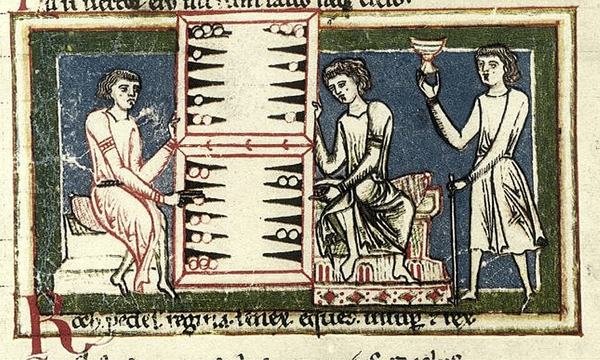
Image credit: Unknown scribe, Benediktbeuern Abbey. Public domain. Source: https://commons.wikimedia.org/wiki/File:Wurfzabel.jpg. Licence: https://creativecommons.org/publicdomain/mark/1.0/. Display, thumbnail and enlargement resized without cropping and JPEG encoded; EXIF orientation applied. The packaged enlargement is 960 × 576 pixels. No AI edits.

A French Jacquet rules sheet saved space in the box
A 2026 Commons record identifies this image as a complete French Jacquet rules sheet. Its description says sheets like it were often bundled with Trictrac boards in the nineteenth and twentieth centuries to reduce manufacturing costs. A small paper insert could therefore teach a second game on the same equipment.
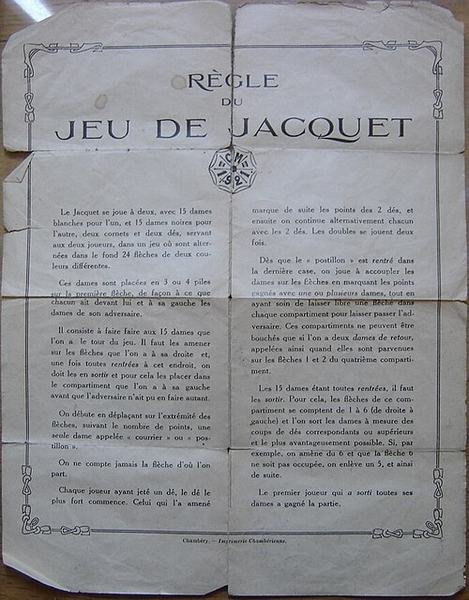
Image credit: Edward Werner. CC BY-SA 4.0. Source: https://commons.wikimedia.org/wiki/File:Jacquet_r%C3%A8gles.jpg. Licence: https://creativecommons.org/licenses/by-sa/4.0/deed.en. Display, thumbnail and enlargement resized without cropping and JPEG encoded; EXIF orientation applied. The packaged enlargement is 500 × 640 pixels. No AI edits.

Tabula holds every checker back until entry is complete
An entered checker in the published reconstruction of Roman Tabula cannot cross into the board’s second half while any friendly checker remains off the board. Rolls may mix further entries with movement inside the first half. The rule keeps the army together longer than ordinary backgammon entry would.
Image credit: Robertgombos. CC BY-SA 4.0. Source: https://commons.wikimedia.org/wiki/File:Backgammon_table.jpg. Licence: https://creativecommons.org/licenses/by-sa/4.0/. Display, thumbnail and enlargement resized without cropping and JPEG encoded; EXIF orientation applied. Enlargement limited to 1400 pixels on its longest side, or source size if smaller. No AI edits.
A 480 CE record guides modern Tabula reconstructions
Backgammon Galore says knowledge of Tabula’s rules comes primarily from records kept by Emperor Zeno in 480 CE. The modern reconstruction therefore rests on a historical written clue rather than a complete surviving rulebook. That distinction matters when describing this Roman relative of later tables games.
Image credit: Robertgombos. CC BY-SA 4.0. Source: https://commons.wikimedia.org/wiki/File:Backgammon_table.jpg. Licence: https://creativecommons.org/licenses/by-sa/4.0/. Display, thumbnail and enlargement resized without cropping and JPEG encoded; EXIF orientation applied. Enlargement limited to 1400 pixels on its longest side, or source size if smaller. No AI edits.
Tables became an umbrella name in England
The Tabula history says the game spread through Europe and became popular in England under the name Tables. “Tables” then grew into a general label for games played on this kind of board, much as “cards” can name a whole family rather than one ruleset.
Image credit: Robertgombos. CC BY-SA 4.0. Source: https://commons.wikimedia.org/wiki/File:Backgammon_table.jpg. Licence: https://creativecommons.org/licenses/by-sa/4.0/. Display, thumbnail and enlargement resized without cropping and JPEG encoded; EXIF orientation applied. Enlargement limited to 1400 pixels on its longest side, or source size if smaller. No AI edits.
Art & Culture
137 facts in this subject.
Backgammon on canvas in 1634
Flemish artist Theodoor Rombouts painted The Backgammon Players in 1634. The scene gathers players and onlookers around a board, turning a tabletop game into the centre of a large painting. Nearly four centuries later, the expressions and concentration still feel familiar.
The painting is held by the North Carolina Museum of Art. It is a vivid reminder that watching a game can be part of the entertainment, too.

Image credit: Theodoor Rombouts; reproduction via Google Cultural Institute. Public domain (PD-Art). Source: https://commons.wikimedia.org/wiki/File:The_Backgammon_Players_-_Theodoor_Rombouts_-_Google_Cultural_Institute.jpg. Licence: https://creativecommons.org/publicdomain/mark/1.0/. Display, thumbnail and enlargement resized without cropping and JPEG encoded; EXIF orientation applied. Enlargement limited to 1400 pixels on its longest side, or source size if smaller. No AI edits.

Spot the board in Caravaggio’s painting
Caravaggio’s famous painting The Cardsharps shows a card game and cheating, but there is another game hiding in plain sight. Look at the lower-left corner: a backgammon-style board sits at the edge of the table.
The painting comes from the late 1500s. Although nobody is playing the board game in this scene, its presence places tables games within the wider world of social play and gambling.
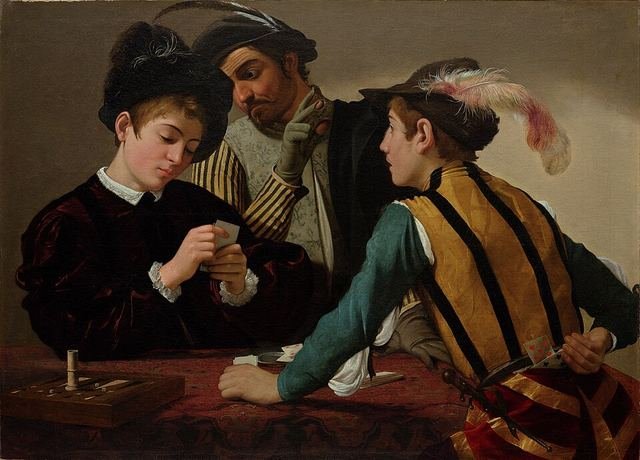
Image credit: Caravaggio; reproduction from Kimbell Art Museum. Public domain (PD-Art). Source: https://commons.wikimedia.org/wiki/File:Caravaggio_-_The_Cardsharps_%281596-97%29_Kimbell_Art_Museum.jpg. Licence: https://creativecommons.org/publicdomain/mark/1.0/. Display, thumbnail and enlargement resized without cropping and JPEG encoded; EXIF orientation applied. Enlargement limited to 1400 pixels on its longest side, or source size if smaller. No AI edits.

An American artist painted backgammon in 1877
American artist Winslow Homer made a watercolour called Backgammon in 1877. The work was painted over a charcoal drawing on paper, showing that a quiet board-game scene could be a subject for fine art.
The picture belongs to the Fine Arts Museums of San Francisco. Unlike a diagram in a rulebook, it records the people and atmosphere around the game.

Image credit: Winslow Homer; reproduction via The AMICA Library / Wikimedia Commons. Public domain (PD-Art). Source: https://commons.wikimedia.org/wiki/File:Winslow_Homer_-_Backgammon_%281877%29.jpg. Licence: https://creativecommons.org/publicdomain/mark/1.0/. Display, thumbnail and enlargement resized without cropping and JPEG encoded; EXIF orientation applied. Enlargement limited to 1400 pixels on its longest side, or source size if smaller. No AI edits.

A game at an Impressionist picnic
Marie Bracquemond’s The Backgammon Players shows two women playing beside a stream. Painted around 1870–1875, the picture was shown at the eighth Impressionist exhibition in Paris in 1886.
Its French title names jacquet, a related tables game with its own rules. The painting captures an outdoor game as part of a leisurely outing, rather than a tournament.
Image credit: Marie Bracquemond; reproduction via Artcurial / Wikimedia Commons. Public domain (PD-Art). Source: https://commons.wikimedia.org/wiki/File:Marie_Bracquemond_-_Les_joueuses_de_jacquet%2C_dit_aussi_%27La_Partie_de_jacquet%27.jpg. Licence: https://creativecommons.org/publicdomain/mark/1.0/. Display, thumbnail and enlargement resized without cropping and JPEG encoded; EXIF orientation applied. Enlargement limited to 1400 pixels on its longest side, or source size if smaller. No AI edits.
Monkeys at the backgammon board
Flemish painter Frans Francken the Younger painted Monkeys Playing Backgammon in the early 1600s. Instead of people, dressed-up monkeys gather around the game. The painting turns a familiar pastime into a comic scene.
The small picture was made with oil paint on copper. Look closely at the players and spectators: even an imaginary animal game can have plenty of drama.
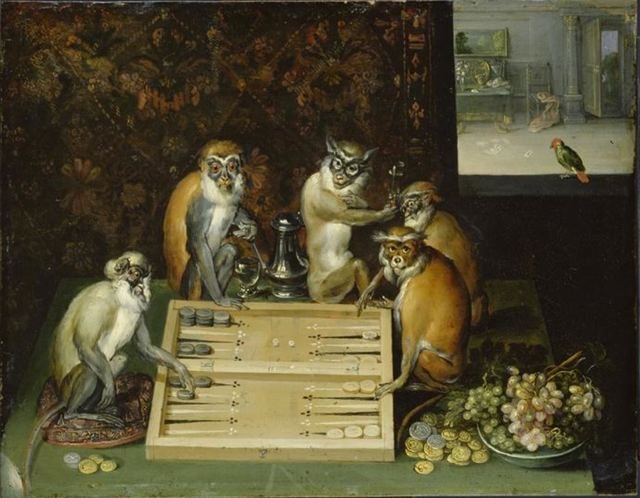
Image credit: Frans Francken the Younger. Public domain. Source: https://commons.wikimedia.org/wiki/File:Frans_Francken_%28II%29_-_Monkeys_playing_backgammon.jpg. Licence: https://creativecommons.org/publicdomain/mark/1.0/. Display, thumbnail and enlargement resized without cropping and JPEG encoded; EXIF orientation applied. Enlargement limited to 1400 pixels on its longest side, or source size if smaller. No AI edits.

A game painted with watercolour
Italian artist Giulio Rosati made The Backgammon Players using pencil and watercolour on paper. The game sits at the centre of a carefully arranged scene, surrounded by clothing, furniture, and decorative details.
This is an artist’s imagined scene, rather than a documentary photograph of a particular match. Rosati died in 1917, making the picture a glimpse into how an earlier artist pictured the game.
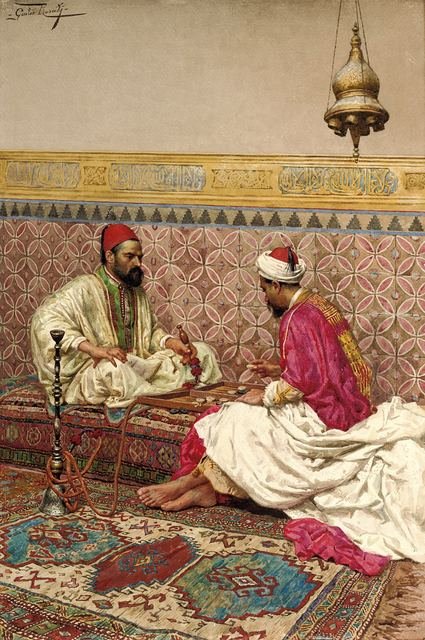
Image credit: Giulio Rosati. Public domain. Source: https://commons.wikimedia.org/wiki/File:The_Backgammon_Players_by_Giulio_Rosati.jpg. Licence: https://creativecommons.org/publicdomain/mark/1.0/. Display, thumbnail and enlargement resized without cropping and JPEG encoded; EXIF orientation applied. Enlargement limited to 1400 pixels on its longest side, or source size if smaller. No AI edits.

Jan Steen makes the game a story
Dutch painter Jan Steen, who died in 1679, created a painting called The Backgammon Players. He used a board game as the focus of a busy indoor scene.
Try looking at the people before you look at the board. Their gestures and expressions help tell the story, even though the picture cannot tell us every move or the final result.
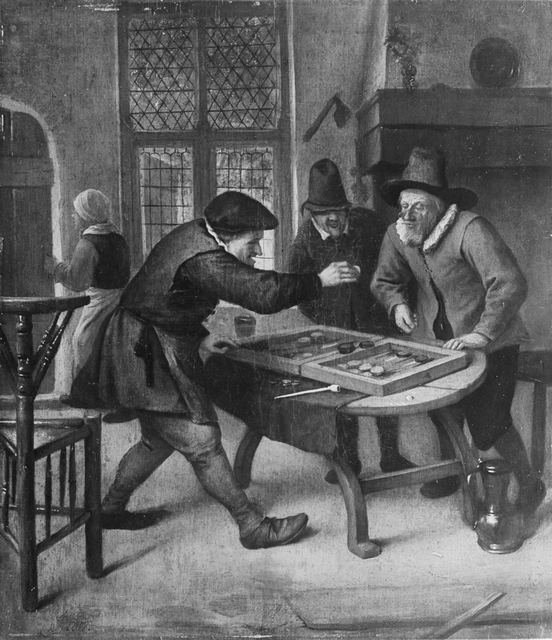
Image credit: Jan Steen. Public domain. Source: https://commons.wikimedia.org/wiki/File:Jan_Steen_-_The_Backgammon_Players_fm1048720.jpg. Licence: https://creativecommons.org/publicdomain/mark/1.0/. Display, thumbnail and enlargement resized without cropping and JPEG encoded; EXIF orientation applied. Enlargement limited to 1400 pixels on its longest side, or source size if smaller. No AI edits.

A backgammon painting from about 1667
Jacob Ochtervelt painted The Backgammon Players around 1667–1669. The Dutch artist worked in the 1600s, long before today’s organised championship circuit.
The picture belongs to the E. G. Bührle Collection. It shows how a tabletop game could become the subject of a carefully composed work of art, rather than simply an object in the background.

Image credit: Jacob Ochtervelt. Public domain. Source: https://commons.wikimedia.org/wiki/File:Jacob_Ochtervelt_-_The_Backgammon_Players.jpg. Licence: https://creativecommons.org/publicdomain/mark/1.0/. Display, thumbnail and enlargement resized without cropping and JPEG encoded; EXIF orientation applied. Enlargement limited to 1400 pixels on its longest side, or source size if smaller. No AI edits.

A painting with a question mark over its artist
The Game of Backgammon, painted around 1630, is attributed to Flemish artist Cornelis de Vos. “Attributed to” means specialists associate it with that artist, but the identification is not certain.
The large oil painting belongs to the Musée Boucher-de-Perthes in Abbeville, France. It is a good reminder that we can know a picture’s subject while still having questions about who painted it.

Image credit: Attributed to Cornelis de Vos. Public domain. Source: https://commons.wikimedia.org/wiki/File:Cornelis_de_Vos_%28attr.%29_-_The_game_of_backgammon.jpg. Licence: https://creativecommons.org/publicdomain/mark/1.0/. Display, thumbnail and enlargement resized without cropping and JPEG encoded; EXIF orientation applied. Enlargement limited to 1400 pixels on its longest side, or source size if smaller. No AI edits.

Backgammon shares a scene with other pastimes
Dutch artist Jan Olis painted a group of men smoking, drinking, and playing backgammon in an interior during the 1600s. The game forms part of a wider social gathering.
The painting is in the Royal Museums of Fine Arts of Belgium. This photograph includes its ornate frame, showing how a familiar pastime can become a museum exhibit.
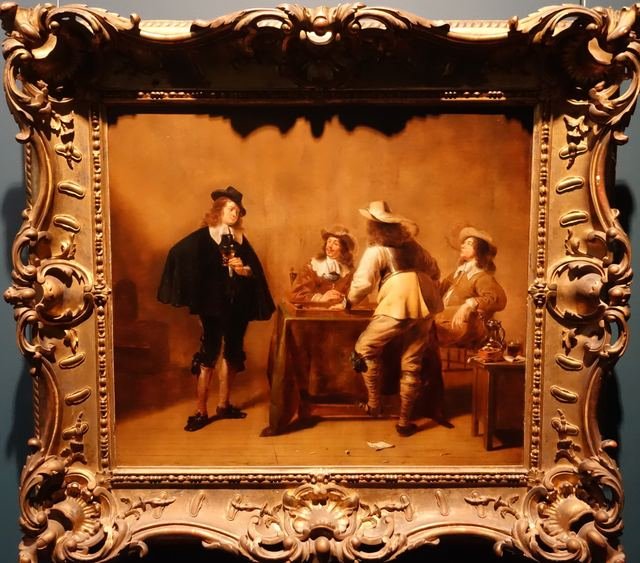
Image credit: Jan Olis; photograph by Karmakolle. CC0 1.0. Source: https://commons.wikimedia.org/wiki/File:Jan_Olis%2C_Backgammon_Players.jpg. Licence: https://creativecommons.org/publicdomain/zero/1.0/. Display, thumbnail and enlargement resized without cropping and JPEG encoded; EXIF orientation applied. Enlargement limited to 1400 pixels on its longest side, or source size if smaller. No AI edits.

A political cartoon uses a backgammon board
Thomas Cockson’s 1609 engraving The Revells of Christendome uses games, including backgammon, to make a political and religious joke. Rulers and church figures compete around a table.
This is satire: an exaggerated picture meant to criticise people and events. It is not a record of a real royal match, but it shows that viewers could recognise board games as a symbol of rivalry.
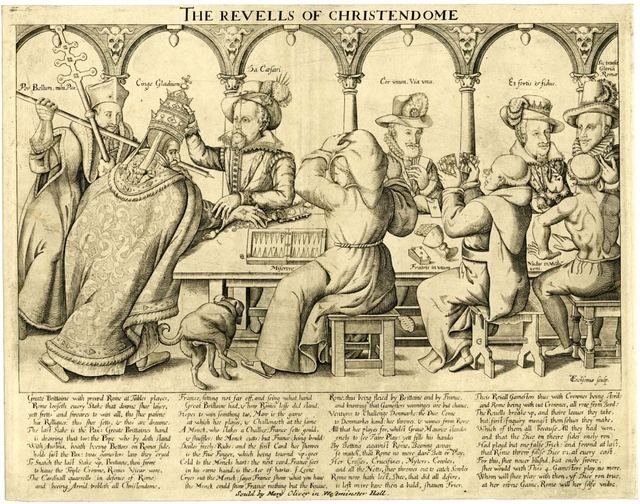
Image credit: Thomas Cockson. Public domain. Source: https://commons.wikimedia.org/wiki/File:The_Revells_of_Christendome.jpg. Licence: https://creativecommons.org/publicdomain/mark/1.0/. Display, thumbnail and enlargement resized without cropping and JPEG encoded; EXIF orientation applied. Enlargement limited to 1400 pixels on its longest side, or source size if smaller. No AI edits.

A publisher’s archive preserves a game photograph
This photograph of two women playing backgammon comes from the archives of educational publisher Pearson Scott Foresman. The publisher donated material to the Wikimedia Foundation and released this image into the public domain.
There is no verified match date or result in the file description. Its value here is the genuine photograph of everyday play, preserved in an archive that people can freely reuse.

Image credit: Pearson Scott Foresman. Public domain. Source: https://commons.wikimedia.org/wiki/File:Backgammon_%28PSF%29.jpg. Licence: https://creativecommons.org/publicdomain/mark/1.0/. Display, thumbnail and enlargement resized without cropping and JPEG encoded; EXIF orientation applied. Enlargement limited to 1400 pixels on its longest side, or source size if smaller. No AI edits.

An eighteenth-century print shows a tables-game afternoon
L’apres-diner, a print dated 1741, shows a social gathering around a tables-game board. It was made by Nicolas de Larmessin IV after a work by Nicolas Lancret, and a copy belongs to the National Gallery of Art in Washington, D.C.
The print was made using engraving and etching, techniques that transfer an image from a prepared plate onto paper. It is a historical scene of a related tables game, rather than a photograph documenting modern backgammon rules.
Image credit: Nicolas de Larmessin IV after Nicolas Lancret; National Gallery of Art. CC0 1.0. Source: https://commons.wikimedia.org/wiki/File:Nicolas_de_Larmessin_IV_after_Nicolas_Lancret,_L%27apres-diner,_1741,_NGA_2745.jpg. Licence: https://creativecommons.org/publicdomain/zero/1.0/. Display, thumbnail and enlargement resized without cropping and JPEG encoded; EXIF orientation applied. Enlargement limited to 1400 pixels on its longest side, or source size if smaller. No AI edits.
The spectator can be part of the picture
Alex Proimos’s photograph titled Saturday Afternoon Backgammon shows a group gathered around open boards. Some men are moving pieces while others watch, so the photograph captures the social side of the game as well as the playing equipment.
Its source records a date in February 2012. A picture can show who is at the table without revealing whether the group is playing separate games, a team format or a particular local variant.
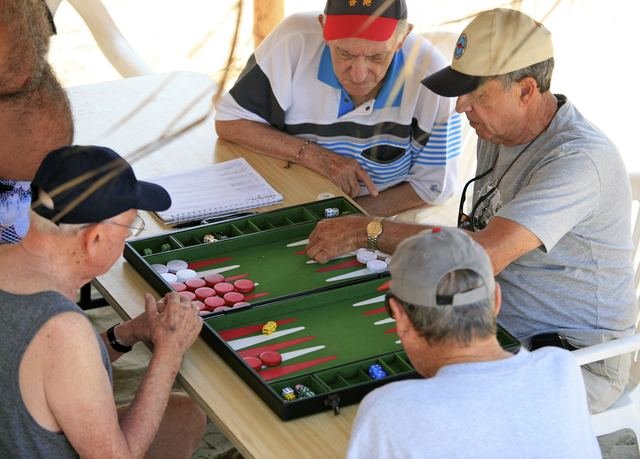
Image credit: Alex Proimos. CC BY 2.0. Source: https://commons.wikimedia.org/wiki/File:Saturday_Afternoon_Backgammon_(6784476822).jpg. Licence: https://creativecommons.org/licenses/by/2.0/. Display, thumbnail and enlargement resized without cropping and JPEG encoded; EXIF orientation applied. Enlargement limited to 1400 pixels on its longest side, or source size if smaller. No AI edits.

Biset painted tables players in a busy room
Karel Emmanuel Biset’s Trictrac Players places a board game among a lively group of people. The painting is held by Denmark’s Statens Museum for Kunst. It records a social setting as well as a game. The title identifies trictrac, so the picture should not be read as proof of modern standard-backgammon rules.
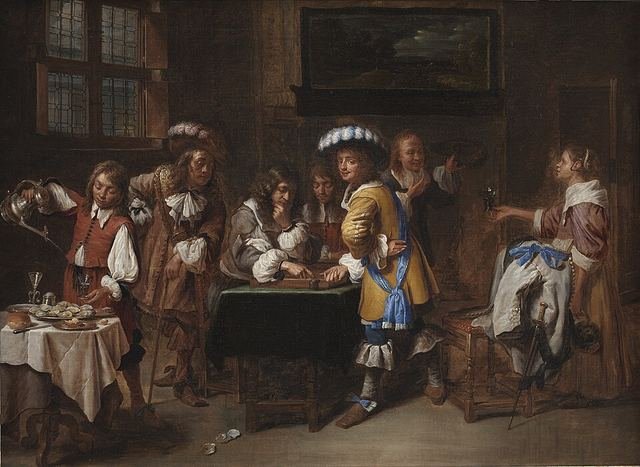
Image credit: Karel Emmanuel Biset; Statens Museum for Kunst. Public domain (historical artwork or museum open access). Source: https://commons.wikimedia.org/wiki/File:Charles_Emmanuel_Biset_-_Trictrac_players.jpg. Licence: https://creativecommons.org/publicdomain/mark/1.0/. Display, thumbnail and enlargement resized without cropping and JPEG encoded; EXIF orientation applied. Enlargement limited to 1400 pixels on its longest side, or source size if smaller. No AI edits.

Judith Leyster painted a trictrac game
Judith Leyster’s A Game of Tric-Trac was painted in the early 1630s and belongs to the Worcester Art Museum. It is oil on a wooden panel. Leyster brings a woman artist into this collection of historical game pictures. The lively group around the board makes the social scene as important as the game itself.

Image credit: Judith Leyster; photograph uploaded by Rlbberlin. Public domain (historical artwork or museum open access). Source: https://commons.wikimedia.org/wiki/File:Judith_Leyster_A_Game_of_Tric_Trac.jpg. Licence: https://creativecommons.org/publicdomain/mark/1.0/. Display, thumbnail and enlargement resized without cropping and JPEG encoded; EXIF orientation applied. Enlargement limited to 1400 pixels on its longest side, or source size if smaller. No AI edits.

Van Mieris used a game in an elegant interior
Frans van Mieris the Elder painted Interior with Figures Playing Tric-trac in 1680. The scene includes finely dressed figures, a table and a game board in a richly furnished room. It is a useful reminder that historical tables games appeared in elegant interiors as well as taverns. A painting is a composed scene, not a photograph.

Image credit: Frans van Mieris the Elder; catalogued Google Art Project reproduction. Public domain (historical artwork or museum open access). Source: https://commons.wikimedia.org/wiki/File:Frans_van_Mieris_the_Elder_-_Interior_with_Figures_Playing_Tric-trac_-_Google_Art_Project.jpg. Licence: https://creativecommons.org/publicdomain/mark/1.0/. Display, thumbnail and enlargement resized without cropping and JPEG encoded; EXIF orientation applied. Enlargement limited to 1400 pixels on its longest side, or source size if smaller. No AI edits.

Van den Eeckhout’s players gather by candlelight
Gerbrand van den Eeckhout’s Tric-Trac Players is dated 1653. Its dark interior draws attention to the people gathered around the board and the light illuminating them. The work is oil on canvas. Historical game paintings can tell stories through lighting and expressions, even when they do not supply enough detail to reconstruct the rules.

Image credit: Gerbrand van den Eeckhout; Web Gallery of Art. Public domain (historical artwork or museum open access). Source: https://commons.wikimedia.org/wiki/File:Gerbrand_van_den_Eeckhout_-_Tric-Trac_Players_-_WGA7471.jpg. Licence: https://creativecommons.org/publicdomain/mark/1.0/. Display, thumbnail and enlargement resized without cropping and JPEG encoded; EXIF orientation applied. Enlargement limited to 1400 pixels on its longest side, or source size if smaller. No AI edits.

A red-covered table anchors Grund’s game scene
The picture catalogued as Norbert Grund’s Two Young Men and a Lady shows a trictrac scene around a red-covered table. The published photograph was taken in 2015; that is the photograph’s date, not the painting’s date. Keeping those dates separate helps avoid a common mistake when using museum and artwork photographs.
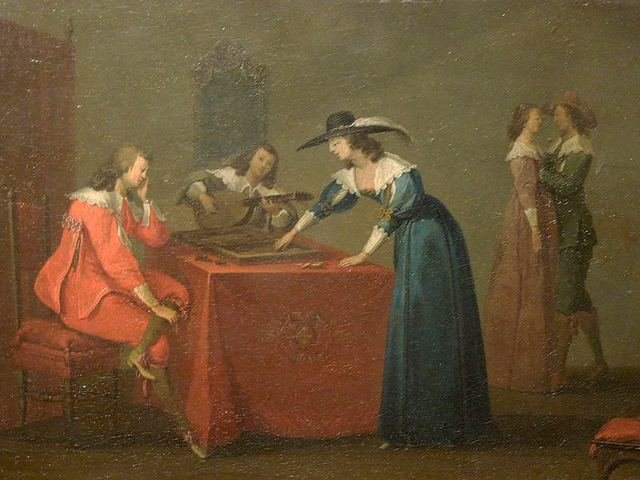
Image credit: Norbert Grund; photograph by Ablakok. CC BY-SA 4.0. Source: https://commons.wikimedia.org/wiki/File:Norbert_Grund_-_Two_Young_Men_and_a_Lady.jpg. Licence: https://creativecommons.org/licenses/by-sa/4.0/deed.en. Display, thumbnail and enlargement resized without cropping and JPEG encoded; EXIF orientation applied. Enlargement limited to 1400 pixels on its longest side, or source size if smaller. No AI edits.

Delcloche placed trictrac outdoors
Paul-Joseph Delcloche’s The Tric-trac Players belongs to the University of Liège collection in Belgium. The image places finely dressed players and companions in an outdoor setting. Delcloche lived from 1716 to 1755. Like other historical game pictures, this is an artist’s composition rather than a record of one identifiable match.

Image credit: Paul-Joseph Delcloche; Université de Liège / BALaT. Public domain (historical artwork or museum open access). Source: https://commons.wikimedia.org/wiki/File:Paul-Joseph_Delcloche,_Les_joueurs_de_tric-trac.jpg. Licence: https://creativecommons.org/publicdomain/mark/1.0/. Display, thumbnail and enlargement resized without cropping and JPEG encoded; EXIF orientation applied. Enlargement limited to 1400 pixels on its longest side, or source size if smaller. No AI edits.

A game scene became a candlelit engraving
Lucas Vorsterman made Tric-trac Players by Candle Light after a design by Adam de Coster. The Rijksmuseum catalogues the print within the period 1619–1628. The engraving shows how a game scene could circulate on paper, reaching viewers beyond the audience for an original painting. Its lighting remains central even without colour.
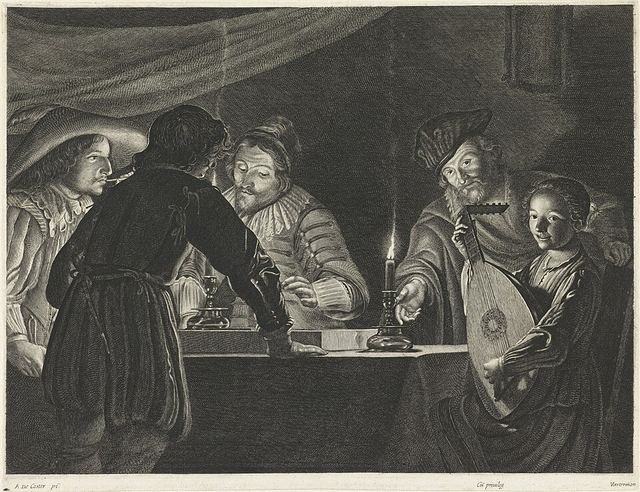
Image credit: Lucas Vorsterman I after Adam de Coster; Rijksmuseum. Public domain (historical artwork or museum open access). Source: https://commons.wikimedia.org/wiki/File:Lucas_Vorsterman_(I)_and_Adam_de_Coster_-_Tric-trac_players_by_candle_light.jpg. Licence: https://creativecommons.org/publicdomain/mark/1.0/. Display, thumbnail and enlargement resized without cropping and JPEG encoded; EXIF orientation applied. Enlargement limited to 1400 pixels on its longest side, or source size if smaller. No AI edits.

A French print puts children at the trictrac table
A seventeenth-century print by Nicolas Bonnart is titled The Three Children of France Playing Tric-Trac. The recorded example is an engraving with hand colouring and touches of gold. It shows the game in a formal setting. The title and technique are documented; the picture alone does not tell us how well the children played.
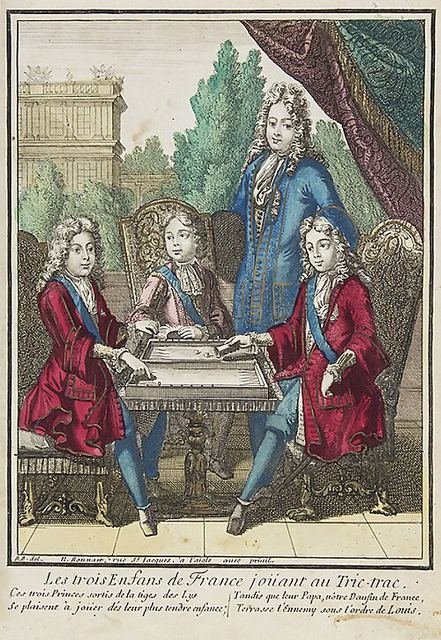
Image credit: Nicolas Bonnart; historical print via Wikimedia Commons. Public domain (historical artwork or museum open access). Source: https://commons.wikimedia.org/wiki/File:Nicolas_Bonnart_-_%27Les_trois_Enfans_de_France_jouant_au_Tric-Trac%27.jpg. Licence: https://creativecommons.org/publicdomain/mark/1.0/. Display, thumbnail and enlargement resized without cropping and JPEG encoded; EXIF orientation applied. Enlargement limited to 1400 pixels on its longest side, or source size if smaller. No AI edits.

An attribution can say circle of an artist
This elegant trictrac scene is attributed to the circle of Johann Georg Platzer, rather than firmly to Platzer himself. That wording matters: it points to an associated artistic environment without naming a certain painter. The small oil-on-panel work shows a richly dressed group around the game. Historical trivia should preserve uncertainty instead of silently removing it.

Image credit: Unknown artist in the circle of Johann Georg Platzer; historical painting via Wikimedia Commons. Public domain (historical artwork or museum open access). Source: https://commons.wikimedia.org/wiki/File:Johann_Georg_Platzer_(Umkreis)_-_Eine_elegante_Gesellschaft_beim_Tric-Trac-Spiel.jpg. Licence: https://creativecommons.org/publicdomain/mark/1.0/. Display, thumbnail and enlargement resized without cropping and JPEG encoded; EXIF orientation applied. Enlargement limited to 1400 pixels on its longest side, or source size if smaller. No AI edits.

Rombouts painted a fight beside a second game
Theodoor Rombouts’s Card and Backgammon Players: Fight over Cards dates to the 1620s. The title distinguishes the card dispute from the tables game also present in the scene. The large oil painting belongs to Denmark’s Statens Museum for Kunst. A dramatic historical game picture can include several activities at once.
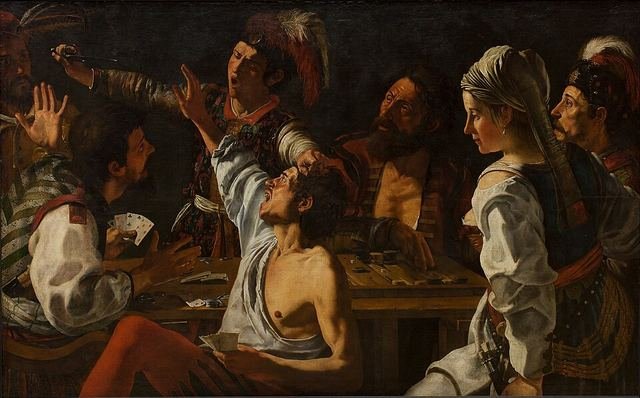
Image credit: Theodoor Rombouts; Statens Museum for Kunst / Google Art Project. Public domain (historical artwork or museum open access). Source: https://commons.wikimedia.org/wiki/File:Theodoor_Rombouts_-_Card_and_Backgammon_Players._Fight_over_Cards_-_Google_Art_Project.jpg. Licence: https://creativecommons.org/publicdomain/mark/1.0/. Display, thumbnail and enlargement resized without cropping and JPEG encoded; EXIF orientation applied. Enlargement limited to 1400 pixels on its longest side, or source size if smaller. No AI edits.

Potter put tables players in a guardroom
Pieter Symonsz. Potter’s Guardroom Interior, also titled Soldiers Playing Backgammon in an Interior, dates to about 1630. It is oil on a wooden panel. The game appears among soldiers and surrounding equipment. The image documents a familiar subject in historical art; it does not identify a particular army’s official gaming rules.
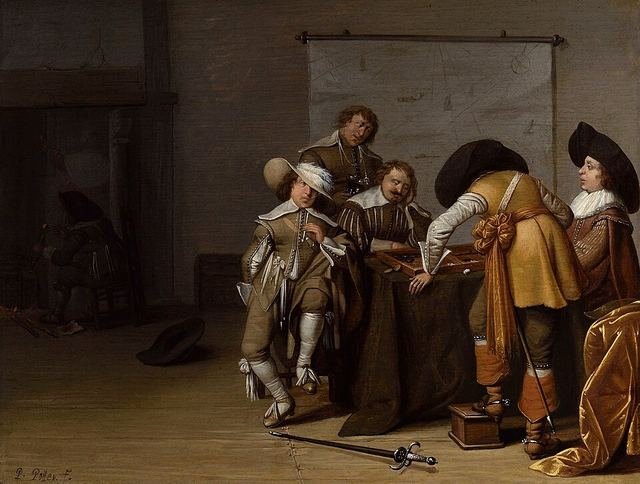
Image credit: Pieter Symonsz. Potter; Web Gallery of Art. Public domain (historical artwork or museum open access). Source: https://commons.wikimedia.org/wiki/File:Pieter_Symonsz._Potter_-_Guardroom_Interior_-_WGA18225.jpg. Licence: https://creativecommons.org/publicdomain/mark/1.0/. Display, thumbnail and enlargement resized without cropping and JPEG encoded; EXIF orientation applied. Enlargement limited to 1400 pixels on its longest side, or source size if smaller. No AI edits.

A backgammon print can fit in your hand
Adriaen van Ostade’s The Backgammon Players is an etching in the Los Angeles County Museum of Art. The recorded sheet is only about 8.9 by 7.6 centimetres. Dated approximately 1682, it packs a social game scene into a very small space. Enlarging the scan reveals details that are easy to miss at thumbnail size.

Image credit: Adriaen van Ostade; Los Angeles County Museum of Art. Public domain (historical artwork or museum open access). Source: https://commons.wikimedia.org/wiki/File:The_Backgammon_Players_LACMA_31.21.97.jpg. Licence: https://creativecommons.org/publicdomain/mark/1.0/. Display, thumbnail and enlargement resized without cropping and JPEG encoded; EXIF orientation applied. Enlargement limited to 1400 pixels on its longest side, or source size if smaller. No AI edits.

A later print revisited an older game scene
Johann Leonhard Appold’s Tric Trac after Ostade is dated 1845. The phrase after Ostade means that it follows an earlier artist’s composition. Such prints helped older game scenes reach new audiences. The credited maker of a reproduction and the artist behind its original design are different people, so both roles matter in a caption.

Image credit: Johann Leonhard Appold after Adriaen van Ostade. Public domain (historical artwork or museum open access). Source: https://commons.wikimedia.org/wiki/File:Leonhard_Appold_Tric_Trac_nach_Ostade.jpg. Licence: https://creativecommons.org/publicdomain/mark/1.0/. Display, thumbnail and enlargement resized without cropping and JPEG encoded; EXIF orientation applied. Enlargement limited to 1400 pixels on its longest side, or source size if smaller. No AI edits.

A backgammon player became a documentary subject
Matvey Natanzon, better known in backgammon as Falafel, was the subject of a documentary called Falafel’s Game. His USBGF biography also records his work mentoring players and commenting on matches. The game has stories about personalities and communities as well as scores and tournament brackets.
Image credit: Alex Proimos. CC BY 2.0. Source: https://commons.wikimedia.org/wiki/File:Saturday_Afternoon_Backgammon_(6784476822).jpg. Licence: https://creativecommons.org/licenses/by/2.0/. Display, thumbnail and enlargement resized without cropping and JPEG encoded; EXIF orientation applied. Enlargement limited to 1400 pixels on its longest side, or source size if smaller. No AI edits.
An 1861 cabinet turned backgammon into Arts and Crafts design
The Metropolitan Museum’s 1861 cabinet called The Backgammon Players combines furniture, painting and metalwork. Philip Webb designed it, Morris, Marshall, Faulkner & Co. made it, and Edward Burne-Jones painted the leather panels. The game scene turned an everyday pastime into a major Arts and Crafts object.

Image credit: Philip Webb; painted by Edward Burne-Jones; manufactured by Morris, Marshall, Faulkner & Co.. CC0 1.0. Source: https://www.metmuseum.org/art/collection/search/195456. Licence: https://creativecommons.org/publicdomain/zero/1.0/. Display, thumbnail and enlargement resized without cropping and JPEG encoded; EXIF orientation applied. The packaged enlargement is 926 × 1200 pixels. No AI edits.
An eighteenth-century backgammon scene survives in red chalk
Johann Esaias Nilson’s eighteenth-century Game of Backgammon is a red-chalk drawing rather than a painting or print. The Metropolitan Museum dates it between 1741 and 1788. Its modest size, about 19 by 30 centimetres, makes this surviving game scene an unusually intimate work on paper.
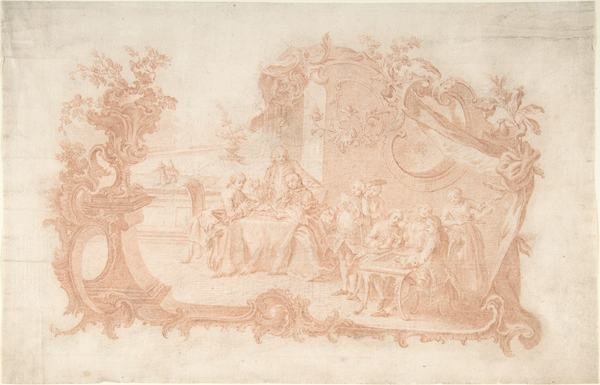
Image credit: Johann Esaias Nilson. CC0 1.0. Source: https://www.metmuseum.org/art/collection/search/335419. Licence: https://creativecommons.org/publicdomain/zero/1.0/. Display, thumbnail and enlargement resized without cropping and JPEG encoded; EXIF orientation applied. The packaged enlargement is 1200 × 771 pixels. No AI edits.
Rowlandson made a backgammon loss look like comic chaos
Thomas Rowlandson’s hand-coloured etching A Hitt at Backgammon was published on November 9, 1810. It shows a furious woman grabbing toward her opponent’s wig while candlesticks topple and a cat reacts nearby. The exaggerated scene used a familiar game to build a joke about bad temper.

Image credit: Thomas Rowlandson; published by Thomas Tegg. CC0 1.0. Source: https://www.metmuseum.org/art/collection/search/811396. Licence: https://creativecommons.org/publicdomain/zero/1.0/. Display, thumbnail and enlargement resized without cropping and JPEG encoded; EXIF orientation applied. The packaged enlargement is 1200 × 849 pixels. No AI edits.
A woman chalked the trictrac score straight onto the board
In Willem Duyster’s painting of about 1625–30, two men play trictrac while a woman writes the score in chalk on the board’s side. Other figures smoke or tend a pipe. The National Gallery reads the scene as quiet social play, without clear signs of drinking or gambling.

Image credit: Willem Duyster. Public Domain Mark 1.0. Source: https://commons.wikimedia.org/wiki/File:Willem_Cornelisz._Duyster_(c.1599-1635)_-_Two_Men_playing_Tric-trac,_with_a_Woman_scoring_-_NG1387_-_National_Gallery.jpg. Licence: https://creativecommons.org/publicdomain/mark/1.0/. Display, thumbnail and enlargement resized without cropping and JPEG encoded; EXIF orientation applied. The packaged enlargement is 1200 × 718 pixels. No AI edits.

Captain Crawley was a literary pen name
The title page of Pardon’s 1858 book credited Captain Crawley rather than his everyday name. A bibliographic note explains that George Frederick Pardon borrowed the pen name from Rawdon Crawley, a character in William Makepeace Thackeray’s novel Vanity Fair. A backgammon author thus hid behind a literary reference.
Image credit: Historical illustration in Alice Howard Cady’s 1895 book; scan via Internet Archive Book Images. Public domain; source marked no known copyright restrictions. Source: https://commons.wikimedia.org/wiki/File:Backgammon_(1895)_(14596242107).jpg. Licence: https://www.flickr.com/commons/usage/. Display, thumbnail and enlargement resized without cropping and JPEG encoded; EXIF orientation applied. Enlargement limited to 1400 pixels on its longest side, or source size if smaller. No AI edits.
American manuals still used French names for dice numbers
Marache’s New York manual of 1866 called the numbers one through six ace, deuce, trois, quatre, cinque and six. This mixture of English and French vocabulary appeared throughout its explanations. A reader could learn backgammon rules and encounter traces of the game’s multilingual European tradition at the same time.
Image credit: Historical illustration in Alice Howard Cady’s 1895 book; scan via Internet Archive Book Images. Public domain; source marked no known copyright restrictions. Source: https://commons.wikimedia.org/wiki/File:Backgammon_(1895)_(14596242107).jpg. Licence: https://www.flickr.com/commons/usage/. Display, thumbnail and enlargement resized without cropping and JPEG encoded; EXIF orientation applied. Enlargement limited to 1400 pixels on its longest side, or source size if smaller. No AI edits.
A 1734 poem turned backgammon into a battle of friars
Daniel Bellamy’s 1734 Backgammon, or the Battle of the Friars was a 22-page tragicomic tale in verse, followed by a short essay against foolish gaming. It was literature and moral commentary rather than a rulebook, showing how easily the game could become a comic subject.
Image credit: Nicolas de Larmessin IV after Nicolas Lancret; National Gallery of Art. CC0 1.0. Source: https://commons.wikimedia.org/wiki/File:Nicolas_de_Larmessin_IV_after_Nicolas_Lancret,_L%27apres-diner,_1741,_NGA_2745.jpg. Licence: https://creativecommons.org/publicdomain/zero/1.0/. Display, thumbnail and enlargement resized without cropping and JPEG encoded; EXIF orientation applied. Enlargement limited to 1400 pixels on its longest side, or source size if smaller. No AI edits.
A 1593 dialogue attacked playing at cards or tables
James Balmford published A Short and Plain Dialogue concerning the unlawfulness of Playing at Cards or Tables in London in 1593. It was a moral argument about gaming, not a backgammon manual. Its title shows that tables games were important enough to receive their own printed religious criticism.
Image credit: Unknown historical illustrator; scan via Wikimedia Commons. Public domain (PD-Art). Source: https://commons.wikimedia.org/wiki/File:The_complete_gamester.gif. Licence: https://creativecommons.org/publicdomain/mark/1.0/. Display, thumbnail and enlargement resized without cropping and JPEG encoded; EXIF orientation applied. Enlargement limited to 1400 pixels on its longest side, or source size if smaller. No AI edits.
Vogue linked backgammon to the appetite for higher risks
In Vogue on September 14, 1929, editor Frank Crowninshield compared the new interest in backgammon with changes in contract bridge. He presented both as signs of a fashionable appetite for greater risks and stakes. The article appeared roughly a month before the October stock-market crash.

Image credit: Vogue; cover artist or photographer unidentified. Public domain in the United States (magazine issue published in 1929). Source: https://nebackgammon.org/index.php/1930s_chronology/. Licence: https://creativecommons.org/publicdomain/mark/1.0/. Display, thumbnail and enlargement resized without cropping and JPEG encoded; EXIF orientation applied. The packaged enlargement is 318 × 420 pixels. No AI edits.
A department store found a game for leftover bridge guests
An Abraham & Straus advertisement in the Brooklyn Daily Eagle on October 2, 1929 proposed backgammon for the two or three dinner guests left over after four people formed a contract-bridge table. Its illustration shows a group gathered around one board, presenting backgammon as a flexible social answer when a party did not divide neatly into bridge fours.
Image credit: Abraham & Straus; advertisement artist unidentified. Public domain in the United States (newspaper advertisement published in 1929). Source: https://nebackgammon.org/index.php/1930s_chronology/. Licence: https://creativecommons.org/publicdomain/mark/1.0/. Display, thumbnail and enlargement resized without cropping and JPEG encoded; EXIF orientation applied. The packaged enlargement is 435 × 1200 pixels. No AI edits.
Players once called the box the owl
In the June 1930 Vanity Fair article Enter Backgammon, Grosvenor Nicholas explained that a chouette’s highest roller played la chouette, meaning the owl, against the group. The less colourful phrase in the box later became standard. The older wording pictured one player fending off several attackers.
Image credit: Vanity Fair and Grosvenor Nicholas. Public domain in the United States (magazine material published in 1930). Source: https://nebackgammon.org/index.php/1930s_chronology/. Licence: https://creativecommons.org/publicdomain/mark/1.0/. Display, thumbnail and enlargement resized without cropping and JPEG encoded; EXIF orientation applied. The packaged enlargement is 400 × 507 pixels. No AI edits.
A 1930 author dated the resort craze back eighteen months
In the foreword to The New Backgammon, dated June 5, 1930, Elizabeth Clark Boyden said the game had awakened about eighteen months earlier and become fashionable at eastern summer resorts. Her timing places the revival around late 1928, before newspapers began covering it heavily.

Image credit: Elizabeth Clark Boyden. Public domain in the United States (book diagram published in 1930). Source: https://nebackgammon.org/index.php/1930s_chronology/. Licence: https://creativecommons.org/publicdomain/mark/1.0/. Display, thumbnail and enlargement resized without cropping and JPEG encoded; EXIF orientation applied. The packaged enlargement is 400 × 446 pixels. No AI edits.
New York instructors charged twenty-five dollars an hour
Gilbert Swan’s syndicated In New York column, printed by the Palo Alto Times on August 14, 1930, reported hourly backgammon instruction costing $25. Swan treated the price as part of New York’s sudden craze, where an ancient game had become a fashionable business opportunity for teachers and promoters.

Image credit: Gilbert Swan; Palo Alto Times. Public domain in the United States (newspaper column published in 1930). Source: https://nebackgammon.org/index.php/1930s_chronology/. Licence: https://creativecommons.org/publicdomain/mark/1.0/. Display, thumbnail and enlargement resized without cropping and JPEG encoded; EXIF orientation applied. The packaged enlargement is 342 × 792 pixels. No AI edits.

A score pad turned a chouette crew into sailors
Harold Thorne marketed 25-cent score pads during the 1930 boom. His printed chouette sheet called members of the captain’s team the First Mate, Bo’sun and Cabin Boy. The playful nautical ranks show publishers inventing colourful language for a group game that many new players were only beginning to learn.
Image credit: Edmond Hoyle; scan via Wikimedia Commons. Public domain (PD-Art). Source: https://commons.wikimedia.org/wiki/File:Hoyle-backgammon.png. Licence: https://creativecommons.org/publicdomain/mark/1.0/. Display, thumbnail and enlargement resized without cropping and JPEG encoded; EXIF orientation applied. Enlargement limited to 1400 pixels on its longest side, or source size if smaller. No AI edits.

Saks opened a backgammon club inside the store
A full-page New Yorker advertisement on August 30, 1930 promoted the Saks-Fifth Avenue Backgammon Club. The department store provided a room, boards and trained assistants so shoppers could learn or play. Similar store clubs and lecture programmes soon appeared in Chicago and Los Angeles.
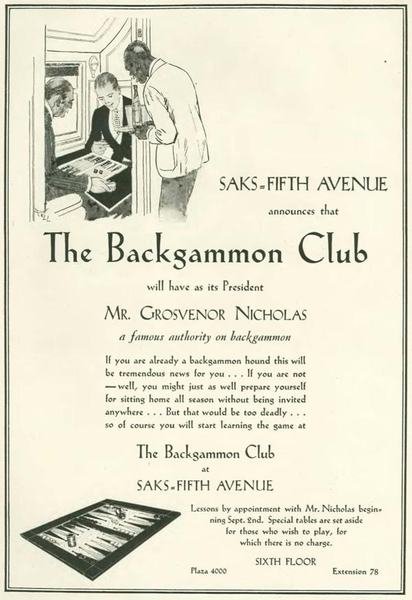
Image credit: Saks-Fifth Avenue; advertisement artist unidentified. Public domain in the United States (magazine advertisement published in 1930). Source: https://nebackgammon.org/index.php/1930s_chronology/. Licence: https://creativecommons.org/publicdomain/mark/1.0/. Display, thumbnail and enlargement resized without cropping and JPEG encoded; EXIF orientation applied. The packaged enlargement is 600 × 873 pixels. No AI edits.
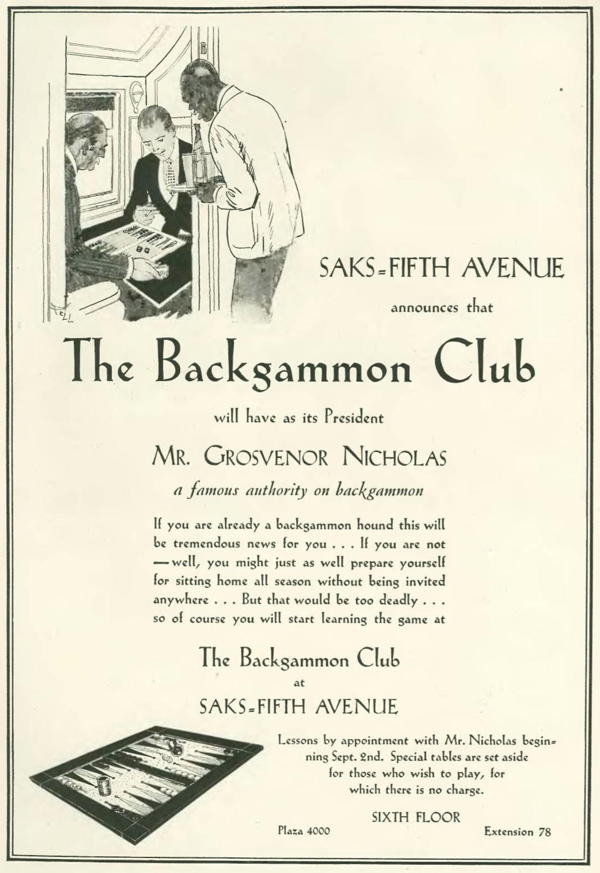
Two racehorses carried backgammon names in 1930
The New Yorker’s Talk of the Town column on September 6, 1930 finished its report on the game’s revival by mentioning two racehorses then running: Chouette and Backgammon. Their names are a small but vivid sign that backgammon language had entered fashionable popular culture beyond the board itself.
Image credit: The New Yorker; writer unidentified in the scan. Public domain in the United States (magazine page published in 1930). Source: https://nebackgammon.org/index.php/1930s_chronology/. Licence: https://creativecommons.org/publicdomain/mark/1.0/. Display, thumbnail and enlargement resized without cropping and JPEG encoded; EXIF orientation applied. The packaged enlargement is 400 × 548 pixels. No AI edits.
A newspaper advised learning backgammon to become popular
The Miami Daily News published an advice item on September 21, 1930 telling a socially uncertain young woman that becoming a local backgammon authority could make her popular. The suggestion reflects how lessons and lectures turned game knowledge into a fashionable social skill, especially for aspiring hostesses.

Image credit: Miami Daily News; advice columnist Chera Lee. Public domain in the United States (newspaper item published in 1930). Source: https://nebackgammon.org/index.php/1930s_chronology/. Licence: https://creativecommons.org/publicdomain/mark/1.0/. Display, thumbnail and enlargement resized without cropping and JPEG encoded; EXIF orientation applied. The packaged enlargement is 1200 × 264 pixels. No AI edits.
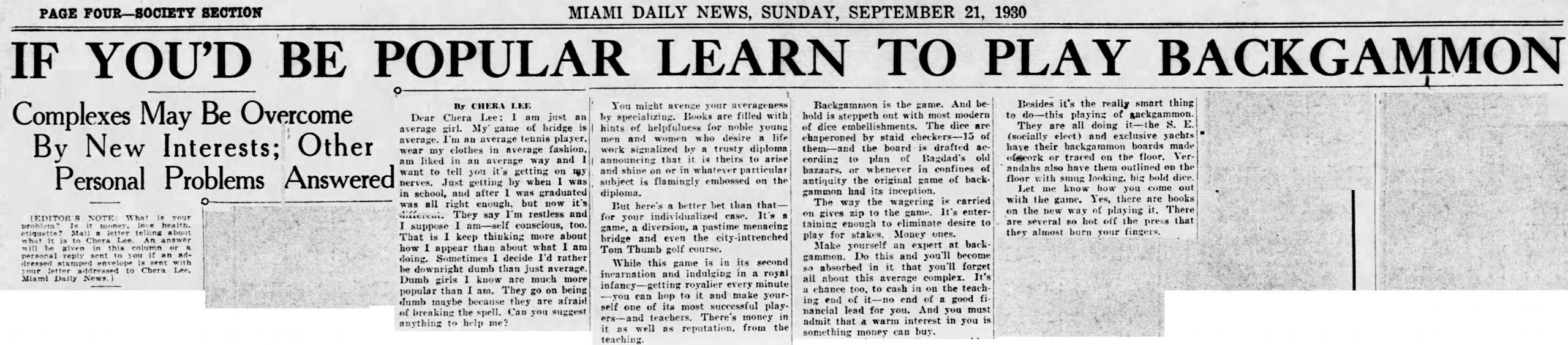
A newspaper predicted a vogue bigger than miniature golf
The Indianapolis Times reported on September 22, 1930 that backgammon threatened to become more widespread and contagious than miniature golf. That comparison placed the revived board game beside another major American leisure craze, showing how large editors expected the winter fashion to become.
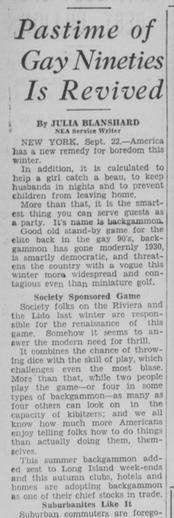
Image credit: The Indianapolis Times and NEA Service. Public domain in the United States (newspaper page published in 1930). Source: https://nebackgammon.org/index.php/1930s_chronology/. Licence: https://creativecommons.org/publicdomain/mark/1.0/. Display, thumbnail and enlargement resized without cropping and JPEG encoded; EXIF orientation applied. The packaged enlargement is 174 × 518 pixels. No AI edits.
Commuters played backgammon on the train
The Indianapolis Times reported on September 22, 1930 that suburban commuters were playing backgammon while travelling to work and home again. The detail puts the craze outside drawing rooms and clubs: a portable board could turn daily train time into a competitive social session.
Image credit: The Indianapolis Times and NEA Service. Public domain in the United States (newspaper page published in 1930). Source: https://nebackgammon.org/index.php/1930s_chronology/. Licence: https://creativecommons.org/publicdomain/mark/1.0/. Display, thumbnail and enlargement resized without cropping and JPEG encoded; EXIF orientation applied. The packaged enlargement is 174 × 518 pixels. No AI edits.
A backgammon game supposedly tested a new beau
The Indianapolis Times reported on September 22, 1930 that bringing out a backgammon board when a new young man visited was considered a way to judge both his intelligence and his social standing. The claim captures the game’s role as fashionable theatre as much as competition.
Image credit: A. G. Spalding photograph supplied to NEA Service; individual photographer unidentified. Public domain in the United States (newspaper photograph published in 1930). Source: https://nebackgammon.org/index.php/1930s_chronology/. Licence: https://creativecommons.org/publicdomain/mark/1.0/. Display, thumbnail and enlargement resized without cropping and JPEG encoded; EXIF orientation applied. The packaged enlargement is 690 × 1032 pixels. No AI edits.
The craze spread from boards to party tableware
The Indianapolis Times reported on September 22, 1930 that stores sold backgammon-themed linens, crepe-paper cloths, napkins, china, beverage sets and smoking accessories. Merchants were selling an entire party style around the game, allowing hosts to carry the board’s imagery into refreshments and room decorations.
Image credit: The Indianapolis Times and NEA Service. Public domain in the United States (newspaper page published in 1930). Source: https://nebackgammon.org/index.php/1930s_chronology/. Licence: https://creativecommons.org/publicdomain/mark/1.0/. Display, thumbnail and enlargement resized without cropping and JPEG encoded; EXIF orientation applied. The packaged enlargement is 174 × 518 pixels. No AI edits.
Bridge experts carried backgammon lessons beyond New York
The authors of Winning Backgammon at Sight came from bridge. Frank Elmer Bruelheide lectured on backgammon at Woodward & Lothrop in Washington, while co-author Freyd spoke at Marshall Field in Chicago during 1930. Their appearances show department-store instruction and game expertise spreading well beyond Manhattan.
Image credit: Pearson Scott Foresman. Public domain. Source: https://commons.wikimedia.org/wiki/File:Backgammon_%28PSF%29.jpg. Licence: https://creativecommons.org/publicdomain/mark/1.0/. Display, thumbnail and enlargement resized without cropping and JPEG encoded; EXIF orientation applied. Enlargement limited to 1400 pixels on its longest side, or source size if smaller. No AI edits.
Ring Lardner joked about the exhausted backgammon addict
The New Yorker published Ring Lardner’s Tables for Two on October 18, 1930. The satire teased Elizabeth Clark Boyden’s instructional book and pictured a chouette enthusiast waking irritable after an evening of mental strain. Backgammon had become familiar enough to the magazine’s readers to support a full comic essay.

Image credit: The New Yorker; cover artist unidentified. Public domain in the United States (magazine cover published in 1930). Source: https://nebackgammon.org/index.php/1930s_chronology/. Licence: https://creativecommons.org/publicdomain/mark/1.0/. Display, thumbnail and enlargement resized without cropping and JPEG encoded; EXIF orientation applied. The packaged enlargement is 500 × 718 pixels. No AI edits.
Party dresses were renamed backgammon frocks
During the 1930 holiday season, American advertisements called informal party dresses backgammon frocks. The Belleville News-Democrat and Chicago Tribune both carried examples on December 13, 1930. It was a marketing name rather than a new garment, attaching the season’s fashionable game to clothing for social evenings.

Image credit: Carson Pirie Scott; advertisement artist unidentified. Public domain in the United States (newspaper advertisement published in 1930). Source: https://nebackgammon.org/index.php/1930s_chronology/. Licence: https://creativecommons.org/publicdomain/mark/1.0/. Display, thumbnail and enlargement resized without cropping and JPEG encoded; EXIF orientation applied. The packaged enlargement is 499 × 1200 pixels. No AI edits.
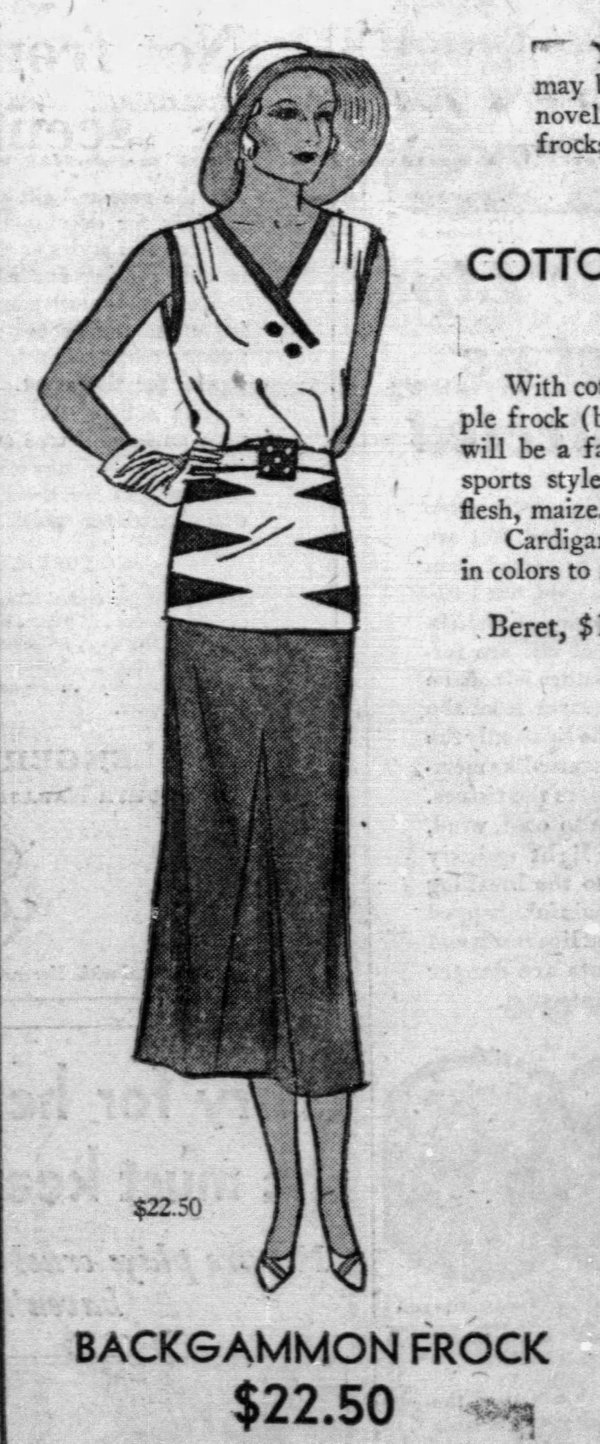
Black, red and white became backgammon colours
Fashion advertisements during 1930 sometimes promoted black, red and white as backgammon colours for dresses, hats or handbags. Those shades echoed common boards and checkers. The game’s visual identity had become recognisable enough for shops to sell a colour combination without putting an actual board in the outfit.

Image credit: Period fashion advertiser; artist unidentified. Public domain in the United States (advertising material published in 1930). Source: https://nebackgammon.org/index.php/1930s_chronology/. Licence: https://creativecommons.org/publicdomain/mark/1.0/. Display, thumbnail and enlargement resized without cropping and JPEG encoded; EXIF orientation applied. The packaged enlargement is 400 × 277 pixels. No AI edits.
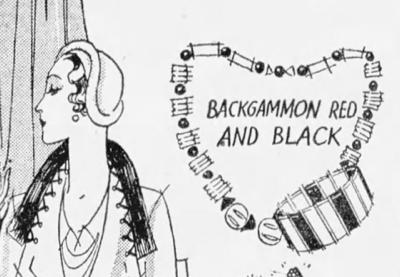
Backgammon patterns reached stockings and pyjamas
By Christmas 1930, designers were using board points, circular checkers and square dice as decorative shapes. Period advertising documented backgammon stockings, purses and pyjamas. These products show the craze moving beyond game equipment into gifts and clothing, where the board’s geometry became a fashionable pattern.
Image credit: Period fashion advertiser; artist unidentified. Public domain in the United States (advertising material published in 1930). Source: https://nebackgammon.org/index.php/1930s_chronology/. Licence: https://creativecommons.org/publicdomain/mark/1.0/. Display, thumbnail and enlargement resized without cropping and JPEG encoded; EXIF orientation applied. The packaged enlargement is 400 × 277 pixels. No AI edits.
St Louis society watched backgammon challenge bridge
The St. Louis Post-Dispatch reported on November 17, 1930 that backgammon had become the local rage. Its society feature described lessons, parties and the game’s spread from eastern resorts toward western cities, presenting the lively chouette as a fashionable challenge to bridge’s usual control of upper-class game nights.

Image credit: St. Louis Post-Dispatch; illustrator unidentified. Public domain in the United States (newspaper illustration published in 1930). Source: https://nebackgammon.org/index.php/1930s_chronology/. Licence: https://creativecommons.org/publicdomain/mark/1.0/. Display, thumbnail and enlargement resized without cropping and JPEG encoded; EXIF orientation applied. The packaged enlargement is 1021 × 1200 pixels. No AI edits.

A California club built giant beach backgammon
The New York Journal-American reported on December 12, 1930 that members of Santa Monica’s Miramar Club had created beachside backgammon. Photographs show a huge cloth board, cushion-like checkers, oversized dice and long croupier sticks, turning a tabletop game into a spectator event at a fashionable resort.
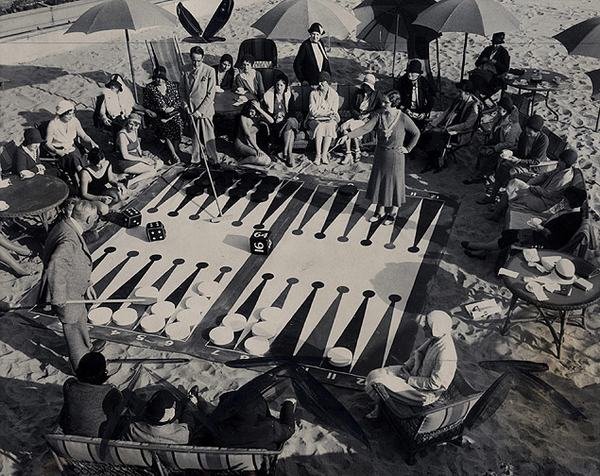
Image credit: New York Journal-American; photographer unidentified. Public domain in the United States (newspaper photograph published in 1930). Source: https://nebackgammon.org/index.php/1930s_chronology/. Licence: https://creativecommons.org/publicdomain/mark/1.0/. Display, thumbnail and enlargement resized without cropping and JPEG encoded; EXIF orientation applied. The packaged enlargement is 635 × 504 pixels. No AI edits.
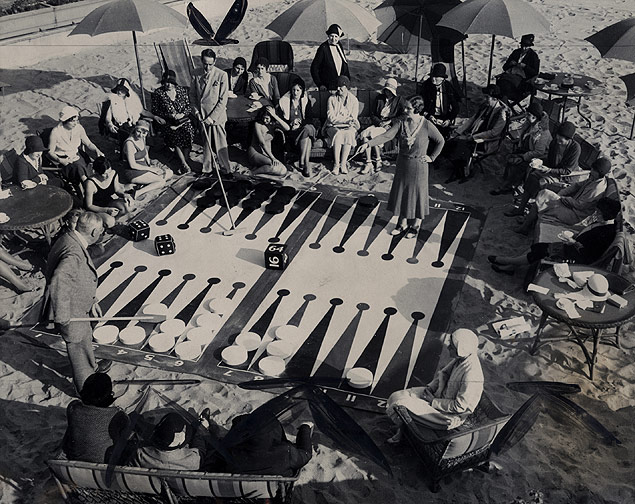
New York offered backgammon lessons at luxury prices
The New Yorker’s December 13, 1930 print issue listed Grosvenor Nicholas’s lessons at the Saks Backgammon Club for $20 an hour and associate instructors at $10. Uninstructed use of the club’s tables and boards was free, so the store combined paid expertise with a place for shoppers to play.
Image credit: Saks-Fifth Avenue; advertisement artist unidentified. Public domain in the United States (magazine advertisement published in 1930). Source: https://nebackgammon.org/index.php/1930s_chronology/. Licence: https://creativecommons.org/publicdomain/mark/1.0/. Display, thumbnail and enlargement resized without cropping and JPEG encoded; EXIF orientation applied. The packaged enlargement is 600 × 873 pixels. No AI edits.
Sources and licence: Source 1 · Source 2 · Source 3 · Source 4
A mermaid and rank badges decorated naval play
This early twentieth-century Acey-Deucey board is more than playing equipment. Its canvas design includes a mermaid, seahorse, compass rose, officers’ rank signs and enlisted rating badges. The decoration turns a backgammon relative into a compact picture of U.S. Navy identity.
Image credit: Naval History & Heritage Command. CC BY 2.0. Source: https://commons.wikimedia.org/wiki/File:Acey-Duecey_Board_(22870733353).jpg. Licence: https://creativecommons.org/licenses/by/2.0/. Display, thumbnail and enlargement resized without cropping and JPEG encoded; EXIF orientation applied. The packaged enlargement is 1200 × 925 pixels. No AI edits.
Four WAVES played Acey-Deucey in 1943
An official U.S. Navy photograph dated 1 September 1943 shows four members of the WAVES playing Acey-Deucey in their quarters. The archive names Vera Hoffman, Harriet Slottee, Pollyanna Persons and Emma Rose Higgs, preserving an unusually specific glimpse of wartime recreation.

Image credit: U.S. Navy; National Museum of the U.S. Navy. Public domain (U.S. Navy work). Source: https://commons.wikimedia.org/wiki/File:80-G-211163_(23700158089).jpg. Licence: https://creativecommons.org/publicdomain/mark/1.0/. Display, thumbnail and enlargement resized without cropping and JPEG encoded; EXIF orientation applied. The packaged enlargement is 1200 × 942 pixels. No AI edits.

Backgammon travelled aboard the USS Wisconsin
A U.S. Navy photograph shows Chief Quartermaster Roy F. Zumberge and Chief Water Tender Donald G. Howdeshell playing backgammon aboard the battleship USS Wisconsin during a Caribbean training cruise. The picture records the game as an off-duty activity at sea.

Image credit: U.S. Navy; contributed by Hennepin County Library via DPLA. Public domain (U.S. Navy work). Source: https://commons.wikimedia.org/wiki/File:Roy_F._Zumberge_with_Donald_G._Howdeshell_-_DPLA_-_956aef96633d2cd8c7008f0d997a963e.jpg. Licence: https://creativecommons.org/publicdomain/mark/1.0/. Display, thumbnail and enlargement resized without cropping and JPEG encoded; EXIF orientation applied. The packaged enlargement is 960 × 694 pixels. No AI edits.

Backgammon filled breaks between artillery manoeuvres
A 1969 Israel Press and Photo Agency series shows soldiers enjoying backgammon between artillery manoeuvres in Sinai, near the Suez Canal. The National Library of Israel preserved the 35 mm black-and-white photographs, turning a short break in military training into documented game history.

Image credit: Israel Press and Photo Agency photographer / Dan Hadani collection / National Library of Israel. CC BY 4.0. Source: https://commons.wikimedia.org/wiki/File:Dan_Hadani_collection_(990044374440205171).jpg. Licence: https://creativecommons.org/licenses/by/4.0/. Display, thumbnail and enlargement resized without cropping and JPEG encoded; EXIF orientation applied. The packaged enlargement is 1200 × 744 pixels. No AI edits.

Sports Illustrated carried the Bahamas story
Sports Illustrated published Edwin Shrake’s feature about the first Bahamas tournament on 3 May 1964. Its resort scenes, personalities, money and match details presented backgammon as a spectator event and fashionable social gathering, not simply a board hidden at home.
Image credit: Daderot. CC0 1.0. Source: https://commons.wikimedia.org/wiki/File:Box_for_playing_backgammon_or_chess%2C_probably_Syria_or_Egypt%2C_late_19th_century%2C_wood%2C_wood_veneers%2C_bone%2C_and_mother_of_pearl_inlay_-_Royal_Ontario_Museum_-_DSC04771.JPG. Licence: https://creativecommons.org/publicdomain/zero/1.0/. Display, thumbnail and enlargement resized without cropping and JPEG encoded; EXIF orientation applied. Enlargement limited to 1400 pixels on its longest side, or source size if smaller. No AI edits.
A 1922 newsreel preserved backgammon on film
Issue four of the Soviet newsreel Kino-Pravda, released on 1 July 1922 and directed by Dziga Vertov, includes backgammon among its scenes of public life. A surviving public-domain copy turns the game into moving social history rather than another still photograph or printed rulebook.

Image credit: All-Russia Photo-Kino Department; directed by Dziga Vertov. Public domain. Source: https://commons.wikimedia.org/wiki/File:1922._Kino-Pravda_04.ogv. Licence: https://creativecommons.org/publicdomain/mark/1.0/. Display, thumbnail and enlargement resized without cropping and JPEG encoded; EXIF orientation applied. The packaged enlargement is 500 × 366 pixels. No AI edits.
The opening dinner postponed the tournament
At the 1964 Grand Bahama tournament, the auction pool and dinner party raised US$15,425 and continued beyond midnight. Sports Illustrated reported that play scheduled for opening night was postponed until the following afternoon. Social events were built into the tournament from the start.
Image credit: Daderot. CC0 1.0. Source: https://commons.wikimedia.org/wiki/File:Box_for_playing_backgammon_or_chess%2C_probably_Syria_or_Egypt%2C_late_19th_century%2C_wood%2C_wood_veneers%2C_bone%2C_and_mother_of_pearl_inlay_-_Royal_Ontario_Museum_-_DSC04771.JPG. Licence: https://creativecommons.org/publicdomain/zero/1.0/. Display, thumbnail and enlargement resized without cropping and JPEG encoded; EXIF orientation applied. Enlargement limited to 1400 pixels on its longest side, or source size if smaller. No AI edits.
Obolensky promoted backgammon with a three-part plan
The U.S. Backgammon Federation says Alexis Obolensky combined three ideas: build a tournament circuit, attract glamorous public figures and reach ordinary people through the media. That plan explains why the 1960s revival linked organised competition, celebrity appearances and magazine coverage so closely.

Image credit: ABC Television. Public domain in the United States (published without copyright notice). Source: https://commons.wikimedia.org/wiki/File:Hugh_Hefner_1966.jpg. Licence: https://creativecommons.org/publicdomain/mark/1.0/. Display, thumbnail and enlargement resized without cropping and JPEG encoded; EXIF orientation applied. The packaged enlargement is 547 × 703 pixels. No AI edits.

A 1970 photograph placed backgammon at a Sinai stronghold
Israeli photojournalist Boris Carmi photographed soldiers at a Sinai artillery stronghold on 7 April 1970. Wikimedia Commons catalogues the scene under people playing backgammon. The black-and-white image shows how a board game could fill quiet moments in a tense military setting.

Image credit: Boris Carmi / Meitar Collection / National Library of Israel / Pritzker Family National Photography Collection. CC BY 4.0. Source: https://commons.wikimedia.org/wiki/File:Sinai_997009324973605171.jpg. Licence: https://creativecommons.org/licenses/by/4.0/. Display, thumbnail and enlargement resized without cropping and JPEG encoded; EXIF orientation applied. The packaged enlargement is 500 × 807 pixels. No AI edits.

Village cafés became informal backgammon rooms
Around 1970, New York mathematicians and games players gathered for small-stakes chouettes at Greenwich Village places including the Olive Tree Café and Singapore Sam’s. This lively café scene helped move serious play outside the older private-club world.
Image credit: Liz Cooke. CC BY-SA 3.0. Source: https://commons.wikimedia.org/wiki/File:Backgammon_Players%2C_Brighton_Beach%2C_Brooklyn_2012.jpg. Licence: https://creativecommons.org/licenses/by-sa/3.0/. Display, thumbnail and enlargement resized without cropping and JPEG encoded; EXIF orientation applied. Enlargement limited to 1400 pixels on its longest side, or source size if smaller. No AI edits.
Hugh Hefner gave backgammon magazine glamour
Robertie dates Hugh Hefner’s adoption of backgammon to 1970. Playboy then showed professionals and celebrities playing chouettes at the mansion. Whatever readers thought of the surrounding glamour, the magazine put the game before a huge new audience.
Image credit: ABC Television. Public domain in the United States (published without copyright notice). Source: https://commons.wikimedia.org/wiki/File:Hugh_Hefner_1966.jpg. Licence: https://creativecommons.org/publicdomain/mark/1.0/. Display, thumbnail and enlargement resized without cropping and JPEG encoded; EXIF orientation applied. The packaged enlargement is 547 × 703 pixels. No AI edits.
Mansion chouettes could run until breakfast
Lewis Deyong remembered US$50-per-point chouettes at Playboy Mansion West during the game’s boom. Play often continued until nearly eight in the morning. His account places backgammon at the centre of a long social evening rather than as a brief party diversion.
Image credit: Glenn Francis (User:Toglenn), www.PacificProDigital.com. CC BY-SA 3.0. Source: https://commons.wikimedia.org/wiki/File:Playboy_Mansion_North_Side_2007.jpg. Licence: https://creativecommons.org/licenses/by-sa/3.0/. Display, thumbnail and enlargement resized without cropping and JPEG encoded; EXIF orientation applied. The packaged enlargement is 1200 × 800 pixels. No AI edits.
A mansion game led to a Playboy book
After watching Lewis Deyong play at the mansion, Hugh Hefner asked him to write a backgammon book. Playboy’s Book of Backgammon followed with a foreword by Hefner. Deyong also links Playboy ownership of London’s Clermont Club with years of prominent tournaments there.
Image credit: Glenn Francis (User:Toglenn), www.PacificProDigital.com. CC BY-SA 3.0. Source: https://commons.wikimedia.org/wiki/File:Playboy_Mansion_North_Side_2007.jpg. Licence: https://creativecommons.org/licenses/by-sa/3.0/. Display, thumbnail and enlargement resized without cropping and JPEG encoded; EXIF orientation applied. The packaged enlargement is 1200 × 800 pixels. No AI edits.
Playboy sent boards to veterans’ hospitals
Time reported in February 1973 that Playboy was sending Bunnies to several veterans’ hospitals with backgammon boards and instructions. The promotion was part of Obolensky’s effort to move the game beyond fashionable clubs and introduce it to a broader public.
Image credit: ABC Television. Public domain in the United States (published without copyright notice). Source: https://commons.wikimedia.org/wiki/File:Hugh_Hefner_1966.jpg. Licence: https://creativecommons.org/publicdomain/mark/1.0/. Display, thumbnail and enlargement resized without cropping and JPEG encoded; EXIF orientation applied. The packaged enlargement is 547 × 703 pixels. No AI edits.
A drinks company backed the tournament campaign
Time’s 1973 account said Seagram Distillers sponsored backgammon tournaments and paid Prince Alexis Obolensky consulting fees. Commercial sponsorship helped turn a private-club pastime into organised entertainment with promotion, venues and a schedule of resort events.
Image credit: Daderot. CC0 1.0. Source: https://commons.wikimedia.org/wiki/File:Box_for_playing_backgammon_or_chess%2C_probably_Syria_or_Egypt%2C_late_19th_century%2C_wood%2C_wood_veneers%2C_bone%2C_and_mother_of_pearl_inlay_-_Royal_Ontario_Museum_-_DSC04771.JPG. Licence: https://creativecommons.org/publicdomain/zero/1.0/. Display, thumbnail and enlargement resized without cropping and JPEG encoded; EXIF orientation applied. Enlargement limited to 1400 pixels on its longest side, or source size if smaller. No AI edits.
A New York club drew three hundred regular players
A 1977 New York Times News Service report said about 300 people regularly visited the Mayfair Bridge and Game Club on East 57th Street. Players described backgammon as a mix of relaxation, excitement, gambling and analysis, showing how city clubs turned the boom into an everyday community.
Image credit: Liz Cooke. CC BY-SA 3.0. Source: https://commons.wikimedia.org/wiki/File:Backgammon_Players%2C_Brighton_Beach%2C_Brooklyn_2012.jpg. Licence: https://creativecommons.org/licenses/by-sa/3.0/. Display, thumbnail and enlargement resized without cropping and JPEG encoded; EXIF orientation applied. Enlargement limited to 1400 pixels on its longest side, or source size if smaller. No AI edits.
Mayfair settled games without cash on the table
At New York’s Mayfair club in 1977, members charged food, table fees, winnings and losses to club accounts, so money did not change hands beside the board. The club checked a member’s bank standing first. Its system made high-stakes play look like an organised private service.
Image credit: Liz Cooke. CC BY-SA 3.0. Source: https://commons.wikimedia.org/wiki/File:Backgammon_Players%2C_Brighton_Beach%2C_Brooklyn_2012.jpg. Licence: https://creativecommons.org/licenses/by-sa/3.0/. Display, thumbnail and enlargement resized without cropping and JPEG encoded; EXIF orientation applied. Enlargement limited to 1400 pixels on its longest side, or source size if smaller. No AI edits.
Bar Point offered an alternative to the bar scene
The Bar Point House of Backgammon opened on West 14th Street in 1976 and had about 300 members by the following year. A director told the New York Times News Service that the homelike club gave people a place to play, read, watch television and meet others.
Image credit: Liz Cooke. CC BY-SA 3.0. Source: https://commons.wikimedia.org/wiki/File:Backgammon_Players%2C_Brighton_Beach%2C_Brooklyn_2012.jpg. Licence: https://creativecommons.org/licenses/by-sa/3.0/. Display, thumbnail and enlargement resized without cropping and JPEG encoded; EXIF orientation applied. Enlargement limited to 1400 pixels on its longest side, or source size if smaller. No AI edits.
Four players share one engraved table
A historical engraving in the Wellcome Collection shows two men and two women seated around a board with counters and dice. The catalogue does not call the game modern backgammon, so the safest reading is a social tables-game scene in which the equipment and company are both part of the subject.
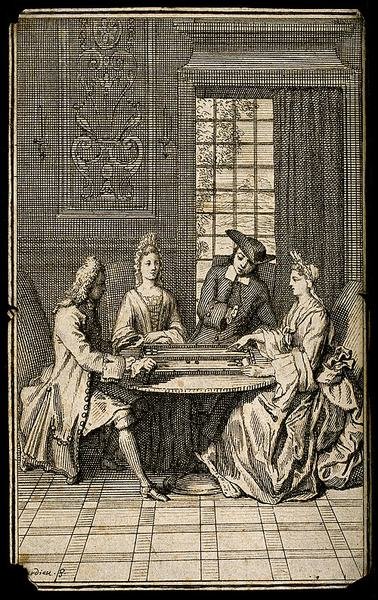
Image credit: Wellcome Library, London. CC BY 4.0. Source: https://commons.wikimedia.org/wiki/File:Two_men_and_two_women_sit_at_a_table_playing_a_board_game_wi_Wellcome_V0040234.jpg. Licence: https://creativecommons.org/licenses/by/4.0/deed.en. Display, thumbnail and enlargement resized without cropping and JPEG encoded; EXIF orientation applied. The packaged enlargement is 500 × 794 pixels. No AI edits.

Officers make trictrac the centre of the room
Reinier de la Haye's painting shows officers playing tricktrack, a historical tables game. De la Haye worked in the later seventeenth century, and the board anchors a carefully staged indoor gathering. The title identifies trictrac, but it does not establish that the players followed the rules of modern backgammon.
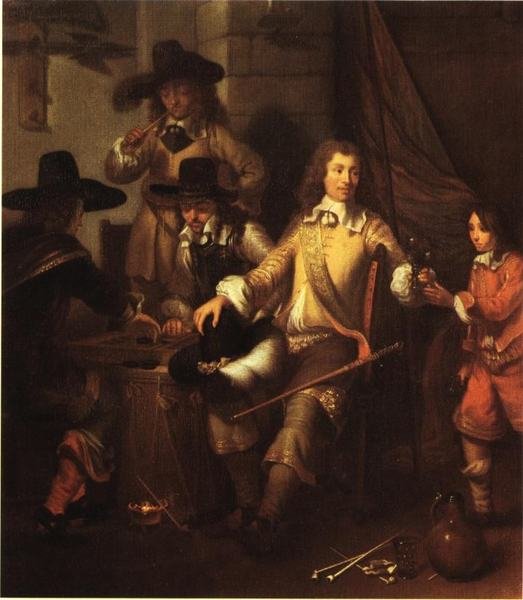
Image credit: Reinier de la Haye ( fl . 1660–1695). Public domain. Source: https://commons.wikimedia.org/wiki/File:Reinier_de_la_Haye_-_Tricktrackspielende_Offiziere.jpg. Licence: https://creativecommons.org/publicdomain/mark/1.0/. Display, thumbnail and enlargement resized without cropping and JPEG encoded; EXIF orientation applied. The packaged enlargement is 681 × 782 pixels. No AI edits.

A 1677 inn scene survives as a drawing
Jan de Groot's Farmers Playing Backgammon in an Inn was published in 1677 and is preserved by Leiden University Libraries. The record also traces the sheet through a 1933 Utrecht sale before its later purchase for the Print Room, giving this game scene a documented collecting history as well as a subject.

Image credit: Groot, Jan de (1650-1726). CC BY 4.0. Source: https://commons.wikimedia.org/wiki/File:Farmers_playing_backgammon_in_an_inn_PK-T-AW-510,_PK-T-AW-540.tiff. Licence: https://creativecommons.org/licenses/by/4.0/deed.en. Display, thumbnail and enlargement resized without cropping and JPEG encoded; EXIF orientation applied. The packaged enlargement is 960 × 522 pixels. No AI edits.
A Persian manuscript places play beside poetry
An early-sixteenth-century page from the Divan of Hatayi shows men playing a tables game. The manuscript is British Library MS Oriental 11388, folio 17. Its catalogue title calls the scene backgammon, but the image should be read as evidence of period game culture rather than modern rules.
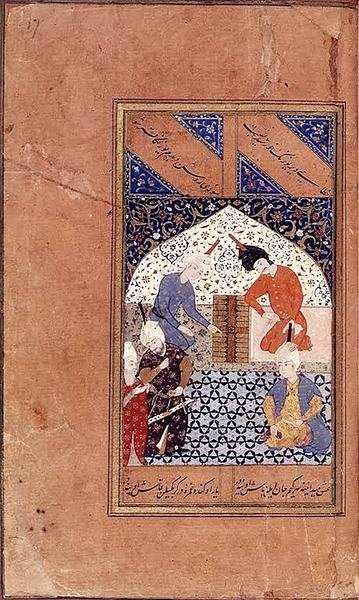
Image credit: Unknown sixteenth-century manuscript artist. Public domain. Source: https://commons.wikimedia.org/wiki/File:Men_playing_backgammon._Divan_of_Hatayi._Ms._Or._11388,_fol._17,_London,_British_Library.jpg. Licence: https://creativecommons.org/publicdomain/mark/1.0/. Display, thumbnail and enlargement resized without cropping and JPEG encoded; EXIF orientation applied. The packaged enlargement is 500 × 835 pixels. No AI edits.

Auvrest redrew a trictrac scene after Teniers
This pen drawing is titled Players of Trictrac and credits Auvrest as the draughtsman working after Teniers. The phrase after Teniers matters: it says the composition follows another artist's design. The sheet therefore records both a tables-game scene and the way game imagery travelled through copies and reinterpretations.
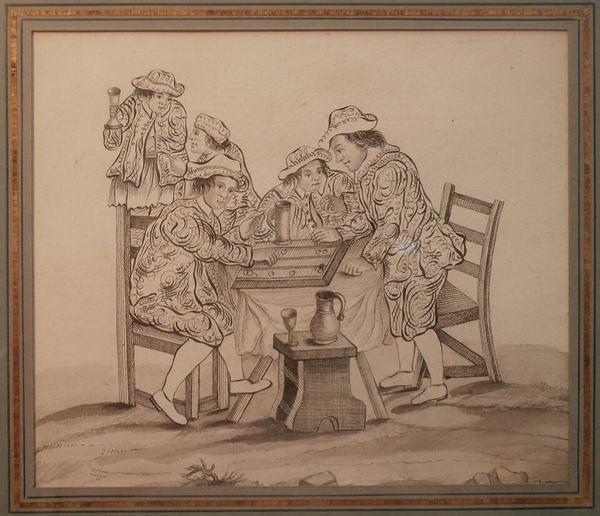
Image credit: Auvrest. Public domain. Source: https://commons.wikimedia.org/wiki/File:Auvrest2.JPG. Licence: https://creativecommons.org/publicdomain/mark/1.0/. Display, thumbnail and enlargement resized without cropping and JPEG encoded; EXIF orientation applied. The packaged enlargement is 960 × 826 pixels. No AI edits.

A soldier meets peasants across a trictrac board
Christoffel Jacobsz van der Laemen painted a soldier playing tric-a-trac with peasants in a tavern around 1650. The mixed company and tavern setting make the board a social meeting point. Trictrac belongs to the wider tables family, so the scene should not be labelled a modern backgammon match.

Image credit: Christoffel Jacobsz van der Laemen (1606/1615–1651). Public domain. Source: https://commons.wikimedia.org/wiki/File:Christoffel_Jacobsz._van_der_Lamen_-_A_soldier_playing_tric-a-trac_with_peasants_in_a_tavern.jpg. Licence: https://creativecommons.org/publicdomain/mark/1.0/. Display, thumbnail and enlargement resized without cropping and JPEG encoded; EXIF orientation applied. The packaged enlargement is 960 × 708 pixels. No AI edits.

Thomas Hyde pictured Coan Ki in 1694
Thomas Hyde included this illustration of Coan Ki, which he called ludus erectus, in a 1694 work on Eastern games. Stewart Culin later reprinted it in 1889. Its long narrow tracks differ from a standard backgammon layout, making the image useful evidence for the variety within historical race-game traditions.

Image credit: Thomas Hyde. Public domain. Source: https://commons.wikimedia.org/wiki/File:Coanki.tiff. Licence: https://creativecommons.org/publicdomain/mark/1.0/. Display, thumbnail and enlargement resized without cropping and JPEG encoded; EXIF orientation applied. The packaged enlargement is 330 × 320 pixels. No AI edits.
Herat painters paired chess with a tables game
A manuscript image made at the court of Baysunghur in Herat in 1427 presents chess and a tables-family game together. The pairing shows two elite board games within one visual programme. The source calls the second game backgammon, but a fifteenth-century picture cannot by itself prove today's complete rule set.

Image credit: 1427 painter, Herat. Public domain. Source: https://commons.wikimedia.org/wiki/File:The_games_of_Backgammon_and_Chess._Herat_1427_(court_of_Baysunghur).jpg. Licence: https://creativecommons.org/publicdomain/mark/1.0/. Display, thumbnail and enlargement resized without cropping and JPEG encoded; EXIF orientation applied. The packaged enlargement is 500 × 770 pixels. No AI edits.

An 1878 plate used the label Aztec backgammon
An illustration published in 1878 or 1879 carries the historical caption Aztec backgammon game. That wording records how a nineteenth-century publication classified the pictured board. It should not be treated as proof that the Aztec game was identical to modern backgammon; the value lies in the period label and diagram.

Image credit: Unknown author. Public domain. Source: https://commons.wikimedia.org/wiki/File:PSM_V14_D512_Aztec_backgammon_game.jpg. Licence: https://creativecommons.org/publicdomain/mark/1.0/. Display, thumbnail and enlargement resized without cropping and JPEG encoded; EXIF orientation applied. The packaged enlargement is 1196 × 1200 pixels. No AI edits.

A dice emblem entered a devotional book
The emblem Nec alea fallit appeared in Henricus Muller's devotional book Geistlicher Danck-Altar, printed in Frankfurt in 1670. Its title translates roughly as the die does not deceive. The print shows how gaming imagery could carry a moral or religious message far beyond the practical setting of a game table.
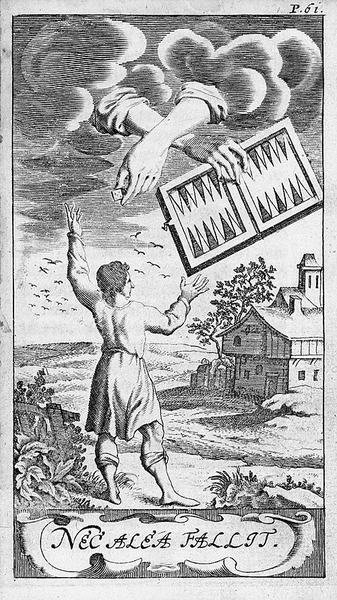
Image credit: Unknown author. Public domain. Source: https://commons.wikimedia.org/wiki/File:Nec_alea_fallit.jpg. Licence: https://creativecommons.org/publicdomain/mark/1.0/. Display, thumbnail and enlargement resized without cropping and JPEG encoded; EXIF orientation applied. The packaged enlargement is 500 × 891 pixels. No AI edits.

Aldegrever linked idleness with games
Heinrich Aldegrever's 1549 engraving Socordia presents a standing woman with playing cards and a tables board. Socordia means sloth or idleness, so the gaming objects help build an allegory rather than document a particular match. The image shows how early-modern artists could use a familiar board as a moral symbol.

Image credit: Heinrich Aldegrever (1502–). Public domain. Source: https://commons.wikimedia.org/wiki/File:Aldegrever,_Heinrich_%E2%80%94_Socordia_%E2%80%94_1549.jpg. Licence: https://creativecommons.org/publicdomain/mark/1.0/. Display, thumbnail and enlargement resized without cropping and JPEG encoded; EXIF orientation applied. The packaged enlargement is 500 × 695 pixels. No AI edits.

A Polish games book printed a compact board diagram
Antoni Stefanski's Polish book Gry umyslowe, published in 1899, included this small printed tables-board diagram on page 21. Its black-and-white design reduces the board, dice and checkers to clear marks suitable for inexpensive printing. The page is evidence of how game instruction circulated visually before colour photography.

Image credit: Stefański, Antoni (1865-1929). Public domain. Source: https://commons.wikimedia.org/wiki/File:Antoni_Stefa%C5%84ski_-_Gry_umys%C5%82owe_page21_1.jpg. Licence: https://creativecommons.org/publicdomain/mark/1.0/. Display, thumbnail and enlargement resized without cropping and JPEG encoded; EXIF orientation applied. The packaged enlargement is 704 × 385 pixels. No AI edits.

Alfonso's book imagined astronomical tables
Folio 97 verso of Alfonso X's 1283 Libro de los juegos depicts the game of astronomical tables. The circular, zodiac-like design is very different from a modern backgammon board. It belongs to the manuscript's broader exploration of games, astronomy and chance, and should not be presented as a standard backgammon position.

Image credit: Alfonso X of Castile and Leon (1221–1284). Public domain. Source: https://commons.wikimedia.org/wiki/File:Alfonso_LJ_97V.jpg. Licence: https://creativecommons.org/publicdomain/mark/1.0/. Display, thumbnail and enlargement resized without cropping and JPEG encoded; EXIF orientation applied. The packaged enlargement is 960 × 1082 pixels. No AI edits.

Shin Yun-bok painted double-six play outdoors
A painting attributed to Korean artist Shin Yun-bok shows people playing ssangnyuk, or double sixes, outdoors with gisaeng companions. The work is thought to date from after 1805 and belongs to the Hyewon genre-painting album. Ssangnyuk is a historical tables game, not simply another name for modern backgammon.
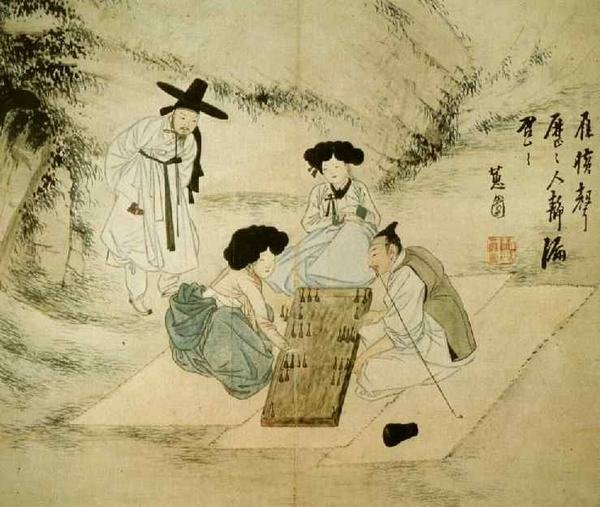
Image credit: 혜원 신윤복 (申潤福: 1758-19세기 초반). Public domain. Source: https://commons.wikimedia.org/wiki/File:Hyewon-Ssanguk.sammae.jpg. Licence: https://creativecommons.org/publicdomain/mark/1.0/. Display, thumbnail and enlargement resized without cropping and JPEG encoded; EXIF orientation applied. The packaged enlargement is 1200 × 1013 pixels. No AI edits.

A 1715 treatise opened with trictrac imagery
This engraving is a fragment of the frontispiece to a trictrac treatise published by Charpentier in 1715. Tardieu made the print. A frontispiece introduced readers to the book visually before the rules began, showing that tables-game instruction was packaged with artwork as well as text three centuries ago.
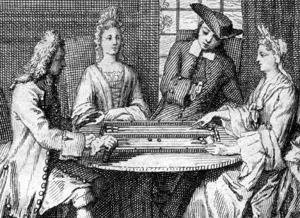
Image credit: Tardieu; scan by Philippe Lalanne. Public domain. Source: https://commons.wikimedia.org/wiki/File:Trictrac.jpg. Licence: https://creativecommons.org/publicdomain/mark/1.0/. Display, thumbnail and enlargement resized without cropping and JPEG encoded; EXIF orientation applied. The packaged enlargement is 300 × 218 pixels. No AI edits.

One Japanese print gathered three board games
Torii Kiyonaga's print from about 1780 brings shogi, go and ban-sugoroku into one scene. Ban-sugoroku is a Japanese tables-family game played with dice and checkers. Placing it beside two other major games records a varied culture of indoor play without claiming that its rules matched modern backgammon.
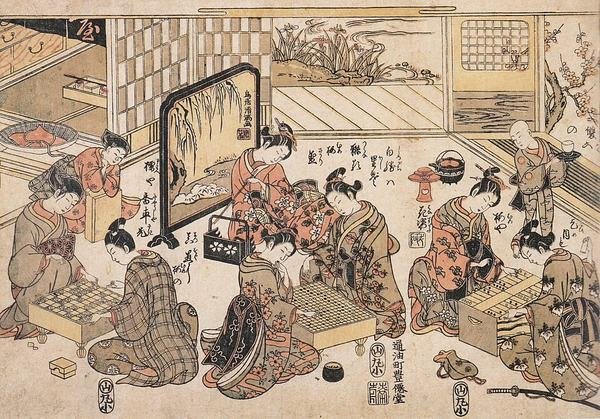
Image credit: Torii Kiyonaga (1752–1815). Public domain. Source: https://commons.wikimedia.org/wiki/File:3_Brettspiele.jpg. Licence: https://creativecommons.org/publicdomain/mark/1.0/. Display, thumbnail and enlargement resized without cropping and JPEG encoded; EXIF orientation applied. The packaged enlargement is 960 × 670 pixels. No AI edits.

The Luttrell Psalter pictured a medieval trictrac game
A page from the Luttrell Psalter, made around 1325 to 1335, includes people at a trictrac board. The manuscript image places a tables game inside a richly illustrated devotional book. It records medieval visual culture, but the pointed board alone cannot establish that the players used every rule of modern backgammon.

Image credit: Anonymous scribes and artists of the Luttrell Psalter. Public domain. Source: https://commons.wikimedia.org/wiki/File:Luttrell1.jpg. Licence: https://creativecommons.org/publicdomain/mark/1.0/. Display, thumbnail and enlargement resized without cropping and JPEG encoded; EXIF orientation applied. The packaged enlargement is 500 × 613 pixels. No AI edits.

Buzurgmihr teaches nard in a royal manuscript
A fourteenth-century manuscript painting shows the sage Buzurgmihr demonstrating nard to Indian rulers. The image visualises a famous Persian story about the game's explanation and courtly exchange. Nard is an ancestor within the tables family, so the scene belongs to backgammon's wider history without depicting the modern game exactly.
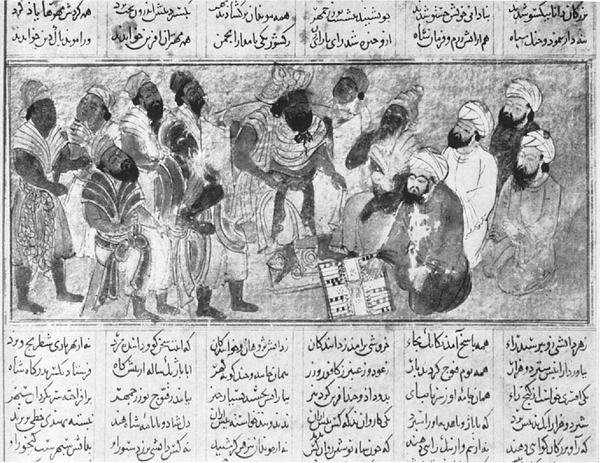
Image credit: Unknown author. Public domain. Source: https://commons.wikimedia.org/wiki/File:Buzurgmihr-nard.jpg. Licence: https://creativecommons.org/publicdomain/mark/1.0/. Display, thumbnail and enlargement resized without cropping and JPEG encoded; EXIF orientation applied. The packaged enlargement is 960 × 740 pixels. No AI edits.

A 1908 catalogue preserved De Hooch's trictrac room
A 1908 auction catalogue reproduced Pieter de Hooch's The Tric-Trac Players. Its text describes well-to-do Dutch men drinking and watching play in a cool interior, with sunlit buildings beyond the window. The scan preserves both a historical game painting and the way dealers described it for sale centuries later.

Image credit: Pieter de Hooch; scan via Internet Archive Book Images. Public domain. Source: https://commons.wikimedia.org/wiki/File:De_luxe_catalogue_of_notable_paintings_by_Masters_of_the_Early_English,_Dutch,_Flemish_and_French_schools_-_consigned_by_T.J._Blakeslee,_to_be_sold_at_unrestricted_public_sale_at_Mendelssohn_Hall_on_(14776224612).jpg. Licence: https://creativecommons.org/publicdomain/mark/1.0/. Display, thumbnail and enlargement resized without cropping and JPEG encoded; EXIF orientation applied. The packaged enlargement is 960 × 694 pixels. No AI edits.

Seis, dos y as received its own manuscript page
Folio 75 verso of Alfonso X's 1283 Libro de los juegos illustrates the game seis, dos, y as. Its name means six, two and ace, linking play to particular dice values. This is a named medieval tables game from the manuscript, not a diagram of the standard modern backgammon opening.

Image credit: Alfonso X of Castile and Leon (1221–1284). Public domain. Source: https://commons.wikimedia.org/wiki/File:Alfonso-seis-dos-as.jpg. Licence: https://creativecommons.org/publicdomain/mark/1.0/. Display, thumbnail and enlargement resized without cropping and JPEG encoded; EXIF orientation applied. The packaged enlargement is 519 × 388 pixels. No AI edits.

A drawing records an inn game and an attribution debate
Leiden University Libraries catalogues this inn interior as the work of an artist in Adriaen van Ostade's circle. The record notes that Hendrick Martensz Sorgh has also been suggested. That cautious attribution is part of the object's history, while the table inscription and gathered farmers make the tables-game subject clear.
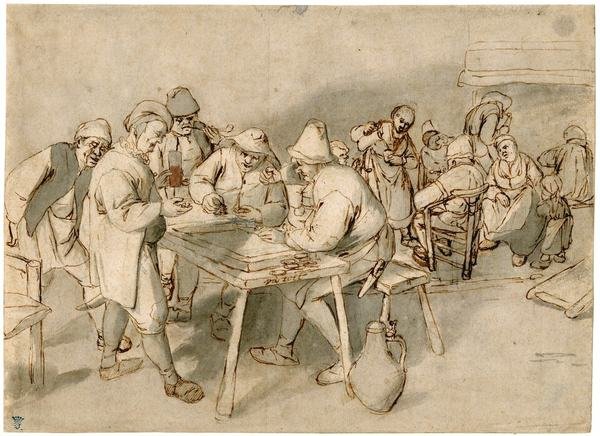
Image credit: Ostade, Adriaen van (circle of). CC BY 4.0. Source: https://commons.wikimedia.org/wiki/File:Interior_of_an_inn_with_farmers_playing_backgammon_(verso_One_of_the_figures_repeated)_PK-T-AW-526,_PK-T-AW-1083.tiff. Licence: https://creativecommons.org/licenses/by/4.0/deed.en. Display, thumbnail and enlargement resized without cropping and JPEG encoded; EXIF orientation applied. The packaged enlargement is 960 × 697 pixels. No AI edits.
Court ladies play double-sixes on silk
Court Ladies Playing Double-sixes is attributed to Zhou Fang, who lived around 730 to 810. The surviving work is ink and colour on silk and measures about 30.5 by 69.1 centimetres. Double-sixes is a historical tables game; the painting is cultural evidence, not a modern backgammon lesson.

Image credit: Zhou Fang (730–810). Public domain. Source: https://commons.wikimedia.org/wiki/File:Zhou_Fang._Court_Ladies_Playing_Double-sixes._Freer_Gallery_of_Art.jpg. Licence: https://creativecommons.org/publicdomain/mark/1.0/. Display, thumbnail and enlargement resized without cropping and JPEG encoded; EXIF orientation applied. The packaged enlargement is 960 × 434 pixels. No AI edits.

A 1907 page recorded Ottoman gaming numbers
V. H. Hagopian's 1907 publication printed the number words used for backgammon and dominoes in Ottoman Turkish. The page combines several scripts with numerical meanings. Its source notes that related terms continued across former Ottoman regions, making the image a record of spoken gaming culture as well as printed language.

Image credit: V. H. Hagopian. Public domain. Source: https://commons.wikimedia.org/wiki/File:Backgammon_and_Dominos_numbers_in_Ottoman_Turkish,_1907.jpg. Licence: https://creativecommons.org/publicdomain/mark/1.0/. Display, thumbnail and enlargement resized without cropping and JPEG encoded; EXIF orientation applied. The packaged enlargement is 960 × 776 pixels. No AI edits.

Two women play laquet in Alfonso's book
An illustration from folio 78 verso of Alfonso X's 1283 Libro de los juegos shows two women playing laquet. The manuscript is held at El Escorial near Madrid. Laquet belongs to the medieval tables family, so the scene should be named precisely instead of being relabelled as a modern backgammon match.
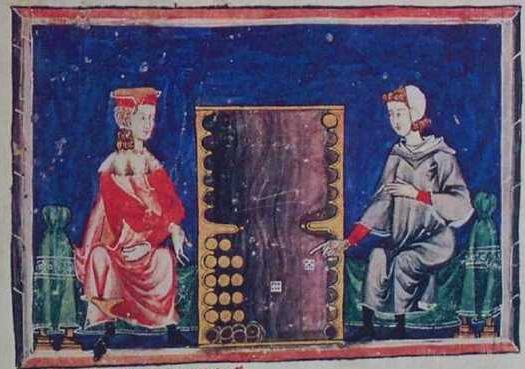
Image credit: Manuscript workshop of Alfonso X. Public domain. Source: https://commons.wikimedia.org/wiki/File:Game_of_Laquet_(Alfonso).png. Licence: https://creativecommons.org/publicdomain/mark/1.0/. Display, thumbnail and enlargement resized without cropping and JPEG encoded; EXIF orientation applied. The packaged enlargement is 525 × 369 pixels. No AI edits.

A Spanish portrait includes a trictrac table
Agustin Esteve's portrait of Josefa Manuela Tellez-Giron dates to about 1798. The young sitter stands beside a backgammon or trictrac table, turning game furniture into part of an aristocratic portrait. The board is not being played; it helps describe the sitter's cultivated domestic world and fashionable surroundings.
Image credit: Agustín Esteve (1753–1830). Public domain. Source: https://commons.wikimedia.org/wiki/File:Josefa_Manuela_T%C3%A9llez_Gir%C3%B3n_por_Esteve.jpg. Licence: https://creativecommons.org/publicdomain/mark/1.0/. Display, thumbnail and enlargement resized without cropping and JPEG encoded; EXIF orientation applied. The packaged enlargement is 312 × 520 pixels. No AI edits.

Mario Ceroli turned backgammon into a pine sculpture
Italian artist Mario Ceroli made a large pine box for backgammon in 1970. Sailko's photograph shows the open, boat-shaped playing surface at Palazzo Pretorio. Oversized forms and visible wood grain move the object between functional game equipment and sculpture, making the board itself the main visual event.

Image credit: Sailko. CC BY-SA 4.0. Source: https://commons.wikimedia.org/wiki/File:Mario_ceroli,_grande_scatola_in_legno_di_pino_per_il_gioco_del_backgammon,_1970_(800-900_art_studio_livorno-lucca)_01.jpg. Licence: https://creativecommons.org/licenses/by-sa/4.0/deed.en. Display, thumbnail and enlargement resized without cropping and JPEG encoded; EXIF orientation applied. The packaged enlargement is 960 × 425 pixels. No AI edits.

A 1532 couple share a trictrac portrait
Jan Sanders van Hemessen's 1532 double portrait places a husband and wife at a trictrac board. Fruit and flowers sit beside the playing surface, joining game play with the language of portraiture and household display. The title identifies trictrac, a tables-family game, rather than standard modern backgammon.
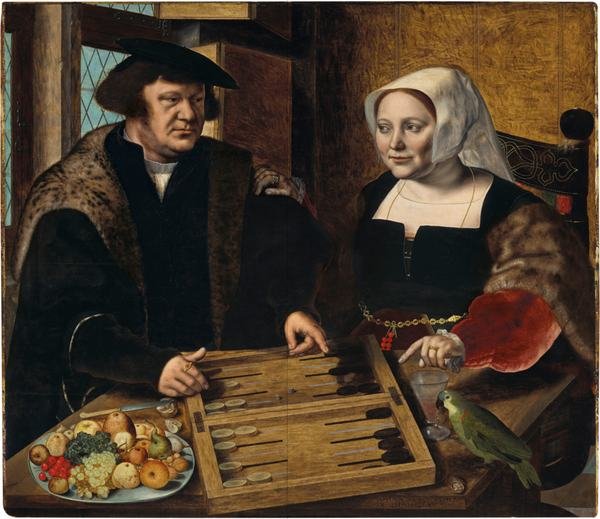
Image credit: Jan Sanders van Hemessen (1500–1556). Public domain. Source: https://commons.wikimedia.org/wiki/File:Jan_Sanders_van_Hemessen_-_Double_portrait_of_a_husband_and_wife_playing_trictrac.png. Licence: https://creativecommons.org/publicdomain/mark/1.0/. Display, thumbnail and enlargement resized without cropping and JPEG encoded; EXIF orientation applied. The packaged enlargement is 960 × 831 pixels. No AI edits.

Britannica explained backgammon with four diagrams
The 1911 Encyclopaedia Britannica article on backgammon included this compact four-part illustration. It labels each player's inner and outer tables and marks the ace, bar and twelve points. The black-and-white plate shows how a general reference work taught board orientation with diagrams long before interactive tutorials.

Image credit: Project Gutenberg Distributed Proofreaders. Public domain. Source: https://commons.wikimedia.org/wiki/File:Backgammon_1.png. Licence: https://creativecommons.org/publicdomain/mark/1.0/. Display, thumbnail and enlargement resized without cropping and JPEG encoded; EXIF orientation applied. The packaged enlargement is 500 × 673 pixels. No AI edits.

A 1756 engraving made trictrac instructional
This French engraving on trictrac dates to 1756 and is associated with the names Soumille and Giroud. It shows a player at a board within an architectural interior. The image belongs to the visual culture of a historical tables game, so its board should not be assumed to use modern backgammon scoring.
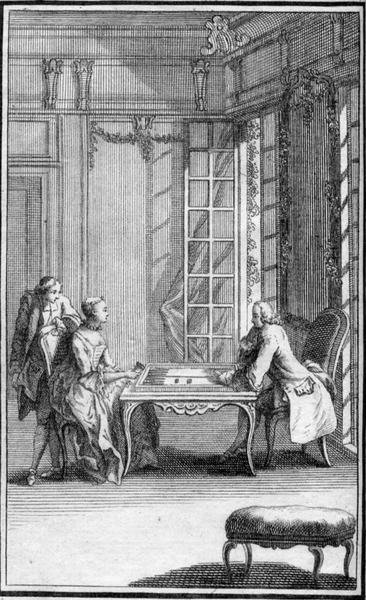
Image credit: Unknown engraver. Public domain. Source: https://commons.wikimedia.org/wiki/File:Soumille_giroud.png. Licence: https://creativecommons.org/publicdomain/mark/1.0/. Display, thumbnail and enlargement resized without cropping and JPEG encoded; EXIF orientation applied. The packaged enlargement is 500 × 819 pixels. No AI edits.

A Penjikent mural preserves an unidentified board game
A mural from Penjikent shows two figures, one haloed, playing a board game while two others watch. The Commons record does not identify the exact rules. It is therefore better evidence for social board play in the painted scene than proof of modern backgammon, even though it appears in tables-game discussions.
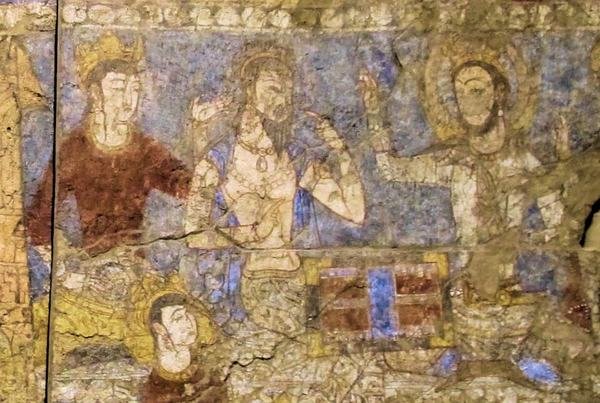
Image credit: sailko. CC BY-SA 3.0. Source: https://commons.wikimedia.org/wiki/File:Penjikent,_figures_with_halos.jpg. Licence: https://creativecommons.org/licenses/by-sa/3.0/deed.en. Display, thumbnail and enlargement resized without cropping and JPEG encoded; EXIF orientation applied. The packaged enlargement is 960 × 644 pixels. No AI edits.

A Baku doorway copies a game board
A 2014 photograph from Baku's walled old city shows a door designed like a backgammon board. Rows of points and round ornaments turn the entrance into an oversized game surface. The photograph demonstrates how the board's geometry can migrate from portable equipment into architecture and street-level decoration.
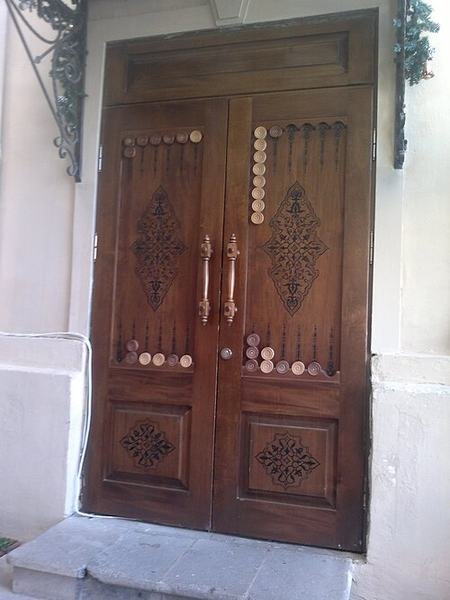
Image credit: Interfase. CC BY-SA 3.0. Source: https://commons.wikimedia.org/wiki/File:Backgammon_door.jpg. Licence: https://creativecommons.org/licenses/by-sa/3.0/deed.en. Display, thumbnail and enlargement resized without cropping and JPEG encoded; EXIF orientation applied. The packaged enlargement is 500 × 667 pixels. No AI edits.

A modern board borrows ancient Greek motifs
Mia Gaitanidis photographed a backgammon game decorated in an ancient Greek style in 2020. Figures and patterned borders cover the exterior rather than changing the familiar interior layout. The photograph is a modern design inspired by antiquity, not archaeological evidence that this exact board existed in ancient Greece.
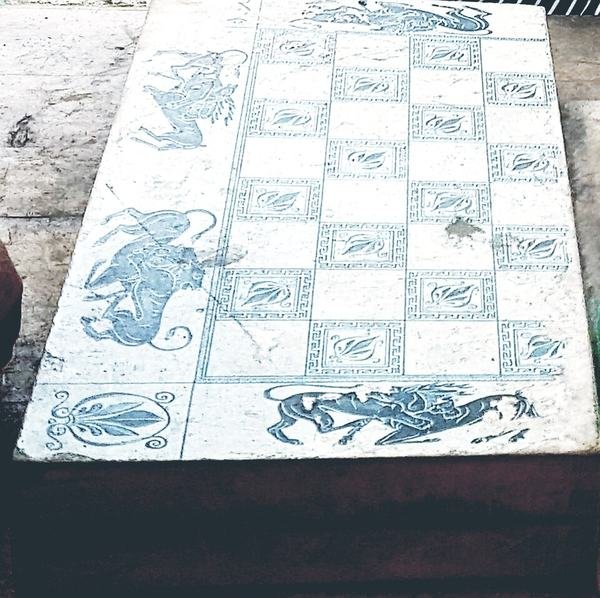
Image credit: Mia Gaitanidis. CC BY-SA 4.0. Source: https://commons.wikimedia.org/wiki/File:Backgammon_game_in_ancient_Greek_design_3.jpg. Licence: https://creativecommons.org/licenses/by-sa/4.0/deed.en. Display, thumbnail and enlargement resized without cropping and JPEG encoded; EXIF orientation applied. The packaged enlargement is 960 × 956 pixels. No AI edits.

Wine Gums join a Lebanese backgammon still life
Terry Grignon's 2024 photograph combines a backgammon board and Wine Gums, held by a Lebanese Maronite hand. Hands, sweets and checkers turn the picture into a playful still life as much as a game record. It documents one staged cultural scene and does not claim these candies are a gaming tradition.

Image credit: Terry.grignon. CC0 1.0. Source: https://commons.wikimedia.org/wiki/File:Backgammon_and_Wine_(Gums).jpg. Licence: https://creativecommons.org/publicdomain/zero/1.0/deed.en. Display, thumbnail and enlargement resized without cropping and JPEG encoded; EXIF orientation applied. The packaged enlargement is 960 × 520 pixels. No AI edits.

A cathedral relief sends a tables player to hell
A carved voussoir on the Last Judgement portal of Tudela Cathedral shows demons tormenting a figure who carries a small tables board. The sculpture places gaming within a medieval vision of hell and moral punishment. It is religious imagery, not a record of an actual match or proof of modern backgammon rules.
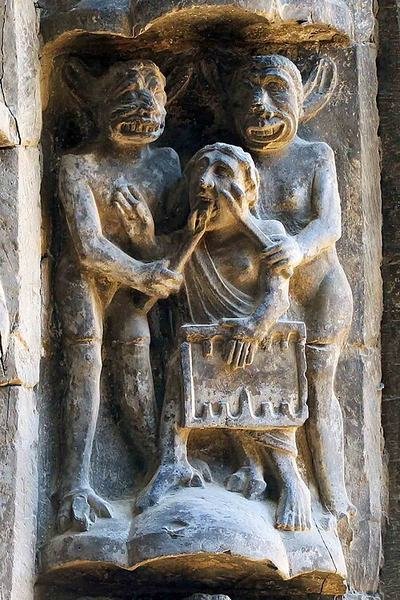
Image credit: Aldamendi. CC BY-SA 4.0. Source: https://commons.wikimedia.org/wiki/File:Dovela_Infierno_7.7.jpg. Licence: https://creativecommons.org/licenses/by-sa/4.0/deed.en. Display, thumbnail and enlargement resized without cropping and JPEG encoded; EXIF orientation applied. The packaged enlargement is 500 × 750 pixels. No AI edits.

A Lyon exhibition displayed the board as cultural history
Benoit Prieur photographed a backgammon set in the 2018 Lyon library exhibition Tu joues ou tu joues pas? The open case, checkers and cups appear behind exhibition framing rather than during play. The image shows a familiar household game temporarily treated as an object of public cultural display.
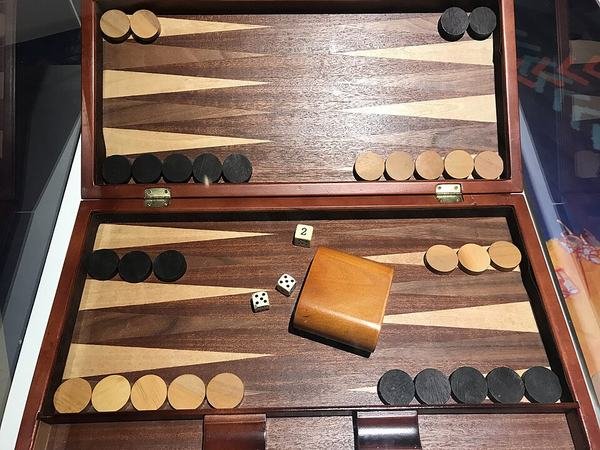
Image credit: Benoît Prieur (1975–). CC0 1.0. Source: https://commons.wikimedia.org/wiki/File:Tu_joues_ou_tu_joues_pas_%3F_(exposition)_-_backgammon.jpg. Licence: https://creativecommons.org/publicdomain/zero/1.0/deed.en. Display, thumbnail and enlargement resized without cropping and JPEG encoded; EXIF orientation applied. The packaged enlargement is 960 × 720 pixels. No AI edits.

A 1480 hellmouth scene includes a game board
An anonymous painting from about 1480 in Regensburg's Historical Museum shows the damned at the mouth of hell. A backgammon-style board appears among the objects in the scene. Like the Tudela relief, the work uses gaming within moral imagery; it does not document a friendly match or reconstruct a ruleset.
Image credit: Unknown artist; photograph by Mattes. CC BY-SA 4.0. Source: https://commons.wikimedia.org/wiki/File:GER_%E2%80%94_BY_%E2%80%94_Oberpfalz_%E2%80%94_Regensburg_%E2%80%94_Dachauplatz_2-4_%E2%80%94_2._OG_(Historisches_Museum)_%E2%80%94_unbekannter_K%C3%BCnstler_%E2%80%94_Armeseelen-Zyklus,_4._Bild_(Die_Verdammten_am_H%C3%B6llenrachen)_%E2%80%94_um_1480_%E2%80%94_Mattes_2022-02-24.jpg. Licence: https://creativecommons.org/licenses/by-sa/4.0/deed.en. Display, thumbnail and enlargement resized without cropping and JPEG encoded; EXIF orientation applied. The packaged enlargement is 330 × 714 pixels. No AI edits.

Monks reach the final move in Gebhardt's painting
Karl Gebhardt's painting The Final Move shows Roman Catholic monks around a tables board. Gebhardt died in 1917, so the work was made before that year. Its title supplies a moment of drama but does not identify the exact game rules; the board places quiet calculation at the centre of the scene.

Image credit: Karl Gebhardt (1860–1917). Public domain. Source: https://commons.wikimedia.org/wiki/File:Karl_Gebhardt_-_The_Final_Move.jpg. Licence: https://creativecommons.org/publicdomain/mark/1.0/. Display, thumbnail and enlargement resized without cropping and JPEG encoded; EXIF orientation applied. The packaged enlargement is 600 × 513 pixels. No AI edits.

A 1909 book froze a bearing-off example
Hoyle's Games Modernized printed this bearing-off diagram in 1909. Its caption places five men on the five-point, three on the four-point, three on the two-point and four on the one-point. The sparse black-and-white figure turns a verbal position into something readers could check at a glance.

Image credit: "Professor Louis Hoffmann" (1839-1919) & Ernest Bergholt (1856-1925). Public domain. Source: https://commons.wikimedia.org/wiki/File:Hoyles_Games_Modernized_275.png. Licence: https://creativecommons.org/publicdomain/mark/1.0/. Display, thumbnail and enlargement resized without cropping and JPEG encoded; EXIF orientation applied. The packaged enlargement is 960 × 872 pixels. No AI edits.

Comenius placed a tables board among pictured games
A page from the 1666 four-language edition of Comenius's Orbis Sensualium Pictus includes a backgammon-style board among other game equipment. The illustrated schoolbook joined words with pictures for learners. Its gaming image belongs to a broad visual lesson, rather than documenting a single identifiable match or modern ruleset.

Image credit: Jan Amos Komenský. Public domain. Source: https://commons.wikimedia.org/wiki/File:Orbis_Sensualium_Pictus_Quadrilinguis_1666_(136619856).jpg. Licence: https://creativecommons.org/publicdomain/mark/1.0/. Display, thumbnail and enlargement resized without cropping and JPEG encoded; EXIF orientation applied. The packaged enlargement is 500 × 665 pixels. No AI edits.

One close-up studies dice, points and checkers
A 2012 close photograph brings a die, rounded checkers and the narrow ends of the playing points into the same shallow-focus scene. The Persian caption identifies dice and pieces from a backgammon set. By cropping out most of the board, the photographer turns small equipment into the visual subject.
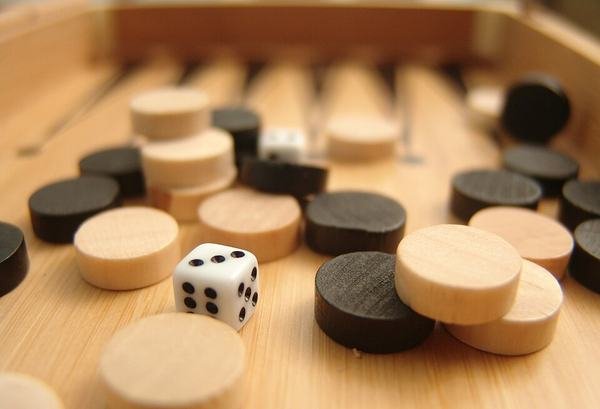
Image credit: درفش کاویانی at Persian Wikipedia. CC BY-SA 3.0. Source: https://commons.wikimedia.org/wiki/File:Backgammon_test.JPG. Licence: https://creativecommons.org/licenses/by-sa/3.0/deed.en. Display, thumbnail and enlargement resized without cropping and JPEG encoded; EXIF orientation applied. The packaged enlargement is 960 × 654 pixels. No AI edits.

A CC0 studio image presents the board as an object
The photograph titled Backgammon board1 isolates an open board and releases the image under CC0. With no people or location supplied, the set itself becomes the entire subject. That limited metadata is useful when read honestly: it documents the appearance of one board, not its maker, age or place of use.
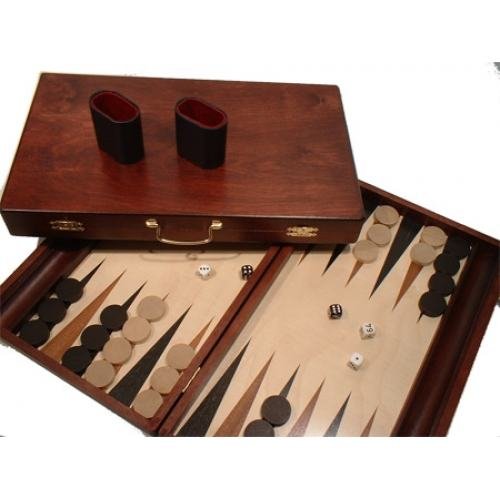
Image credit: Shiq. CC0 1.0. Source: https://commons.wikimedia.org/wiki/File:Backgammon_board1.jpg. Licence: https://creativecommons.org/publicdomain/zero/1.0/deed.en. Display, thumbnail and enlargement resized without cropping and JPEG encoded; EXIF orientation applied. The packaged enlargement is 500 × 500 pixels. No AI edits.

A study photograph turns chance into a still life
Terry Grignon titled this 2024 photograph Backgammon Study and described chance and strategy meeting in a friendly contest. The arranged board, dice and pieces create an artistic still life rather than a report of a named tournament. The CC0 image shows how photographers can treat ordinary equipment as a visual theme.
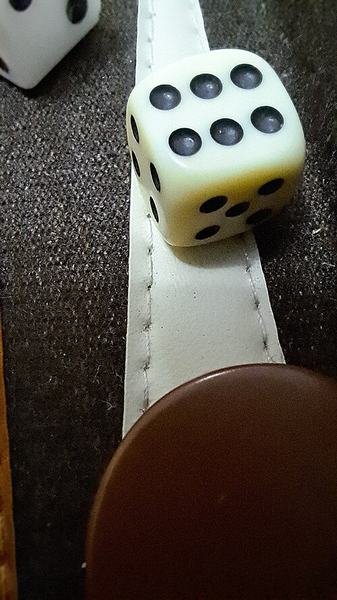
Image credit: Terry.grignon. CC0 1.0. Source: https://commons.wikimedia.org/wiki/File:Backgammon_study.jpg. Licence: https://creativecommons.org/publicdomain/zero/1.0/deed.en. Display, thumbnail and enlargement resized without cropping and JPEG encoded; EXIF orientation applied. The packaged enlargement is 500 × 889 pixels. No AI edits.

Four playing dice surround a marked cube
Clint Budd's 2020 close-up shows four ordinary dice and a backgammon doubling die. The large die displays numbers such as 16 and 64, distinguishing it from the movement dice. The macro composition makes equipment differences visible without needing to show an entire board or a complete playing position.

Image credit: Clint Budd. CC BY 2.0. Source: https://commons.wikimedia.org/wiki/File:Backgammon_Dice_(49482395197).jpg. Licence: https://creativecommons.org/licenses/by/2.0/deed.en. Display, thumbnail and enlargement resized without cropping and JPEG encoded; EXIF orientation applied. The packaged enlargement is 960 × 736 pixels. No AI edits.

Frans Francken placed a tables game inside a genre scene
Frans Francken III painted this indoor genre scene in the first half of the seventeenth century. A tables game appears among figures, furnishings, pictures and a dog, making play one part of a crowded room. The artwork records the social setting artists associated with games without identifying modern backgammon rules.
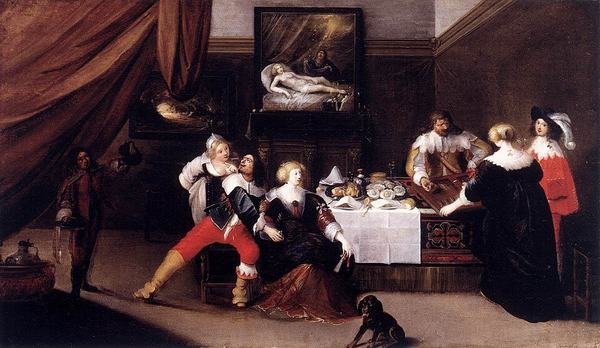
Image credit: Frans Francken III (1607–1667). Public domain. Source: https://commons.wikimedia.org/wiki/File:Frans_Francken_(III)_-_Genre_Scene_-_WGA08214.jpg. Licence: https://creativecommons.org/publicdomain/mark/1.0/. Display, thumbnail and enlargement resized without cropping and JPEG encoded; EXIF orientation applied. The packaged enlargement is 960 × 557 pixels. No AI edits.

Macro Monday cropped the board down to its pieces
Clint Budd made this 2021 photograph for the Macro Mondays theme Board game pieces. Only a few backgammon checkers and a glimpse of the board remain in frame. The deliberate crop changes equipment documentation into a study of circles, edges and texture rather than a readable game position.

Image credit: Clint Budd from About 15 miles North of Swansea, Wales. CC BY 2.0. Source: https://commons.wikimedia.org/wiki/File:Backgammon_(51231756285).jpg. Licence: https://creativecommons.org/licenses/by/2.0/deed.en. Display, thumbnail and enlargement resized without cropping and JPEG encoded; EXIF orientation applied. The packaged enlargement is 960 × 640 pixels. No AI edits.

An Italian diagram labels all four table quarters
Francesco De Lorenzo's 2005 Italian diagram shows the opening arrangement and labels the inner and outer tables for both red and white. It also marks the bar. The picture is a designed teaching graphic rather than a photographed board, making spatial vocabulary visible before a learner studies legal moves.

Image credit: Francesco De Lorenzo. CC BY-SA 3.0. Source: https://commons.wikimedia.org/wiki/File:Backgammon–Tavola_e_pedine_ad_inizio_gioco.jpg. Licence: https://creativecommons.org/licenses/by-sa/3.0/deed.en. Display, thumbnail and enlargement resized without cropping and JPEG encoded; EXIF orientation applied. The packaged enlargement is 960 × 1080 pixels. No AI edits.

A 2002 photograph catches a board mid-game
Salim Virji photographed a backgammon board in July 2002. The picture centres the checker pattern and dice rather than the players, preserving one ordinary game state without claiming it as an instructional problem. Its early digital date makes it part of the everyday online visual record of the game.

Image credit: Salim Virji. CC BY-SA 2.0. Source: https://commons.wikimedia.org/wiki/File:The_backgammon_board_(19418977).jpg. Licence: https://creativecommons.org/licenses/by-sa/2.0/deed.en. Display, thumbnail and enlargement resized without cropping and JPEG encoded; EXIF orientation applied. The packaged enlargement is 640 × 480 pixels. No AI edits.

A camera lesson became a backgammon record
Hillary photographed friends' roommates playing backgammon in January 2010 while learning to use a camera's manual mode. Hands, cups and a contemporary case enter the frame. The caption preserves both activities: someone was learning the game while the photographer was learning how to expose an indoor scene.
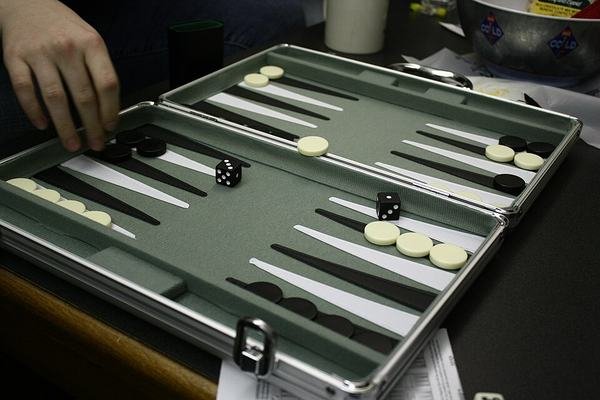
Image credit: Hillary from Atlanta, United States. CC BY-SA 2.0. Source: https://commons.wikimedia.org/wiki/File:026_-_Backgammon_(4308596866).jpg. Licence: https://creativecommons.org/licenses/by-sa/2.0/deed.en. Display, thumbnail and enlargement resized without cropping and JPEG encoded; EXIF orientation applied. The packaged enlargement is 960 × 640 pixels. No AI edits.

Who will win? leaves the players outside the frame
David de la Luz titled this 2006 backgammon photograph Who will win? The camera looks closely at a board position while leaving the competitors unseen. That choice invites the viewer to imagine the decision and outcome, turning an ordinary game state into a small visual mystery rather than a documented lesson.
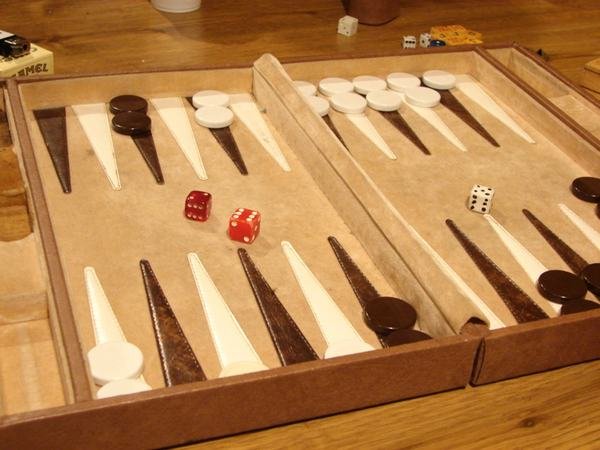
Image credit: David de la Luz from Mexico City, Mexico. CC BY-SA 2.0. Source: https://commons.wikimedia.org/wiki/File:Backgammon_(392323481).jpg. Licence: https://creativecommons.org/licenses/by-sa/2.0/deed.en. Display, thumbnail and enlargement resized without cropping and JPEG encoded; EXIF orientation applied. The packaged enlargement is 800 × 600 pixels. No AI edits.

A bottle-side game became a 2012 travel photograph
Xlibber's 2012 photograph shows an open backgammon board set beside a bottle and domestic furnishings. The spare Commons caption simply says Backgammon, so the image supports only modest claims: it records contemporary equipment in use or ready for use, without supplying a place, players or tournament context.

Image credit: xlibber. CC BY 2.0. Source: https://commons.wikimedia.org/wiki/File:Backgammon_(7433789872).jpg. Licence: https://creativecommons.org/licenses/by/2.0/deed.en. Display, thumbnail and enlargement resized without cropping and JPEG encoded; EXIF orientation applied. The packaged enlargement is 960 × 638 pixels. No AI edits.

A lone doubling cube sharpens the focus
Gosheshe's 2009 photograph Backgammon Delight focuses on a doubling cube standing upright against a blurred board. The composition makes one modern piece of equipment dominate the scene. Because the source gives no match details, the image is best read as an expressive close-up rather than evidence of a particular cube decision.

Image credit: gosheshe. CC BY 2.0. Source: https://commons.wikimedia.org/wiki/File:Backgammon_delight_(3277150463).jpg. Licence: https://creativecommons.org/licenses/by/2.0/deed.en. Display, thumbnail and enlargement resized without cropping and JPEG encoded; EXIF orientation applied. The packaged enlargement is 960 × 643 pixels. No AI edits.

Red pigment survived on a Samson trictrac piece
A mid-twelfth-century trictrac piece in the Louvre is carved from walrus ivory and still carries red paint. Its scene is identified as Samson and the foxes. The surviving colour shows that at least some carved gaming pieces were painted as well as sculpted.
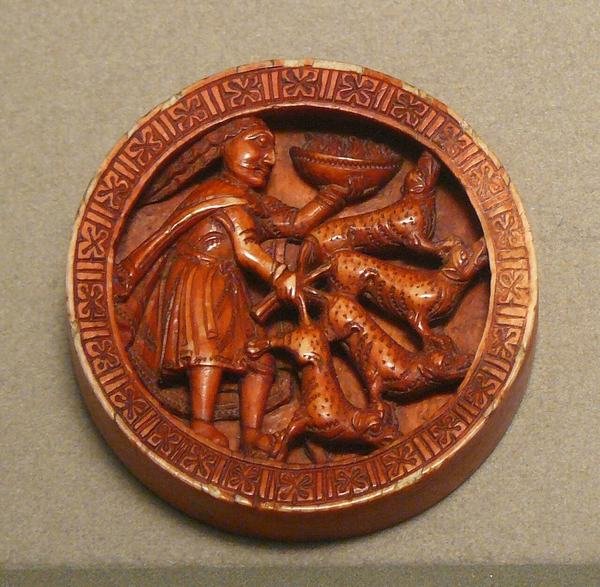
Image credit: Siren-Com. CC BY-SA 3.0. Source: https://commons.wikimedia.org/wiki/File:Pion_de_tric-trac_3.jpg. Licence: https://creativecommons.org/licenses/by-sa/3.0/. Display, thumbnail and enlargement resized without cropping and JPEG encoded; EXIF orientation applied. The packaged enlargement is 1200 × 1175 pixels. No AI edits.

Brickworld rebuilt backgammon in plastic bricks
Mark Anderson photographed a backgammon model at Brickworld 2010. The cream-and-red board is built from interlocking plastic bricks and displayed like a fan creation. Its recognisable points and pieces show that the board's geometry can survive a change of material, moving from traditional wood or cloth into hobby construction.
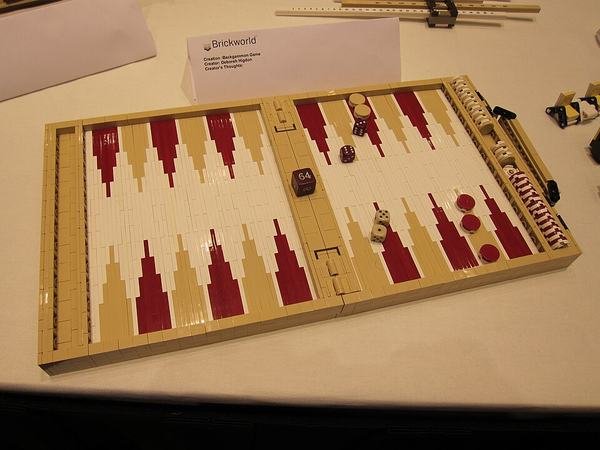
Image credit: Mark Anderson from Schuamburg. CC BY 2.0. Source: https://commons.wikimedia.org/wiki/File:Brickworld_2010_(4715322716).jpg. Licence: https://creativecommons.org/licenses/by/2.0/deed.en. Display, thumbnail and enlargement resized without cropping and JPEG encoded; EXIF orientation applied. The packaged enlargement is 960 × 720 pixels. No AI edits.

A prison museum staged a board beside bunk beds
A 2016 photograph inside Ankara's Ulucanlar Prison Museum includes a backgammon board, stools, tea and wax figures in a reconstructed cell scene. The display uses familiar leisure objects to interpret prison life. It is a museum staging, not a documentary photograph of named prisoners actually playing.

Image credit: Ankara'dan. CC0 1.0. Source: https://commons.wikimedia.org/wiki/File:Ulucanlar_Cezaevi,_Ulus_06.jpg. Licence: https://creativecommons.org/publicdomain/zero/1.0/deed.en. Display, thumbnail and enlargement resized without cropping and JPEG encoded; EXIF orientation applied. The packaged enlargement is 960 × 720 pixels. No AI edits.

A shoe promotion arrived as a suitcase board
The Florsheim Shoes Philippines promotional object opens like a suitcase into a backgammon board. Branded leather dice cups and a central Florsheim label make the sponsor visible during play. The photograph documents advertising that became usable game equipment, joining retail identity with the social appeal of a portable set.

Image credit: Valenzuela400. CC BY-SA 4.0. Source: https://commons.wikimedia.org/wiki/File:Florsheim_Shoes_Philippines_BackgammonF.jpg. Licence: https://creativecommons.org/licenses/by-sa/4.0/deed.en. Display, thumbnail and enlargement resized without cropping and JPEG encoded; EXIF orientation applied. The packaged enlargement is 960 × 675 pixels. No AI edits.

A 2012 tabletop portrait records an ordinary set
Razvan Bargaoanu made this photograph of a backgammon table in July 2012. The short source record names the object but gives no place or match. That limited metadata is still useful: it documents one contemporary set and credits its photographer without inventing a maker, owner, age or tournament story.

Image credit: Razvan.bargaoanu. CC BY-SA 3.0. Source: https://commons.wikimedia.org/wiki/File:Backgammon_Bulan.jpg. Licence: https://creativecommons.org/licenses/by-sa/3.0/deed.en. Display, thumbnail and enlargement resized without cropping and JPEG encoded; EXIF orientation applied. The packaged enlargement is 400 × 300 pixels. No AI edits.

A 2019 photograph stops halfway through a game
Clint Budd photographed a backgammon game partway through play in April 2019. Checkers, dice and the marked doubling cube remain where the action paused. The source frames it as part of a personal Play the Game photography challenge, turning a private recreational moment into a dated public image.
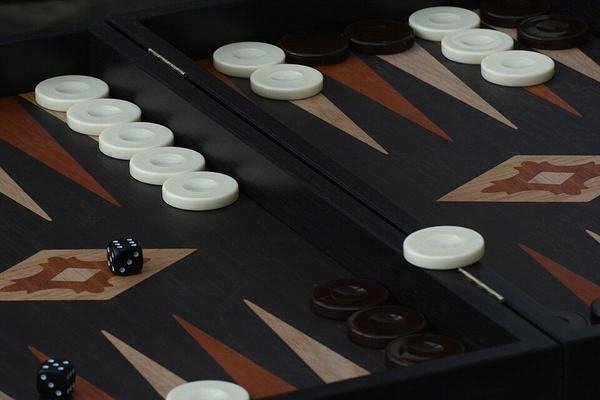
Image credit: Clint Budd from About 15 miles North of Swansea, Wales. CC BY 2.0. Source: https://commons.wikimedia.org/wiki/File:Backgammon_(40577847383).jpg. Licence: https://creativecommons.org/licenses/by/2.0/deed.en. Display, thumbnail and enlargement resized without cropping and JPEG encoded; EXIF orientation applied. The packaged enlargement is 960 × 640 pixels. No AI edits.

A photographer turned the board into an invitation
Alper Cugun titled this 2009 photograph Shall we play a game? The open backgammon board fills the frame, so the question seems addressed directly to the viewer rather than to a pictured opponent. The source supplies no match details, making the image a playful invitation and an object portrait instead of documentary reportage.
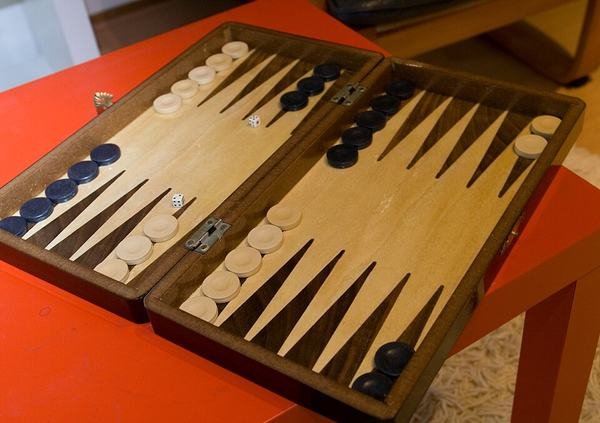
Image credit: Alper Çuğun from Berlin, Germany. CC BY 2.0. Source: https://commons.wikimedia.org/wiki/File:Shall_we_play_a_game%3F_(3775316134).jpg. Licence: https://creativecommons.org/licenses/by/2.0/deed.en. Display, thumbnail and enlargement resized without cropping and JPEG encoded; EXIF orientation applied. The packaged enlargement is 960 × 677 pixels. No AI edits.

A macro photograph freezes a decisive roll
Clint Budd titled this 2024 macro photograph Double or Quits? and described it as a decisive moment in a backgammon game. The tight view concentrates on dice and nearby checkers while withholding the whole position. The title creates suspense, but the source does not claim that an actual doubling decision is pictured.

Image credit: Clint Budd from About 15 miles North of Swansea, Wales. CC BY 2.0. Source: https://commons.wikimedia.org/wiki/File:Double_or_Quits%3F_(54132075315).jpg. Licence: https://creativecommons.org/licenses/by/2.0/deed.en. Display, thumbnail and enlargement resized without cropping and JPEG encoded; EXIF orientation applied. The packaged enlargement is 500 × 750 pixels. No AI edits.

An Occitan graphic labels the backgammon board
Nicolas Eynaud's 2021 graphic describes a backgammon board in Occitan. Labels are placed around a clean digital playing surface, turning the image into both a game diagram and a language resource. Its value is not a novel position but the preservation of specialised board vocabulary in a regional European language.
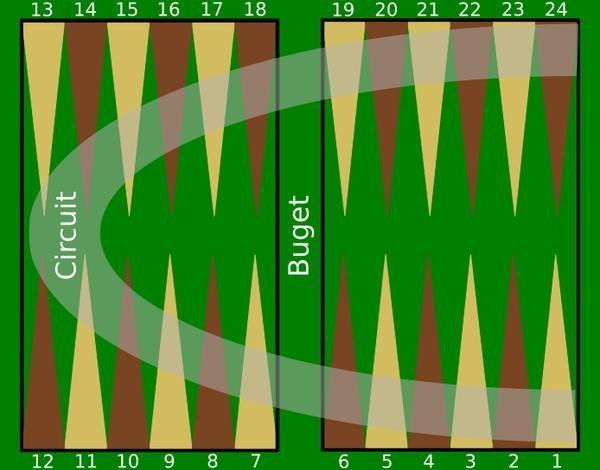
Image credit: Nicolas Eynaud. CC BY-SA 4.0. Source: https://commons.wikimedia.org/wiki/File:Backgammon_-_Descripcion_dau_faudau.png. Licence: https://creativecommons.org/licenses/by-sa/4.0/deed.en. Display, thumbnail and enlargement resized without cropping and JPEG encoded; EXIF orientation applied. The packaged enlargement is 694 × 544 pixels. No AI edits.

One graphic diagrams a mixed long-and-short match
Vitalii Rykovanov's 2019 Russian diagram represents a mixed match combining long and short nardy. The graphic separates the two formats within one visual plan. It is useful evidence that related tables variants can be joined in match design, without implying that either follows every rule of modern international backgammon.

Image credit: Vitalii Rykovanov. CC BY-SA 4.0. Source: https://commons.wikimedia.org/wiki/File:Giper-long-short.png. Licence: https://creativecommons.org/licenses/by-sa/4.0/deed.en. Display, thumbnail and enlargement resized without cropping and JPEG encoded; EXIF orientation applied. The packaged enlargement is 528 × 131 pixels. No AI edits.

Rosati painted an imagined Trictrac gathering
The Commons record gives the French title Arabes jouant au tric-trac, or Arabs playing Trictrac, and identifies artist Giulio Rosati as living from 1858 to 1917. The scene is a painting rather than a photograph, so its costumes and setting should not be read as neutral evidence of daily life.

Image credit: Giulio Rosati. Public domain. Source: https://commons.wikimedia.org/wiki/File:Giulio_Rosati_18.jpg. Licence: https://creativecommons.org/publicdomain/mark/1.0/. Display, thumbnail and enlargement resized without cropping and JPEG encoded; EXIF orientation applied. The packaged enlargement is 500 × 721 pixels. No AI edits.

Around the World
148 facts in this subject.
An archival game with an unsolved location
Photographer Thomas Taylor Hammond captured these men playing backgammon during a trip to the Soviet Union in 1964. The photograph survives in his archive, but its description says the pictures were unlabeled. The exact location and the people’s identities are unknown.
That makes the image a small historical mystery. We can see the game and its audience, even though we cannot name the players or say exactly where they were sitting.

Image credit: Thomas Taylor Hammond; University of Virginia collection. CC BY-SA 4.0. Source: https://commons.wikimedia.org/wiki/File:Hammond_Slides_Central_Asia_31.jpg. Licence: https://creativecommons.org/licenses/by-sa/4.0/. Display, thumbnail and enlargement resized without cropping and JPEG encoded; EXIF orientation applied. Enlargement limited to 1400 pixels on its longest side, or source size if smaller. No AI edits.

Backgammon in a Brooklyn park
Backgammon is not confined to tournament halls or private clubs. This photograph records players in Second Street Park at Brighton Beach, Brooklyn, in 2012. The board is surrounded by people, making the game part of a shared outdoor gathering.
The scene offers a modern counterpart to old paintings of players and spectators: a portable board, a place to sit, and a game that gives people a reason to spend time together.
Image credit: Liz Cooke. CC BY-SA 3.0. Source: https://commons.wikimedia.org/wiki/File:Backgammon_Players%2C_Brighton_Beach%2C_Brooklyn_2012.jpg. Licence: https://creativecommons.org/licenses/by-sa/3.0/. Display, thumbnail and enlargement resized without cropping and JPEG encoded; EXIF orientation applied. Enlargement limited to 1400 pixels on its longest side, or source size if smaller. No AI edits.
In Greece, one board can mean three games
Tavli is a Greek tradition that brings together three tables games: Portes, Plakoto, and Fevga. Players commonly play them in sequence during a match, using the same kind of board and checkers.
Portes is close to standard backgammon, but it has no doubling cube and some different rules. The familiar board can therefore be the setting for more than one kind of contest.
Image credit: Sascha Kohlmann. CC BY-SA 3.0. Source: https://commons.wikimedia.org/wiki/File:Playing_Backgammon_Athens_Greece_%28113613901%29.jpeg. Licence: https://creativecommons.org/licenses/by-sa/3.0/. Display, thumbnail and enlargement resized without cropping and JPEG encoded; EXIF orientation applied. Enlargement limited to 1400 pixels on its longest side, or source size if smaller. No AI edits.
A street-side game in Georgia
Photographer Marcin Konsek captured these men playing backgammon in Kutaisi, Georgia, on 26 May 2014. The board rests between them, with everyday street life around the game.
The photograph records a specific place and moment. It does not tell us the score or the exact local rules, but it shows that a game can turn an ordinary spot into a meeting place.

Image credit: Marcin Konsek / Wikimedia Commons. CC BY-SA 4.0. Source: https://commons.wikimedia.org/wiki/File:2014_Kutaisi%2C_M%C4%99%C5%BCczyzni_graj%C4%85cy_w_tryktraka.jpg. Licence: https://creativecommons.org/licenses/by-sa/4.0/. Display, thumbnail and enlargement resized without cropping and JPEG encoded; EXIF orientation applied. Enlargement limited to 1400 pixels on its longest side, or source size if smaller. No AI edits.

Backgammon photographed in Armenia
This Peace Corps photograph shows local Armenian men playing backgammon in August 2007. The players lean towards the board while the game becomes a shared social activity.
The file is titled Nardy Players in Armenia. Its description identifies the game as backgammon, but does not give a match result or enough detail to identify every rule being used.
Image credit: Peace Corps. Public domain. Source: https://commons.wikimedia.org/wiki/File:Nardy_players_in_Armenia.jpg. Licence: https://creativecommons.org/publicdomain/mark/1.0/. Display, thumbnail and enlargement resized without cropping and JPEG encoded; EXIF orientation applied. Enlargement limited to 1400 pixels on its longest side, or source size if smaller. No AI edits.
Fevga sends both sides the same way
In the Greek game Fevga, both players move their checkers counterclockwise. That differs from standard backgammon, where the two sides travel in opposite directions.
Fevga also has no hitting: one opposing checker is enough to block a point. Its movement and blocking rules create a different kind of race on the familiar board.
Image credit: Niko Kitsakis. CC BY 4.0. Source: https://commons.wikimedia.org/wiki/File:Tavli_Board_without_slots_%28traditional%29_B.jpg. Licence: https://creativecommons.org/licenses/by/4.0/. Display, thumbnail and enlargement resized without cropping and JPEG encoded; EXIF orientation applied. Enlargement limited to 1400 pixels on its longest side, or source size if smaller. No AI edits.
A game on a Nazareth pavement
James Emery photographed two men playing backgammon on a pavement in Nazareth in May 2007. The board sits between simple seats, with parked vehicles nearby.
A small board is enough to turn a street corner into a place to play. The photograph records the setting, but leaves the score and the players’ exact rules unknown.

Image credit: James Emery. CC BY 2.0. Source: https://commons.wikimedia.org/wiki/File:Backgammon_in_Nazareth_0780_%28506270689%29.jpg. Licence: https://creativecommons.org/licenses/by/2.0/. Display, thumbnail and enlargement resized without cropping and JPEG encoded; EXIF orientation applied. Enlargement limited to 1400 pixels on its longest side, or source size if smaller. No AI edits.

An evening game in Istanbul
David Berkowitz photographed this backgammon scene during a visit to Istanbul in September 2013. The evening setting places the game among the city’s everyday social activities.
In Turkey, backgammon is often called tavla. Local customs can differ from formal tournament rules, so a casual café game should not automatically be described as championship-style play.

Image credit: David Berkowitz. CC BY 2.0. Source: https://commons.wikimedia.org/wiki/File:Istanbul%2C_Turkey_%2810582737355%29.jpg. Licence: https://creativecommons.org/licenses/by/2.0/. Display, thumbnail and enlargement resized without cropping and JPEG encoded; EXIF orientation applied. Enlargement limited to 1400 pixels on its longest side, or source size if smaller. No AI edits.

A park game in Bucharest
Jeroen Komen’s photograph Boardgames in Bucarest records an outdoor game in Bucharest in July 2012. Players face each other across the board in a green, open-air setting.
The scene adds Romania to this collection’s map of everyday play. It tells us where the photograph was taken, rather than who won or which precise rules the players agreed to use.

Image credit: Jeroen Komen. CC BY-SA 2.0. Source: https://commons.wikimedia.org/wiki/File:Boardgames_in_Bucarest_%2810654287715%29.jpg. Licence: https://creativecommons.org/licenses/by-sa/2.0/. Display, thumbnail and enlargement resized without cropping and JPEG encoded; EXIF orientation applied. Enlargement limited to 1400 pixels on its longest side, or source size if smaller. No AI edits.

A street game in Netanya
Bryan Doane photographed backgammon players on a street in Netanya, Israel, in July 2013. It is another example of a board game being played outside a club or tournament hall.
Look at how close the players sit to the board. A face-to-face game makes every roll and decision something both players can watch as it happens.
Image credit: Bryan Doane. CC BY 2.0. Source: https://commons.wikimedia.org/wiki/File:Backgammon-playwers-netanya-street-july-2013.jpg. Licence: https://creativecommons.org/licenses/by/2.0/. Display, thumbnail and enlargement resized without cropping and JPEG encoded; EXIF orientation applied. Enlargement limited to 1400 pixels on its longest side, or source size if smaller. No AI edits.
Tawleh photographed in Tunisia
Monaam Ben Fredj photographed these tawleh players in Tunisia in February 2019. The image was entered in Wiki Loves Africa, a photography contest whose theme that year was “Play.”
The photographer describes tawleh as a board game similar to backgammon. The photograph connects the tables-game family with a modern African setting, without claiming that every local rule is identical to standard backgammon.

Image credit: Monaam Ben Fredj. CC BY-SA 4.0. Source: https://commons.wikimedia.org/wiki/File:Tawleh_Players_01.jpg. Licence: https://creativecommons.org/licenses/by-sa/4.0/. Display, thumbnail and enlargement resized without cropping and JPEG encoded; EXIF orientation applied. Enlargement limited to 1400 pixels on its longest side, or source size if smaller. No AI edits.

Narde limits departures from the starting point
In Narde, a Russian relative of backgammon, each player begins with fifteen checkers on one point, called the head. Normally, only one checker may leave that point in a turn.
There are special exceptions on the first roll. The game also has no hitting: a single opposing checker blocks its point, making careful movement and blocking central to play.
Image credit: Peace Corps. Public domain. Source: https://commons.wikimedia.org/wiki/File:Nardy_players_in_Armenia.jpg. Licence: https://creativecommons.org/publicdomain/mark/1.0/. Display, thumbnail and enlargement resized without cropping and JPEG encoded; EXIF orientation applied. Enlargement limited to 1400 pixels on its longest side, or source size if smaller. No AI edits.
A travel photograph catches a game in Mozambique
A photograph by Stig Nygaard shows tourists playing backgammon in Nacala, Mozambique. Its recorded date is November 2007, and the players have a portable board open on a table beside the water.
The scene is a reminder that backgammon travels well: one board, checkers and dice can turn a break in a journey into a game. This is a casual travel scene, not a tournament photograph.
Image credit: Stig Nygaard. CC BY 2.0. Source: https://commons.wikimedia.org/wiki/File:Nacala_-_Bay_Diving_(2767931598).jpg. Licence: https://creativecommons.org/licenses/by/2.0/. Display, thumbnail and enlargement resized without cropping and JPEG encoded; EXIF orientation applied. Enlargement limited to 1400 pixels on its longest side, or source size if smaller. No AI edits.
A Jerusalem street becomes a place to play
In September 2017, photographer TZivyA captured two men playing backgammon in Jerusalem’s Old City. The file description places the scene by the Via Dolorosa, near the street known as Qanater Khudair.
The board rests between the seated players rather than in a dedicated games room. Like the library’s photographs from other cities, this image records one everyday game; it does not tell us which local rules they were using.
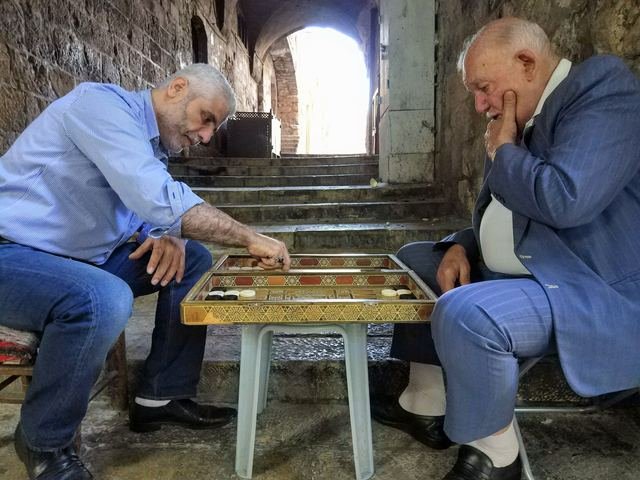
Image credit: TZivyA. CC BY-SA 4.0. Source: https://commons.wikimedia.org/wiki/File:Backgammon12.jpg. Licence: https://creativecommons.org/licenses/by-sa/4.0/. Display, thumbnail and enlargement resized without cropping and JPEG encoded; EXIF orientation applied. Enlargement limited to 1400 pixels on its longest side, or source size if smaller. No AI edits.

Backgammon joined a Czech games festival
Backgammon was photographed at Deskohraní, a Czech board-game festival, in 2008. Matěj Baťha’s image shows several tables of players, and its file description identifies a backgammon tournament.
The picture shows how the same game can fit into a wider celebration of board games. It documents the gathering, without supplying enough information to name a winner or claim a tournament record.
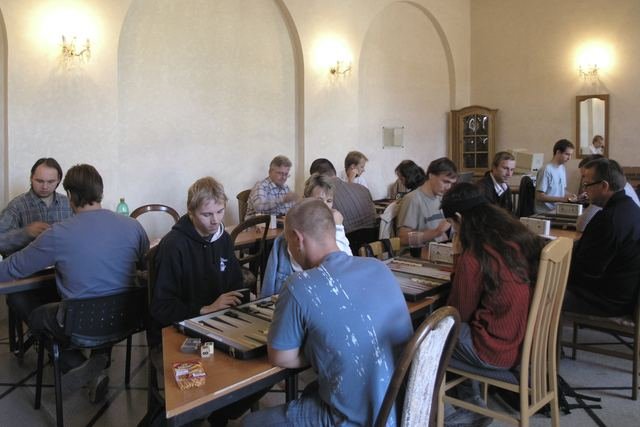
Image credit: Matěj Baťha. CC BY-SA 3.0. Source: https://commons.wikimedia.org/wiki/File:Deskohran%C3%AD_08s4_077_-_Backgammon.jpg. Licence: https://creativecommons.org/licenses/by-sa/3.0/. Display, thumbnail and enlargement resized without cropping and JPEG encoded; EXIF orientation applied. Enlargement limited to 1400 pixels on its longest side, or source size if smaller. No AI edits.

One checker can block better than two
In the published Blocking Backgammon rules, exactly one checker owns a point and keeps the opponent out. Adding a second checker removes that ownership, allowing the opponent to land there. There is no hitting. This flips a familiar standard-backgammon idea: an extra checker does not always make a stronger block.
Image credit: Roland Scheicher; table designed by Alois Scheicher. Public domain (author dedication). Source: https://commons.wikimedia.org/wiki/File:Backgammontisch.jpg. Licence: https://creativecommons.org/publicdomain/mark/1.0/. Display, thumbnail and enlargement resized without cropping and JPEG encoded; EXIF orientation applied. Enlargement limited to 1400 pixels on its longest side, or source size if smaller. No AI edits.
A stack can trap its owner
Blocking Backgammon uses a last-in, first-out rule: only the checker most recently placed on a point may leave it. If you put your checker on top of an opponent’s pair, those opposing checkers cannot move until you leave. The stack becomes a trap instead of a safe point.
Image credit: James Emery. CC BY 2.0. Source: https://commons.wikimedia.org/wiki/File:Backgammon_in_Nazareth_0780_%28506270689%29.jpg. Licence: https://creativecommons.org/licenses/by/2.0/. Display, thumbnail and enlargement resized without cropping and JPEG encoded; EXIF orientation applied. Enlargement limited to 1400 pixels on its longest side, or source size if smaller. No AI edits.
European Acey-Deucey plays both sides of the dice
In the published European Acey-Deucey rules, a double is followed by its complement: the opposite face of the die. Rolling 2–2 can give four twos and then four fives, followed by another roll, provided the required moves can be used. Opposite faces add to seven.
Image credit: Monaam Ben Fredj. CC BY-SA 4.0. Source: https://commons.wikimedia.org/wiki/File:Tawleh_Players_01.jpg. Licence: https://creativecommons.org/licenses/by-sa/4.0/. Display, thumbnail and enlargement resized without cropping and JPEG encoded; EXIF orientation applied. Enlargement limited to 1400 pixels on its longest side, or source size if smaller. No AI edits.
A player can ask to have a blot hit
Greek Acey-Deucey has an unusual compulsory-hit option. Before the opponent rolls, you can name one of your own exposed checkers and require the opponent to hit it if possible. The opponent chooses how to make the hit. This unusual rule shows how a regional variant can change the meaning of an exposed checker.
Image credit: TZivyA. CC BY-SA 4.0. Source: https://commons.wikimedia.org/wiki/File:Backgammon12.jpg. Licence: https://creativecommons.org/licenses/by-sa/4.0/. Display, thumbnail and enlargement resized without cropping and JPEG encoded; EXIF orientation applied. Enlargement limited to 1400 pixels on its longest side, or source size if smaller. No AI edits.
Mexican Backgammon limits crowded points
The published Mexican Backgammon rules allow no more than five checkers on one point. They also require the lower die number to be played first. These restrictions change which moves are available. The name identifies a ruleset; it does not establish how widely that game is currently played in Mexico.
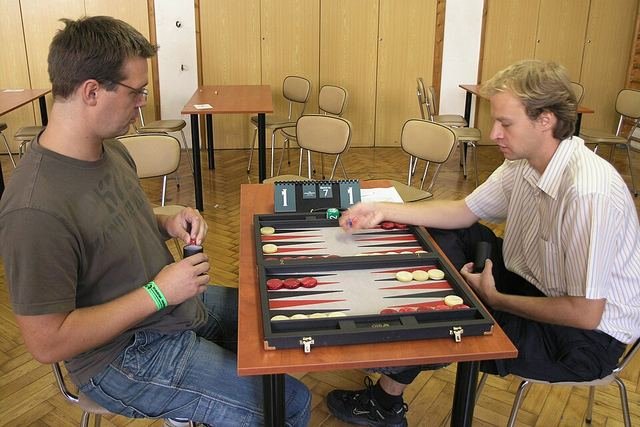
Image credit: Matěj Baťha. CC BY-SA 3.0. Source: https://commons.wikimedia.org/wiki/File:Deskohran%C3%AD_2009_353.jpg. Licence: https://creativecommons.org/licenses/by-sa/3.0/deed.en. Display, thumbnail and enlargement resized without cropping and JPEG encoded; EXIF orientation applied. Enlargement limited to 1400 pixels on its longest side, or source size if smaller. No AI edits.

Crazy Narde can turn a double into a long turn
Gul Bara is also called Crazy Narde. After the opening three rolls, a double can be followed by every higher double through 6–6. For example, 3–3 can lead to four threes, four fours, four fives and four sixes. If the required moves become impossible, the remaining sequence is lost.
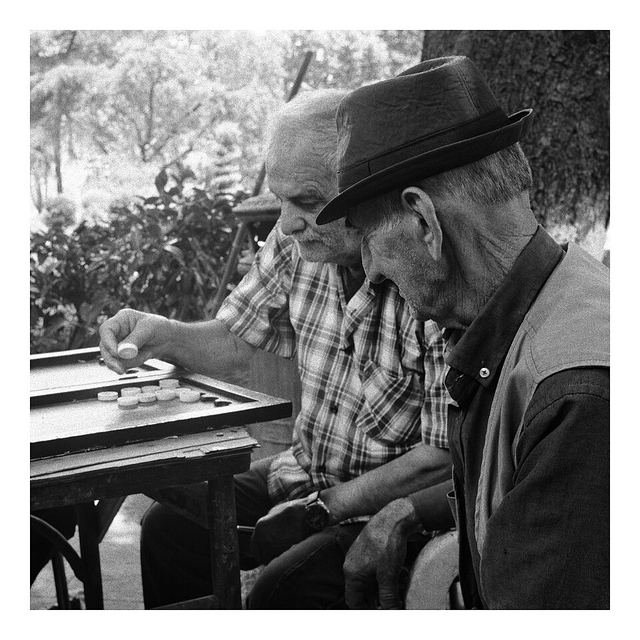
Image credit: madras91. CC BY 2.0. Source: https://commons.wikimedia.org/wiki/File:In_the_street_(50409818923).jpg. Licence: https://creativecommons.org/licenses/by/2.0/deed.en. Display, thumbnail and enlargement resized without cropping and JPEG encoded; EXIF orientation applied. Enlargement limited to 1400 pixels on its longest side, or source size if smaller. No AI edits.

Gioul gives unused doubles to the opponent
In Gioul, a rolled double starts a sequence of higher doubles through 6–6. If you cannot finish the sequence, the opponent plays the unused part. The turn therefore rewards both mobility and blocking. One checker can hold a point, and there is no hitting in this published ruleset.
Image credit: Unknown historical maker; Metropolitan Museum of Art Open Access. CC0 1.0. Source: https://commons.wikimedia.org/wiki/File:Chess_and_backgammon_board_MET_3668.jpg. Licence: https://creativecommons.org/publicdomain/zero/1.0/. Display, thumbnail and enlargement resized without cropping and JPEG encoded; EXIF orientation applied. Enlargement limited to 1400 pixels on its longest side, or source size if smaller. No AI edits.
One runner must lead the way in Moultezim
In Moultezim, your first checker must pass the opponent’s starting point before you can move any of your other checkers. Both players move in the same direction, and a single opposing checker blocks a point. The opening is therefore a carefully managed journey for one lead checker.
Image credit: Marcin Konsek / Wikimedia Commons. CC BY-SA 4.0. Source: https://commons.wikimedia.org/wiki/File:2014_Kutaisi%2C_M%C4%99%C5%BCczyzni_graj%C4%85cy_w_tryktraka.jpg. Licence: https://creativecommons.org/licenses/by-sa/4.0/. Display, thumbnail and enlargement resized without cropping and JPEG encoded; EXIF orientation applied. Enlargement limited to 1400 pixels on its longest side, or source size if smaller. No AI edits.
Plakoto Express adds a chain of doubles
Plakoto Express combines checker pinning with a sequence of higher doubles. Rolling 3–3 can be followed by 4–4, 5–5 and 6–6. If a player cannot complete the required sequence, play passes to the opponent for the unused part. This makes it different from ordinary Plakoto.
Image credit: David Berkowitz. CC BY 2.0. Source: https://commons.wikimedia.org/wiki/File:Istanbul%2C_Turkey_%2810582737355%29.jpg. Licence: https://creativecommons.org/licenses/by/2.0/. Display, thumbnail and enlargement resized without cropping and JPEG encoded; EXIF orientation applied. Enlargement limited to 1400 pixels on its longest side, or source size if smaller. No AI edits.
Portes does not use the standard doubling cube
Portes is one of the Greek tavli games. In the published rules, a normal win scores one point and a gammon scores two; there is no separate three-point backgammon result and no doubling cube. Similar-looking boards can therefore produce different scores under different regional rules.
Image credit: Sascha Kohlmann. CC BY-SA 3.0. Source: https://commons.wikimedia.org/wiki/File:Playing_Backgammon_Athens_Greece_%28113613901%29.jpeg. Licence: https://creativecommons.org/licenses/by-sa/3.0/. Display, thumbnail and enlargement resized without cropping and JPEG encoded; EXIF orientation applied. Enlargement limited to 1400 pixels on its longest side, or source size if smaller. No AI edits.
Shesh Besh narrows the backgammon condition
In the cited Shesh Besh rules, the three-point backgammon result requires the loser to have a checker on the bar, as well as having borne off none. A checker left in the winner’s home board alone does not qualify. Standard Western backgammon uses a broader condition, so agree on the rules before playing.
Image credit: Monaam Ben Fredj. CC BY-SA 4.0. Source: https://commons.wikimedia.org/wiki/File:Tawleh_Players_01.jpg. Licence: https://creativecommons.org/licenses/by-sa/4.0/. Display, thumbnail and enlargement resized without cropping and JPEG encoded; EXIF orientation applied. Enlargement limited to 1400 pixels on its longest side, or source size if smaller. No AI edits.
Bulgaria’s Tapa is a pinning game
Tapa is a Bulgarian tables game related to Greek Plakoto. Instead of sending a lone opposing checker to the bar, you can pin it by landing on it. The source explains the name tapa as bottle cap. Its published scoring includes a two-point result called mars when the loser has borne off no checkers.
Image credit: TZivyA. CC BY-SA 4.0. Source: https://commons.wikimedia.org/wiki/File:Backgammon12.jpg. Licence: https://creativecommons.org/licenses/by-sa/4.0/. Display, thumbnail and enlargement resized without cropping and JPEG encoded; EXIF orientation applied. Enlargement limited to 1400 pixels on its longest side, or source size if smaller. No AI edits.
Takhteh restricts hit-and-run at home
Takhteh is a Persian name for backgammon. In the cited rules, a checker that hits inside its own home board must stay exposed or be covered; it cannot immediately run away using the other die. This changes attacking choices. The description is of this published ruleset, since household practices can differ.
Image credit: Onceinawhile. CC BY-SA 4.0. Source: https://commons.wikimedia.org/wiki/File:Damascene-style_inlaid_Backgammon_board,_Cairo,_Khan_el-Khalili.jpg. Licence: https://creativecommons.org/licenses/by-sa/4.0/deed.en. Display, thumbnail and enlargement resized without cropping and JPEG encoded; EXIF orientation applied. Enlargement limited to 1400 pixels on its longest side, or source size if smaller. No AI edits.
Tawula starts with two checkers and thirteen waiting
In the published Tawula rules, each player begins with two checkers on the board and thirteen off it. The original pair cannot move until the waiting checkers have entered. Both sides travel in the same direction. This gives the opening a different shape from the familiar standard arrangement.
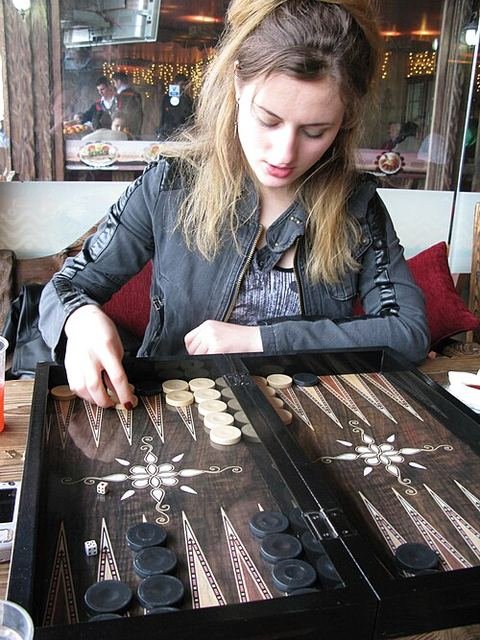
Image credit: Henri Bergius from Berlin, Germany. CC BY-SA 2.0. Source: https://commons.wikimedia.org/wiki/File:Some_backgammon_(2382705999).jpg. Licence: https://creativecommons.org/licenses/by-sa/2.0/deed.en. Display, thumbnail and enlargement resized without cropping and JPEG encoded; EXIF orientation applied. Enlargement limited to 1400 pixels on its longest side, or source size if smaller. No AI edits.

A variant lets you choose between hitting and pinning
Nicholas Frantzis’s Never-Finishing Game combines two ways to attack a lone opposing checker. You can hit it onto the bar or trap it underneath your own checker. The name is playful; the published game still has a normal finish when one player bears off all the checkers.
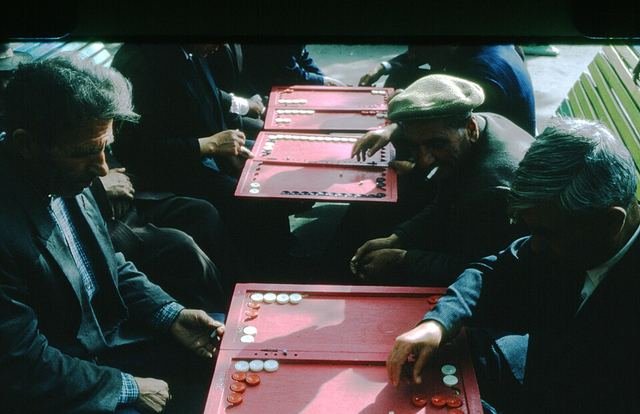
Image credit: Thomas Taylor Hammond (1920-1993). CC BY-SA 4.0. Source: https://commons.wikimedia.org/wiki/File:Hammond_Slides_Central_Asia_34.jpg. Licence: https://creativecommons.org/licenses/by-sa/4.0/deed.en. Display, thumbnail and enlargement resized without cropping and JPEG encoded; EXIF orientation applied. Enlargement limited to 1400 pixels on its longest side, or source size if smaller. No AI edits.

French Backgammon starts with an empty board
In the published French Backgammon rules, all checkers begin off the board. Doubles are followed by the numbers on the opposite faces of the dice and then another roll, if the required moves can be made. This named variant is separate from Grand Trictrac, despite their similar geographic labels.
Image credit: Sascha Kohlmann. CC BY-SA 3.0. Source: https://commons.wikimedia.org/wiki/File:Playing_Backgammon_Athens_Greece_%28113613901%29.jpeg. Licence: https://creativecommons.org/licenses/by-sa/3.0/. Display, thumbnail and enlargement resized without cropping and JPEG encoded; EXIF orientation applied. Enlargement limited to 1400 pixels on its longest side, or source size if smaller. No AI edits.
One Russian variant shares the same finishing area
The ruleset published as Russian Backgammon has both players enter through the same area and bear off from the same area, moving in the same direction. It also has special complement-doubles rules after entry. This is a named variant and should not be treated as a description of every game played in Russia.
Image credit: Marcin Konsek / Wikimedia Commons. CC BY-SA 4.0. Source: https://commons.wikimedia.org/wiki/File:2014_Kutaisi%2C_M%C4%99%C5%BCczyzni_graj%C4%85cy_w_tryktraka.jpg. Licence: https://creativecommons.org/licenses/by-sa/4.0/. Display, thumbnail and enlargement resized without cropping and JPEG encoded; EXIF orientation applied. Enlargement limited to 1400 pixels on its longest side, or source size if smaller. No AI edits.
The Pin Game scores remaining distance
In the published Pin Game, the winner scores according to the loser’s remaining pip count: the distance the checkers still need to travel to come home and bear off. Gammons and backgammons multiply that amount. Pinning replaces hitting. The result rewards not only winning but also leaving the opponent far behind.
Image credit: James Emery. CC BY 2.0. Source: https://commons.wikimedia.org/wiki/File:Backgammon_in_Nazareth_0780_%28506270689%29.jpg. Licence: https://creativecommons.org/licenses/by/2.0/. Display, thumbnail and enlargement resized without cropping and JPEG encoded; EXIF orientation applied. Enlargement limited to 1400 pixels on its longest side, or source size if smaller. No AI edits.
Swedish Tables can reward a tower
In Swedish Tables, a player can win by arranging all fifteen checkers on the final point, making a tower. It is one of several special finishing patterns called handsome wins. Once you bear off a checker, you lose the chance to make such a pattern. Winning need not mean removing every checker.
Image credit: Chris 73 / Wikimedia Commons. CC BY-SA 3.0. Source: https://commons.wikimedia.org/wiki/File:Old_Backgammon_Vasa.jpg. Licence: https://creativecommons.org/licenses/by-sa/3.0/. Display, thumbnail and enlargement resized without cropping and JPEG encoded; EXIF orientation applied. Enlargement limited to 1400 pixels on its longest side, or source size if smaller. No AI edits.
Swedish Tables can break a closed point
Under the published Swedish Tables rules, a six-point prime can be attacked: an opposing move onto one of its points sends all checkers there to the bar. There is another special exception related to re-entry space. This is very different from standard backgammon, where a made point is safe from hits.
Image credit: Chris 73 / Wikimedia Commons. CC BY-SA 3.0. Source: https://commons.wikimedia.org/wiki/File:Old_Backgammon_Vasa.jpg. Licence: https://creativecommons.org/licenses/by-sa/3.0/. Display, thumbnail and enlargement resized without cropping and JPEG encoded; EXIF orientation applied. Enlargement limited to 1400 pixels on its longest side, or source size if smaller. No AI edits.
A street game in Tbilisi was photographed in 2019
Photographer madras91 recorded people playing backgammon in Tbilisi, Georgia, in July 2019. The photograph is black and white and concentrates on the group around the board. This is a documented modern playing scene, not a claim about national participation figures or tournament results. Everyday game photographs add a different kind of history to the collection.
Image credit: madras91. CC BY 2.0. Source: https://commons.wikimedia.org/wiki/File:%E1%83%A5%E1%83%90%E1%83%A0%E1%83%97%E1%83%95%E1%83%94%E1%83%9A%E1%83%94%E1%83%91%E1%83%98_%E1%83%9C%E1%83%90%E1%83%A0%E1%83%93%E1%83%98%E1%83%A1_%E1%83%97%E1%83%90%E1%83%9B%E1%83%90%E1%83%A8%E1%83%9D%E1%83%91%E1%83%94%E1%83%9C_(48397852796).jpg. Licence: https://creativecommons.org/licenses/by/2.0/deed.en. Display, thumbnail and enlargement resized without cropping and JPEG encoded; EXIF orientation applied. Enlargement limited to 1400 pixels on its longest side, or source size if smaller. No AI edits.
Backgammon appeared at Acre’s White Market
Liorca photographed a playing scene at the White Market in Acre’s Old City in October 2017. The file is part of a heritage-photography record. The board sits between the players in a street setting. The image documents this particular scene; it does not identify the players or establish which local rules they were using.
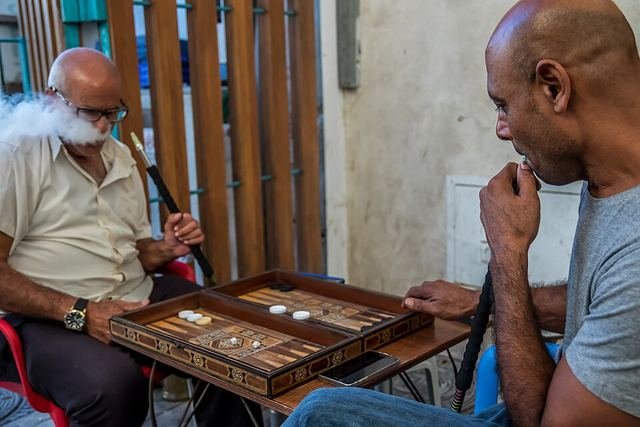
Image credit: Liorca. CC BY-SA 4.0. Source: https://commons.wikimedia.org/wiki/File:%D7%9E%D7%A9%D7%97%D7%A7%D7%99%D7%9D_%D7%A9%D7%A9-%D7%91%D7%A9_%D7%91%D7%A9%D7%95%D7%A7_%D7%94%D7%9C%D7%91%D7%9F_17.10-17.jpg. Licence: https://creativecommons.org/licenses/by-sa/4.0/deed.en. Display, thumbnail and enlargement resized without cropping and JPEG encoded; EXIF orientation applied. Enlargement limited to 1400 pixels on its longest side, or source size if smaller. No AI edits.

A Czech games festival put a board on the table
Matěj Baťha’s photograph from the 2009 Deskohraní games festival shows two players seated at a tables-game board. It was recorded in September 2009. The photograph provides a genuine modern scene from a broader games event. No winner, prize amount or exact match result is identified by this image record.
Image credit: Matěj Baťha. CC BY-SA 3.0. Source: https://commons.wikimedia.org/wiki/File:Deskohran%C3%AD_2009_353.jpg. Licence: https://creativecommons.org/licenses/by-sa/3.0/deed.en. Display, thumbnail and enlargement resized without cropping and JPEG encoded; EXIF orientation applied. Enlargement limited to 1400 pixels on its longest side, or source size if smaller. No AI edits.
A federation programme supplied boards for students
The USBGF’s history dates its Boards for Kids programme to January 2010 and describes free backgammon boards for students. Supplying equipment makes it easier to introduce the game in a group. This entry records the programme’s historical launch; it does not promise that the same offer is currently available.
Image credit: Alex Proimos. CC BY 2.0. Source: https://commons.wikimedia.org/wiki/File:Saturday_Afternoon_Backgammon_(6784476822).jpg. Licence: https://creativecommons.org/licenses/by/2.0/. Display, thumbnail and enlargement resized without cropping and JPEG encoded; EXIF orientation applied. Enlargement limited to 1400 pixels on its longest side, or source size if smaller. No AI edits.
A Goan board mixed local work with imported game forms
The Met catalogues an early nineteenth-century chess and backgammon box-board as Indo-Portuguese and made in Goa. Its materials are tortoiseshell, ivory and wood, and it opens to nearly 50 centimetres wide. The object records how familiar game forms travelled and were remade through regional craftsmanship.
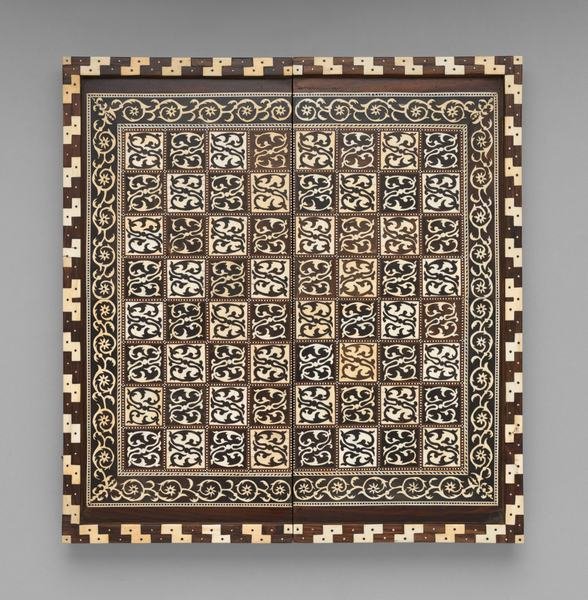
Image credit: Unknown Indo-Portuguese maker in Goa; image courtesy The Metropolitan Museum of Art. CC0 1.0. Source: https://www.metmuseum.org/art/collection/search/199971. Licence: https://creativecommons.org/publicdomain/zero/1.0/. Display, thumbnail and enlargement resized without cropping and JPEG encoded; EXIF orientation applied. The packaged enlargement is 1175 × 1200 pixels. No AI edits.
German Backgammon let opponents claim unused moves
In the German Backgammon rules recorded by Falkener in 1892, a player could use moves that an opponent forgot or could not play. That made inattention costly in an unusual way: unused movement became the other player’s opportunity. Falkener also said the same-direction race produced frequent hits.
Image credit: G41rn8. CC BY-SA 4.0. Source: https://commons.wikimedia.org/wiki/File:German_16c_Backgammon_Set_in_Vatican_Museums.jpg. Licence: https://creativecommons.org/licenses/by-sa/4.0/deed.en. Display, thumbnail and enlargement resized without cropping and JPEG encoded; EXIF orientation applied. Enlargement limited to 1400 pixels on its longest side, or source size if smaller. No AI edits.
Falkener dated his Turkish rules to play in Asia Minor
Falkener introduced his Turkish Backgammon chapter by saying he had played the game in Asia Minor in 1845. When the rules appeared in his 1892 book, they were therefore based partly on personal play nearly half a century earlier, rather than only on another writer’s description.
Image credit: David Berkowitz. CC BY 2.0. Source: https://commons.wikimedia.org/wiki/File:Istanbul%2C_Turkey_%2810582737355%29.jpg. Licence: https://creativecommons.org/licenses/by/2.0/. Display, thumbnail and enlargement resized without cropping and JPEG encoded; EXIF orientation applied. Enlargement limited to 1400 pixels on its longest side, or source size if smaller. No AI edits.
A Turkish hit had to leave a route back in
Falkener’s Turkish rules required a player who hit an opposing piece in its entry division to leave an open point for that captured piece to return. Elsewhere on the board, no such escape space was required. The rule limited how completely a player could close the entry area after a hit.
Image credit: David Berkowitz. CC BY 2.0. Source: https://commons.wikimedia.org/wiki/File:Istanbul%2C_Turkey_%2810582737355%29.jpg. Licence: https://creativecommons.org/licenses/by/2.0/. Display, thumbnail and enlargement resized without cropping and JPEG encoded; EXIF orientation applied. Enlargement limited to 1400 pixels on its longest side, or source size if smaller. No AI edits.
A Turkish capote could count as seven games
Falkener recorded a dramatic Turkish result called a capote. It occurred when one player had brought every piece home and borne one off while the opponent had a captured piece unable to re-enter behind six occupied points. The capote counted as seven games, far above an ordinary win.
Image credit: David Berkowitz. CC BY 2.0. Source: https://commons.wikimedia.org/wiki/File:Istanbul%2C_Turkey_%2810582737355%29.jpg. Licence: https://creativecommons.org/licenses/by/2.0/. Display, thumbnail and enlargement resized without cropping and JPEG encoded; EXIF orientation applied. Enlargement limited to 1400 pixels on its longest side, or source size if smaller. No AI edits.
Reporters traced the revival through Riviera society
The Indianapolis Times reported on September 22, 1930 that society players on the Riviera and the Lido during the previous winter helped revive backgammon. The newspaper’s account shows a fashionable game moving through European resort circles before becoming a heavily promoted American social activity.
Image credit: A. G. Spalding photograph supplied to NEA Service; individual photographer unidentified. Public domain in the United States (newspaper photograph published in 1930). Source: https://nebackgammon.org/index.php/1930s_chronology/. Licence: https://creativecommons.org/publicdomain/mark/1.0/. Display, thumbnail and enlargement resized without cropping and JPEG encoded; EXIF orientation applied. The packaged enlargement is 690 × 1032 pixels. No AI edits.
A Beirut shop sells pieces beside dice
Marsupium's 2025 photograph records a shelf in Karout Mall, Beirut, stocked with backgammon pieces and dice. Packaged sets, loose-looking supplies and other shop goods share the frame. The image documents the game's retail life in a particular place and time rather than a staged museum display.

Image credit: Marsupium. CC BY 4.0. Source: https://commons.wikimedia.org/wiki/File:Shop_shelf_in_Teska_shop_in_Karout_Mall_in_Beirut_with_backgammon_pieces_and_dice.jpg. Licence: https://creativecommons.org/licenses/by/4.0/deed.en. Display, thumbnail and enlargement resized without cropping and JPEG encoded; EXIF orientation applied. The packaged enlargement is 500 × 667 pixels. No AI edits.

A painted board stood at Tbilisi's Dry Bridge Market
Alexkom000 photographed a decorated backgammon board at Tbilisi's Dry Bridge Market on 19 April 2025. Displayed outdoors among market goods, the hinged set carries painted figures on its case. The image records how game boards can be sold as useful equipment, souvenirs and examples of local decorative craft.
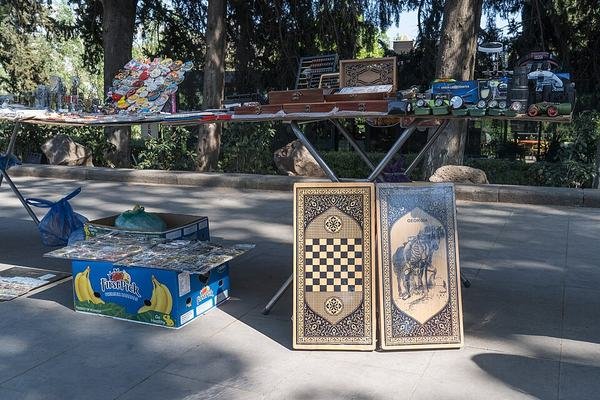
Image credit: Alexkom000. CC BY 4.0. Source: https://commons.wikimedia.org/wiki/File:2025-04-19_Backgammon_board_at_the_Dry_Bridge_Market_in_Tbilisi.jpg. Licence: https://creativecommons.org/licenses/by/4.0/deed.en. Display, thumbnail and enlargement resized without cropping and JPEG encoded; EXIF orientation applied. The packaged enlargement is 960 × 640 pixels. No AI edits.

An Athens shop stacked boards from floor to shelf
Stefanos Kofopoulos's 2007 photograph records what its caption calls a huge load of backgammons in an Athens shop. Closed wooden cases stand in dense rows, turning repeated board shapes into a retail pattern. The scene documents the visibility of tavli equipment in the Greek city rather than one particular game.
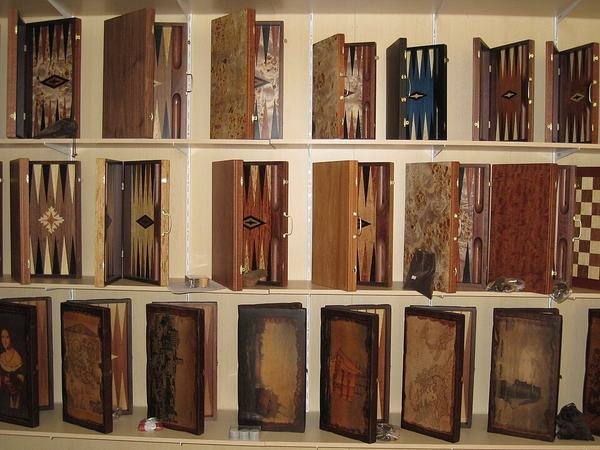
Image credit: Stefanos Kofopoulos. CC BY-SA 2.0. Source: https://commons.wikimedia.org/wiki/File:Athens,_Greece_2007.jpg. Licence: https://creativecommons.org/licenses/by-sa/2.0/deed.en. Display, thumbnail and enlargement resized without cropping and JPEG encoded; EXIF orientation applied. The packaged enlargement is 960 × 720 pixels. No AI edits.

Several carved boards share a Tbilisi market table
A second Dry Bridge Market photograph from 19 April 2025 shows several backgammon boards together. Different carved and painted exteriors can be compared in one frame. Whereas a single-board portrait highlights one design, this wider view records variety, display methods and the commercial setting of Tbilisi's open-air market.

Image credit: Alexkom000. CC BY 4.0. Source: https://commons.wikimedia.org/wiki/File:2025-04-19_Backgammon_boards_at_the_Dry_Bridge_Market_in_Tbilisi.jpg. Licence: https://creativecommons.org/licenses/by/4.0/deed.en. Display, thumbnail and enlargement resized without cropping and JPEG encoded; EXIF orientation applied. The packaged enlargement is 960 × 640 pixels. No AI edits.

A yacht carried backgammon through the Greek islands
Akella8877 photographed Alia Azamat Ashkenazi playing backgammon aboard a yacht sailing among the Greek islands in September 2023. The source identifies both player and setting. The image places a portable board within contemporary travel culture, showing a game continuing even when the table itself is moving.

Image credit: Akella8877. CC BY-SA 4.0. Source: https://commons.wikimedia.org/wiki/File:Alia_Azamat_Ashkenazi_Backgammon_Yacht.jpg. Licence: https://creativecommons.org/licenses/by-sa/4.0/deed.en. Display, thumbnail and enlargement resized without cropping and JPEG encoded; EXIF orientation applied. The packaged enlargement is 500 × 667 pixels. No AI edits.

An Armenian three-panel board opens like furniture
Varaga's 2012 photograph is captioned with the Armenian name eranardi. Its unusual wooden playing surface opens in three connected sections rather than the familiar two-part case. The image documents one regional tables-game object; the board's form should not be assumed to represent the standard modern backgammon setup.
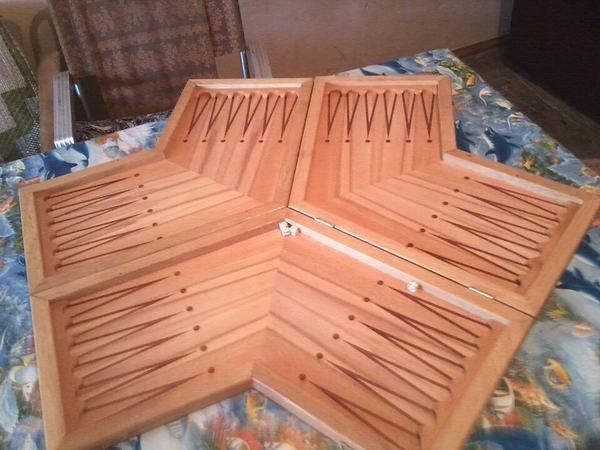
Image credit: Varaga. CC BY-SA 3.0. Source: https://commons.wikimedia.org/wiki/File:%D0%A4%D0%BE%D1%82%D0%BE0934.jpg. Licence: https://creativecommons.org/licenses/by-sa/3.0/deed.en. Display, thumbnail and enlargement resized without cropping and JPEG encoded; EXIF orientation applied. The packaged enlargement is 960 × 720 pixels. No AI edits.

An Achrafieh game entered an early digital album
A 2004 photograph from Achrafieh, Beirut, shows people playing backgammon near the homes of Patrick and Anthony. The source's informal caption preserves a neighbourhood memory rather than a public event. Its value lies in documenting ordinary social play, without naming the players or the local rule variation.
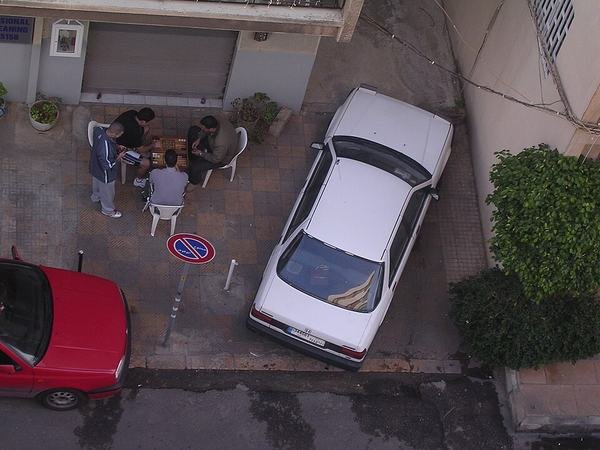
Image credit: Rekd (source-page attribution; machine-readable author absent). CC BY-SA 3.0. Source: https://commons.wikimedia.org/wiki/File:DSCN3337.JPG. Licence: https://creativecommons.org/licenses/by-sa/3.0/deed.en. Display, thumbnail and enlargement resized without cropping and JPEG encoded; EXIF orientation applied. The packaged enlargement is 960 × 720 pixels. No AI edits.

Two childhood friends play tavla in winter sun
Theigumus photographed two older childhood friends in Turkey passing time with tavla under the winter sun in 2019. Their small outdoor table and familiar companionship carry the meaning of the picture. The caption identifies the social moment but does not name the neighbourhood or the particular Turkish rules in use.

Image credit: Theigumus. CC BY-SA 4.0. Source: https://commons.wikimedia.org/wiki/File:Tavla_Oynayan_Amcalar.jpg. Licence: https://creativecommons.org/licenses/by-sa/4.0/deed.en. Display, thumbnail and enlargement resized without cropping and JPEG encoded; EXIF orientation applied. The packaged enlargement is 960 × 720 pixels. No AI edits.

A 2020 photograph locates an ordinary game in Jordan
Jose Huwaidi's photograph is simply titled Backgammon game and located in Jordan. Made in December 2020, it contributes a contemporary regional image without naming the players or event. Its limited caption supports a careful claim: the picture documents backgammon as recreation in Jordan, not a national rule variation.
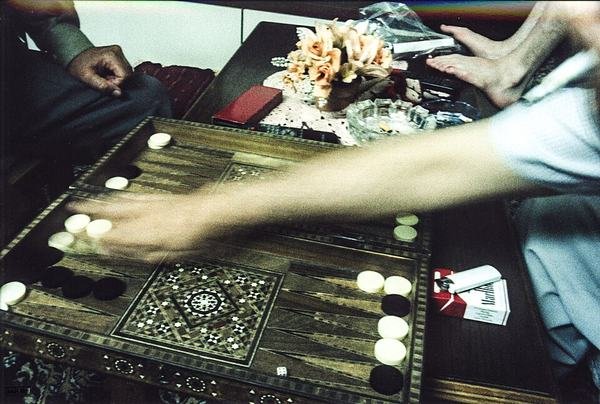
Image credit: Jose Huwaidi. CC BY-SA 4.0. Source: https://commons.wikimedia.org/wiki/File:Backgammon_game.jpg. Licence: https://creativecommons.org/licenses/by-sa/4.0/deed.en. Display, thumbnail and enlargement resized without cropping and JPEG encoded; EXIF orientation applied. The packaged enlargement is 960 × 647 pixels. No AI edits.

A Petah Tikva market game draws spectators
Udi Steinwell's 2013 photograph records people playing shesh besh at a market in Petah Tikva, Israel. Three seated men cluster around the wooden board while another watches. The archive's original Hebrew title identifies the game, giving the street scene firmer context than appearance alone would provide.

Image credit: udi Steinwell. CC BY 2.5. Source: https://commons.wikimedia.org/wiki/File:PikiWiki_Israel_28934_Cities_in_Israel.JPG. Licence: https://creativecommons.org/licenses/by/2.5/deed.en. Display, thumbnail and enlargement resized without cropping and JPEG encoded; EXIF orientation applied. The packaged enlargement is 960 × 643 pixels. No AI edits.

An Iranian game photograph centres hands and inlay
Chris Blackhead photographed a game of backgammon in Iran in 2014. The close view concentrates on a pointing hand, pale checkers and geometric inlay. Because the source gives the country but no player names or city, the photograph documents a particular Iranian game scene without turning it into a claim about all play there.
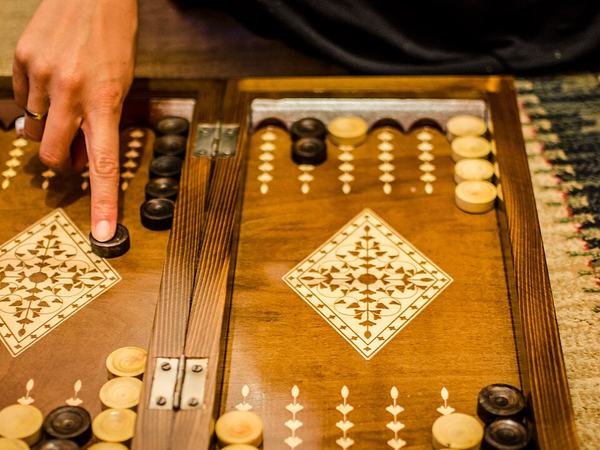
Image credit: Chris Blackhead. CC BY-SA 2.0. Source: https://commons.wikimedia.org/wiki/File:Backgammon_Iran.jpg. Licence: https://creativecommons.org/licenses/by-sa/2.0/deed.en. Display, thumbnail and enlargement resized without cropping and JPEG encoded; EXIF orientation applied. The packaged enlargement is 960 × 720 pixels. No AI edits.

Tel Aviv installed tables boards in public space
Beko's 2018 photograph shows a dedicated backgammon area in Tel Aviv. A board pattern is fixed onto a concrete picnic table with matching stools, making equipment part of the streetscape. Unlike a portable case, the installation invites play only at that location and treats the city itself as the games room.

Image credit: Beko. CC BY-SA 4.0. Source: https://commons.wikimedia.org/wiki/File:Backgammon_area_in_Tel_Aviv_(1).jpg. Licence: https://creativecommons.org/licenses/by-sa/4.0/deed.en. Display, thumbnail and enlargement resized without cropping and JPEG encoded; EXIF orientation applied. The packaged enlargement is 960 × 640 pixels. No AI edits.

Tavla filled time at a 2013 vigil
Bernd Schwabe photographed men playing tavla during a 2013 vigil in Hanover connected with protests in Turkey. The board occupies their waiting time within a political public gathering. The caption identifies the context and participants broadly, while the image does not record their names, score or chosen tables variant.

Image credit: Bernd Schwabe in Hannover. CC BY 3.0. Source: https://commons.wikimedia.org/wiki/File:37g9f_W%C3%A4hrend_die_mittelalte_Generation_bei_der_Mahnwache_auf_dem_Klagesmarkt_in_Hannover_noch_offline_Tavla_Backgammon_spielt_….jpg. Licence: https://creativecommons.org/licenses/by/3.0/deed.en. Display, thumbnail and enlargement resized without cropping and JPEG encoded; EXIF orientation applied. The packaged enlargement is 960 × 727 pixels. No AI edits.

A Beirut shelf displays boards by their closed covers
Marsupium photographed backgammon boards on a shop shelf in Karout Mall, Beirut, in January 2025. Most sets are closed, so carved lids and case sizes sell the objects before customers see their interiors. The image records how board design functions as packaging, decoration and retail display at once.
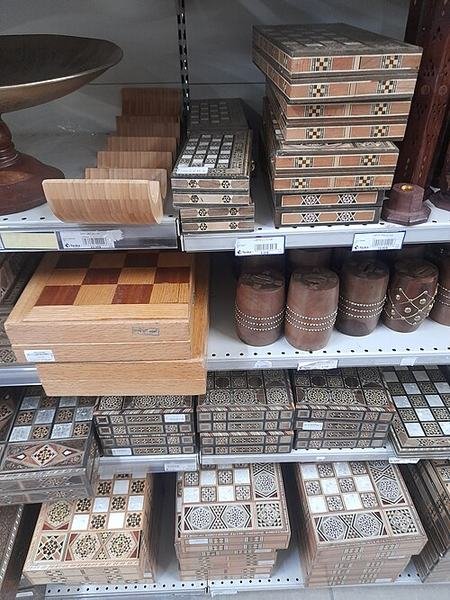
Image credit: Marsupium. CC BY 4.0. Source: https://commons.wikimedia.org/wiki/File:Shop_shelf_in_Teska_shop_in_Karout_Mall_in_Beirut_with_backgammon_boards_02.jpg. Licence: https://creativecommons.org/licenses/by/4.0/deed.en. Display, thumbnail and enlargement resized without cropping and JPEG encoded; EXIF orientation applied. The packaged enlargement is 500 × 667 pixels. No AI edits.

Habima Square built a board into concrete
Maor X photographed a backgammon board built into one of the concrete tables at Habima Square, Tel Aviv, in 2017. Circular seats surround the permanent surface. The design moves a normally portable game into civic furniture, allowing passers-by to bring pieces and turn the square into a shared play space.

Image credit: Maor X. CC BY-SA 4.0. Source: https://commons.wikimedia.org/wiki/File:Backgammon_board_at_Habima_Square,_Tel_Aviv.jpg. Licence: https://creativecommons.org/licenses/by-sa/4.0/deed.en. Display, thumbnail and enlargement resized without cropping and JPEG encoded; EXIF orientation applied. The packaged enlargement is 960 × 640 pixels. No AI edits.

Tyumen's friendship festival made room for backgammon
RG72 photographed people playing backgammon outdoors at the Bridge of Friendship ethnic festival in Tyumen, Russia, on 12 June 2026. The source's Esperanto caption names the event, while Commons categories identify the activity. The scene documents recreation within a public festival rather than a formal backgammon tournament.

Image credit: RG72. CC BY 4.0. Source: https://commons.wikimedia.org/wiki/File:Etna_festivalo_%22Ponto_de_Amikeco%22_(2026)_14.jpg. Licence: https://creativecommons.org/licenses/by/4.0/deed.en. Display, thumbnail and enlargement resized without cropping and JPEG encoded; EXIF orientation applied. The packaged enlargement is 960 × 432 pixels. No AI edits.

Greek coffee joins tavli in a close still life
Nikos Kitsakis's 2021 photograph places a cup of Greek coffee beside an open tavli board. Only part of the playing surface appears, letting the drink, spoon, points and red checker share the composition. It is a cultural still life, not evidence that coffee forms part of any formal game rule.
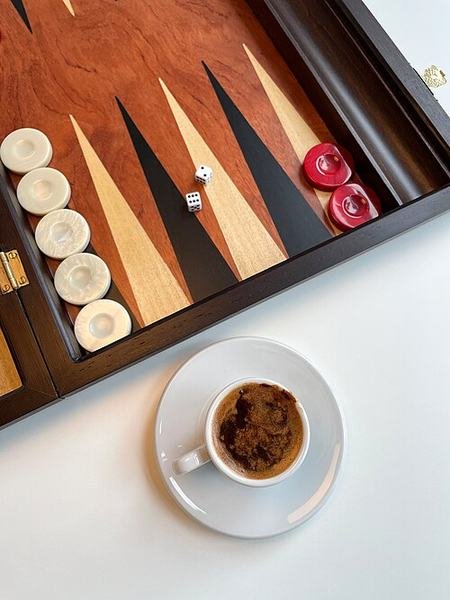
Image credit: Nikos Kitsakis. CC BY 4.0. Source: https://commons.wikimedia.org/wiki/File:Greek_Coffee_next_to_a_board_of_Tavli.jpg. Licence: https://creativecommons.org/licenses/by/4.0/deed.en. Display, thumbnail and enlargement resized without cropping and JPEG encoded; EXIF orientation applied. The packaged enlargement is 500 × 667 pixels. No AI edits.

Rothschild Boulevard offered an oversized board
Yehudit Garinkol's 2012 photograph records a large public shesh besh board on Rothschild Boulevard in Tel Aviv. The playing fields are built into a street table rather than carried in a case. Enlarged civic equipment turns a two-player game into part of the boulevard's visible recreational landscape.
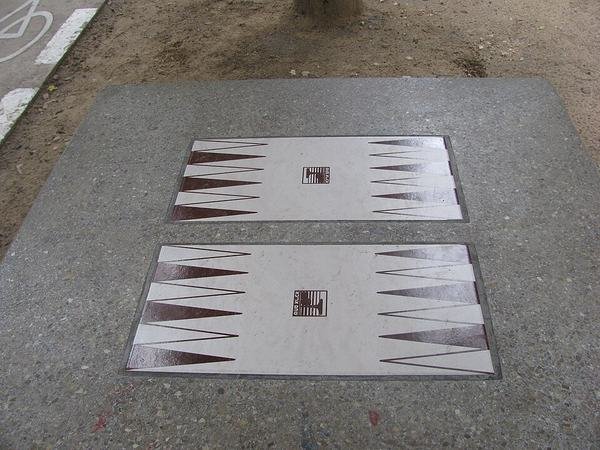
Image credit: Yehudit Garinkol. CC BY 2.5. Source: https://commons.wikimedia.org/wiki/File:PikiWiki_Israel_20272_Rothschild_Boulevard.JPG. Licence: https://creativecommons.org/licenses/by/2.5/deed.en. Display, thumbnail and enlargement resized without cropping and JPEG encoded; EXIF orientation applied. The packaged enlargement is 960 × 720 pixels. No AI edits.

A 1998 Acre photograph records play in the old city
Moshe Milner photographed a backgammon game in Acre's old city on 25 May 1998. Players and onlookers sit along a stone-lined street with the board between them. The Government Press Office caption supplies the place and date, distinguishing this scene from later backgammon photographs made elsewhere in Acre.
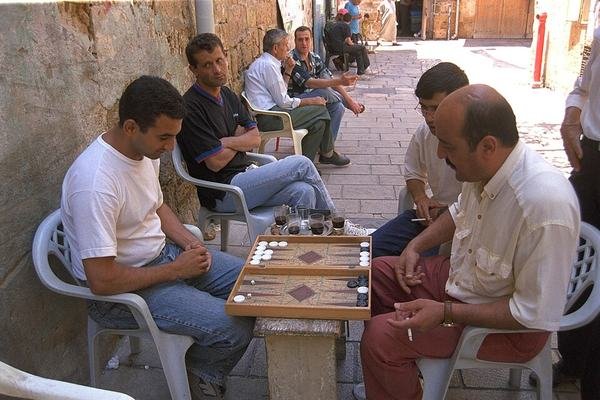
Image credit: Moshe Milner / Government Press Office. CC BY-SA 3.0. Source: https://commons.wikimedia.org/wiki/File:Flickr_-_Government_Press_Office_(GPO)_-_Backgammon_in_Acre.jpg. Licence: https://creativecommons.org/licenses/by-sa/3.0/deed.en. Display, thumbnail and enlargement resized without cropping and JPEG encoded; EXIF orientation applied. The packaged enlargement is 960 × 640 pixels. No AI edits.

Fifteen checkers wait off the Acey-Deucey board
American Acey-Deucey begins with every checker off the board. A roll can be used to enter checkers in the opponent’s home board, move checkers already entered, or do both. That opening creates a gradual build-up instead of standard backgammon’s ready-made starting formation.
Image credit: Ptkfgs. Public domain (author dedication). Source: https://commons.wikimedia.org/wiki/File:Backgammon_PrecisionDice.jpg. Licence: https://creativecommons.org/publicdomain/mark/1.0/. Display, thumbnail and enlargement resized without cropping and JPEG encoded; EXIF orientation applied. Enlargement limited to 1400 pixels on its longest side, or source size if smaller. No AI edits.
One-two can earn a chosen double and another roll
In the published American Acey-Deucey rules, a player who rolls 1–2 first plays those numbers, then chooses any double and plays it, then rolls again. Another 1–2 can repeat the sequence, making this one modest-looking roll the variant’s most powerful result.
Image credit: Ptkfgs. Public domain (author dedication). Source: https://commons.wikimedia.org/wiki/File:Backgammon_PrecisionDice.jpg. Licence: https://creativecommons.org/publicdomain/mark/1.0/. Display, thumbnail and enlargement resized without cropping and JPEG encoded; EXIF orientation applied. Enlargement limited to 1400 pixels on its longest side, or source size if smaller. No AI edits.
An incomplete one-two can end the whole bonus
American Acey-Deucey links its bonus to completing the ordinary 1–2. If either number cannot be played, the player loses the chosen double and the extra roll. A player may choose a double that cannot be fully used, but doing so also ends the turn.
Image credit: Ptkfgs. Public domain (author dedication). Source: https://commons.wikimedia.org/wiki/File:Backgammon_PrecisionDice.jpg. Licence: https://creativecommons.org/publicdomain/mark/1.0/. Display, thumbnail and enlargement resized without cropping and JPEG encoded; EXIF orientation applied. Enlargement limited to 1400 pixels on its longest side, or source size if smaller. No AI edits.
European Acey-Deucey demands exact bear-offs
Once all checkers are home in the cited European Acey-Deucey rules, they may only be borne off. A checker needs the exact number of its point; an oversized roll cannot remove a lower checker. Empty-point numbers are simply lost, making the final stage slower and more exacting.
Image credit: Monaam Ben Fredj. CC BY-SA 4.0. Source: https://commons.wikimedia.org/wiki/File:Tawleh_Players_01.jpg. Licence: https://creativecommons.org/licenses/by-sa/4.0/. Display, thumbnail and enlargement resized without cropping and JPEG encoded; EXIF orientation applied. Enlargement limited to 1400 pixels on its longest side, or source size if smaller. No AI edits.
A broken double loses its hidden second half
European Acey-Deucey gives a double its opposite-face complement, but only after all four original moves are used. If a player can use just three parts of 4–4, for example, the four threes and the promised extra roll disappear with the unusable fourth four.
Image credit: Ptkfgs. Public domain (author dedication). Source: https://commons.wikimedia.org/wiki/File:Backgammon_PrecisionDice.jpg. Licence: https://creativecommons.org/publicdomain/mark/1.0/. Display, thumbnail and enlargement resized without cropping and JPEG encoded; EXIF orientation applied. Enlargement limited to 1400 pixels on its longest side, or source size if smaller. No AI edits.
Some European games let one-two raise the stakes
The cited European Acey-Deucey rules use neither gammons nor a standard doubling cube. They also record a local option in which every 1–2 automatically doubles the stakes. It is a useful reminder that published variant pages may preserve optional customs as well as a core ruleset.
Image credit: Monaam Ben Fredj. CC BY-SA 4.0. Source: https://commons.wikimedia.org/wiki/File:Tawleh_Players_01.jpg. Licence: https://creativecommons.org/licenses/by-sa/4.0/. Display, thumbnail and enlargement resized without cropping and JPEG encoded; EXIF orientation applied. Enlargement limited to 1400 pixels on its longest side, or source size if smaller. No AI edits.
Three Greek variant names describe how they play
A Greek Tavli article translates Portes as “doors,” Plakoto through a verb meaning to place something on top, and Fevga as “to run.” Each name points toward a signature idea: blocking, pinning or racing. The vocabulary makes the three-game rotation easier to remember without claiming that every household uses identical rules.
Image credit: Sascha Kohlmann. CC BY-SA 3.0. Source: https://commons.wikimedia.org/wiki/File:Playing_Backgammon_Athens_Greece_%28113613901%29.jpeg. Licence: https://creativecommons.org/licenses/by-sa/3.0/. Display, thumbnail and enlargement resized without cropping and JPEG encoded; EXIF orientation applied. Enlargement limited to 1400 pixels on its longest side, or source size if smaller. No AI edits.
Greek Acey-Deucey starts from one crowded point
In the published Greek Acey-Deucey setup, all fifteen checkers begin together on the opponent’s one-point. That differs from both standard backgammon and versions of Acey-Deucey that start with every checker off the board, even though all share a special treatment of the 1–2 roll.
Image credit: Sascha Kohlmann. CC BY-SA 3.0. Source: https://commons.wikimedia.org/wiki/File:Playing_Backgammon_Athens_Greece_%28113613901%29.jpeg. Licence: https://creativecommons.org/licenses/by-sa/3.0/. Display, thumbnail and enlargement resized without cropping and JPEG encoded; EXIF orientation applied. Enlargement limited to 1400 pixels on its longest side, or source size if smaller. No AI edits.
Ace-Deo stops after its chosen double
A 1–2 in the cited Greek Acey-Deucey rules lets the player move the one and two, then choose and play a double. The turn ends there. American and European forms commonly add another roll, so this small difference can greatly shorten a lucky sequence.
Image credit: Ptkfgs. Public domain (author dedication). Source: https://commons.wikimedia.org/wiki/File:Backgammon_PrecisionDice.jpg. Licence: https://creativecommons.org/publicdomain/mark/1.0/. Display, thumbnail and enlargement resized without cropping and JPEG encoded; EXIF orientation applied. Enlargement limited to 1400 pixels on its longest side, or source size if smaller. No AI edits.
Blocking Express climbs from a double to sixes
Blocking Express adds a ladder to ordinary Blocking Backgammon. A player who rolls 3–3 must try four threes, then four fours, four fives and four sixes. The long sequence rewards open routes, while the variant’s unusual one-checker blocks can stop it abruptly.
Image credit: Niko Kitsakis. CC BY 4.0. Source: https://commons.wikimedia.org/wiki/File:Tavli_Board_without_slots_%28traditional%29_B.jpg. Licence: https://creativecommons.org/licenses/by/4.0/. Display, thumbnail and enlargement resized without cropping and JPEG encoded; EXIF orientation applied. Enlargement limited to 1400 pixels on its longest side, or source size if smaller. No AI edits.
A high roll chooses the box and captain
A common chouette begins with every player rolling one die. The highest roller becomes the box, playing alone, while the second-highest becomes captain of the opposing team and moves its checkers. The remaining rolls establish the team’s rotation, with tied players rolling again.
Image credit: Liz Cooke. CC BY-SA 3.0. Source: https://commons.wikimedia.org/wiki/File:Backgammon_Players%2C_Brighton_Beach%2C_Brooklyn_2012.jpg. Licence: https://creativecommons.org/licenses/by-sa/3.0/. Display, thumbnail and enlargement resized without cropping and JPEG encoded; EXIF orientation applied. Enlargement limited to 1400 pixels on its longest side, or source size if smaller. No AI edits.
Consultation rules can change from club to club
Some chouettes allow the team to discuss every checker play, while others forbid advice. A published compromise permits consultation only after the cube has been turned. Newcomers are advised to learn the local custom first because there is no universal chouette rulebook.
Image credit: Liz Cooke. CC BY-SA 3.0. Source: https://commons.wikimedia.org/wiki/File:Backgammon_Players%2C_Brighton_Beach%2C_Brooklyn_2012.jpg. Licence: https://creativecommons.org/licenses/by-sa/3.0/. Display, thumbnail and enlargement resized without cropping and JPEG encoded; EXIF orientation applied. Enlargement limited to 1400 pixels on its longest side, or source size if smaller. No AI edits.
Every teammate may own a separate cube
Most modern chouettes described by Backgammon Galore use multiple cubes. Each team member may double the box independently and answer a double independently. The same board can therefore carry several financial contests at once, with different cube values and even different winners.
Image credit: Liz Cooke. CC BY-SA 3.0. Source: https://commons.wikimedia.org/wiki/File:Backgammon_Players%2C_Brighton_Beach%2C_Brooklyn_2012.jpg. Licence: https://creativecommons.org/licenses/by-sa/3.0/. Display, thumbnail and enlargement resized without cropping and JPEG encoded; EXIF orientation applied. Enlargement limited to 1400 pixels on its longest side, or source size if smaller. No AI edits.
Domino Backgammon freezes its runners for three turns
Although players choose dominoes instead of rolling dice, the published rules add another opening restriction: the back checkers may not move until the player’s fourth turn. Early tile choices must therefore develop the rest of the position, saving escape plans for later.
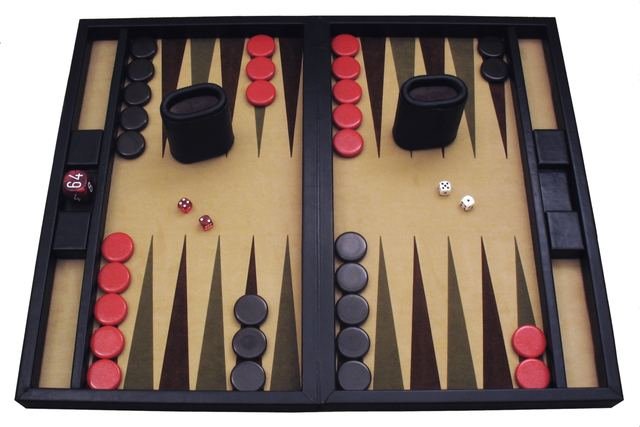
Image credit: Ptkfgs. Public domain. Source: https://commons.wikimedia.org/wiki/File:Backgammon_lg.jpg. Licence: https://creativecommons.org/publicdomain/mark/1.0/. Display, thumbnail and enlargement resized without cropping and JPEG encoded; EXIF orientation applied. Enlargement limited to 1400 pixels on its longest side, or source size if smaller. No AI edits. Source image has a digitally removed carpet background.

Used domino rolls return face down
A player selects a non-double domino, plays its two numbers like a dice roll, then returns the tile face down to its place. When both non-double collections are exhausted, the players swap those collections and continue. The movement supply therefore renews in a predictable cycle.
Image credit: Ptkfgs. Public domain. Source: https://commons.wikimedia.org/wiki/File:Backgammon_lg.jpg. Licence: https://creativecommons.org/publicdomain/mark/1.0/. Display, thumbnail and enlargement resized without cropping and JPEG encoded; EXIF orientation applied. Enlargement limited to 1400 pixels on its longest side, or source size if smaller. No AI edits. Source image has a digitally removed carpet background.
Mahbouseh turns every checker left into a point
In Mahbouseh, a Southwest Asian tables game, the winner scores one point for every opposing checker still on the board, and play continues until someone reaches 31. The Digital Ludeme Project cites R. Barakat’s 1974 study of Arabic folklore for this rule set.
Image credit: Liorca. CC BY-SA 4.0. Source: https://commons.wikimedia.org/wiki/File:%D7%9E%D7%A9%D7%97%D7%A7%D7%99%D7%9D_%D7%A9%D7%A9-%D7%91%D7%A9_%D7%91%D7%A9%D7%95%D7%A7_%D7%94%D7%9C%D7%91%D7%9F_17.10-17.jpg. Licence: https://creativecommons.org/licenses/by-sa/4.0/deed.en. Display, thumbnail and enlargement resized without cropping and JPEG encoded; EXIF orientation applied. Enlargement limited to 1400 pixels on its longest side, or source size if smaller. No AI edits.
Dutch Backgammon delays every possible hit
Although Dutch Backgammon begins with all checkers off the board, hitting is not immediately allowed. A player must first bring at least one checker all the way into their own home board. Until then, opposing blots are safe even when an ordinary backgammon hit would be available.

Image credit: upyernoz. CC BY 2.0. Source: https://commons.wikimedia.org/wiki/File:Beckgammon_Players_(2893114310).jpg. Licence: https://creativecommons.org/licenses/by/2.0/. Display, thumbnail and enlargement resized without cropping and JPEG encoded; EXIF orientation applied. Enlargement limited to 1400 pixels on its longest side, or source size if smaller. No AI edits.

Dutch turns can mix entry and forward movement
After entering at least one checker in Dutch Backgammon, a later roll may be split between bringing another checker onto the board and moving an entered checker forward. The player is not required to enter all fifteen before beginning the journey, unlike several other empty-board variants.
Image credit: upyernoz. CC BY 2.0. Source: https://commons.wikimedia.org/wiki/File:Beckgammon_Players_(2893114310).jpg. Licence: https://creativecommons.org/licenses/by/2.0/. Display, thumbnail and enlargement resized without cropping and JPEG encoded; EXIF orientation applied. Enlargement limited to 1400 pixels on its longest side, or source size if smaller. No AI edits.
Dutch scoring stops at two points
The cited Dutch Backgammon rules score one point for a normal win and two when the loser has borne off nothing. They do not use the doubling cube or a separate three-point backgammon result. Its scoring is therefore simpler than standard Western money play.
Image credit: upyernoz. CC BY 2.0. Source: https://commons.wikimedia.org/wiki/File:Beckgammon_Players_(2893114310).jpg. Licence: https://creativecommons.org/licenses/by/2.0/. Display, thumbnail and enlargement resized without cropping and JPEG encoded; EXIF orientation applied. Enlargement limited to 1400 pixels on its longest side, or source size if smaller. No AI edits.
A single checker owns a Fevga point
Fevga has no hitting. Even one opposing checker closes a point, so a lone piece acts like a two-checker point in standard backgammon. This makes continuous barriers easier to build and turns the game toward timing, movement and blocking instead of sending pieces to the bar.
Image credit: Sascha Kohlmann. CC BY-SA 3.0. Source: https://commons.wikimedia.org/wiki/File:Playing_Backgammon_Athens_Greece_%28113613901%29.jpeg. Licence: https://creativecommons.org/licenses/by-sa/3.0/. Display, thumbnail and enlargement resized without cropping and JPEG encoded; EXIF orientation applied. Enlargement limited to 1400 pixels on its longest side, or source size if smaller. No AI edits.
Fevga sends one pioneer past the enemy start
Before moving any other checker in Fevga, a player must send the first checker past the opponent’s starting point. If that pioneer becomes blocked, the rest of the stack must wait. The rule gives the opening checker a special job that shapes the early game.
Image credit: Sascha Kohlmann. CC BY-SA 3.0. Source: https://commons.wikimedia.org/wiki/File:Playing_Backgammon_Athens_Greece_%28113613901%29.jpeg. Licence: https://creativecommons.org/licenses/by-sa/3.0/. Display, thumbnail and enlargement resized without cropping and JPEG encoded; EXIF orientation applied. Enlargement limited to 1400 pixels on its longest side, or source size if smaller. No AI edits.
Fevga forbids a complete starting-board wall
The published Fevga rules do not allow a player to close all six points in the starting table. A six-point prime may exist elsewhere, but if the opponent’s entire army is trapped on the point behind it, one point must be opened to allow movement.
Image credit: Sascha Kohlmann. CC BY-SA 3.0. Source: https://commons.wikimedia.org/wiki/File:Playing_Backgammon_Athens_Greece_%28113613901%29.jpeg. Licence: https://creativecommons.org/licenses/by-sa/3.0/. Display, thumbnail and enlargement resized without cropping and JPEG encoded; EXIF orientation applied. Enlargement limited to 1400 pixels on its longest side, or source size if smaller. No AI edits.
French Backgammon enters all fifteen before advancing
Every checker begins off the board in French Backgammon, and all fifteen must enter the opponent’s home board before any checker moves forward. This creates a distinct entry phase, unlike European Acey-Deucey, where players may mix entry with movement.
Image credit: Marie Bracquemond; reproduction via Artcurial / Wikimedia Commons. Public domain (PD-Art). Source: https://commons.wikimedia.org/wiki/File:Marie_Bracquemond_-_Les_joueuses_de_jacquet%2C_dit_aussi_%27La_Partie_de_jacquet%27.jpg. Licence: https://creativecommons.org/publicdomain/mark/1.0/. Display, thumbnail and enlargement resized without cropping and JPEG encoded; EXIF orientation applied. Enlargement limited to 1400 pixels on its longest side, or source size if smaller. No AI edits.
French Backgammon offers a running or rolling wall
The source describes two broad strategies. A player may run a few checkers ahead to build home-board blocks while leaving others back to hit, or keep the army together as a prime that rolls forward. Complement doubles make either plan capable of sudden movement.
Image credit: Marie Bracquemond; reproduction via Artcurial / Wikimedia Commons. Public domain (PD-Art). Source: https://commons.wikimedia.org/wiki/File:Marie_Bracquemond_-_Les_joueuses_de_jacquet%2C_dit_aussi_%27La_Partie_de_jacquet%27.jpg. Licence: https://creativecommons.org/publicdomain/mark/1.0/. Display, thumbnail and enlargement resized without cropping and JPEG encoded; EXIF orientation applied. Enlargement limited to 1400 pixels on its longest side, or source size if smaller. No AI edits.
Grasshopper moves by quadrants instead of pips
A normal Grasshopper move takes one checker from any of the first three quadrants and places it on an empty point in the next quadrant. There are no dice or fixed pip counts. Position, open landing points and the walls already built determine every legal choice.
Image credit: Robertgombos. CC BY-SA 4.0. Source: https://commons.wikimedia.org/wiki/File:Backgammon_table.jpg. Licence: https://creativecommons.org/licenses/by-sa/4.0/. Display, thumbnail and enlargement resized without cropping and JPEG encoded; EXIF orientation applied. Enlargement limited to 1400 pixels on its longest side, or source size if smaller. No AI edits.
A Grasshopper wall both blocks and jumps
Two friendly checkers exactly six points apart can combine into a wall. Single checkers of either colour cannot cross it, but the top checker of a wall can jump over any number of walls if a legal landing awaits. The same structure is therefore barrier and mobile piece.
Image credit: Robertgombos. CC BY-SA 4.0. Source: https://commons.wikimedia.org/wiki/File:Backgammon_table.jpg. Licence: https://creativecommons.org/licenses/by-sa/4.0/. Display, thumbnail and enlargement resized without cropping and JPEG encoded; EXIF orientation applied. Enlargement limited to 1400 pixels on its longest side, or source size if smaller. No AI edits.
A 1997 primer ranged from rules to table experiments
The catalogue record for J. du C. Vere Molyneux's 126-page Begin Backgammon lists a broad syllabus: rules, elementary strategy, probabilities, a sample game, doubling, tournaments and etiquette. It ends with the tables-game family and experiments on the backgammon board.
Image credit: Robertgombos. CC BY-SA 4.0. Source: https://commons.wikimedia.org/wiki/File:Backgammon_table.jpg. Licence: https://creativecommons.org/licenses/by-sa/4.0/. Display, thumbnail and enlargement resized without cropping and JPEG encoded; EXIF orientation applied. Enlargement limited to 1400 pixels on its longest side, or source size if smaller. No AI edits.
Hyper-backgammon keeps the cube in a tiny game
Despite using only three checkers per side, Hyper-backgammon retains the doubling cube and ordinary single, gammon and backgammon scores. The published rules apply the Jacoby rule, so extra gammon values in money play remain inactive until a double has been offered and accepted.
Image credit: Ptkfgs. Public domain. Source: https://commons.wikimedia.org/wiki/File:Backgammon_lg.jpg. Licence: https://creativecommons.org/publicdomain/mark/1.0/. Display, thumbnail and enlargement resized without cropping and JPEG encoded; EXIF orientation applied. Enlargement limited to 1400 pixels on its longest side, or source size if smaller. No AI edits. Source image has a digitally removed carpet background.
Thirty-two million Hyper positions were solved
Hugh Sconyers calculated the exact equity of all 32 million possible Hyper-backgammon positions, according to the cited rules page. That made the three-checker variant solvable for perfect computer play, a manageable universe compared with full backgammon’s enormous number of positions.
Image credit: Ptkfgs. Public domain. Source: https://commons.wikimedia.org/wiki/File:Backgammon_lg.jpg. Licence: https://creativecommons.org/publicdomain/mark/1.0/. Display, thumbnail and enlargement resized without cropping and JPEG encoded; EXIF orientation applied. Enlargement limited to 1400 pixels on its longest side, or source size if smaller. No AI edits. Source image has a digitally removed carpet background.
Jacquet players travel in the same direction
Jacquet’s published setup places fifteen checkers per player on opposite far-side corners. Both armies move counterclockwise along the same route toward different finishing tables. That shared direction separates historical French Jacquet from modern backgammon, where opponents travel opposite ways around the board.
Image credit: Marie Bracquemond; reproduction via Artcurial / Wikimedia Commons. Public domain (PD-Art). Source: https://commons.wikimedia.org/wiki/File:Marie_Bracquemond_-_Les_joueuses_de_jacquet%2C_dit_aussi_%27La_Partie_de_jacquet%27.jpg. Licence: https://creativecommons.org/publicdomain/mark/1.0/. Display, thumbnail and enlargement resized without cropping and JPEG encoded; EXIF orientation applied. Enlargement limited to 1400 pixels on its longest side, or source size if smaller. No AI edits.
Jacquet limits building near the start
Jacquet allows no more than two closed points in a player’s starting table and no more than two checkers on the midpoint. These limits prevent heavy early barriers while the courier and the remaining army travel around the shared route.
Image credit: Marie Bracquemond; reproduction via Artcurial / Wikimedia Commons. Public domain (PD-Art). Source: https://commons.wikimedia.org/wiki/File:Marie_Bracquemond_-_Les_joueuses_de_jacquet%2C_dit_aussi_%27La_Partie_de_jacquet%27.jpg. Licence: https://creativecommons.org/publicdomain/mark/1.0/. Display, thumbnail and enlargement resized without cropping and JPEG encoded; EXIF orientation applied. Enlargement limited to 1400 pixels on its longest side, or source size if smaller. No AI edits.
Jacquet bear-off begins with the farthest checker
In Jacquet, a bear-off die must equal or exceed the farthest-back checker’s point number. A nearer checker cannot leave while a farther one blocks that choice, and players may not waste pips when a checker can legally bear off.
Image credit: Marie Bracquemond; reproduction via Artcurial / Wikimedia Commons. Public domain (PD-Art). Source: https://commons.wikimedia.org/wiki/File:Marie_Bracquemond_-_Les_joueuses_de_jacquet%2C_dit_aussi_%27La_Partie_de_jacquet%27.jpg. Licence: https://creativecommons.org/publicdomain/mark/1.0/. Display, thumbnail and enlargement resized without cropping and JPEG encoded; EXIF orientation applied. Enlargement limited to 1400 pixels on its longest side, or source size if smaller. No AI edits.
Jacquet could reward winning without a prime
Jacquet scores an ordinary win at one point and marcia, a shutout, at two. Marcia per punto scores three when the winner has never built a six-point prime, so the rules can reward reaching a shutout without the strongest continuous barrier.
Image credit: Marie Bracquemond; reproduction via Artcurial / Wikimedia Commons. Public domain (PD-Art). Source: https://commons.wikimedia.org/wiki/File:Marie_Bracquemond_-_Les_joueuses_de_jacquet%2C_dit_aussi_%27La_Partie_de_jacquet%27.jpg. Licence: https://creativecommons.org/publicdomain/mark/1.0/. Display, thumbnail and enlargement resized without cropping and JPEG encoded; EXIF orientation applied. Enlargement limited to 1400 pixels on its longest side, or source size if smaller. No AI edits.
Mexican Backgammon plays the lower die first
The published Mexican Backgammon rules require the smaller number of a mixed roll to be played before the larger one. Standard backgammon lets a player choose the order when both can be used, so this compulsory order changes legal combinations and can make a seemingly open move impossible.
Image credit: Ptkfgs. Public domain (author dedication). Source: https://commons.wikimedia.org/wiki/File:Backgammon_PrecisionDice.jpg. Licence: https://creativecommons.org/publicdomain/mark/1.0/. Display, thumbnail and enlargement resized without cropping and JPEG encoded; EXIF orientation applied. Enlargement limited to 1400 pixels on its longest side, or source size if smaller. No AI edits.
One-two chooses a double but ends the Mexican turn
In this named ruleset, 1–2 is followed by a double chosen by the roller. Unlike American Acey-Deucey, there is no extra roll after the chosen double. The bonus is powerful but contained, and the page cautions only by presenting one published version of the game.
Image credit: Ptkfgs. Public domain (author dedication). Source: https://commons.wikimedia.org/wiki/File:Backgammon_PrecisionDice.jpg. Licence: https://creativecommons.org/publicdomain/mark/1.0/. Display, thumbnail and enlargement resized without cropping and JPEG encoded; EXIF orientation applied. Enlargement limited to 1400 pixels on its longest side, or source size if smaller. No AI edits.
Mexican Backgammon scores checkers left behind
The winner scores one point for every opposing checker not yet borne off under the cited Mexican Backgammon rules. Gammons and backgammons do not add multipliers, and no doubling cube is used. The final score therefore measures how many pieces the loser failed to finish.
Image credit: Niko Kitsakis. CC BY 4.0. Source: https://commons.wikimedia.org/wiki/File:Tavli_Board_without_slots_%28traditional%29_B.jpg. Licence: https://creativecommons.org/licenses/by/4.0/. Display, thumbnail and enlargement resized without cropping and JPEG encoded; EXIF orientation applied. Enlargement limited to 1400 pixels on its longest side, or source size if smaller. No AI edits.
Misere has one way to win and two ways to lose
In the published Misere rules, the winner is the last player with checkers remaining. A player loses immediately by bearing off the final checker or by becoming unable to move. Blocking every route can therefore be just as dangerous as racing too quickly.
Image credit: Robertgombos. CC BY-SA 4.0. Source: https://commons.wikimedia.org/wiki/File:Backgammon_table.jpg. Licence: https://creativecommons.org/licenses/by-sa/4.0/. Display, thumbnail and enlargement resized without cropping and JPEG encoded; EXIF orientation applied. Enlargement limited to 1400 pixels on its longest side, or source size if smaller. No AI edits.
Misere removes the bar from hitting
A blot is not sent to the bar in Misere. When hit, it is moved to its owner’s one-point instead. The player then keeps moving normally, with no bar-entry priority, so an attack changes distance without creating standard backgammon’s separate re-entry problem.
Image credit: Robertgombos. CC BY-SA 4.0. Source: https://commons.wikimedia.org/wiki/File:Backgammon_table.jpg. Licence: https://creativecommons.org/licenses/by-sa/4.0/. Display, thumbnail and enlargement resized without cropping and JPEG encoded; EXIF orientation applied. Enlargement limited to 1400 pixels on its longest side, or source size if smaller. No AI edits.
Narde has no hitting at all
The published Narde rules let a single checker close a point and contain no hitting. Both players travel counterclockwise from opposite corners. Blocking and timing replace attacks on blots, giving the game a shared-direction race similar to Fevga but with its own opening limits.
Image credit: Peace Corps. Public domain. Source: https://commons.wikimedia.org/wiki/File:Nardy_players_in_Armenia.jpg. Licence: https://creativecommons.org/publicdomain/mark/1.0/. Display, thumbnail and enlargement resized without cropping and JPEG encoded; EXIF orientation applied. Enlargement limited to 1400 pixels on its longest side, or source size if smaller. No AI edits.
One opening double can release two Narde checkers
Narde normally allows only one checker to leave the head on a turn. The source lists three opening doubles—3–3, 4–4 and 6–6—as exceptions that may release two because one checker alone cannot use all four moves without landing back on the head.
Image credit: Peace Corps. Public domain. Source: https://commons.wikimedia.org/wiki/File:Nardy_players_in_Armenia.jpg. Licence: https://creativecommons.org/publicdomain/mark/1.0/. Display, thumbnail and enlargement resized without cropping and JPEG encoded; EXIF orientation applied. Enlargement limited to 1400 pixels on its longest side, or source size if smaller. No AI edits.
Narde’s mars win is worth two
The cited Narde scoring awards one point for a normal win and two for mars when the loser has borne off nothing. There is no separate three-point backgammon result and no doubling cube, keeping the score focused on whether the losing side began bearing off.
Image credit: Peace Corps. Public domain. Source: https://commons.wikimedia.org/wiki/File:Nardy_players_in_Armenia.jpg. Licence: https://creativecommons.org/publicdomain/mark/1.0/. Display, thumbnail and enlargement resized without cropping and JPEG encoded; EXIF orientation applied. Enlargement limited to 1400 pixels on its longest side, or source size if smaller. No AI edits.
Plakoto begins with two opposing corner stacks
In the published Plakoto setup, each player’s fifteen checkers begin together on the opponent’s one-point. They travel in opposite directions and may gradually spread into the board. The crowded start makes releasing the back of the stack an important part of the race.
Image credit: Niko Kitsakis. CC BY 4.0. Source: https://commons.wikimedia.org/wiki/File:Tavli_Board_without_slots_%28traditional%29_B.jpg. Licence: https://creativecommons.org/licenses/by/4.0/. Display, thumbnail and enlargement resized without cropping and JPEG encoded; EXIF orientation applied. Enlargement limited to 1400 pixels on its longest side, or source size if smaller. No AI edits.
A pinned checker can help close a point
Plakoto treats one friendly checker sitting above a pinned enemy checker as a block. The opponent cannot land or touch down on that point, just as if two friendly checkers occupied it. Pinning therefore removes an enemy piece and builds protection at the same time.
Image credit: Niko Kitsakis. CC BY 4.0. Source: https://commons.wikimedia.org/wiki/File:Tavli_Board_without_slots_%28traditional%29_B.jpg. Licence: https://creativecommons.org/licenses/by/4.0/. Display, thumbnail and enlargement resized without cropping and JPEG encoded; EXIF orientation applied. Enlargement limited to 1400 pixels on its longest side, or source size if smaller. No AI edits.
Pinning the mother can end Plakoto immediately
The last checker remaining on a player’s starting point is called the mother. If the opponent pins it before it leaves, the source awards a two-point win immediately, unless the opponent’s own mother is still exposed. If both mothers are pinned, the game is a tie.
Image credit: Niko Kitsakis. CC BY 4.0. Source: https://commons.wikimedia.org/wiki/File:Tavli_Board_without_slots_%28traditional%29_B.jpg. Licence: https://creativecommons.org/licenses/by/4.0/. Display, thumbnail and enlargement resized without cropping and JPEG encoded; EXIF orientation applied. Enlargement limited to 1400 pixels on its longest side, or source size if smaller. No AI edits.
Hypergammon begins with only three checkers per side
Hypergammon uses the standard backgammon board and rules but begins with only three checkers per player instead of fifteen. Tom Keith notes that the shorter game has been solved, meaning a computer can calculate perfect play. The smaller armies create quicker games and let researchers answer questions that remain unsolved in full backgammon.
Image credit: Ptkfgs. Public domain. Source: https://commons.wikimedia.org/wiki/File:Backgammon_lg.jpg. Licence: https://creativecommons.org/publicdomain/mark/1.0/. Display, thumbnail and enlargement resized without cropping and JPEG encoded; EXIF orientation applied. Enlargement limited to 1400 pixels on its longest side, or source size if smaller. No AI edits. Source image has a digitally removed carpet background.
Roll-Over is deliberately kept from the opening
The cited Roll-Over rules do not allow the reroll privilege on the opening throw. It becomes available only after play has begun. That preserves standard backgammon’s opening procedure while adding one controlled interruption to later luck.
Image credit: Ptkfgs. Public domain (author dedication). Source: https://commons.wikimedia.org/wiki/File:Backgammon_PrecisionDice.jpg. Licence: https://creativecommons.org/publicdomain/mark/1.0/. Display, thumbnail and enlargement resized without cropping and JPEG encoded; EXIF orientation applied. Enlargement limited to 1400 pixels on its longest side, or source size if smaller. No AI edits.
Russian Backgammon starts entirely off the board
All fifteen checkers for both players begin off the board in the published Russian Backgammon rules. They enter through the same table, travel in the same direction and eventually bear off from the same finishing table, creating more direct traffic than opposite-direction backgammon.
Image credit: Peace Corps. Public domain. Source: https://commons.wikimedia.org/wiki/File:Nardy_players_in_Armenia.jpg. Licence: https://creativecommons.org/publicdomain/mark/1.0/. Display, thumbnail and enlargement resized without cropping and JPEG encoded; EXIF orientation applied. Enlargement limited to 1400 pixels on its longest side, or source size if smaller. No AI edits.
Russian doubles reveal the opposite face
After entry, a double in Russian Backgammon is followed by four moves of its complement, the number on the opposite die face, and then another roll. A 2–2 can therefore lead to four twos, four fives and a fresh throw if every required move remains legal.
Image credit: Ptkfgs. Public domain (author dedication). Source: https://commons.wikimedia.org/wiki/File:Backgammon_PrecisionDice.jpg. Licence: https://creativecommons.org/publicdomain/mark/1.0/. Display, thumbnail and enlargement resized without cropping and JPEG encoded; EXIF orientation applied. Enlargement limited to 1400 pixels on its longest side, or source size if smaller. No AI edits.
Russian entry can postpone a double’s complement
When doubles are rolled during the entry phase, the player first enters four checkers using the shown number. The complement is withheld while more than four checkers remain off the board, but can continue immediately if that double finishes the required entries.
Image credit: Peace Corps. Public domain. Source: https://commons.wikimedia.org/wiki/File:Nardy_players_in_Armenia.jpg. Licence: https://creativecommons.org/publicdomain/mark/1.0/. Display, thumbnail and enlargement resized without cropping and JPEG encoded; EXIF orientation applied. Enlargement limited to 1400 pixels on its longest side, or source size if smaller. No AI edits.
The lower opening roll moves first in Swedish Tables
Swedish Tables begins with both players rolling one die, but the lower roller starts. After the first game, the previous loser goes first. These customs reverse two expectations common in backgammon, where a higher opening die wins and match starts are handled differently.
Image credit: Robertgombos. CC BY-SA 4.0. Source: https://commons.wikimedia.org/wiki/File:Backgammon_table.jpg. Licence: https://creativecommons.org/licenses/by-sa/4.0/. Display, thumbnail and enlargement resized without cropping and JPEG encoded; EXIF orientation applied. Enlargement limited to 1400 pixels on its longest side, or source size if smaller. No AI edits.
Swedish Tables can break a tie by win quality
Swedish Tables is commonly played over three, five or seven games. If the match score is tied, the cited rules compare each player’s highest-value victory, then the next highest if needed. A forced jan can therefore decide the match even when both players won the same number of games.
Image credit: Robertgombos. CC BY-SA 4.0. Source: https://commons.wikimedia.org/wiki/File:Backgammon_table.jpg. Licence: https://creativecommons.org/licenses/by-sa/4.0/. Display, thumbnail and enlargement resized without cropping and JPEG encoded; EXIF orientation applied. Enlargement limited to 1400 pixels on its longest side, or source size if smaller. No AI edits.
One surviving Swedish checker cannot crack a closed point
Swedish Tables sometimes allows a player to hit a closed point and send every checker on it to the bar. The exception is late in the game: once a player has only one checker left on the board, that checker may no longer make such a hit. Escape power disappears at the smallest force.
Image credit: Robertgombos. CC BY-SA 4.0. Source: https://commons.wikimedia.org/wiki/File:Backgammon_table.jpg. Licence: https://creativecommons.org/licenses/by-sa/4.0/. Display, thumbnail and enlargement resized without cropping and JPEG encoded; EXIF orientation applied. Enlargement limited to 1400 pixels on its longest side, or source size if smaller. No AI edits.
Tawula plays the opening dice instead of rerolling
In the published Tawula rules, each player throws one die and the higher roller begins. Those two opening numbers become the first turn; the winner does not pick up both dice and roll again. That procedure contrasts with several other regional tables rules, even before Tawula’s unusual entry restrictions matter.
Image credit: Monaam Ben Fredj. CC BY-SA 4.0. Source: https://commons.wikimedia.org/wiki/File:Tawleh_Players_01.jpg. Licence: https://creativecommons.org/licenses/by-sa/4.0/. Display, thumbnail and enlargement resized without cropping and JPEG encoded; EXIF orientation applied. Enlargement limited to 1400 pixels on its longest side, or source size if smaller. No AI edits.
Julbahar opens by moving the opponent’s pieces
Julbahar, also called Gulbahar, begins with a striking role reversal: the player who wins the opening throw uses that result to move the opponent’s pieces. Regular play then begins. The Digital Ludeme Project describes it as a Southwest Asian member of the Tawulat ul-Zahr family.
Image credit: Monaam Ben Fredj. CC BY-SA 4.0. Source: https://commons.wikimedia.org/wiki/File:Tawleh_Players_01.jpg. Licence: https://creativecommons.org/licenses/by-sa/4.0/. Display, thumbnail and enlargement resized without cropping and JPEG encoded; EXIF orientation applied. Enlargement limited to 1400 pixels on its longest side, or source size if smaller. No AI edits.
Only the Tawula head can hold a friendly stack
On the opponent’s side of a Tawula board, a player normally may not place more than one friendly checker on a point. The exception is the leftmost point, called the head, which can hold any number. That restriction means a player’s own scattered checkers can block later entries.
Image credit: Monaam Ben Fredj. CC BY-SA 4.0. Source: https://commons.wikimedia.org/wiki/File:Tawleh_Players_01.jpg. Licence: https://creativecommons.org/licenses/by-sa/4.0/. Display, thumbnail and enlargement resized without cropping and JPEG encoded; EXIF orientation applied. Enlargement limited to 1400 pixels on its longest side, or source size if smaller. No AI edits.
Blast Off can teach the cube in a pure race
Oswald Jacoby and John Crawford designed Blast Off for children learning checker movement. Because hitting is removed and the back checkers are brought forward, it is mostly a race. The source suggests adding a cube so beginners can practise doubling decisions in simple running positions.
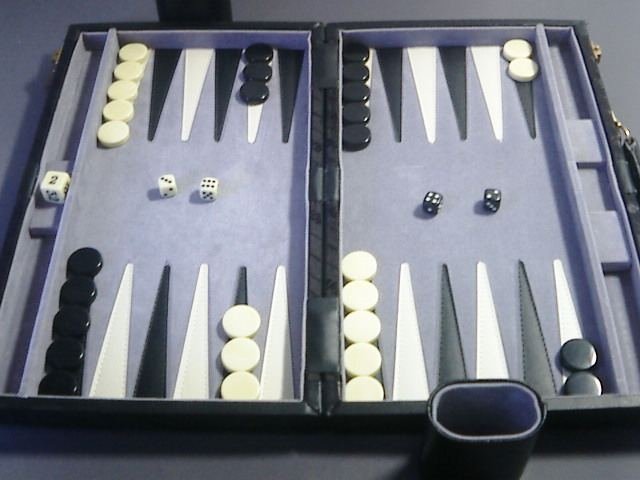
Image credit: Kyoku. CC BY-SA 3.0. Source: https://commons.wikimedia.org/wiki/File:Backgammon_Set.jpg. Licence: https://creativecommons.org/licenses/by-sa/3.0/. Display, thumbnail and enlargement resized without cropping and JPEG encoded; EXIF orientation applied. Enlargement limited to 1400 pixels on its longest side, or source size if smaller. No AI edits.

Gioul uses one-checker blocks without hitting
Gioul combines opposite-direction movement with a no-hitting rule. A single checker controls its point, and the opponent cannot land or touch down there. The source traces the game to Turkey and says it is played across the Middle East, while related published forms include Gul Bara and Plakoto Express.
Image credit: Monaam Ben Fredj. CC BY-SA 4.0. Source: https://commons.wikimedia.org/wiki/File:Tawleh_Players_01.jpg. Licence: https://creativecommons.org/licenses/by-sa/4.0/. Display, thumbnail and enlargement resized without cropping and JPEG encoded; EXIF orientation applied. Enlargement limited to 1400 pixels on its longest side, or source size if smaller. No AI edits.
One Greek account separates Vidos from Portes
In a 2006 Tavli article, Vassilis Condos calls Portes the familiar backgammon-like game but names Vidos as the exact equivalent of standard backgammon. The distinction shows how an English umbrella label can flatten local game names. It is one documented account, so club vocabulary may differ.
Image credit: Sascha Kohlmann. CC BY-SA 3.0. Source: https://commons.wikimedia.org/wiki/File:Playing_Backgammon_Athens_Greece_%28113613901%29.jpeg. Licence: https://creativecommons.org/licenses/by-sa/3.0/. Display, thumbnail and enlargement resized without cropping and JPEG encoded; EXIF orientation applied. Enlargement limited to 1400 pixels on its longest side, or source size if smaller. No AI edits.
A Tokyo championship drew 180 entrants and a car prize
A June 1981 report in Las Vegas Backgammon Magazine said the previous November’s Japan Championship in Tokyo attracted 180 entrants, with Makoto Shimada winning a Suzuki car. The period account also mentioned local tournaments in Osaka and Sapporo, showing organised play beyond a single capital-city event.
Image credit: Robertgombos. CC BY-SA 4.0. Source: https://commons.wikimedia.org/wiki/File:Backgammon_table.jpg. Licence: https://creativecommons.org/licenses/by-sa/4.0/. Display, thumbnail and enlargement resized without cropping and JPEG encoded; EXIF orientation applied. Enlargement limited to 1400 pixels on its longest side, or source size if smaller. No AI edits.
Moultezim permits only four occupied enemy-start points
Moultezim does not let a player occupy more than four points in the opponent’s starting table. The restriction prevents a complete prime directly in front of the opponent’s starting stack. Together with one-checker blocks and no hitting, it shapes a race built around controlled access.
Image credit: Sascha Kohlmann. CC BY-SA 3.0. Source: https://commons.wikimedia.org/wiki/File:Playing_Backgammon_Athens_Greece_%28113613901%29.jpeg. Licence: https://creativecommons.org/licenses/by-sa/3.0/. Display, thumbnail and enlargement resized without cropping and JPEG encoded; EXIF orientation applied. Enlargement limited to 1400 pixels on its longest side, or source size if smaller. No AI edits.
Nackgammon preserves the cube and Jacoby rule
Nackgammon alters the opening position but otherwise follows backgammon. Its published money-game rules use the doubling cube and the Jacoby rule, so gammons and backgammons gain extra value only after a double is accepted. The added back checkers encourage primes and back games over quick blitzes.
Image credit: Ptkfgs. Public domain. Source: https://commons.wikimedia.org/wiki/File:Backgammon_lg.jpg. Licence: https://creativecommons.org/publicdomain/mark/1.0/. Display, thumbnail and enlargement resized without cropping and JPEG encoded; EXIF orientation applied. Enlargement limited to 1400 pixels on its longest side, or source size if smaller. No AI edits. Source image has a digitally removed carpet background.
The Never-Finishing Game still has ordinary scoring
Despite its playful name and choice between hitting and trapping, the Never-Finishing Game does end by bearing off. The published scoring gives one point for a normal win and two when the loser bears off nothing. There is no three-point result and no doubling cube.
Image credit: Niko Kitsakis. CC BY 4.0. Source: https://commons.wikimedia.org/wiki/File:Tavli_Board_without_slots_%28traditional%29_B.jpg. Licence: https://creativecommons.org/licenses/by/4.0/. Display, thumbnail and enlargement resized without cropping and JPEG encoded; EXIF orientation applied. Enlargement limited to 1400 pixels on its longest side, or source size if smaller. No AI edits.
The Pin Game scatters two checkers forward at setup
The Pin Game starts with thirteen checkers on the opponent’s one-point, plus one on the opponent’s eight-point and one on the ten-point. Those two advanced checkers break up the huge starting stack before the first roll and create early opportunities for pinning and blocking.
Image credit: Niko Kitsakis. CC BY 4.0. Source: https://commons.wikimedia.org/wiki/File:Tavli_Board_without_slots_%28traditional%29_B.jpg. Licence: https://creativecommons.org/licenses/by/4.0/. Display, thumbnail and enlargement resized without cropping and JPEG encoded; EXIF orientation applied. Enlargement limited to 1400 pixels on its longest side, or source size if smaller. No AI edits.
Plakoto Express keeps Plakoto’s two-point shutout
Plakoto Express keeps Plakoto’s simple scoring even though its doubles can create much longer turns. A normal win scores one point; if the loser has borne off nothing, the result scores two. The published rules use no doubling cube, so the doubles ladder changes movement rather than stakes.
Image credit: Niko Kitsakis. CC BY 4.0. Source: https://commons.wikimedia.org/wiki/File:Tavli_Board_without_slots_%28traditional%29_B.jpg. Licence: https://creativecommons.org/licenses/by/4.0/. Display, thumbnail and enlargement resized without cropping and JPEG encoded; EXIF orientation applied. Enlargement limited to 1400 pixels on its longest side, or source size if smaller. No AI edits.
A four-point head start can come with an ace penalty
The published Handicap Matches proposition starts a five-point match with White leading 4–0 and no cube. Whenever White rolls a one, Black plays that number instead; 1–1 gives Black four ones plus Black’s normal turn. The puzzle is whether the huge score lead balances this repeated movement penalty.
Image credit: Ptkfgs. Public domain (author dedication). Source: https://commons.wikimedia.org/wiki/File:Backgammon_PrecisionDice.jpg. Licence: https://creativecommons.org/publicdomain/mark/1.0/. Display, thumbnail and enlargement resized without cropping and JPEG encoded; EXIF orientation applied. Enlargement limited to 1400 pixels on its longest side, or source size if smaller. No AI edits.
Two cancellations can create a three-roll turn
In Roll-Over Backgammon, one player may cancel a roll and force a reroll. If the opponent still owns the same once-per-game option, that reroll can also be cancelled, producing a third throw in one turn. The rare chain uses up both players’ markers at once.
Image credit: Ptkfgs. Public domain (author dedication). Source: https://commons.wikimedia.org/wiki/File:Backgammon_PrecisionDice.jpg. Licence: https://creativecommons.org/publicdomain/mark/1.0/. Display, thumbnail and enlargement resized without cropping and JPEG encoded; EXIF orientation applied. Enlargement limited to 1400 pixels on its longest side, or source size if smaller. No AI edits.
Snake begins with nine checkers on the bar
The training proposition called Snake gives one side a normal backgammon setup. The other begins with nine checkers on the bar and pairs on the opponent’s one-, two- and three-points. Ordinary rules then apply, creating immediate practice in playing and opposing an extreme back game.
Image credit: Ptkfgs. Public domain. Source: https://commons.wikimedia.org/wiki/File:Backgammon_lg.jpg. Licence: https://creativecommons.org/publicdomain/mark/1.0/. Display, thumbnail and enlargement resized without cropping and JPEG encoded; EXIF orientation applied. Enlargement limited to 1400 pixels on its longest side, or source size if smaller. No AI edits. Source image has a digitally removed carpet background.
Zarsız Tavla replaces dice with visible choices
No Chance Backgammon, or Zarsız Tavla in Turkish, was created by Naim Ağman in 2002. It uses a standard board and checker rules but no dice. Instead, six numbers are written on the bar and each player marks a chosen number with a coloured arrow.
Image credit: Monaam Ben Fredj. CC BY-SA 4.0. Source: https://commons.wikimedia.org/wiki/File:Tawleh_Players_01.jpg. Licence: https://creativecommons.org/licenses/by-sa/4.0/. Display, thumbnail and enlargement resized without cropping and JPEG encoded; EXIF orientation applied. Enlargement limited to 1400 pixels on its longest side, or source size if smaller. No AI edits.
Takhteh forbids wasting pips during bear-off
The published Takhteh rules require a player to bear off when possible instead of using a smaller die to move that checker forward and waste pips. Combined with the restriction on hit-and-run in the home board, this makes some legal Western backgammon choices unavailable.
Image credit: Peace Corps. Public domain. Source: https://commons.wikimedia.org/wiki/File:Nardy_players_in_Armenia.jpg. Licence: https://creativecommons.org/publicdomain/mark/1.0/. Display, thumbnail and enlargement resized without cropping and JPEG encoded; EXIF orientation applied. Enlargement limited to 1400 pixels on its longest side, or source size if smaller. No AI edits.
Tavla rerolls after the opening contest
In the published Tavla rules, both players roll one die to choose the starter. The higher roller does not use those two numbers as the first move; instead, that player picks up both dice and rolls again. This small procedural difference separates the cited Turkish ruleset from standard Western backgammon.
Image credit: Monaam Ben Fredj. CC BY-SA 4.0. Source: https://commons.wikimedia.org/wiki/File:Tawleh_Players_01.jpg. Licence: https://creativecommons.org/licenses/by-sa/4.0/. Display, thumbnail and enlargement resized without cropping and JPEG encoded; EXIF orientation applied. Enlargement limited to 1400 pixels on its longest side, or source size if smaller. No AI edits.
Fast Tavli players share one pair of dice
The published Greek tavli customs use one shared pair of dice. A player may pick them up while the opponent is moving, which keeps play quick, but must wait to roll until the opponent releases the checker. An early throw does not count and must be repeated.
Image credit: Sascha Kohlmann. CC BY-SA 3.0. Source: https://commons.wikimedia.org/wiki/File:Playing_Backgammon_Athens_Greece_%28113613901%29.jpeg. Licence: https://creativecommons.org/licenses/by-sa/3.0/. Display, thumbnail and enlargement resized without cropping and JPEG encoded; EXIF orientation applied. Enlargement limited to 1400 pixels on its longest side, or source size if smaller. No AI edits.
A modern photograph labels the position ace-deuce
Commons catalogues CasparGirl’s 2012 photograph as “Backgammon – ace/deuce.” The label connects a real board position with the English name for a 1–2 roll, the result that powers several related variants. The photograph documents the term without claiming that every Acey-Deucey ruleset uses the pictured position.

Image credit: CasparGirl. CC BY 2.0. Source: https://commons.wikimedia.org/wiki/File:Backgammon_-_ace_deuce_(7602781966).jpg. Licence: https://creativecommons.org/licenses/by/2.0/deed.en. Display, thumbnail and enlargement resized without cropping and JPEG encoded; EXIF orientation applied. The packaged enlargement is 960 × 644 pixels. No AI edits.

Russian backgammon was photographed mid-game
A 2012 Wikimedia Commons file is explicitly described as a Russian Backgammon game in progress. Its creator, 1backgammon1, presented a live position rather than an empty board. The image is useful evidence of how one published regional form can be shown visually, while household rules may still differ.

Image credit: 1backgammon1. CC BY-SA 3.0. Source: https://commons.wikimedia.org/wiki/File:Russian_for_Wiki.tiff. Licence: https://creativecommons.org/licenses/by-sa/3.0/deed.en. Display, thumbnail and enlargement resized without cropping and JPEG encoded; EXIF orientation applied. The packaged enlargement is 500 × 368 pixels. No AI edits.
A Lebanese board carries two Arabic game names
Commons describes this wooden board from Lebanon with the Arabic names al-tawla, “the table,” and al-nard, “the dice.” The description also notes that boards in the region may be decorated with shell or valuable woods. The photograph documents one object, not a single design used everywhere.
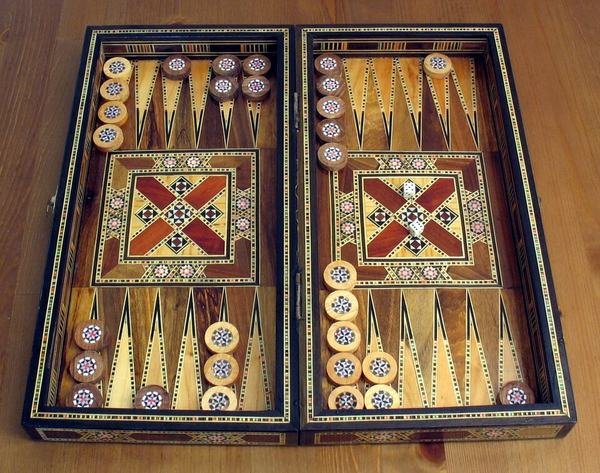
Image credit: User:Ptkfgs. Public domain. Source: https://commons.wikimedia.org/wiki/File:Bg_board_L.jpg. Licence: https://creativecommons.org/publicdomain/mark/1.0/. Display, thumbnail and enlargement resized without cropping and JPEG encoded; EXIF orientation applied. The packaged enlargement is 960 × 757 pixels. No AI edits.

Khatam work covers a Persian backgammon board
A close photograph dated 2023 identifies its subject as a Persian backgammon board made with the Khatam technique. The view concentrates on the surface detail, making the craft as visible as the playing layout. It provides a modern, reusable record of a regional board-making tradition.

Image credit: Nikos Kitsakis. CC BY 4.0. Source: https://commons.wikimedia.org/wiki/File:Detail_of_Persian_Backgammon_board_made_in_Khatam_technique.jpg. Licence: https://creativecommons.org/licenses/by/4.0/deed.en. Display, thumbnail and enlargement resized without cropping and JPEG encoded; EXIF orientation applied. The packaged enlargement is 500 × 667 pixels. No AI edits.

One 2007 Commons file records two spellings of nardy
A 2007 Commons photograph is titled Nardui and described simply with the Cyrillic word “Нарды.” The brief record preserves two visible spellings beside an actual board. It is a reminder that searchable image archives may catalogue the same tables-game family through different alphabets and transliterations.
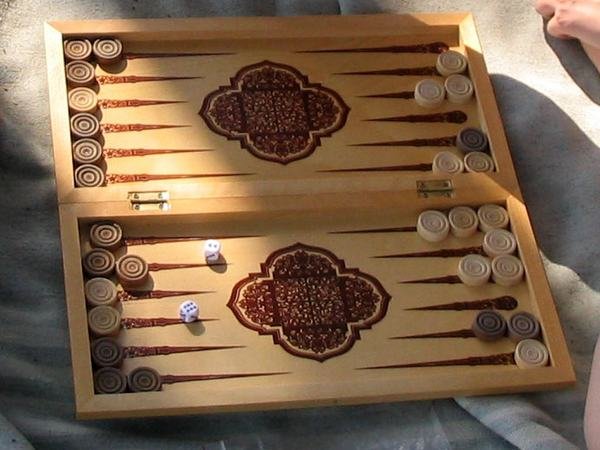
Image credit: Loyna. CC BY-SA 2.5. Source: https://commons.wikimedia.org/wiki/File:Nardui.jpg. Licence: https://creativecommons.org/licenses/by-sa/2.5/deed.en. Display, thumbnail and enlargement resized without cropping and JPEG encoded; EXIF orientation applied. The packaged enlargement is 692 × 519 pixels. No AI edits.

A tavla board was recorded before the first move
A public-domain Commons photograph from 2006 carries the French caption “the tavla board before the first move.” The starting position makes the regional name part of the record. It documents one arranged board, so it should not be treated as proof of every local setup.

Image credit: Bruno Burgund. Public domain. Source: https://commons.wikimedia.org/wiki/File:Tavla1.jpg. Licence: https://creativecommons.org/publicdomain/mark/1.0/. Display, thumbnail and enlargement resized without cropping and JPEG encoded; EXIF orientation applied. The packaged enlargement is 600 × 349 pixels. No AI edits.

A Portuguese Gamão diagram began as Nackgammon
The creator of this 2006 Portuguese-language image explains that it was adapted from a German Wikipedia Nackgammon diagram. The pieces were rearranged to show traditional backgammon, called gamão in Portuguese, and both PNG and JPEG versions were released. One teaching image therefore records translation as well as correction.
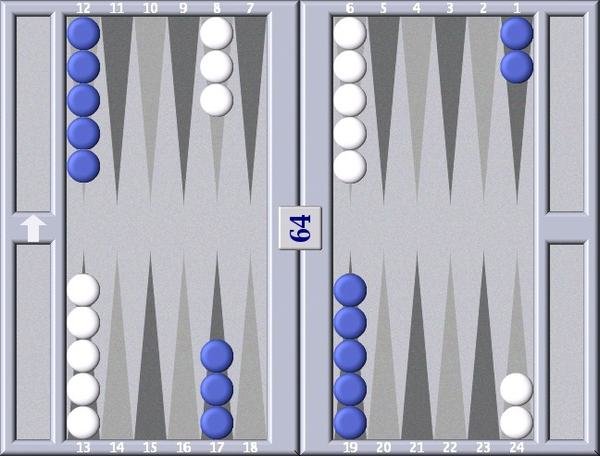
Image credit: Luis Dantas. Public domain. Source: https://commons.wikimedia.org/wiki/File:Gamao_inicio.png. Licence: https://creativecommons.org/publicdomain/mark/1.0/. Display, thumbnail and enlargement resized without cropping and JPEG encoded; EXIF orientation applied. The packaged enlargement is 648 × 492 pixels. No AI edits.

Each Zarsız Tavla turn preserves half the last pair
After the two starting numbers are chosen in Zarsız Tavla, a player changes only their own arrow on each turn. The opponent’s marked number stays in place, so it becomes the other half of the new pair. Every choice therefore shapes both the current move and the opponent’s next options.
Image credit: Ptkfgs. Public domain (author dedication). Source: https://commons.wikimedia.org/wiki/File:Backgammon_PrecisionDice.jpg. Licence: https://creativecommons.org/publicdomain/mark/1.0/. Display, thumbnail and enlargement resized without cropping and JPEG encoded; EXIF orientation applied. Enlargement limited to 1400 pixels on its longest side, or source size if smaller. No AI edits.
Zarsız Tavla permits only two chosen doubles
A player in Zarsız Tavla normally must choose a number different from both marked numbers. Twice per game, however, the player may select the opponent’s number and create a double. This turns doubles from random events into limited resources that both players can see and plan around.
Image credit: Ptkfgs. Public domain (author dedication). Source: https://commons.wikimedia.org/wiki/File:Backgammon_PrecisionDice.jpg. Licence: https://creativecommons.org/publicdomain/mark/1.0/. Display, thumbnail and enlargement resized without cropping and JPEG encoded; EXIF orientation applied. Enlargement limited to 1400 pixels on its longest side, or source size if smaller. No AI edits.
Atlanta chouette advice follows the live cubes
The Atlanta Backgammon Association’s 2003 chouette rules tie checker-play advice to cube status. The captain may ask players whose cubes remain in the game, while players already out must stay silent. The captain still makes the final checker decision, keeping one hand in charge of the team.
Image credit: Liz Cooke. CC BY-SA 3.0. Source: https://commons.wikimedia.org/wiki/File:Backgammon_Players%2C_Brighton_Beach%2C_Brooklyn_2012.jpg. Licence: https://creativecommons.org/licenses/by-sa/3.0/. Display, thumbnail and enlargement resized without cropping and JPEG encoded; EXIF orientation applied. Enlargement limited to 1400 pixels on its longest side, or source size if smaller. No AI edits.
A large Atlanta chouette may give the box a partner
Under the Atlanta rules, the box may take a partner when the team is large, customarily with six or more players. The partner can share some consultation rights, but the rules limit when checker-play discussion begins. A crowded social game therefore needs roles beyond simply “one against everyone.”
Image credit: Liz Cooke. CC BY-SA 3.0. Source: https://commons.wikimedia.org/wiki/File:Backgammon_Players%2C_Brighton_Beach%2C_Brooklyn_2012.jpg. Licence: https://creativecommons.org/licenses/by-sa/3.0/. Display, thumbnail and enlargement resized without cropping and JPEG encoded; EXIF orientation applied. Enlargement limited to 1400 pixels on its longest side, or source size if smaller. No AI edits.
Atlanta chouette stakes are written before play
The Atlanta rules say the basic stake should be agreed and written at the top of the score sheet. Players may arrange approved multiples against particular opponents, while later changes require the other person’s consent. Recording the agreement gives a busy multi-cube session a clear financial starting point.
Image credit: Liz Cooke. CC BY-SA 3.0. Source: https://commons.wikimedia.org/wiki/File:Backgammon_Players%2C_Brighton_Beach%2C_Brooklyn_2012.jpg. Licence: https://creativecommons.org/licenses/by-sa/3.0/. Display, thumbnail and enlargement resized without cropping and JPEG encoded; EXIF orientation applied. Enlargement limited to 1400 pixels on its longest side, or source size if smaller. No AI edits.
Duodecagammon stretches each die to twelve sides
Backgammon Galore’s variant index records Duodecagammon, a form of backgammon played with 12-sided dice. Each die can therefore show 7 through 12, numbers that standard six-sided dice never produce. That single equipment change creates possible movement values far beyond an ordinary roll.
Image credit: Ptkfgs. Public domain (author dedication). Source: https://commons.wikimedia.org/wiki/File:Backgammon_PrecisionDice.jpg. Licence: https://creativecommons.org/publicdomain/mark/1.0/. Display, thumbnail and enlargement resized without cropping and JPEG encoded; EXIF orientation applied. Enlargement limited to 1400 pixels on its longest side, or source size if smaller. No AI edits.
Championships & Players
176 facts in this subject.
The champion who taught through a newspaper
Backgammon expert Paul Magriel brought game strategy to a wide audience through a weekly column in The New York Times from 1977 to 1980. Readers could study positions and learn how strong players approached difficult decisions.
Magriel was also a major tournament player and the 1978 world champion. The photograph here shows him years later at the 2005 World Series of Poker; it is a portrait of the player, rather than a photograph of his backgammon championship.
Image credit: flipchip / LasVegasVegas.com. CC BY-SA 3.0. Source: https://commons.wikimedia.org/wiki/File:PaulMagriel.jpg. Licence: https://creativecommons.org/licenses/by-sa/3.0/. Display, thumbnail and enlargement resized without cropping and JPEG encoded; EXIF orientation applied. Enlargement limited to 1400 pixels on its longest side, or source size if smaller. No AI edits.
Sources and licence: Source 1 · Source 2 · Source 3 · Source 4
Monte Carlo’s big backgammon year
In 1979, the World Backgammon Championship moved to Monte Carlo after the Bahamas and Monte Carlo events were combined. Luigi Villa of Italy won the final against American Jeff Westheimer by 25–22.
Backgammon historian Bill Robertie reports 340 main-event players and a US$119,000 Open prize pool. That was the event’s pool, rather than the amount won by Villa alone.
Image credit: Unknown postcard artist; scan by Tylwyth Eldar. CC BY-SA 4.0 (scan). Source: https://commons.wikimedia.org/wiki/File:Monte_Carlo_-_Casino.jpg. Licence: https://creativecommons.org/licenses/by-sa/4.0/. Display, thumbnail and enlargement resized without cropping and JPEG encoded; EXIF orientation applied. Enlargement limited to 1400 pixels on its longest side, or source size if smaller. No AI edits.

Tim Holland wins the early titles
Tim Holland won the first Las Vegas event called the World Championship of Backgammon in 1967. He won again in 1968 and 1971, becoming one of the major names of the early tournament era.
Those wins came before the championship settled in Monte Carlo in 1979. Early tournament history has some disputed details, so these titles belong to the game’s developing championship circuit.
Image credit: Ptkfgs. Public domain. Source: https://commons.wikimedia.org/wiki/File:Backgammon_lg.jpg. Licence: https://creativecommons.org/publicdomain/mark/1.0/. Display, thumbnail and enlargement resized without cropping and JPEG encoded; EXIF orientation applied. Enlargement limited to 1400 pixels on its longest side, or source size if smaller. No AI edits. Source image has a digitally removed carpet background.
Carol Crawford’s 1973 championship
Carol Crawford won the backgammon World Championship in Las Vegas in 1973. Lewis Deyong was the runner-up. Her victory is part of the championship’s early history.
Lists sometimes disagree about older events and “first” claims. The useful, well-supported fact here is the result: Crawford was the 1973 champion.
Image credit: Kyoku. CC BY-SA 3.0. Source: https://commons.wikimedia.org/wiki/File:Backgammon_Set.jpg. Licence: https://creativecommons.org/licenses/by-sa/3.0/. Display, thumbnail and enlargement resized without cropping and JPEG encoded; EXIF orientation applied. Enlargement limited to 1400 pixels on its longest side, or source size if smaller. No AI edits.
A chess champion takes a backgammon break
This photograph shows former chess world champion Anatoly Karpov playing backgammon on a beach in Dubai in November 1986. The image was taken during the period of the 1986 Chess Olympiad.
A famous chess player enjoying a different board game makes an appealing crossover story. The photograph shows a recreational moment, not evidence that Karpov won a backgammon championship.

Image credit: MBIHund. CC BY-SA 4.0. Source: https://commons.wikimedia.org/wiki/File:Karpow_1986_Dubai.jpeg. Licence: https://creativecommons.org/licenses/by-sa/4.0/. Display, thumbnail and enlargement resized without cropping and JPEG encoded; EXIF orientation applied. Enlargement limited to 1400 pixels on its longest side, or source size if smaller. No AI edits.

Bill Robertie wins twice in Monte Carlo
Bill Robertie won the World Championship in Monte Carlo in both 1983 and 1987. Before becoming a leading backgammon player, he had already been a chess master.
He also became a well-known backgammon author. His career connects tournament play with explaining difficult decisions to readers who want to improve.
Image credit: Unknown postcard artist; scan by Tylwyth Eldar. CC BY-SA 4.0 (scan). Source: https://commons.wikimedia.org/wiki/File:Monte_Carlo_-_Casino.jpg. Licence: https://creativecommons.org/licenses/by-sa/4.0/. Display, thumbnail and enlargement resized without cropping and JPEG encoded; EXIF orientation applied. Enlargement limited to 1400 pixels on its longest side, or source size if smaller. No AI edits.
An international tournament began with a small field
Prince Alexis Obolensky organised an international backgammon tournament on Grand Bahama in March 1964. Bill Robertie’s historical account records a field of 32 players.
Charles Wacker III beat Porter Ijams in the final. The event helped launch a growing international tournament scene, several years before the first Las Vegas event called the World Championship.
Image credit: Daderot. CC0 1.0. Source: https://commons.wikimedia.org/wiki/File:Box_for_playing_backgammon_or_chess%2C_probably_Syria_or_Egypt%2C_late_19th_century%2C_wood%2C_wood_veneers%2C_bone%2C_and_mother_of_pearl_inlay_-_Royal_Ontario_Museum_-_DSC04771.JPG. Licence: https://creativecommons.org/publicdomain/zero/1.0/. Display, thumbnail and enlargement resized without cropping and JPEG encoded; EXIF orientation applied. Enlargement limited to 1400 pixels on its longest side, or source size if smaller. No AI edits.
A million-dollar tournament in the Bahamas
The PartyGammon Million took place on Paradise Island in January 2007. It guaranteed at least US$1 million in prizes; entry cost US$10,000.
Andreas Märtens won the main event, receiving more than US$500,000. The million-dollar figure was the guaranteed prize fund, not one player’s winnings.
Image credit: Ptkfgs. Public domain. Source: https://commons.wikimedia.org/wiki/File:Backgammon_lg.jpg. Licence: https://creativecommons.org/publicdomain/mark/1.0/. Display, thumbnail and enlargement resized without cropping and JPEG encoded; EXIF orientation applied. Enlargement limited to 1400 pixels on its longest side, or source size if smaller. No AI edits. Source image has a digitally removed carpet background.
Akiko Yazawa wins the world title twice
Japan’s Akiko Yazawa won the World Championship in Monte Carlo in 2014 and again in 2018.
Four years separated the victories. She returned to a major tournament and succeeded against another field of opponents, adding a second world title to her record.
Image credit: Unknown postcard artist; scan by Tylwyth Eldar. CC BY-SA 4.0 (scan). Source: https://commons.wikimedia.org/wiki/File:Monte_Carlo_-_Casino.jpg. Licence: https://creativecommons.org/licenses/by-sa/4.0/. Display, thumbnail and enlargement resized without cropping and JPEG encoded; EXIF orientation applied. Enlargement limited to 1400 pixels on its longest side, or source size if smaller. No AI edits.
Three world titles across seventeen years
Sweden’s Jörgen Granstedt won the World Championship in 1999, 2001, and 2016. Seventeen years separated his first and third titles.
His record connects championship play at the end of the 1900s with the next generation of tournaments.
Image credit: Unknown postcard artist; scan by Tylwyth Eldar. CC BY-SA 4.0 (scan). Source: https://commons.wikimedia.org/wiki/File:Monte_Carlo_-_Casino.jpg. Licence: https://creativecommons.org/licenses/by-sa/4.0/. Display, thumbnail and enlargement resized without cropping and JPEG encoded; EXIF orientation applied. Enlargement limited to 1400 pixels on its longest side, or source size if smaller. No AI edits.
The World Cup used a match within a match
The backgammon World Cups from 1988 to 1998 used the best of five eleven-point matches in each round. A player needed three match wins to advance.
Billy Horan won in 1990 and 1994. A round tested players across several separate matches, rather than one long match.
Image credit: MBIHund. CC BY-SA 4.0. Source: https://commons.wikimedia.org/wiki/File:Karpow_1986_Dubai.jpeg. Licence: https://creativecommons.org/licenses/by-sa/4.0/. Display, thumbnail and enlargement resized without cropping and JPEG encoded; EXIF orientation applied. Enlargement limited to 1400 pixels on its longest side, or source size if smaller. No AI edits.
A 1977 tournament had two different money pools
Ken Goodman won the 1977 World Championship on Paradise Island in the Bahamas, beating Jim Crosby in the final. The championship division attracted 216 players.
Bill Robertie’s account reports a prize fund above US$50,000 and a separate auction pool of US$140,000. Those are different pools of money, and neither figure should be presented as Goodman’s personal winnings.
Image credit: Ptkfgs. Public domain. Source: https://commons.wikimedia.org/wiki/File:Backgammon_lg.jpg. Licence: https://creativecommons.org/publicdomain/mark/1.0/. Display, thumbnail and enlargement resized without cropping and JPEG encoded; EXIF orientation applied. Enlargement limited to 1400 pixels on its longest side, or source size if smaller. No AI edits. Source image has a digitally removed carpet background.
Lee Genud took the world title in 1981
American player Lee Genud won the 1981 World Championship, defeating Britain’s Joe Dwek in the final. Her name appears among the champions in the game’s international results history.
Image credit: Unknown postcard artist; scan by Tylwyth Eldar. CC BY-SA 4.0 (scan). Source: https://commons.wikimedia.org/wiki/File:Monte_Carlo_-_Casino.jpg. Licence: https://creativecommons.org/licenses/by-sa/4.0/. Display, thumbnail and enlargement resized without cropping and JPEG encoded; EXIF orientation applied. Enlargement limited to 1400 pixels on its longest side, or source size if smaller. No AI edits.
Katie Scalamandre’s championship year was 2000
Katie Scalamandre of the United States won the 2000 World Championship. Denmark’s Thomas Holm was the runner-up. Her victory is another example of a woman winning backgammon’s world title.
Image credit: Kyoku. CC BY-SA 3.0. Source: https://commons.wikimedia.org/wiki/File:Backgammon_Set.jpg. Licence: https://creativecommons.org/licenses/by-sa/3.0/. Display, thumbnail and enlargement resized without cropping and JPEG encoded; EXIF orientation applied. Enlargement limited to 1400 pixels on its longest side, or source size if smaller. No AI edits.
Michael Meyburg won seven years apart
Germany’s Michael Meyburg won the World Championship in 1991 and again in 1998. Seven years separated his victories, showing that a player can return to the top after a long gap.
Image credit: Unknown postcard artist; scan by Tylwyth Eldar. CC BY-SA 4.0 (scan). Source: https://commons.wikimedia.org/wiki/File:Monte_Carlo_-_Casino.jpg. Licence: https://creativecommons.org/licenses/by-sa/4.0/. Display, thumbnail and enlargement resized without cropping and JPEG encoded; EXIF orientation applied. Enlargement limited to 1400 pixels on its longest side, or source size if smaller. No AI edits.
The 2007 final brought South American countries together
The 2007 World Championship winner was Jorge Pan of Argentina. The runner-up represented Brazil. Both finalists therefore came from South America, a useful reminder of backgammon’s international reach.
Image credit: Ptkfgs. Public domain. Source: https://commons.wikimedia.org/wiki/File:Backgammon_lg.jpg. Licence: https://creativecommons.org/publicdomain/mark/1.0/. Display, thumbnail and enlargement resized without cropping and JPEG encoded; EXIF orientation applied. Enlargement limited to 1400 pixels on its longest side, or source size if smaller. No AI edits. Source image has a digitally removed carpet background.
Japan supplied champions in 2009 and 2011
Masayuki Mochizuki of Japan won the 2009 World Championship. Two years later, another Japanese player, Takumitsu Suzuki, won the title. These victories came before Akiko Yazawa’s championship wins featured elsewhere in this library.
Image credit: Unknown postcard artist; scan by Tylwyth Eldar. CC BY-SA 4.0 (scan). Source: https://commons.wikimedia.org/wiki/File:Monte_Carlo_-_Casino.jpg. Licence: https://creativecommons.org/licenses/by-sa/4.0/. Display, thumbnail and enlargement resized without cropping and JPEG encoded; EXIF orientation applied. Enlargement limited to 1400 pixels on its longest side, or source size if smaller. No AI edits.
Duplicate play gives different boards the same dice
Duplicate backgammon has players on separate boards receive the same dice sequence. The aim is to compare their decisions with luck held more nearly equal. But positions can quickly diverge, so the same roll may be excellent on one board and disastrous on another. Matching dice does not guarantee matching situations.
Image credit: Niko Kitsakis. CC BY 4.0. Source: https://commons.wikimedia.org/wiki/File:Tavli_Board_without_slots_%28traditional%29_B.jpg. Licence: https://creativecommons.org/licenses/by/4.0/. Display, thumbnail and enlargement resized without cropping and JPEG encoded; EXIF orientation applied. Enlargement limited to 1400 pixels on its longest side, or source size if smaller. No AI edits.
Richard Munitz won three ABT annual races
The USBGF credits Richard Munitz with winning the American Backgammon Tour annual championship in 2006, 2018 and 2025. These are season-long tour results, rather than three titles from one weekend tournament. The nineteen-year span shows how a player’s record can remain strong across different periods of competitive play.
Image credit: David Berkowitz. CC BY 2.0. Source: https://commons.wikimedia.org/wiki/File:Istanbul%2C_Turkey_%2810582737355%29.jpg. Licence: https://creativecommons.org/licenses/by/2.0/. Display, thumbnail and enlargement resized without cropping and JPEG encoded; EXIF orientation applied. Enlargement limited to 1400 pixels on its longest side, or source size if smaller. No AI edits.
A tournament champion also built an online system
Richard Munitz is credited with developing the USBGF’s Online Tournament System. His Hall of Fame biography combines playing achievements with software and organisational work. An effective backgammon community needs more than strong players: it also needs ways to organise matches and record results.

Image credit: Joe Mabel. CC BY-SA 3.0. Source: https://commons.wikimedia.org/wiki/File:LCM_-_DEC_PDP-10_-_01.jpg. Licence: https://creativecommons.org/licenses/by-sa/3.0/. Display, thumbnail and enlargement resized without cropping and JPEG encoded; EXIF orientation applied. Enlargement limited to 1400 pixels on its longest side, or source size if smaller. No AI edits.

Marty Storer’s ABT titles were twenty-nine years apart
Marty Storer won the first American Backgammon Tour annual championship in 1993 and won it again in 2022, according to the USBGF. The gap is twenty-nine years. Those dated results offer a clear example of long-term competitive success, without claiming that he won every intervening year.
Image credit: Matěj Baťha. CC BY-SA 3.0. Source: https://commons.wikimedia.org/wiki/File:Deskohran%C3%AD_08s4_077_-_Backgammon.jpg. Licence: https://creativecommons.org/licenses/by-sa/3.0/. Display, thumbnail and enlargement resized without cropping and JPEG encoded; EXIF orientation applied. Enlargement limited to 1400 pixels on its longest side, or source size if smaller. No AI edits.
Backgammon Praxis studies complete high-level matches
Marty Storer authored the two-volume Backgammon Praxis. The USBGF describes the work as detailed analysis of high-level matches. Studying a whole match connects individual decisions to the changing score and position. It differs from looking at an isolated puzzle where the story begins and ends with one roll.

Image credit: Henri Bergius from Berlin, Germany. CC BY-SA 2.0. Source: https://commons.wikimedia.org/wiki/File:Backgammon_night_(3468685282).jpg. Licence: https://creativecommons.org/licenses/by-sa/2.0/deed.en. Display, thumbnail and enlargement resized without cropping and JPEG encoded; EXIF orientation applied. Enlargement limited to 1400 pixels on its longest side, or source size if smaller. No AI edits.

Wilcox Snellings topped two early Giants votes
The USBGF records Wilcox Snellings as the number-one Giant of Backgammon in 1993 and 1997. The Giants list is a voted ranking, so those honours should be distinguished from winning a tournament championship. They show how other knowledgeable participants rated his strength during that era.
Image credit: Thomas Taylor Hammond (1920-1993). CC BY-SA 4.0. Source: https://commons.wikimedia.org/wiki/File:Hammond_Slides_Central_Asia_34.jpg. Licence: https://creativecommons.org/licenses/by-sa/4.0/deed.en. Display, thumbnail and enlargement resized without cropping and JPEG encoded; EXIF orientation applied. Enlargement limited to 1400 pixels on its longest side, or source size if smaller. No AI edits.
Snellings returned after a long tournament break
Wilcox Snellings’s Hall of Fame biography reports a twenty-two-year break from tournament play before a top-eight finish at Monte Carlo in 2019. It also records another top-eight result in 2022. These are finishing positions, not World Championship wins, but they document a notable competitive return.
Image credit: Sascha Kohlmann. CC BY-SA 3.0. Source: https://commons.wikimedia.org/wiki/File:Playing_Backgammon_Athens_Greece_%28113613901%29.jpeg. Licence: https://creativecommons.org/licenses/by-sa/3.0/. Display, thumbnail and enlargement resized without cropping and JPEG encoded; EXIF orientation applied. Enlargement limited to 1400 pixels on its longest side, or source size if smaller. No AI edits.
Falafel helped Mochy prepare for his breakthrough
Masayuki Mochizuki credited Matvey Natanzon, known as Falafel, with intensive study sessions in Tel Aviv in spring 2009. Falafel reviewed his online games and explained mistakes. Mochizuki won the World Championship later that year. The account documents valued coaching; it does not claim that coaching alone caused the title.
Image credit: Peace Corps. Public domain. Source: https://commons.wikimedia.org/wiki/File:Nardy_players_in_Armenia.jpg. Licence: https://creativecommons.org/publicdomain/mark/1.0/. Display, thumbnail and enlargement resized without cropping and JPEG encoded; EXIF orientation applied. Enlargement limited to 1400 pixels on its longest side, or source size if smaller. No AI edits.
A Monte Carlo player auction raised $256,000
The USBGF’s biography credits Lewis Deyong with raising $256,000 as an auctioneer at Monte Carlo. That figure describes money raised through a tournament auction, not personal prize money won by Deyong or a single player. The source does not give an event year for the figure, so none is added here.
Image credit: Unknown postcard artist; scan by Tylwyth Eldar. CC BY-SA 4.0 (scan). Source: https://commons.wikimedia.org/wiki/File:Monte_Carlo_-_Casino.jpg. Licence: https://creativecommons.org/licenses/by-sa/4.0/. Display, thumbnail and enlargement resized without cropping and JPEG encoded; EXIF orientation applied. Enlargement limited to 1400 pixels on its longest side, or source size if smaller. No AI edits.
Deyong helped build a travelling tournament scene
Lewis Deyong’s USBGF biography describes a shift from strong player to promoter, organiser, director and auctioneer. His events included an EF Pro-Am series run for ten years, moving from the Bahamas to Florida and then Las Vegas. Backgammon’s tournament history includes the people who created the events as well as their winners.
Image credit: Unknown postcard artist; scan by Tylwyth Eldar. CC BY-SA 4.0 (scan). Source: https://commons.wikimedia.org/wiki/File:Monte_Carlo_-_Casino.jpg. Licence: https://creativecommons.org/licenses/by-sa/4.0/. Display, thumbnail and enlargement resized without cropping and JPEG encoded; EXIF orientation applied. Enlargement limited to 1400 pixels on its longest side, or source size if smaller. No AI edits.
Lee Genud won Women’s titles before her open title
Before her 1981 Backgammon World Championship victory, Lee Genud won the Women’s World Championship in both 1978 and 1979, according to the USBGF. These were separate competition titles. Keeping the event names clear makes the record more useful than combining different championships under a vague count of world titles.
Image credit: Van Der Meulen Christofle. CC0 1.0. Source: https://commons.wikimedia.org/wiki/File:Backgammon_(1)_(Venise,_XIVe_siecle).jpg. Licence: https://creativecommons.org/publicdomain/zero/1.0/. Display, thumbnail and enlargement resized without cropping and JPEG encoded; EXIF orientation applied. Enlargement limited to 1400 pixels on its longest side, or source size if smaller. No AI edits.
Lee Genud taught thousands of new players
The USBGF credits Lee Genud with teaching thousands of students and directing clubs in California and New York. Her career therefore included introducing people to backgammon as well as competing. The teaching work is part of her Hall of Fame record, showing another way a champion can influence a game.
Image credit: Matěj Baťha. CC BY-SA 3.0. Source: https://commons.wikimedia.org/wiki/File:Deskohran%C3%AD_08s4_077_-_Backgammon.jpg. Licence: https://creativecommons.org/licenses/by-sa/3.0/. Display, thumbnail and enlargement resized without cropping and JPEG encoded; EXIF orientation applied. Enlargement limited to 1400 pixels on its longest side, or source size if smaller. No AI edits.
John Crawford played bridge as well as backgammon
John R. Crawford was an American bridge and backgammon player. He also co-authored The Backgammon Book with Oswald Jacoby. His name survives in backgammon’s Crawford rule, but his career reached beyond that one contribution. The USBGF inducted him into its American Backgammon Hall of Fame in 2025.
Image credit: Matěj Baťha. CC BY-SA 3.0. Source: https://commons.wikimedia.org/wiki/File:Deskohran%C3%AD_2009_353.jpg. Licence: https://creativecommons.org/licenses/by-sa/3.0/deed.en. Display, thumbnail and enlargement resized without cropping and JPEG encoded; EXIF orientation applied. Enlargement limited to 1400 pixels on its longest side, or source size if smaller. No AI edits.
The American Backgammon Hall of Fame began in 2015
The USBGF dates the establishment of the American Backgammon Hall of Fame to February 2015. It recognises major playing achievements and important contributions to backgammon in the United States. A Hall of Fame honour is therefore broader than a trophy for winning one particular tournament.
Image credit: madras91. CC BY 2.0. Source: https://commons.wikimedia.org/wiki/File:%E1%83%A5%E1%83%90%E1%83%A0%E1%83%97%E1%83%95%E1%83%94%E1%83%9A%E1%83%94%E1%83%91%E1%83%98_%E1%83%9C%E1%83%90%E1%83%A0%E1%83%93%E1%83%98%E1%83%A1_%E1%83%97%E1%83%90%E1%83%9B%E1%83%90%E1%83%A8%E1%83%9D%E1%83%91%E1%83%94%E1%83%9C_(48397852796).jpg. Licence: https://creativecommons.org/licenses/by/2.0/deed.en. Display, thumbnail and enlargement resized without cropping and JPEG encoded; EXIF orientation applied. Enlargement limited to 1400 pixels on its longest side, or source size if smaller. No AI edits.
The Giants ranking is built from votes
Every two years, championship-level players and tournament directors submit rankings for the Giants of Backgammon list. The votes are collected into an international list. This is different from a rating calculated directly from match results or an award based on computer-measured error. Several systems can recognise strength in different ways.
Image credit: Liorca. CC BY-SA 4.0. Source: https://commons.wikimedia.org/wiki/File:%D7%9E%D7%A9%D7%97%D7%A7%D7%99%D7%9D_%D7%A9%D7%A9-%D7%91%D7%A9_%D7%91%D7%A9%D7%95%D7%A7_%D7%94%D7%9C%D7%91%D7%9F_17.10-17.jpg. Licence: https://creativecommons.org/licenses/by-sa/4.0/deed.en. Display, thumbnail and enlargement resized without cropping and JPEG encoded; EXIF orientation applied. Enlargement limited to 1400 pixels on its longest side, or source size if smaller. No AI edits.
Master titles can be earned through measured decisions
The Backgammon Masters Awarding Body awards titles and proficiency certificates based on demonstrated skill in verified tournament matches. Its system uses calculated performance ratings across many matches. This adds another form of recognition beyond finishing position: a player can be assessed on the quality of decisions, while dice still affect who wins.
Image credit: Roland Scheicher; table designed by Alois Scheicher. Public domain (author dedication). Source: https://commons.wikimedia.org/wiki/File:Backgammontisch.jpg. Licence: https://creativecommons.org/publicdomain/mark/1.0/. Display, thumbnail and enlargement resized without cropping and JPEG encoded; EXIF orientation applied. Enlargement limited to 1400 pixels on its longest side, or source size if smaller. No AI edits.
The American tour gained an online version in 2020
The USBGF dates the creation of ABT Online! to April 2020, in response to COVID-19 restrictions. Moving organised play online gave players another way to compete when in-person events were disrupted. This is a dated organisational milestone, rather than a claim that online backgammon itself began in 2020.
Image credit: Joe Mabel. CC BY-SA 3.0. Source: https://commons.wikimedia.org/wiki/File:LCM_-_DEC_PDP-10_-_01.jpg. Licence: https://creativecommons.org/licenses/by-sa/3.0/. Display, thumbnail and enlargement resized without cropping and JPEG encoded; EXIF orientation applied. Enlargement limited to 1400 pixels on its longest side, or source size if smaller. No AI edits.
Duo-Gammon partners alternate without discussing moves
Duo-Gammon has two partners play one game by alternating turns. In Bill Davis’s 1980 account, they cannot consult about checker moves, and discussion of cube decisions is tightly limited. Each player therefore has to understand and continue the partner’s developing plan. It differs from ordinary consultation doubles.
Image credit: David Berkowitz. CC BY 2.0. Source: https://commons.wikimedia.org/wiki/File:Istanbul%2C_Turkey_%2810582737355%29.jpg. Licence: https://creativecommons.org/licenses/by/2.0/. Display, thumbnail and enlargement resized without cropping and JPEG encoded; EXIF orientation applied. Enlargement limited to 1400 pixels on its longest side, or source size if smaller. No AI edits.
A quiet team format did not make matches faster
Bill Davis reported a Duo-Gammon tournament in Northbrook, Illinois, in 1980. Removing most partner consultation did not speed up play as expected: players considered moves carefully before handing the position back. The event ran long enough for the Open main final to be split. It is a documented early experiment, not a universal timing result.
Image credit: Bryan Doane. CC BY 2.0. Source: https://commons.wikimedia.org/wiki/File:Backgammon-playwers-netanya-street-july-2013.jpg. Licence: https://creativecommons.org/licenses/by/2.0/. Display, thumbnail and enlargement resized without cropping and JPEG encoded; EXIF orientation applied. Enlargement limited to 1400 pixels on its longest side, or source size if smaller. No AI edits.
The Indiana Open lasted more than half a century
Robertie’s chronology calls the 1953 Indiana Open the first regional backgammon tournament. The Indianapolis event continued for 54 years, with its final edition held in 2006. Its long run bridged the quiet post-war years and the later tournament boom.
Image credit: Matěj Baťha. CC BY-SA 3.0. Source: https://commons.wikimedia.org/wiki/File:Deskohran%C3%AD_08s4_077_-_Backgammon.jpg. Licence: https://creativecommons.org/licenses/by-sa/3.0/. Display, thumbnail and enlargement resized without cropping and JPEG encoded; EXIF orientation applied. Enlargement limited to 1400 pixels on its longest side, or source size if smaller. No AI edits.
The 1964 final lasted two and a half hours
Charles Wacker III defeated Porter Ijams in the 1964 Grand Bahama final. Sports Illustrated recorded a 26–20 score after two and a half hours of play to 25 points. The recorded total passed 25 because the final game awarded multiple points.
Image credit: Daderot. CC0 1.0. Source: https://commons.wikimedia.org/wiki/File:Box_for_playing_backgammon_or_chess%2C_probably_Syria_or_Egypt%2C_late_19th_century%2C_wood%2C_wood_veneers%2C_bone%2C_and_mother_of_pearl_inlay_-_Royal_Ontario_Museum_-_DSC04771.JPG. Licence: https://creativecommons.org/publicdomain/zero/1.0/. Display, thumbnail and enlargement resized without cropping and JPEG encoded; EXIF orientation applied. Enlargement limited to 1400 pixels on its longest side, or source size if smaller. No AI edits.
A world club began organising players in 1967
The U.S. Backgammon Federation credits Alexis Obolensky with founding the World Backgammon Club in 1967. Based in New York City, it promoted the game through tournaments and a master list of players, giving the fast-growing scene an organisation as well as headline events.
Image credit: Matěj Baťha. CC BY-SA 3.0. Source: https://commons.wikimedia.org/wiki/File:Deskohran%C3%AD_2009_353.jpg. Licence: https://creativecommons.org/licenses/by-sa/3.0/deed.en. Display, thumbnail and enlargement resized without cropping and JPEG encoded; EXIF orientation applied. Enlargement limited to 1400 pixels on its longest side, or source size if smaller. No AI edits.
London hosted an international championship by 1966
The U.S. Backgammon Federation records an International Backgammon Championship in London by 1966, when Tim Holland won. Holland returned to win the London title in 1972 and 1973. The series shows that the modern tournament revival spread beyond American resorts and Las Vegas at an early stage.
Image credit: Alex Proimos. CC BY 2.0. Source: https://commons.wikimedia.org/wiki/File:Saturday_Afternoon_Backgammon_(6784476822).jpg. Licence: https://creativecommons.org/licenses/by/2.0/. Display, thumbnail and enlargement resized without cropping and JPEG encoded; EXIF orientation applied. Enlargement limited to 1400 pixels on its longest side, or source size if smaller. No AI edits.
Obolensky’s Las Vegas championship era spanned 1967 to 1975
The U.S. Backgammon Federation credits Alexis Obolensky with organising World Championships in Las Vegas from 1967 through 1975. That span linked the growing tournament circuit with a city already famous for casino resorts and headline entertainment.
Image credit: Dell Publishing. Public domain in the United States (copyright not renewed). Source: https://commons.wikimedia.org/wiki/File:The_Rat_Pack_with_Jack_Entratter_at_the_Sands_1960.jpg. Licence: https://creativecommons.org/publicdomain/mark/1.0/. Display, thumbnail and enlargement resized without cropping and JPEG encoded; EXIF orientation applied. The packaged enlargement is 1200 × 668 pixels. No AI edits.

A hotel opening came with a $10,000 backgammon mission
Alexis Obolensky organised the first of a Bahamas tournament series in March 1964 after a hotel-opening friend offered him $10,000 to gather a jet-set backgammon crowd and fly them to Freeport. Dale Kerr records an invitational field of 32, or possibly 40, players.
Image credit: Dell Publishing. Public domain in the United States (copyright not renewed). Source: https://commons.wikimedia.org/wiki/File:The_Rat_Pack_with_Jack_Entratter_at_the_Sands_1960.jpg. Licence: https://creativecommons.org/publicdomain/mark/1.0/. Display, thumbnail and enlargement resized without cropping and JPEG encoded; EXIF orientation applied. The packaged enlargement is 1200 × 668 pixels. No AI edits.
Two early championship years remain blank in one archive
Sport-Komplett's championship table lists Tim Holland in 1968 and again in 1971, but leaves both 1969 and 1970 blank. The missing names show why early title histories can conflict, especially when later lists treat loosely documented events as world championships.
Image credit: Alex Proimos. CC BY 2.0. Source: https://commons.wikimedia.org/wiki/File:Saturday_Afternoon_Backgammon_(6784476822).jpg. Licence: https://creativecommons.org/licenses/by/2.0/. Display, thumbnail and enlargement resized without cropping and JPEG encoded; EXIF orientation applied. Enlargement limited to 1400 pixels on its longest side, or source size if smaller. No AI edits.
A 1964 magazine report counted 48 tournament entrants
Sports Illustrated reported that Prince Alexis Obolensky and Bindy Banker created the 1964 Grand Bahama tournament and that it grew to 48 contestants. The contemporary story also described the resort crowd, showing how competition and social publicity worked together during backgammon's revival.
Image credit: Pearson Scott Foresman. Public domain. Source: https://commons.wikimedia.org/wiki/File:Backgammon_%28PSF%29.jpg. Licence: https://creativecommons.org/publicdomain/mark/1.0/. Display, thumbnail and enlargement resized without cropping and JPEG encoded; EXIF orientation applied. Enlargement limited to 1400 pixels on its longest side, or source size if smaller. No AI edits.
Harper’s printed an early player ranking
Jon Bradshaw’s June 1972 Harper’s article included an early ranking list of leading backgammon players. It came from an informal poll at major New York and London clubs, with Tim Holland placed first. The published list preserved how a club-based backgammon community judged its leading players at the time.
Image credit: Ptkfgs. Public domain. Source: https://commons.wikimedia.org/wiki/File:Backgammon_lg.jpg. Licence: https://creativecommons.org/publicdomain/mark/1.0/. Display, thumbnail and enlargement resized without cropping and JPEG encoded; EXIF orientation applied. Enlargement limited to 1400 pixels on its longest side, or source size if smaller. No AI edits. Source image has a digitally removed carpet background.
A 1973 event mixed a huge purse with side bets
Time reported a US$98,000 prize pool at a Las Vegas tournament held four weeks before its 19 February 1973 issue. It also reported side wagers as high as US$100,000 per game, showing that official prize money told only part of the story.
Image credit: Dell Publishing. Public domain in the United States (copyright not renewed). Source: https://commons.wikimedia.org/wiki/File:The_Rat_Pack_with_Jack_Entratter_at_the_Sands_1960.jpg. Licence: https://creativecommons.org/publicdomain/mark/1.0/. Display, thumbnail and enlargement resized without cropping and JPEG encoded; EXIF orientation applied. The packaged enlargement is 1200 × 668 pixels. No AI edits.
Winning the event was not the largest payday
At that 1973 Las Vegas tournament, Time said winner Oswald Jacoby received US$4,000 in prize money. Bettors who had bought his tournament-auction share collected another US$20,000. The contrast shows why auction totals and a champion’s personal winnings must be kept separate.
Image credit: Dell Publishing. Public domain in the United States (copyright not renewed). Source: https://commons.wikimedia.org/wiki/File:The_Rat_Pack_with_Jack_Entratter_at_the_Sands_1960.jpg. Licence: https://creativecommons.org/publicdomain/mark/1.0/. Display, thumbnail and enlargement resized without cropping and JPEG encoded; EXIF orientation applied. The packaged enlargement is 1200 × 668 pixels. No AI edits.
Jacoby belonged to two different games’ halls of fame
The U.S. Backgammon Federation calls Oswald Jacoby one of the twentieth century’s leading all-round gamesmen. He was a top backgammon player and 1972 world champion, while the American Contract Bridge League had already elected him to its Hall of Fame in 1965.
Image credit: Matěj Baťha. CC BY-SA 3.0. Source: https://commons.wikimedia.org/wiki/File:Deskohran%C3%AD_2009_353.jpg. Licence: https://creativecommons.org/licenses/by-sa/3.0/deed.en. Display, thumbnail and enlargement resized without cropping and JPEG encoded; EXIF orientation applied. Enlargement limited to 1400 pixels on its longest side, or source size if smaller. No AI edits.
The first Masters event invited only twelve players
Prince Obolensky held his first invitation-only Masters tournament at Oby’s club in Miami in 1975. Twelve leading American players entered, and Chuck Papazian defeated Arthur Dickman in the final. The small field was selected for strength, not open entry.
Image credit: Daderot. CC0 1.0. Source: https://commons.wikimedia.org/wiki/File:Box_for_playing_backgammon_or_chess%2C_probably_Syria_or_Egypt%2C_late_19th_century%2C_wood%2C_wood_veneers%2C_bone%2C_and_mother_of_pearl_inlay_-_Royal_Ontario_Museum_-_DSC04771.JPG. Licence: https://creativecommons.org/publicdomain/zero/1.0/. Display, thumbnail and enlargement resized without cropping and JPEG encoded; EXIF orientation applied. Enlargement limited to 1400 pixels on its longest side, or source size if smaller. No AI edits.
A contemporary newsletter placed the 1975 title in Las Vegas
Later lists disagreed about the 1975 championship's location. Dale Kerr reports that the July issue of Backgammon News placed the event in Las Vegas, called it the seventh World Championship and said the winner received the Wacker Cup.
Image credit: Dell Publishing. Public domain in the United States (copyright not renewed). Source: https://commons.wikimedia.org/wiki/File:The_Rat_Pack_with_Jack_Entratter_at_the_Sands_1960.jpg. Licence: https://creativecommons.org/publicdomain/mark/1.0/. Display, thumbnail and enlargement resized without cropping and JPEG encoded; EXIF orientation applied. The packaged enlargement is 1200 × 668 pixels. No AI edits.
Billy Eisenberg learned backgammon at twenty-three
Billy Eisenberg told a 1982 profile that he learned backgammon at the Manhasset Bridge Club when he was twenty-three. He later won the 1975 World Championship in Las Vegas. His route from bridge student to backgammon champion shows how closely the two competitive communities overlapped.
Image credit: Matěj Baťha. CC BY-SA 3.0. Source: https://commons.wikimedia.org/wiki/File:Deskohran%C3%AD_2009_353.jpg. Licence: https://creativecommons.org/licenses/by-sa/3.0/deed.en. Display, thumbnail and enlargement resized without cropping and JPEG encoded; EXIF orientation applied. Enlargement limited to 1400 pixels on its longest side, or source size if smaller. No AI edits.
A Hall of Famer who helped found the USBGF
The USBGF says Richard Munitz helped found the federation in 2009. He later served on its board and on its Rules and Ethics and Ratings and Stats committees, chairing both committees at different times. The federation gave him a Lifetime Achievement Award in 2022 and inducted him into its Hall of Fame in 2026.
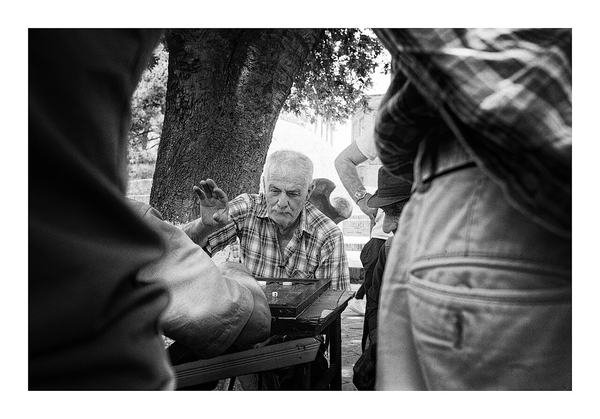
Image credit: madras91. CC BY 2.0. Source: https://commons.wikimedia.org/wiki/File:Backgammon_(48218966616).jpg. Licence: https://creativecommons.org/licenses/by/2.0/deed.en. Display, thumbnail and enlargement resized without cropping and JPEG encoded; EXIF orientation applied. The packaged enlargement is 1200 × 837 pixels. No AI edits.

Walter Coratella opened the 1980s as world champion
Mexico's Walter Coratella won the 1980 World Championship. Sport-Komplett's historical table places his title immediately after Luigi Villa's 1979 victory and before Lee Genud's 1981 win, making Coratella the first champion listed for the new decade.
Image credit: Unknown postcard artist; scan by Tylwyth Eldar. CC BY-SA 4.0 (scan). Source: https://commons.wikimedia.org/wiki/File:Monte_Carlo_-_Casino.jpg. Licence: https://creativecommons.org/licenses/by-sa/4.0/. Display, thumbnail and enlargement resized without cropping and JPEG encoded; EXIF orientation applied. Enlargement limited to 1400 pixels on its longest side, or source size if smaller. No AI edits.
Free monthly lessons in a New York club
Richard Munitz has combined tournament play with community teaching. His USBGF profile says he helps organize the New York City Backgammon Club and gives free lessons there each month. His professional background in computer science and financial-data systems also helps explain his long involvement with tournament technology and statistics.

Image credit: Artprof23. CC0 1.0. Source: https://commons.wikimedia.org/wiki/File:Nyc_union_square_backgammon_game_nov.2024.jpg. Licence: https://creativecommons.org/publicdomain/zero/1.0/deed.en. Display, thumbnail and enlargement resized without cropping and JPEG encoded; EXIF orientation applied. The packaged enlargement is 1200 × 580 pixels. No AI edits.

A Grandmaster title backed by recorded play
When Marty Storer entered the American Backgammon Hall of Fame in 2025, the USBGF listed him as a BMAB Grandmaster Class 1 with a performance rating of 3.19. The profile said he was one of only three Americans then holding that class and had reached third in the world rankings.
Image credit: Beko. CC BY-SA 4.0. Source: https://commons.wikimedia.org/wiki/File:Backgammon_area_in_Tel_Aviv_(1).jpg. Licence: https://creativecommons.org/licenses/by-sa/4.0/deed.en. Display, thumbnail and enlargement resized without cropping and JPEG encoded; EXIF orientation applied. The packaged enlargement is 960 × 640 pixels. No AI edits.
Jacques Michel won the 1982 Monte Carlo final
Jacques Michel of Switzerland became world champion in 1982. Hardy Hübener's historical champions table places Michel between Lee Genud's 1981 title and Bill Robertie's 1983 victory, preserving his place in the early Monte Carlo era.
Image credit: Unknown postcard artist; scan by Tylwyth Eldar. CC BY-SA 4.0 (scan). Source: https://commons.wikimedia.org/wiki/File:Monte_Carlo_-_Casino.jpg. Licence: https://creativecommons.org/licenses/by-sa/4.0/. Display, thumbnail and enlargement resized without cropping and JPEG encoded; EXIF orientation applied. Enlargement limited to 1400 pixels on its longest side, or source size if smaller. No AI edits.
Storer helped Team USA win the Magriel Cup
Marty Storer was part of the Team USA side that won the Magriel Cup in 2020. His Hall of Fame profile also records three New England Backgammon Club championships. Together, those results show two different kinds of success: contributing to a national team and repeatedly winning within a strong local club.
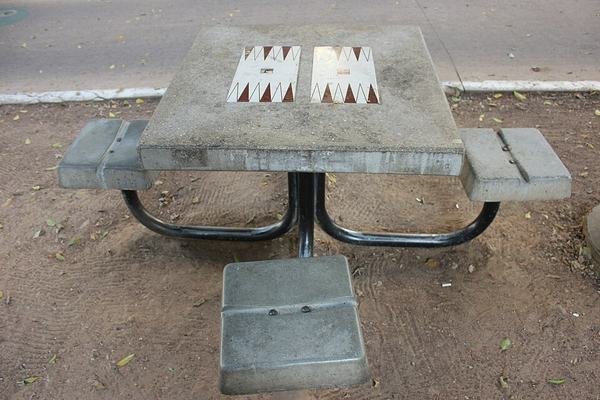
Image credit: Beko. CC BY-SA 4.0. Source: https://commons.wikimedia.org/wiki/File:Backgammon_area_in_Tel_Aviv_(2).jpg. Licence: https://creativecommons.org/licenses/by-sa/4.0/deed.en. Display, thumbnail and enlargement resized without cropping and JPEG encoded; EXIF orientation applied. The packaged enlargement is 960 × 640 pixels. No AI edits.

Mike Svobodny took the 1984 world title
Mike Svobodny won the 1984 World Championship in Monte Carlo. His USBGF Hall of Fame profile also describes him as a travelling promoter who helped host events in Cancun and sponsored the development of promising players. The profile connects his world title with work that helped other competitors enter the game.
Image credit: Unknown postcard artist; scan by Tylwyth Eldar. CC BY-SA 4.0 (scan). Source: https://commons.wikimedia.org/wiki/File:Monte_Carlo_-_Casino.jpg. Licence: https://creativecommons.org/licenses/by-sa/4.0/. Display, thumbnail and enlargement resized without cropping and JPEG encoded; EXIF orientation applied. Enlargement limited to 1400 pixels on its longest side, or source size if smaller. No AI edits.
Falafel stayed near the top of the Giants list
Matvey ‘Falafel’ Natanzon appeared in the top ten of the Giants of Backgammon rankings for seven consecutive editions. He reached number one twice and number two once. The USBGF presents those repeated votes as evidence that expert players valued his intuitive decisions over a sustained period, not just during one tournament.
Image credit: Terry.grignon. CC0 1.0. Source: https://commons.wikimedia.org/wiki/File:Backgammon_study.jpg. Licence: https://creativecommons.org/publicdomain/zero/1.0/deed.en. Display, thumbnail and enlargement resized without cropping and JPEG encoded; EXIF orientation applied. The packaged enlargement is 500 × 889 pixels. No AI edits.
Falafel’s teaching reached several elite players
Falafel’s influence extended well beyond his own results. The USBGF credits him with mentoring Michihito Kageyama, Zdeněk Žižka and Matt Cohn-Geier, among other players. It also remembers him as a gifted commentator, able to explain difficult positions quickly and entertain spectators while high-level matches were being played.
Image credit: Clint Budd from About 15 miles North of Swansea, Wales. CC BY 2.0. Source: https://commons.wikimedia.org/wiki/File:Double_or_Quits%3F_(54132075315).jpg. Licence: https://creativecommons.org/licenses/by/2.0/deed.en. Display, thumbnail and enlargement resized without cropping and JPEG encoded; EXIF orientation applied. The packaged enlargement is 500 × 750 pixels. No AI edits.
The 1985 final appears to have gone the distance
Charles-Henri Sabet of Switzerland won the 1985 World Championship over Israel's Shimon Kagan. A detailed historical table gives the score as 25–24, but marks it with a question mark. That small symbol matters: it separates a documented champion from a score that remains uncertain.
Image credit: Unknown postcard artist; scan by Tylwyth Eldar. CC BY-SA 4.0 (scan). Source: https://commons.wikimedia.org/wiki/File:Monte_Carlo_-_Casino.jpg. Licence: https://creativecommons.org/licenses/by-sa/4.0/. Display, thumbnail and enlargement resized without cropping and JPEG encoded; EXIF orientation applied. Enlargement limited to 1400 pixels on its longest side, or source size if smaller. No AI edits.
Mochy won three of four early UBC contests
The USBGF’s 2023 Hall of Fame profile says Masayuki ‘Mochy’ Mochizuki won the Ultimate Backgammon Championship three times in its first four editions. He then won the April 2023 contender event, earning another opportunity to challenge the reigning champion. The record combines repeated success with a demanding qualification route.
Image credit: Nikos Kitsakis. CC BY 4.0. Source: https://commons.wikimedia.org/wiki/File:Greek_Coffee_next_to_a_board_of_Tavli.jpg. Licence: https://creativecommons.org/licenses/by/4.0/deed.en. Display, thumbnail and enlargement resized without cropping and JPEG encoded; EXIF orientation applied. The packaged enlargement is 500 × 667 pixels. No AI edits.
BMAB created an exclusive class for Mochy
Mochy’s unusually low recorded performance ratings led the Backgammon Masters Awarding Body to classify him as a Super Grandmaster. His USBGF Hall of Fame profile said he was the only person then holding that classification. The title reflects measured decisions from recorded matches rather than popularity, reputation or a single championship result.
Image credit: Theigumus. CC BY-SA 4.0. Source: https://commons.wikimedia.org/wiki/File:Tavla_Oynayan_Amcalar.jpg. Licence: https://creativecommons.org/licenses/by-sa/4.0/deed.en. Display, thumbnail and enlargement resized without cropping and JPEG encoded; EXIF orientation applied. The packaged enlargement is 960 × 720 pixels. No AI edits.
Clement Palacci won the 1986 world title
Clement Palacci of Italy won the 1986 World Championship in Monte Carlo. A historical champions table places his victory between Charles-Henri Sabet's 1985 title and Bill Robertie's 1987 win. That three-year sequence produced champions listed under three different countries.
Image credit: Unknown postcard artist; scan by Tylwyth Eldar. CC BY-SA 4.0 (scan). Source: https://commons.wikimedia.org/wiki/File:Monte_Carlo_-_Casino.jpg. Licence: https://creativecommons.org/licenses/by-sa/4.0/. Display, thumbnail and enlargement resized without cropping and JPEG encoded; EXIF orientation applied. Enlargement limited to 1400 pixels on its longest side, or source size if smaller. No AI edits.
Mochy topped the Giants poll six times
Mochy’s USBGF profile reports six number-one finishes in the Giants of Backgammon voting and one finish at number two. The poll is based on ballots from recognised players and officials, so repeated first-place rankings show how strongly the international backgammon community rated his play across multiple voting cycles.
Image credit: Terry.grignon. CC0 1.0. Source: https://commons.wikimedia.org/wiki/File:Backgammon_and_Wine_(Gums).jpg. Licence: https://creativecommons.org/publicdomain/zero/1.0/deed.en. Display, thumbnail and enlargement resized without cropping and JPEG encoded; EXIF orientation applied. The packaged enlargement is 960 × 520 pixels. No AI edits.
A rare double win in the Super Jackpot
Alongside his major match titles, Mochy achieved what his USBGF profile calls an unprecedented double victory in the Super Jackpot event. The same profile notes that he shares his knowledge through seminars and lectures. His career therefore joins elite competition with the less visible work of teaching other players.
Image credit: Clint Budd from About 15 miles North of Swansea, Wales. CC BY 2.0. Source: https://commons.wikimedia.org/wiki/File:Backgammon_(52600594028).jpg. Licence: https://creativecommons.org/licenses/by/2.0/deed.en. Display, thumbnail and enlargement resized without cropping and JPEG encoded; EXIF orientation applied. The packaged enlargement is 960 × 640 pixels. No AI edits.
Phillip Marmorstein won the 1988 championship
Phillip Marmorstein of Germany won the 1988 World Championship in Monte Carlo. A historical champions table places his victory after Bill Robertie's 1987 title and before Joe Russell's 1989 win. Marmorstein was the first German player on that published winners list.
Image credit: Unknown postcard artist; scan by Tylwyth Eldar. CC BY-SA 4.0 (scan). Source: https://commons.wikimedia.org/wiki/File:Monte_Carlo_-_Casino.jpg. Licence: https://creativecommons.org/licenses/by-sa/4.0/. Display, thumbnail and enlargement resized without cropping and JPEG encoded; EXIF orientation applied. Enlargement limited to 1400 pixels on its longest side, or source size if smaller. No AI edits.
A first tournament cash launched O’Hagan’s run
John O’Hagan first earned prize money at the Nevada State tournament in 1989, according to his 2022 USBGF Hall of Fame profile. The result came after he began studying backgammon books following college. It marked the start of a competitive career that later included many American Backgammon Tour titles.
Image credit: Liz Cooke. CC BY-SA 3.0. Source: https://commons.wikimedia.org/wiki/File:Backgammon_Players%2C_Brighton_Beach%2C_Brooklyn_2012.jpg. Licence: https://creativecommons.org/licenses/by-sa/3.0/. Display, thumbnail and enlargement resized without cropping and JPEG encoded; EXIF orientation applied. Enlargement limited to 1400 pixels on its longest side, or source size if smaller. No AI edits.
O’Hagan’s 2022 season crossed five events
John O’Hagan’s 2022 season carried him across several major American events. His USBGF profile records a Chicago Masters victory, a shared third place at the Cherry Blossom, cashes at the U.S. Open and Ohio State tournaments, and the Texas Championship title. Texas also awarded him the Geoffrey Parker board.
Image credit: Sascha Kohlmann. CC BY-SA 3.0. Source: https://commons.wikimedia.org/wiki/File:Playing_Backgammon_Athens_Greece_%28113613901%29.jpeg. Licence: https://creativecommons.org/licenses/by-sa/3.0/. Display, thumbnail and enlargement resized without cropping and JPEG encoded; EXIF orientation applied. Enlargement limited to 1400 pixels on its longest side, or source size if smaller. No AI edits.
Joe Russell won in 1989 and returned in 2016
Joe Russell won the 1989 World Championship in Monte Carlo. His USBGF Hall of Fame profile also records that he reached another world final in 2016, twenty-seven years later. That unusually long gap shows how one player remained competitive across very different tournament eras.
Image credit: Unknown postcard artist; scan by Tylwyth Eldar. CC BY-SA 4.0 (scan). Source: https://commons.wikimedia.org/wiki/File:Monte_Carlo_-_Casino.jpg. Licence: https://creativecommons.org/licenses/by-sa/4.0/. Display, thumbnail and enlargement resized without cropping and JPEG encoded; EXIF orientation applied. Enlargement limited to 1400 pixels on its longest side, or source size if smaller. No AI edits.
O’Hagan’s name became a cube guideline
John O’Hagan studied match equity and developed practical rules for estimating take points and gammon values during match play. One doubling guideline became known as O’Hagan’s Law. His USBGF profile says both intermediate and elite players use it, turning one player’s analysis into a shared over-the-board tool.
Image credit: Marcin Konsek / Wikimedia Commons. CC BY-SA 4.0. Source: https://commons.wikimedia.org/wiki/File:2014_Kutaisi%2C_M%C4%99%C5%BCczyzni_graj%C4%85cy_w_tryktraka.jpg. Licence: https://creativecommons.org/licenses/by-sa/4.0/. Display, thumbnail and enlargement resized without cropping and JPEG encoded; EXIF orientation applied. Enlargement limited to 1400 pixels on its longest side, or source size if smaller. No AI edits.
Hal Heinrich became Canada's 1990 world champion
Hal Heinrich of Canada won the 1990 World Championship in Monte Carlo. A historical champions table places him between Joe Russell's 1989 victory and Michael Meyburg's 1991 title. Heinrich is the first Canadian winner named on that published list.
Image credit: Unknown postcard artist; scan by Tylwyth Eldar. CC BY-SA 4.0 (scan). Source: https://commons.wikimedia.org/wiki/File:Monte_Carlo_-_Casino.jpg. Licence: https://creativecommons.org/licenses/by-sa/4.0/. Display, thumbnail and enlargement resized without cropping and JPEG encoded; EXIF orientation applied. Enlargement limited to 1400 pixels on its longest side, or source size if smaller. No AI edits.
Art Benjamin climbed all three ABT podium places
Between 1993 and 1997, Art Benjamin finished first, second and third in different American Backgammon Tour seasons. His USBGF Hall of Fame profile highlights that range because he attended only a limited number of events while working as a mathematics professor. Strong results did not require a full-time tournament schedule.
Image credit: Peace Corps. Public domain. Source: https://commons.wikimedia.org/wiki/File:Nardy_players_in_Armenia.jpg. Licence: https://creativecommons.org/publicdomain/mark/1.0/. Display, thumbnail and enlargement resized without cropping and JPEG encoded; EXIF orientation applied. Enlargement limited to 1400 pixels on its longest side, or source size if smaller. No AI edits.
The first ABT Online Series had a mathematician champion
Harvey Mudd College reported that mathematics professor Art Benjamin won the inaugural American Backgammon Tour Online series in 2020, finishing best across seventeen national tournaments. The result connected his academic career with organised online competition during a year when the traditional tour moved away from in-person events.
Image credit: James Emery. CC BY 2.0. Source: https://commons.wikimedia.org/wiki/File:Backgammon_in_Nazareth_0780_%28506270689%29.jpg. Licence: https://creativecommons.org/licenses/by/2.0/. Display, thumbnail and enlargement resized without cropping and JPEG encoded; EXIF orientation applied. Enlargement limited to 1400 pixels on its longest side, or source size if smaller. No AI edits.
Ion Ressu won a seven-hour world final
Romania’s Ion Ressu won the 1992 World Championship after a final lasting more than seven hours against John Simon. A contemporary Finnish Backgammon Association magazine reported that hundreds of spectators followed the match on a large screen, turning a very long contest into a shared tournament spectacle.
Image credit: Unknown postcard artist; scan by Tylwyth Eldar. CC BY-SA 4.0 (scan). Source: https://commons.wikimedia.org/wiki/File:Monte_Carlo_-_Casino.jpg. Licence: https://creativecommons.org/licenses/by-sa/4.0/. Display, thumbnail and enlargement resized without cropping and JPEG encoded; EXIF orientation applied. Enlargement limited to 1400 pixels on its longest side, or source size if smaller. No AI edits.
A 7–3 record helped Team USA win
Art Benjamin produced a 7–3 match record for Team USA in the World Online Team Championship. The USBGF says the event brought together thirty national teams and describes his results as critical to the American victory. Team competitions reward dependable results across many rounds, not one successful knockout match.
Image credit: David Berkowitz. CC BY 2.0. Source: https://commons.wikimedia.org/wiki/File:Istanbul%2C_Turkey_%2810582737355%29.jpg. Licence: https://creativecommons.org/licenses/by/2.0/. Display, thumbnail and enlargement resized without cropping and JPEG encoded; EXIF orientation applied. Enlargement limited to 1400 pixels on its longest side, or source size if smaller. No AI edits.
Math Overboard brings research to players
Art Benjamin writes a regular PrimeTime Backgammon column called Math Overboard. His USBGF profile says the articles examine doubling, racing, match equity and shortcuts that players can use at the board. The column connects his academic work in combinatorics and probability with practical decisions made during real matches.
Image credit: Jeroen Komen. CC BY-SA 2.0. Source: https://commons.wikimedia.org/wiki/File:Boardgames_in_Bucarest_%2810654287715%29.jpg. Licence: https://creativecommons.org/licenses/by-sa/2.0/. Display, thumbnail and enlargement resized without cropping and JPEG encoded; EXIF orientation applied. Enlargement limited to 1400 pixels on its longest side, or source size if smaller. No AI edits.
Peter Jes Thomsen won the 1993 world title
Denmark's Peter Jes Thomsen won the 1993 World Championship. Sport-Komplett's historical table places him after Romania's Ion Ressu in 1992 and before American Frank Frigo in 1994, recording a Danish champion between winners from two other countries.
Image credit: Unknown postcard artist; scan by Tylwyth Eldar. CC BY-SA 4.0 (scan). Source: https://commons.wikimedia.org/wiki/File:Monte_Carlo_-_Casino.jpg. Licence: https://creativecommons.org/licenses/by-sa/4.0/. Display, thumbnail and enlargement resized without cropping and JPEG encoded; EXIF orientation applied. Enlargement limited to 1400 pixels on its longest side, or source size if smaller. No AI edits.
A mathematics meeting became a recruiting ground
For ten years before his 2022 Hall of Fame induction, Art Benjamin ran a backgammon workshop and playing session at national Mathematical Association of America meetings. The USBGF credits those sessions with introducing new players to the game. They brought tournament ideas to an audience already interested in probability and strategic puzzles.
Image credit: Bryan Doane. CC BY 2.0. Source: https://commons.wikimedia.org/wiki/File:Backgammon-playwers-netanya-street-july-2013.jpg. Licence: https://creativecommons.org/licenses/by/2.0/. Display, thumbnail and enlargement resized without cropping and JPEG encoded; EXIF orientation applied. Enlargement limited to 1400 pixels on its longest side, or source size if smaller. No AI edits.
Karen Davis led the USBGF through several roles
Karen Davis served on the USBGF board from its creation in 2009. She chaired the board from 2010 through 2017, then served as president and executive director from 2017 through 2020. Those changing roles placed her at the centre of the federation’s early organisation, membership work and national programmes.
Image credit: Monaam Ben Fredj. CC BY-SA 4.0. Source: https://commons.wikimedia.org/wiki/File:Tawleh_Players_01.jpg. Licence: https://creativecommons.org/licenses/by-sa/4.0/. Display, thumbnail and enlargement resized without cropping and JPEG encoded; EXIF orientation applied. Enlargement limited to 1400 pixels on its longest side, or source size if smaller. No AI edits.
Archived finals show the 1994 title change
Frank Frigo won the 1994 World Championship final against Peter Jes Thomsen, who had taken the title one year earlier. Hardy Hübener’s archive preserves downloadable records of both the 1993 and 1994 finals. The paired match files let readers trace how the crown passed from one champion to the next.
Image credit: Unknown postcard artist; scan by Tylwyth Eldar. CC BY-SA 4.0 (scan). Source: https://commons.wikimedia.org/wiki/File:Monte_Carlo_-_Casino.jpg. Licence: https://creativecommons.org/licenses/by-sa/4.0/. Display, thumbnail and enlargement resized without cropping and JPEG encoded; EXIF orientation applied. Enlargement limited to 1400 pixels on its longest side, or source size if smaller. No AI edits.
Online tournaments became a pandemic-era proving ground
Karen Davis adopted online tournament systems early during the COVID-19 pandemic. Her USBGF Hall of Fame profile says this work demonstrated both the practicality and wider potential of organised internet competition. The shift helped players continue competing when normal travel and face-to-face events were heavily restricted.
Image credit: Stig Nygaard. CC BY 2.0. Source: https://commons.wikimedia.org/wiki/File:Nacala_-_Bay_Diving_(2767931598).jpg. Licence: https://creativecommons.org/licenses/by/2.0/. Display, thumbnail and enlargement resized without cropping and JPEG encoded; EXIF orientation applied. Enlargement limited to 1400 pixels on its longest side, or source size if smaller. No AI edits.
A 1995 newsletter preserved the final four
David Ben-Zion won the 1995 World Championship, defeating Josef Tissona in the final. A contemporary Chicago Point report lists Fredrik Reinholdson and Ricardo Spinola as semifinalists. The dated newsletter preserves the final four from that Monte Carlo championship rather than only naming its winner.
Image credit: Unknown postcard artist; scan by Tylwyth Eldar. CC BY-SA 4.0 (scan). Source: https://commons.wikimedia.org/wiki/File:Monte_Carlo_-_Casino.jpg. Licence: https://creativecommons.org/licenses/by-sa/4.0/. Display, thumbnail and enlargement resized without cropping and JPEG encoded; EXIF orientation applied. Enlargement limited to 1400 pixels on its longest side, or source size if smaller. No AI edits.
Davis represented three different Team USA sides
Karen Davis represented the United States at the 2019 World Team Championship in Montenegro and the 2020 Magriel Cup against Britain. She also captained the American women in the 2020 Genud Cup and was named the team’s most valuable player, combining organisational leadership with results at the board.
Image credit: TZivyA. CC BY-SA 4.0. Source: https://commons.wikimedia.org/wiki/File:Backgammon12.jpg. Licence: https://creativecommons.org/licenses/by-sa/4.0/. Display, thumbnail and enlargement resized without cropping and JPEG encoded; EXIF orientation applied. Enlargement limited to 1400 pixels on its longest side, or source size if smaller. No AI edits.
Two tournaments grew under the same organiser
Karen Davis organised the Cherry Blossom Backgammon Championship in Washington from 2017 through 2021 and the Sunny Florida Championship from 2018 through 2021. Her USBGF profile also credits her with founding the DC Metro Club. These projects linked regular local play with larger national events.
Image credit: Matěj Baťha. CC BY-SA 3.0. Source: https://commons.wikimedia.org/wiki/File:Deskohran%C3%AD_08s4_077_-_Backgammon.jpg. Licence: https://creativecommons.org/licenses/by-sa/3.0/. Display, thumbnail and enlargement resized without cropping and JPEG encoded; EXIF orientation applied. Enlargement limited to 1400 pixels on its longest side, or source size if smaller. No AI edits.
David Nahmad led a 186-player championship
David Nahmad won the 1996 World Championship in a 186-player championship flight, according to a Danish federation magazine. Shlomo Vahab finished second, while Manfred Hollederer and Dirk Schiemann reached the semifinals. The same report also recorded separate consolation, beginner and intermediate sections.
Image credit: Unknown postcard artist; scan by Tylwyth Eldar. CC BY-SA 4.0 (scan). Source: https://commons.wikimedia.org/wiki/File:Monte_Carlo_-_Casino.jpg. Licence: https://creativecommons.org/licenses/by-sa/4.0/. Display, thumbnail and enlargement resized without cropping and JPEG encoded; EXIF orientation applied. Enlargement limited to 1400 pixels on its longest side, or source size if smaller. No AI edits.
Tahoe’s Colossus paid O’Laughlin $50,000
Ed O’Laughlin won the first-place prize at the 1998 Tahoe Caesar’s Colossus. His USBGF Hall of Fame profile gives the prize as $50,000. Because that figure comes from the federation’s own biography, it can be reported as a documented tournament payment rather than a guess based on an entry list or later recollection.
Image credit: Alex Proimos. CC BY 2.0. Source: https://commons.wikimedia.org/wiki/File:Saturday_Afternoon_Backgammon_(6784476822).jpg. Licence: https://creativecommons.org/licenses/by/2.0/. Display, thumbnail and enlargement resized without cropping and JPEG encoded; EXIF orientation applied. Enlargement limited to 1400 pixels on its longest side, or source size if smaller. No AI edits.
A late-career ABT season reached number one
Ed O’Laughlin finished first in the American Backgammon Tour standings in 2016. His 2020 Hall of Fame profile also records second-place seasons in 2002, 2013 and 2017. The fifteen-year spread between those runner-up results shows unusual competitive durability across different eras of American tournament play.
Image credit: Roland Scheicher; table designed by Alois Scheicher. Public domain (author dedication). Source: https://commons.wikimedia.org/wiki/File:Backgammontisch.jpg. Licence: https://creativecommons.org/publicdomain/mark/1.0/. Display, thumbnail and enlargement resized without cropping and JPEG encoded; EXIF orientation applied. Enlargement limited to 1400 pixels on its longest side, or source size if smaller. No AI edits.
Jerry Grandell returned from finalist to champion
Jerry Grandell lost the 1987 World Championship final to Bill Robertie, then returned to win the title in 1997 against Frédéric Banjout. Hardy Hübener’s match archive preserves records of both finals. The ten-year span shows that an early defeat did not end Grandell’s championship story.
Image credit: Unknown postcard artist; scan by Tylwyth Eldar. CC BY-SA 4.0 (scan). Source: https://commons.wikimedia.org/wiki/File:Monte_Carlo_-_Casino.jpg. Licence: https://creativecommons.org/licenses/by-sa/4.0/. Display, thumbnail and enlargement resized without cropping and JPEG encoded; EXIF orientation applied. Enlargement limited to 1400 pixels on its longest side, or source size if smaller. No AI edits.
Three USBGF titles arrived in five years
Ed O’Laughlin won the USBGF Grand Championship in 2016. He also won the federation’s National Championship East in 2012 and again in 2016. Those three titles, listed in his Hall of Fame profile, show repeated success in events carrying the national federation’s name rather than one isolated run.
Image credit: Liz Cooke. CC BY-SA 3.0. Source: https://commons.wikimedia.org/wiki/File:Backgammon_Players%2C_Brighton_Beach%2C_Brooklyn_2012.jpg. Licence: https://creativecommons.org/licenses/by-sa/3.0/. Display, thumbnail and enlargement resized without cropping and JPEG encoded; EXIF orientation applied. Enlargement limited to 1400 pixels on its longest side, or source size if smaller. No AI edits.
Steve Sax reached number six among the Giants
Steve Sax was elected to nine consecutive Giants of Backgammon lists and reached a career-high position of number six. His USBGF Hall of Fame profile combines that peer recognition with a long tournament record. Repeated voting matters because each list reflects a fresh judgement by people active in the game.
Image credit: Sascha Kohlmann. CC BY-SA 3.0. Source: https://commons.wikimedia.org/wiki/File:Playing_Backgammon_Athens_Greece_%28113613901%29.jpeg. Licence: https://creativecommons.org/licenses/by-sa/3.0/. Display, thumbnail and enlargement resized without cropping and JPEG encoded; EXIF orientation applied. Enlargement limited to 1400 pixels on its longest side, or source size if smaller. No AI edits.
A book preserves Mads Andersen's 2002 title run
Mads Andersen of Denmark won the 2002 World Championship in Monte Carlo. A book published by the Danish Backgammon Federation analyses his semifinal against Jan Bloxham and his final against Felix Ziva. The surviving match material preserves more than the champion’s name.
Image credit: Unknown postcard artist; scan by Tylwyth Eldar. CC BY-SA 4.0 (scan). Source: https://commons.wikimedia.org/wiki/File:Monte_Carlo_-_Casino.jpg. Licence: https://creativecommons.org/licenses/by-sa/4.0/. Display, thumbnail and enlargement resized without cropping and JPEG encoded; EXIF orientation applied. Enlargement limited to 1400 pixels on its longest side, or source size if smaller. No AI edits.
Sax scored ABT points in nineteen of twenty-two years
Steve Sax won the American Backgammon Tour in 2002. By his 2019 Hall of Fame induction, he ranked fourth on the tour’s all-time points list and had earned points in nineteen of the previous twenty-two years. That consistency stretches far beyond the single season in which he finished first.
Image credit: Marcin Konsek / Wikimedia Commons. CC BY-SA 4.0. Source: https://commons.wikimedia.org/wiki/File:2014_Kutaisi%2C_M%C4%99%C5%BCczyzni_graj%C4%85cy_w_tryktraka.jpg. Licence: https://creativecommons.org/licenses/by-sa/4.0/. Display, thumbnail and enlargement resized without cropping and JPEG encoded; EXIF orientation applied. Enlargement limited to 1400 pixels on its longest side, or source size if smaller. No AI edits.
One record included Masters, ABT and Vietor titles
Steve Sax’s Hall of Fame profile lists fourteen Masters titles, six American Backgammon Tour titles and two Vietor Cup victories. It also notes twelve finalist finishes across those event groups. The numbers show how a long career can contain both outright wins and repeated deep runs against strong fields.
Image credit: Peace Corps. Public domain. Source: https://commons.wikimedia.org/wiki/File:Nardy_players_in_Armenia.jpg. Licence: https://creativecommons.org/publicdomain/mark/1.0/. Display, thumbnail and enlargement resized without cropping and JPEG encoded; EXIF orientation applied. Enlargement limited to 1400 pixels on its longest side, or source size if smaller. No AI edits.
Jon Røyset became Norway's 2003 world champion
Jon Røyset won the 2003 World Championship in a field of 271 championship entrants. The year-specific results page lists Moshe Tissona second, with Dirk Schiemann and Katja Spillum in the semifinals. Those placings preserve the tournament’s final four rather than only the champion.
Image credit: Unknown postcard artist; scan by Tylwyth Eldar. CC BY-SA 4.0 (scan). Source: https://commons.wikimedia.org/wiki/File:Monte_Carlo_-_Casino.jpg. Licence: https://creativecommons.org/licenses/by-sa/4.0/. Display, thumbnail and enlargement resized without cropping and JPEG encoded; EXIF orientation applied. Enlargement limited to 1400 pixels on its longest side, or source size if smaller. No AI edits.
A Grandmaster also worked behind the camera
Steve Sax held a BMAB Grandmaster 2 ranking when inducted into the Hall of Fame. The USBGF also credits his teaching, writing, analysis, photography and commentary. Tournament communities need those supporting skills: they preserve matches, explain decisions and help new players take part in serious competition.
Image credit: James Emery. CC BY 2.0. Source: https://commons.wikimedia.org/wiki/File:Backgammon_in_Nazareth_0780_%28506270689%29.jpg. Licence: https://creativecommons.org/licenses/by/2.0/. Display, thumbnail and enlargement resized without cropping and JPEG encoded; EXIF orientation applied. Enlargement limited to 1400 pixels on its longest side, or source size if smaller. No AI edits.
Peter Hallberg won the 2004 championship
Peter Hallberg of Denmark won the 2004 World Championship over American Bob Wachtel. The year-specific results page records 276 championship entrants, with Dag Ekmark and Serge Engelhardt completing the semifinal group in Monte Carlo that year.
Image credit: Unknown postcard artist; scan by Tylwyth Eldar. CC BY-SA 4.0 (scan). Source: https://commons.wikimedia.org/wiki/File:Monte_Carlo_-_Casino.jpg. Licence: https://creativecommons.org/licenses/by-sa/4.0/. Display, thumbnail and enlargement resized without cropping and JPEG encoded; EXIF orientation applied. Enlargement limited to 1400 pixels on its longest side, or source size if smaller. No AI edits.
Louise Goldsmith built clubs where champions developed
Louise Goldsmith oversaw play at New York’s Mayfair Club in the 1970s, then directed her own Coterie club in the 1980s and 1990s. Her USBGF profile credits those settings with helping players such as Paul Magriel, Billy Horan, Michael Senkiewicz and Eric Seidel develop their games.
Image credit: David Berkowitz. CC BY 2.0. Source: https://commons.wikimedia.org/wiki/File:Istanbul%2C_Turkey_%2810582737355%29.jpg. Licence: https://creativecommons.org/licenses/by/2.0/. Display, thumbnail and enlargement resized without cropping and JPEG encoded; EXIF orientation applied. Enlargement limited to 1400 pixels on its longest side, or source size if smaller. No AI edits.
John Crawford won the 1965 Bahamas tournament
John Crawford won the 1965 International Tournament of Champions in the Bahamas. A USBGF Hall of Fame announcement describes that event as the leading international tournament of its time. The victory adds a dated playing achievement to Crawford’s better-known legacy as an author and the namesake of the Crawford rule.
Image credit: Jeroen Komen. CC BY-SA 2.0. Source: https://commons.wikimedia.org/wiki/File:Boardgames_in_Bucarest_%2810654287715%29.jpg. Licence: https://creativecommons.org/licenses/by-sa/2.0/. Display, thumbnail and enlargement resized without cropping and JPEG encoded; EXIF orientation applied. Enlargement limited to 1400 pixels on its longest side, or source size if smaller. No AI edits.
Double match point decided the 2005 final
Dennis Carlston defeated John O’Hagan in the 2005 World Championship final after their 25-point match reached double match point. A Hoosier Backgammon Club report says Carlston then rolled a key double-six that produced the winning race. One game decided the title.
Image credit: Unknown postcard artist; scan by Tylwyth Eldar. CC BY-SA 4.0 (scan). Source: https://commons.wikimedia.org/wiki/File:Monte_Carlo_-_Casino.jpg. Licence: https://creativecommons.org/licenses/by-sa/4.0/. Display, thumbnail and enlargement resized without cropping and JPEG encoded; EXIF orientation applied. Enlargement limited to 1400 pixels on its longest side, or source size if smaller. No AI edits.
A 1972 association worked on standard rules
In 1972, Alexis Obolensky founded the Backgammon Association of America. His USBGF biography says the organisation created standard rules for tournament play. Shared rules were essential as players began travelling between events, because local customs could otherwise change how dice, legal moves and match procedures were handled.
Image credit: Bryan Doane. CC BY 2.0. Source: https://commons.wikimedia.org/wiki/File:Backgammon-playwers-netanya-street-july-2013.jpg. Licence: https://creativecommons.org/licenses/by/2.0/. Display, thumbnail and enlargement resized without cropping and JPEG encoded; EXIF orientation applied. Enlargement limited to 1400 pixels on its longest side, or source size if smaller. No AI edits.
A 544-player win came at age twenty-one
Joe Sylvester entered the 1983 World Amateur Championship in Las Vegas at age twenty-one and won a field of 544 players. His USBGF Hall of Fame profile treats that victory as the beginning of a twelve-year period when many regarded him as the game’s leading tournament player.
Image credit: Monaam Ben Fredj. CC BY-SA 4.0. Source: https://commons.wikimedia.org/wiki/File:Tawleh_Players_01.jpg. Licence: https://creativecommons.org/licenses/by-sa/4.0/. Display, thumbnail and enlargement resized without cropping and JPEG encoded; EXIF orientation applied. Enlargement limited to 1400 pixels on its longest side, or source size if smaller. No AI edits.
The 1979 champion returned to the 2006 final
Philip Vischjager won the 2006 World Championship over 1979 champion Luigi Villa. The year-specific results page lists 212 championship entrants and names Andreas Humke and Kazuhiro Shino as semifinalists. Villa’s return to the final twenty-seven years after his title linked two tournament generations.
Image credit: Unknown postcard artist; scan by Tylwyth Eldar. CC BY-SA 4.0 (scan). Source: https://commons.wikimedia.org/wiki/File:Monte_Carlo_-_Casino.jpg. Licence: https://creativecommons.org/licenses/by-sa/4.0/. Display, thumbnail and enlargement resized without cropping and JPEG encoded; EXIF orientation applied. Enlargement limited to 1400 pixels on its longest side, or source size if smaller. No AI edits.
PRAT turned cube judgement into three questions
Joe Sylvester was the first player credited by the USBGF with using PRAT as a doubling guide. The letters stand for Position, Race and Threats. Checking those three features helps a player decide whether the board has changed enough to offer, take or pass a double.
Image credit: Stig Nygaard. CC BY 2.0. Source: https://commons.wikimedia.org/wiki/File:Nacala_-_Bay_Diving_(2767931598).jpg. Licence: https://creativecommons.org/licenses/by/2.0/. Display, thumbnail and enlargement resized without cropping and JPEG encoded; EXIF orientation applied. Enlargement limited to 1400 pixels on its longest side, or source size if smaller. No AI edits.
Sylvester won two Illinois titles four years apart
Joe Sylvester won the Illinois State Championship in 2007 and again in 2011. His USBGF Hall of Fame profile calls them recent achievements alongside victories from the 1980s and 1990s. The four-year gap between the Illinois wins shows that his competitive record continued well beyond his early peak.
Image credit: TZivyA. CC BY-SA 4.0. Source: https://commons.wikimedia.org/wiki/File:Backgammon12.jpg. Licence: https://creativecommons.org/licenses/by-sa/4.0/. Display, thumbnail and enlargement resized without cropping and JPEG encoded; EXIF orientation applied. Enlargement limited to 1400 pixels on its longest side, or source size if smaller. No AI edits.
Lars Trabolt followed a title with another final
Lars Trabolt won the World Championship in 2008 and reached the final again in 2009. Hardy Hübener’s match archive records that Masayuki Mochizuki defeated him in the second final, becoming Japan’s first world champion. Trabolt therefore came within one match of consecutive titles.
Image credit: Unknown postcard artist; scan by Tylwyth Eldar. CC BY-SA 4.0 (scan). Source: https://commons.wikimedia.org/wiki/File:Monte_Carlo_-_Casino.jpg. Licence: https://creativecommons.org/licenses/by-sa/4.0/. Display, thumbnail and enlargement resized without cropping and JPEG encoded; EXIF orientation applied. Enlargement limited to 1400 pixels on its longest side, or source size if smaller. No AI edits.
Fogerlund set an 88.80-point ABT season record
Ray Fogerlund earned 88.80 American Backgammon Tour points in 2011, a single-season record listed by the USBGF at his 2017 Hall of Fame induction. Tour points depend on results and event size, so the total represents a full season of unusually deep finishes rather than one isolated victory.
Image credit: Matěj Baťha. CC BY-SA 3.0. Source: https://commons.wikimedia.org/wiki/File:Deskohran%C3%AD_08s4_077_-_Backgammon.jpg. Licence: https://creativecommons.org/licenses/by-sa/3.0/. Display, thumbnail and enlargement resized without cropping and JPEG encoded; EXIF orientation applied. Enlargement limited to 1400 pixels on its longest side, or source size if smaller. No AI edits.
Lars Bentzon won the 2010 world title
Lars Bentzon of Denmark won the 2010 World Championship, defeating Spain’s Ricardo Malas in the final. The year-specific archive preserves a downloadable record of their Monte Carlo match, giving players a chance to study the championship encounter move by move.
Image credit: Unknown postcard artist; scan by Tylwyth Eldar. CC BY-SA 4.0 (scan). Source: https://commons.wikimedia.org/wiki/File:Monte_Carlo_-_Casino.jpg. Licence: https://creativecommons.org/licenses/by-sa/4.0/. Display, thumbnail and enlargement resized without cropping and JPEG encoded; EXIF orientation applied. Enlargement limited to 1400 pixels on its longest side, or source size if smaller. No AI edits.
Fifteen straight years on the ABT scoreboard
From 2002 through 2016, Ray Fogerlund earned American Backgammon Tour points in every season. His USBGF profile identifies the fifteen-year run as a tour record. Maintaining such a streak requires more than attendance: a player must repeatedly finish high enough in qualifying events to collect points.
Image credit: Alex Proimos. CC BY 2.0. Source: https://commons.wikimedia.org/wiki/File:Saturday_Afternoon_Backgammon_(6784476822).jpg. Licence: https://creativecommons.org/licenses/by/2.0/. Display, thumbnail and enlargement resized without cropping and JPEG encoded; EXIF orientation applied. Enlargement limited to 1400 pixels on its longest side, or source size if smaller. No AI edits.
Thirty-one ABT championships in fourteen years
Ray Fogerlund won thirty-one American Backgammon Tour championships from 2003 through 2016, according to his Hall of Fame profile. The listed total includes eleven Championship and sixteen Masters titles, with other wins completing the count. It reflects success across several tournament formats and difficulty levels.
Image credit: Roland Scheicher; table designed by Alois Scheicher. Public domain (author dedication). Source: https://commons.wikimedia.org/wiki/File:Backgammontisch.jpg. Licence: https://creativecommons.org/publicdomain/mark/1.0/. Display, thumbnail and enlargement resized without cropping and JPEG encoded; EXIF orientation applied. Enlargement limited to 1400 pixels on its longest side, or source size if smaller. No AI edits.
Nevzat Dogan won the 2012 world title
Nevzat Dogan won the 2012 World Championship in Monte Carlo, with Michihito Kageyama finishing second. The year-specific results page lists 136 championship entrants and Victor Petersen and Michel Serrero as semifinalists. Using that event page avoids relying on broader lists that disagree about Dogan’s country label.
Image credit: Unknown postcard artist; scan by Tylwyth Eldar. CC BY-SA 4.0 (scan). Source: https://commons.wikimedia.org/wiki/File:Monte_Carlo_-_Casino.jpg. Licence: https://creativecommons.org/licenses/by-sa/4.0/. Display, thumbnail and enlargement resized without cropping and JPEG encoded; EXIF orientation applied. Enlargement limited to 1400 pixels on its longest side, or source size if smaller. No AI edits.
A U.S. Open win joined five Los Angeles victories
Ray Fogerlund won the U.S. Open in Las Vegas in 2014. His USBGF profile also credits him with five championship victories in Los Angeles, his home city, plus major jackpot titles in Chicago and Las Vegas. His strongest results were spread across several important American tournament centres.
Image credit: Liz Cooke. CC BY-SA 3.0. Source: https://commons.wikimedia.org/wiki/File:Backgammon_Players%2C_Brighton_Beach%2C_Brooklyn_2012.jpg. Licence: https://creativecommons.org/licenses/by-sa/3.0/. Display, thumbnail and enlargement resized without cropping and JPEG encoded; EXIF orientation applied. Enlargement limited to 1400 pixels on its longest side, or source size if smaller. No AI edits.
Joe Russell topped the ABT in 1995
Joseph ‘Joe’ Russell finished first in the American Backgammon Tour point standings in 1995. His USBGF Hall of Fame profile also records more than twenty-five wins in regional, national and international events. The combination shows both one outstanding tour season and a broader record across different levels of competition.
Image credit: Sascha Kohlmann. CC BY-SA 3.0. Source: https://commons.wikimedia.org/wiki/File:Playing_Backgammon_Athens_Greece_%28113613901%29.jpeg. Licence: https://creativecommons.org/licenses/by-sa/3.0/. Display, thumbnail and enlargement resized without cropping and JPEG encoded; EXIF orientation applied. Enlargement limited to 1400 pixels on its longest side, or source size if smaller. No AI edits.
Vyacheslav Pryadkin won the 2013 championship
Ukraine’s Vyacheslav Pryadkin won the 2013 World Championship, with Denmark’s Lars Trabolt second. The year-specific results page records 141 championship entrants and lists Petko Kostadinov and Ensio Einola Tero as semifinalists, preserving the event’s final four.
Image credit: Unknown postcard artist; scan by Tylwyth Eldar. CC BY-SA 4.0 (scan). Source: https://commons.wikimedia.org/wiki/File:Monte_Carlo_-_Casino.jpg. Licence: https://creativecommons.org/licenses/by-sa/4.0/. Display, thumbnail and enlargement resized without cropping and JPEG encoded; EXIF orientation applied. Enlargement limited to 1400 pixels on its longest side, or source size if smaller. No AI edits.
A founding director later chaired the federation
Joe Russell was a founding member of the U.S. Backgammon Federation’s board. He served on its Education, Executive and Hall of Fame committees and chaired the board for a decade. The USBGF also highlights his support for youth and collegiate backgammon, linking administration with efforts to find future players.
Image credit: Marcin Konsek / Wikimedia Commons. CC BY-SA 4.0. Source: https://commons.wikimedia.org/wiki/File:2014_Kutaisi%2C_M%C4%99%C5%BCczyzni_graj%C4%85cy_w_tryktraka.jpg. Licence: https://creativecommons.org/licenses/by-sa/4.0/. Display, thumbnail and enlargement resized without cropping and JPEG encoded; EXIF orientation applied. Enlargement limited to 1400 pixels on its longest side, or source size if smaller. No AI edits.
Markowitz directed the million-dollar Bahamas event
Howard Markowitz directed the PartyGammon Million in the Bahamas in 2007. He later co-directed the Monte Carlo World Championship from 2009 through 2012. His USBGF profile presents both as part of a long career designing large events with strong fields and unusually high payouts.
Image credit: Peace Corps. Public domain. Source: https://commons.wikimedia.org/wiki/File:Nardy_players_in_Armenia.jpg. Licence: https://creativecommons.org/publicdomain/mark/1.0/. Display, thumbnail and enlargement resized without cropping and JPEG encoded; EXIF orientation applied. Enlargement limited to 1400 pixels on its longest side, or source size if smaller. No AI edits.
Ali Cihangir Çetinel became the first Turkish champion
Ali Cihangir Çetinel defeated Russia's Sergey Erokhin in the double-elimination final to win the 2015 World Championship. The event's official page calls it the fortieth championship and identifies Çetinel as the first Turkish world champion.
Image credit: Unknown postcard artist; scan by Tylwyth Eldar. CC BY-SA 4.0 (scan). Source: https://commons.wikimedia.org/wiki/File:Monte_Carlo_-_Casino.jpg. Licence: https://creativecommons.org/licenses/by-sa/4.0/. Display, thumbnail and enlargement resized without cropping and JPEG encoded; EXIF orientation applied. Enlargement limited to 1400 pixels on its longest side, or source size if smaller. No AI edits.
Nearly three decades directing the Chicago Open
Howard Markowitz organised the Chicago Open from 1981 through 2009. His Hall of Fame profile also says he directed the Las Vegas Open and Nevada State Championship from 1992 onward. Running recurring events for that long requires dependable rules, schedules, staff and relationships with travelling players.
Image credit: James Emery. CC BY 2.0. Source: https://commons.wikimedia.org/wiki/File:Backgammon_in_Nazareth_0780_%28506270689%29.jpg. Licence: https://creativecommons.org/licenses/by/2.0/. Display, thumbnail and enlargement resized without cropping and JPEG encoded; EXIF orientation applied. Enlargement limited to 1400 pixels on its longest side, or source size if smaller. No AI edits.
Two major Los Angeles wins arrived in 2012
Howard Markowitz won both the Los Angeles Open Championship and the Super-32 in 2012. Earlier victories listed by the USBGF include the Michigan Summer Championships in 1984 and 1993 and the 1990 Midwest Championship. The dates show a tournament career spanning nearly three decades.
Image credit: David Berkowitz. CC BY 2.0. Source: https://commons.wikimedia.org/wiki/File:Istanbul%2C_Turkey_%2810582737355%29.jpg. Licence: https://creativecommons.org/licenses/by/2.0/. Display, thumbnail and enlargement resized without cropping and JPEG encoded; EXIF orientation applied. Enlargement limited to 1400 pixels on its longest side, or source size if smaller. No AI edits.
Didier Assaraf won between two repeat champions
France's Didier Assaraf won the 2017 World Championship, with Petko Kostadinov finishing second. The result came one year after Jörgen Granstedt's third title and one year before Akiko Yazawa's second, placing a first-time winner between two repeat champions.
Image credit: Unknown postcard artist; scan by Tylwyth Eldar. CC BY-SA 4.0 (scan). Source: https://commons.wikimedia.org/wiki/File:Monte_Carlo_-_Casino.jpg. Licence: https://creativecommons.org/licenses/by-sa/4.0/. Display, thumbnail and enlargement resized without cropping and JPEG encoded; EXIF orientation applied. Enlargement limited to 1400 pixels on its longest side, or source size if smaller. No AI edits.
Kleinman put mathematics behind checker and cube play
The USBGF describes Danny Kleinman as backgammon’s first mathematical theorist and analyst. It credits him with pioneering the use of mathematics to explain both checker moves and doubling-cube decisions. His work helped turn expert intuition into arguments that readers could inspect, calculate and debate.
Image credit: Jeroen Komen. CC BY-SA 2.0. Source: https://commons.wikimedia.org/wiki/File:Boardgames_in_Bucarest_%2810654287715%29.jpg. Licence: https://creativecommons.org/licenses/by-sa/2.0/. Display, thumbnail and enlargement resized without cropping and JPEG encoded; EXIF orientation applied. Enlargement limited to 1400 pixels on its longest side, or source size if smaller. No AI edits.
Eli Roymi won the 2019 double-elimination final
Israel's Eli Roymi defeated Petko Kostadinov of the United States to win the 2019 World Championship. The official event page specifically describes their deciding contest as a double-elimination final, distinguishing its structure from a simple one-loss knockout final.
Image credit: Unknown postcard artist; scan by Tylwyth Eldar. CC BY-SA 4.0 (scan). Source: https://commons.wikimedia.org/wiki/File:Monte_Carlo_-_Casino.jpg. Licence: https://creativecommons.org/licenses/by-sa/4.0/. Display, thumbnail and enlargement resized without cropping and JPEG encoded; EXIF orientation applied. Enlargement limited to 1400 pixels on its longest side, or source size if smaller. No AI edits.
A shelf of Kleinman books covered fifteen years
Danny Kleinman published a long sequence of backgammon books from 1980 through 1995. Titles ranged from Vision Laughs at Counting to Long Road to Gammon. His Hall of Fame profile also lists four later collaborations, showing how he used both instruction and humour to keep exploring the game.
Image credit: Bryan Doane. CC BY 2.0. Source: https://commons.wikimedia.org/wiki/File:Backgammon-playwers-netanya-street-july-2013.jpg. Licence: https://creativecommons.org/licenses/by/2.0/. Display, thumbnail and enlargement resized without cropping and JPEG encoded; EXIF orientation applied. Enlargement limited to 1400 pixels on its longest side, or source size if smaller. No AI edits.
Gibson directed thousands of weekly tournaments
By his 2016 Hall of Fame induction, Patrick Gibson had directed seventy-six Los Angeles Open and California State championships and more than 3,600 weekly tournaments in the Los Angeles area. Those totals illustrate how a tournament director can shape a community through regular local events as well as annual championships.
Image credit: Monaam Ben Fredj. CC BY-SA 4.0. Source: https://commons.wikimedia.org/wiki/File:Tawleh_Players_01.jpg. Licence: https://creativecommons.org/licenses/by-sa/4.0/. Display, thumbnail and enlargement resized without cropping and JPEG encoded; EXIF orientation applied. Enlargement limited to 1400 pixels on its longest side, or source size if smaller. No AI edits.
The championship record jumps from 2019 to 2021
The official championship sequence lists Eli Roymi in 2019 and Masayuki Mochizuki in 2021, with no 2020 champion between them. That gap matters when counting titles or editions. This fact records the missing championship year without guessing at details not stated on the results page.
Image credit: Unknown postcard artist; scan by Tylwyth Eldar. CC BY-SA 4.0 (scan). Source: https://commons.wikimedia.org/wiki/File:Monte_Carlo_-_Casino.jpg. Licence: https://creativecommons.org/licenses/by-sa/4.0/. Display, thumbnail and enlargement resized without cropping and JPEG encoded; EXIF orientation applied. Enlargement limited to 1400 pixels on its longest side, or source size if smaller. No AI edits.
The oldest U.S. tournament found a long-term steward
Beginning in 2000, Patrick Gibson directed sixteen editions of the Vietor Cup in La Jolla, which his USBGF profile calls the oldest tournament in the United States. He had already founded the Gammon Associates Club in 1978 and developed it into a large USBGF Prime Club.
Image credit: Stig Nygaard. CC BY 2.0. Source: https://commons.wikimedia.org/wiki/File:Nacala_-_Bay_Diving_(2767931598).jpg. Licence: https://creativecommons.org/licenses/by/2.0/. Display, thumbnail and enlargement resized without cropping and JPEG encoded; EXIF orientation applied. Enlargement limited to 1400 pixels on its longest side, or source size if smaller. No AI edits.
Drawsheets became a historical database
Patrick Gibson guided the creation of a rankings and statistics database using tournament drawsheets. The project entered main-event and major-jackpot brackets from American national tournaments beginning in 2009. The USBGF describes it as a valuable resource because it preserves results that might otherwise disappear after an event ends.
Image credit: TZivyA. CC BY-SA 4.0. Source: https://commons.wikimedia.org/wiki/File:Backgammon12.jpg. Licence: https://creativecommons.org/licenses/by-sa/4.0/. Display, thumbnail and enlargement resized without cropping and JPEG encoded; EXIF orientation applied. Enlargement limited to 1400 pixels on its longest side, or source size if smaller. No AI edits.
Mochy became a two-time champion in 2021
Masayuki 'Mochy' Mochizuki defeated Carlos Estenssoro to win the 2021 World Championship in Monte Carlo. It was Mochizuki's second title, twelve years after his 2009 victory. The official event page labels the tournament the fifty-second World Championship.
Image credit: Unknown postcard artist; scan by Tylwyth Eldar. CC BY-SA 4.0 (scan). Source: https://commons.wikimedia.org/wiki/File:Monte_Carlo_-_Casino.jpg. Licence: https://creativecommons.org/licenses/by-sa/4.0/. Display, thumbnail and enlargement resized without cropping and JPEG encoded; EXIF orientation applied. Enlargement limited to 1400 pixels on its longest side, or source size if smaller. No AI edits.
Gibson won in three states across sixteen years
Patrick Gibson’s own tournament wins include the 1994 San Diego Grand Prix, the 2007 Michigan Summer Championship and the 2010 Nevada State Championship. His USBGF profile also records top-three American Backgammon Tour seasons in 1994 and 2007, showing achievement alongside his better-known directing work.
Image credit: Matěj Baťha. CC BY-SA 3.0. Source: https://commons.wikimedia.org/wiki/File:Deskohran%C3%AD_08s4_077_-_Backgammon.jpg. Licence: https://creativecommons.org/licenses/by-sa/3.0/. Display, thumbnail and enlargement resized without cropping and JPEG encoded; EXIF orientation applied. Enlargement limited to 1400 pixels on its longest side, or source size if smaller. No AI edits.
Neil’s Numbers made match equity portable
Neil Kazaross devised ‘Neil’s Numbers,’ a shorthand method for estimating match equity during play. He also co-authored the Rockwell–Kazaross Match Equity Table. His USBGF Hall of Fame profile highlights these tools because tournament players need practical estimates while deciding whether to double, take or pass.
Image credit: Alex Proimos. CC BY 2.0. Source: https://commons.wikimedia.org/wiki/File:Saturday_Afternoon_Backgammon_(6784476822).jpg. Licence: https://creativecommons.org/licenses/by/2.0/. Display, thumbnail and enlargement resized without cropping and JPEG encoded; EXIF orientation applied. Enlargement limited to 1400 pixels on its longest side, or source size if smaller. No AI edits.
Sander Lylloff won the 2022 double-elimination final
Denmark's Sander Lylloff won the fifty-third World Championship in Monte Carlo in 2022. He defeated Czech player Zdenek Zizka in a double-elimination final. That format gave the finalists a different path from a simple one-loss knockout bracket.
Image credit: Unknown postcard artist; scan by Tylwyth Eldar. CC BY-SA 4.0 (scan). Source: https://commons.wikimedia.org/wiki/File:Monte_Carlo_-_Casino.jpg. Licence: https://creativecommons.org/licenses/by-sa/4.0/. Display, thumbnail and enlargement resized without cropping and JPEG encoded; EXIF orientation applied. Enlargement limited to 1400 pixels on its longest side, or source size if smaller. No AI edits.
Ten consecutive top-ten Giants rankings
Neil Kazaross appeared on eleven consecutive Giants of Backgammon lists. His 2015 Hall of Fame profile reported ten straight top-ten placements beginning in 1995 and a top-five position in every poll from 2005 to that point. The sequence reflects unusually durable respect from expert voters.
Image credit: Roland Scheicher; table designed by Alois Scheicher. Public domain (author dedication). Source: https://commons.wikimedia.org/wiki/File:Backgammontisch.jpg. Licence: https://creativecommons.org/publicdomain/mark/1.0/. Display, thumbnail and enlargement resized without cropping and JPEG encoded; EXIF orientation applied. Enlargement limited to 1400 pixels on its longest side, or source size if smaller. No AI edits.
Frank Frigo returned after twenty-nine years
Frank Frigo became the 2023 World Champion, returning to the top of the event twenty-nine years after his 1994 title. The USBGF’s Fall 2023 PrimeTime page identifies him as winner of the 54th championship and describes the title as a repeat victory.
Image credit: Unknown postcard artist; scan by Tylwyth Eldar. CC BY-SA 4.0 (scan). Source: https://commons.wikimedia.org/wiki/File:Monte_Carlo_-_Casino.jpg. Licence: https://creativecommons.org/licenses/by-sa/4.0/. Display, thumbnail and enlargement resized without cropping and JPEG encoded; EXIF orientation applied. Enlargement limited to 1400 pixels on its longest side, or source size if smaller. No AI edits.
ABT records and the first USBGF national title
At his 2015 induction, Neil Kazaross led the American Backgammon Tour in career points, had finished number one six times, placed in the top three eight times and won seventeen tour events. He also won the inaugural USBGF National Championship in 2011, adding a federation title to his tour record.
Image credit: Liz Cooke. CC BY-SA 3.0. Source: https://commons.wikimedia.org/wiki/File:Backgammon_Players%2C_Brighton_Beach%2C_Brooklyn_2012.jpg. Licence: https://creativecommons.org/licenses/by-sa/3.0/. Display, thumbnail and enlargement resized without cropping and JPEG encoded; EXIF orientation applied. Enlargement limited to 1400 pixels on its longest side, or source size if smaller. No AI edits.
Goulding introduced an American rating system
Kent Goulding introduced the first United States backgammon rating system, according to his USBGF Hall of Fame profile. A rating system gives players a continuing measurement beyond individual trophies. It can compare results over time and help organisers seed, classify or simply understand a competitive field.
Image credit: Sascha Kohlmann. CC BY-SA 3.0. Source: https://commons.wikimedia.org/wiki/File:Playing_Backgammon_Athens_Greece_%28113613901%29.jpeg. Licence: https://creativecommons.org/licenses/by-sa/3.0/. Display, thumbnail and enlargement resized without cropping and JPEG encoded; EXIF orientation applied. Enlargement limited to 1400 pixels on its longest side, or source size if smaller. No AI edits.
Johan Moazed won the 2024 world final
Sweden's Johan Moazed won the 2024 World Championship in Monte Carlo, defeating Britain's Brandon Macklin in the final. A report from the UK Backgammon Federation described the result soon after the event. No prize amount is attached here because the cited report supports the sporting result.
Image credit: Unknown postcard artist; scan by Tylwyth Eldar. CC BY-SA 4.0 (scan). Source: https://commons.wikimedia.org/wiki/File:Monte_Carlo_-_Casino.jpg. Licence: https://creativecommons.org/licenses/by-sa/4.0/. Display, thumbnail and enlargement resized without cropping and JPEG encoded; EXIF orientation applied. Enlargement limited to 1400 pixels on its longest side, or source size if smaller. No AI edits.
Clocks and match recordings entered the World Cup
As a World Cup director, Kent Goulding introduced clocks and recorded matches. Clocks made the available thinking time explicit, while recordings let players review decisions after the event. The USBGF credits both innovations to him, showing how tournament procedure can improve fairness and later analysis.
Image credit: Marcin Konsek / Wikimedia Commons. CC BY-SA 4.0. Source: https://commons.wikimedia.org/wiki/File:2014_Kutaisi%2C_M%C4%99%C5%BCczyzni_graj%C4%85cy_w_tryktraka.jpg. Licence: https://creativecommons.org/licenses/by-sa/4.0/. Display, thumbnail and enlargement resized without cropping and JPEG encoded; EXIF orientation applied. Enlargement limited to 1400 pixels on its longest side, or source size if smaller. No AI edits.
Annotated matches arrived by subscription
Kent Goulding published twelve issues of Backgammon with the Champions in 1981 and 1982, presenting annotated match play. He later co-published Inside Backgammon with Bill Robertie from 1991 through 1998. Both projects preserved expert decisions for readers before modern streaming and analysis sites became common.
Image credit: Peace Corps. Public domain. Source: https://commons.wikimedia.org/wiki/File:Nardy_players_in_Armenia.jpg. Licence: https://creativecommons.org/publicdomain/mark/1.0/. Display, thumbnail and enlargement resized without cropping and JPEG encoded; EXIF orientation applied. Enlargement limited to 1400 pixels on its longest side, or source size if smaller. No AI edits.
Timo Väätäinen took the 2025 world title
Finland's Timo Väätäinen won the 2025 Backgammon World Championship in Monte Carlo. The result appears in the international tournament results archive. This entry records the title only and avoids attaching an unverified prize figure or final score.
Image credit: Unknown postcard artist; scan by Tylwyth Eldar. CC BY-SA 4.0 (scan). Source: https://commons.wikimedia.org/wiki/File:Monte_Carlo_-_Casino.jpg. Licence: https://creativecommons.org/licenses/by-sa/4.0/. Display, thumbnail and enlargement resized without cropping and JPEG encoded; EXIF orientation applied. Enlargement limited to 1400 pixels on its longest side, or source size if smaller. No AI edits.
Sources and licence: Source 1 · Source 2 · Source 3 · Source 4
The World Cup had two long-serving organisers
Kent Goulding and Bill Robertie organised and directed the World Cup, known in its early years as the U.S. Invitational, from 1984 through 1998. Goulding’s Hall of Fame profile also records his 1978 Tournament of Champions victory in the Bahamas, giving him experience as both director and elite competitor.
Image credit: James Emery. CC BY 2.0. Source: https://commons.wikimedia.org/wiki/File:Backgammon_in_Nazareth_0780_%28506270689%29.jpg. Licence: https://creativecommons.org/licenses/by/2.0/. Display, thumbnail and enlargement resized without cropping and JPEG encoded; EXIF orientation applied. Enlargement limited to 1400 pixels on its longest side, or source size if smaller. No AI edits.
Malcolm Davis recorded matches before it was routine
Malcolm Davis was among the first leading players to videotape and analyse his own backgammon matches. His USBGF Hall of Fame profile highlights the habit because recorded play allows exact review instead of relying on memory. Today it is common in serious competition, but it was once unusual.
Image credit: David Berkowitz. CC BY 2.0. Source: https://commons.wikimedia.org/wiki/File:Istanbul%2C_Turkey_%2810582737355%29.jpg. Licence: https://creativecommons.org/licenses/by/2.0/. Display, thumbnail and enlargement resized without cropping and JPEG encoded; EXIF orientation applied. Enlargement limited to 1400 pixels on its longest side, or source size if smaller. No AI edits.
Petko Kostadinov's third final brought the 2026 crown
Petko Kostadinov became world champion in 2026 after finishing runner-up in both 2017 and 2019. The official championship site highlights those two earlier finals when announcing his victory. Persistence turned three appearances in the final into one title.
Image credit: Unknown postcard artist; scan by Tylwyth Eldar. CC BY-SA 4.0 (scan). Source: https://commons.wikimedia.org/wiki/File:Monte_Carlo_-_Casino.jpg. Licence: https://creativecommons.org/licenses/by-sa/4.0/. Display, thumbnail and enlargement resized without cropping and JPEG encoded; EXIF orientation applied. Enlargement limited to 1400 pixels on its longest side, or source size if smaller. No AI edits.
A human defeated TD-Gammon in two years
Malcolm Davis defeated IBM’s TD-Gammon in both 1997 and 1998, according to his Hall of Fame profile. TD-Gammon was an influential self-learning program, so the matches belong to the period when strong players and neural-network software were testing one another’s methods and strengths.
Image credit: Jeroen Komen. CC BY-SA 2.0. Source: https://commons.wikimedia.org/wiki/File:Boardgames_in_Bucarest_%2810654287715%29.jpg. Licence: https://creativecommons.org/licenses/by-sa/2.0/. Display, thumbnail and enlargement resized without cropping and JPEG encoded; EXIF orientation applied. Enlargement limited to 1400 pixels on its longest side, or source size if smaller. No AI edits.
More than seventy-five major firsts or seconds
Across the forty years from 1975 through 2014, Malcolm Davis finished first or second in more than seventy-five major events. His USBGF profile also records nine American Backgammon Tour victories and a number-one tour season in 2003. The totals show sustained results across several tournament generations.
Image credit: Bryan Doane. CC BY 2.0. Source: https://commons.wikimedia.org/wiki/File:Backgammon-playwers-netanya-street-july-2013.jpg. Licence: https://creativecommons.org/licenses/by/2.0/. Display, thumbnail and enlargement resized without cropping and JPEG encoded; EXIF orientation applied. Enlargement limited to 1400 pixels on its longest side, or source size if smaller. No AI edits.
Joe Sylvester won the first backgammon World Cup
Joe Sylvester won the first World Cup in Dallas in 1988. His USBGF Hall of Fame profile also records runner-up and third-place World Cup finishes in 1994 and 1992. Three podium-level results across six years show that his success in the series went beyond its opening event.
Image credit: Kyoku. CC BY-SA 3.0. Source: https://commons.wikimedia.org/wiki/File:Backgammon_Set.jpg. Licence: https://creativecommons.org/licenses/by-sa/3.0/. Display, thumbnail and enlargement resized without cropping and JPEG encoded; EXIF orientation applied. Enlargement limited to 1400 pixels on its longest side, or source size if smaller. No AI edits.
Bill Davis created the American Backgammon Tour
Bill Davis founded and directed the American Backgammon Tour. The tour gave a season-long structure to major United States events, allowing players to earn points at different stops and compete for annual standings. His USBGF Hall of Fame profile treats the tour as his central contribution to organised American play.
Image credit: Monaam Ben Fredj. CC BY-SA 4.0. Source: https://commons.wikimedia.org/wiki/File:Tawleh_Players_01.jpg. Licence: https://creativecommons.org/licenses/by-sa/4.0/. Display, thumbnail and enlargement resized without cropping and JPEG encoded; EXIF orientation applied. Enlargement limited to 1400 pixels on its longest side, or source size if smaller. No AI edits.
Mike Svobodny added the 1992 World Cup
Mike Svobodny won the 1992 World Cup in Dallas. His USBGF profile says he later won the 1996 Nordic Open in Copenhagen, another major international event. Those victories came four years apart and on different continents, adding to a tournament career that took him widely around the world.
Image credit: Kyoku. CC BY-SA 3.0. Source: https://commons.wikimedia.org/wiki/File:Backgammon_Set.jpg. Licence: https://creativecommons.org/licenses/by-sa/3.0/. Display, thumbnail and enlargement resized without cropping and JPEG encoded; EXIF orientation applied. Enlargement limited to 1400 pixels on its longest side, or source size if smaller. No AI edits.
Three directing jobs formed one long timeline
Bill Davis directed the Chicago Bar Point Club from 1983, the Midwest Backgammon Championships from 1984 through 2009 and the Central States Invitational from 2010. Those overlapping dates, recorded by the USBGF, show how weekly club leadership and major-event organisation can reinforce each other.
Image credit: Stig Nygaard. CC BY 2.0. Source: https://commons.wikimedia.org/wiki/File:Nacala_-_Bay_Diving_(2767931598).jpg. Licence: https://creativecommons.org/licenses/by/2.0/. Display, thumbnail and enlargement resized without cropping and JPEG encoded; EXIF orientation applied. Enlargement limited to 1400 pixels on its longest side, or source size if smaller. No AI edits.
Chicago Point carried results beyond Chicago
Bill Davis published the Chicago Point newsletter, website and social-media page for an international audience. His Hall of Fame profile credits those outlets with reaching thousands of players. They supplied news and tournament records in an era when much local backgammon information could otherwise remain difficult to find.
Image credit: TZivyA. CC BY-SA 4.0. Source: https://commons.wikimedia.org/wiki/File:Backgammon12.jpg. Licence: https://creativecommons.org/licenses/by-sa/4.0/. Display, thumbnail and enlargement resized without cropping and JPEG encoded; EXIF orientation applied. Enlargement limited to 1400 pixels on its longest side, or source size if smaller. No AI edits.
Malcolm Davis won the fifth World Cup
Malcolm Davis won the World Cup in 1996. His USBGF Hall of Fame profile places that title alongside a 1986 Williams Island Pro-Am victory with Jim Scott and nine career American Backgammon Tour event wins. The record combines individual, partnership and season-long competition.
Image credit: Kyoku. CC BY-SA 3.0. Source: https://commons.wikimedia.org/wiki/File:Backgammon_Set.jpg. Licence: https://creativecommons.org/licenses/by-sa/3.0/. Display, thumbnail and enlargement resized without cropping and JPEG encoded; EXIF orientation applied. Enlargement limited to 1400 pixels on its longest side, or source size if smaller. No AI edits.
The tour founder also won tour events
Bill Davis was not only an organiser. His USBGF profile lists five American Backgammon Tour tournament victories and a win in the 2012 Chicago Open. It also ranked him second in Chicagoland points for the 1974–2014 period, showing a competitive record alongside decades of directing and publishing.
Image credit: Matěj Baťha. CC BY-SA 3.0. Source: https://commons.wikimedia.org/wiki/File:Deskohran%C3%AD_08s4_077_-_Backgammon.jpg. Licence: https://creativecommons.org/licenses/by-sa/3.0/. Display, thumbnail and enlargement resized without cropping and JPEG encoded; EXIF orientation applied. Enlargement limited to 1400 pixels on its longest side, or source size if smaller. No AI edits.
A father-and-son team won the 1973 Cup
Barclay Cooke and his son Walt won the British-American Cup together in 1973. The result, recorded in Cooke’s USBGF Hall of Fame profile, is a rare family milestone in international team play. It also came during the decade when organised backgammon was rapidly gaining visibility on both sides of the Atlantic.
Image credit: Alex Proimos. CC BY 2.0. Source: https://commons.wikimedia.org/wiki/File:Saturday_Afternoon_Backgammon_(6784476822).jpg. Licence: https://creativecommons.org/licenses/by/2.0/. Display, thumbnail and enlargement resized without cropping and JPEG encoded; EXIF orientation applied. Enlargement limited to 1400 pixels on its longest side, or source size if smaller. No AI edits.
Howard Ring won the final World Cup in the series
Howard Ring won World Cup VI in Dallas in 1998, leading a field listed at forty-six players by the Danish federation’s magazine. Johannes Levermann finished second, with Fred Chamanara and Malcolm Davis in the semifinals. The numbered result identifies it as the sixth event in the series.
Image credit: Kyoku. CC BY-SA 3.0. Source: https://commons.wikimedia.org/wiki/File:Backgammon_Set.jpg. Licence: https://creativecommons.org/licenses/by-sa/3.0/. Display, thumbnail and enlargement resized without cropping and JPEG encoded; EXIF orientation applied. Enlargement limited to 1400 pixels on its longest side, or source size if smaller. No AI edits.
Four American stars beat Europe in 1979
Barclay Cooke joined Oswald Jacoby, Paul Magriel and Lee Genud on the winning American team in the 1979 ITT Telecom USA-versus-Europe match. The lineup brought together players from different generations, including world champions and influential authors, for an early high-profile international team contest.
Image credit: Roland Scheicher; table designed by Alois Scheicher. Public domain (author dedication). Source: https://commons.wikimedia.org/wiki/File:Backgammontisch.jpg. Licence: https://creativecommons.org/publicdomain/mark/1.0/. Display, thumbnail and enlargement resized without cropping and JPEG encoded; EXIF orientation applied. Enlargement limited to 1400 pixels on its longest side, or source size if smaller. No AI edits.
Six Vietor Cups across eighteen years
Barclay Cooke won the Vietor Cup six times: 1963, 1966, 1974, 1979, 1980 and 1981. His USBGF profile also lists three major books published between 1974 and 1980. The repeated Cup victories and writing helped establish his reputation as both a competitor and a public voice for modern backgammon.
Image credit: Liz Cooke. CC BY-SA 3.0. Source: https://commons.wikimedia.org/wiki/File:Backgammon_Players%2C_Brighton_Beach%2C_Brooklyn_2012.jpg. Licence: https://creativecommons.org/licenses/by-sa/3.0/. Display, thumbnail and enlargement resized without cropping and JPEG encoded; EXIF orientation applied. Enlargement limited to 1400 pixels on its longest side, or source size if smaller. No AI edits.
A 1978 Crawford game became a published lesson
Gabriel Horowitz and Art Roman analysed a position from the early rounds of the 1978 World Amateur Championship. Black led 10-8 in a match to 11, so the position occurred during the Crawford game and the doubling cube was unavailable.
Image credit: Kyoku. CC BY-SA 3.0. Source: https://commons.wikimedia.org/wiki/File:Backgammon_Set.jpg. Licence: https://creativecommons.org/licenses/by-sa/3.0/. Display, thumbnail and enlargement resized without cropping and JPEG encoded; EXIF orientation applied. Enlargement limited to 1400 pixels on its longest side, or source size if smaller. No AI edits.
A club and newsletter began in Flint in 1978
Carol Joy Cole founded the Flint Area Backgammon Club in 1978 and published the Flint Area Backgammon News. Her USBGF Hall of Fame profile treats these projects as the start of decades of community work. A recurring club and its newsletter gave local players both competition and a shared record.
Image credit: Sascha Kohlmann. CC BY-SA 3.0. Source: https://commons.wikimedia.org/wiki/File:Playing_Backgammon_Athens_Greece_%28113613901%29.jpeg. Licence: https://creativecommons.org/licenses/by-sa/3.0/. Display, thumbnail and enlargement resized without cropping and JPEG encoded; EXIF orientation applied. Enlargement limited to 1400 pixels on its longest side, or source size if smaller. No AI edits.
A 1979 final entered a courtroom on videotape
During a court case about whether backgammon was mainly skill or luck, an unedited videotape of the 1979 World Amateur Championship final was entered as evidence. Paul Magriel narrated the match, and the judge watched more than two hours of play.
Image credit: Kyoku. CC BY-SA 3.0. Source: https://commons.wikimedia.org/wiki/File:Backgammon_Set.jpg. Licence: https://creativecommons.org/licenses/by-sa/3.0/. Display, thumbnail and enlargement resized without cropping and JPEG encoded; EXIF orientation applied. Enlargement limited to 1400 pixels on its longest side, or source size if smaller. No AI edits.
Two Michigan events continued from 1982
Carol Joy Cole directed the Michigan Summer Championships and the Fleet Underwood Charity Tournament from 1982. Her Hall of Fame profile also notes service on the staff of many other events. Long-running tournaments depend on this repeated organisational work, much of which happens away from the board.
Image credit: Marcin Konsek / Wikimedia Commons. CC BY-SA 4.0. Source: https://commons.wikimedia.org/wiki/File:2014_Kutaisi%2C_M%C4%99%C5%BCczyzni_graj%C4%85cy_w_tryktraka.jpg. Licence: https://creativecommons.org/licenses/by-sa/4.0/. Display, thumbnail and enlargement resized without cropping and JPEG encoded; EXIF orientation applied. Enlargement limited to 1400 pixels on its longest side, or source size if smaller. No AI edits.
Cole preserved results and built the Giants site
From 1993, Carol Joy Cole helped maintain United States tournament schedules and results on the Chicago Point website. She also created and maintained the Giants of Backgammon website. The USBGF credits both projects, which gave players access to historical records and an influential international ranking.
Image credit: Peace Corps. Public domain. Source: https://commons.wikimedia.org/wiki/File:Nardy_players_in_Armenia.jpg. Licence: https://creativecommons.org/publicdomain/mark/1.0/. Display, thumbnail and enlargement resized without cropping and JPEG encoded; EXIF orientation applied. Enlargement limited to 1400 pixels on its longest side, or source size if smaller. No AI edits.
Wayne Araki won before a field of almost 600
Wayne Araki won the 1979 World Amateur Backgammon Championship in Las Vegas after arriving with little major-tournament experience. A contemporary GAMMON report says the 24-year-old truck driver topped a field of almost 600, while Alan Martin won the separate Open division.
Image credit: Kyoku. CC BY-SA 3.0. Source: https://commons.wikimedia.org/wiki/File:Backgammon_Set.jpg. Licence: https://creativecommons.org/licenses/by-sa/3.0/. Display, thumbnail and enlargement resized without cropping and JPEG encoded; EXIF orientation applied. Enlargement limited to 1400 pixels on its longest side, or source size if smaller. No AI edits.
Cole’s results span Open, national and jackpot events
Carol Joy Cole won the 2009 U.S. Open in Washington, reached the final of the inaugural USBGF National Championship in 2011 and won the Paul Dingwell Amateur Jackpot in Los Angeles in 2014. Her Hall of Fame profile records achievement in three different event types across six years.
Image credit: James Emery. CC BY 2.0. Source: https://commons.wikimedia.org/wiki/File:Backgammon_in_Nazareth_0780_%28506270689%29.jpg. Licence: https://creativecommons.org/licenses/by/2.0/. Display, thumbnail and enlargement resized without cropping and JPEG encoded; EXIF orientation applied. Enlargement limited to 1400 pixels on its longest side, or source size if smaller. No AI edits.
Ballard led three straight Giants polls
Nack Ballard appeared on eleven consecutive Giants of Backgammon lists. His USBGF Hall of Fame profile records three successive number-one rankings, two number-two finishes and sixteen years in the top ten. That voting record reflects sustained peer recognition across many tournament seasons and changes in analysis technology.
Image credit: David Berkowitz. CC BY 2.0. Source: https://commons.wikimedia.org/wiki/File:Istanbul%2C_Turkey_%2810582737355%29.jpg. Licence: https://creativecommons.org/licenses/by/2.0/. Display, thumbnail and enlargement resized without cropping and JPEG encoded; EXIF orientation applied. Enlargement limited to 1400 pixels on its longest side, or source size if smaller. No AI edits.
A newspaper preserved the 1980 amateur final
A July 1980 newspaper column analysed the World Amateur Championship final between Russell Sands and Wayne Drogseth. It records Sands leading 8–1 in their 19-point match and examines a missed cube decision. The column preserves an actual position from the final, not just the winner’s name.
Image credit: Kyoku. CC BY-SA 3.0. Source: https://commons.wikimedia.org/wiki/File:Backgammon_Set.jpg. Licence: https://creativecommons.org/licenses/by-sa/3.0/. Display, thumbnail and enlargement resized without cropping and JPEG encoded; EXIF orientation applied. Enlargement limited to 1400 pixels on its longest side, or source size if smaller. No AI edits.
Two different 1980s titles recognised Ballard
Nack Ballard won the 1982 World Professional Championship in Las Vegas. In 1984, the U.S. Invitational in Washington voted him the world’s number-one player. His USBGF profile lists both honours, which came through different formats: one was a championship result and the other a formal expert judgement.
Image credit: Jeroen Komen. CC BY-SA 2.0. Source: https://commons.wikimedia.org/wiki/File:Boardgames_in_Bucarest_%2810654287715%29.jpg. Licence: https://creativecommons.org/licenses/by-sa/2.0/. Display, thumbnail and enlargement resized without cropping and JPEG encoded; EXIF orientation applied. Enlargement limited to 1400 pixels on its longest side, or source size if smaller. No AI edits.
Three Pro-Am doubles wins with two partners
Nack Ballard won the Pro-Am Doubles Championship three times. He partnered Harvey Huie in 2001, then Wayne McClintock for victories in 2003 and 2004. The USBGF record shows that he succeeded with two partners and then defended the title with the same teammate in consecutive years.
Image credit: Bryan Doane. CC BY 2.0. Source: https://commons.wikimedia.org/wiki/File:Backgammon-playwers-netanya-street-july-2013.jpg. Licence: https://creativecommons.org/licenses/by/2.0/. Display, thumbnail and enlargement resized without cropping and JPEG encoded; EXIF orientation applied. Enlargement limited to 1400 pixels on its longest side, or source size if smaller. No AI edits.
Bill Kennedy and Nick Maffeo topped different sections
In June 1981, Bill Kennedy won the Amateur division and Nick Maffeo won the Open at the large Las Vegas event. A contemporary Backgammon Magazine report lists the two winners in separate columns, making clear that they topped different sections rather than sharing one championship.
Image credit: Kyoku. CC BY-SA 3.0. Source: https://commons.wikimedia.org/wiki/File:Backgammon_Set.jpg. Licence: https://creativecommons.org/licenses/by-sa/3.0/. Display, thumbnail and enlargement resized without cropping and JPEG encoded; EXIF orientation applied. Enlargement limited to 1400 pixels on its longest side, or source size if smaller. No AI edits.
Woolsey connected early software with FIBS
Kit Woolsey wrote his own backgammon analysis programs in the early 1980s. He later ran the First Internet Backgammon Server, which Andreas Schneider had created. His USBGF profile places him at two stages of computer backgammon: private analytical programming and a network where people could play one another online.
Image credit: Monaam Ben Fredj. CC BY-SA 4.0. Source: https://commons.wikimedia.org/wiki/File:Tawleh_Players_01.jpg. Licence: https://creativecommons.org/licenses/by-sa/4.0/. Display, thumbnail and enlargement resized without cropping and JPEG encoded; EXIF orientation applied. Enlargement limited to 1400 pixels on its longest side, or source size if smaller. No AI edits.
The first online backgammon magazine ran 53 issues
Kit Woolsey edited GammOnLine, described by the USBGF as the first online backgammon magazine. It ran for fifty-three issues on the GammonU website. Long before today’s streams and social feeds, the publication gave players a regular internet source for annotated positions, match ideas and tournament discussion.
Image credit: Stig Nygaard. CC BY 2.0. Source: https://commons.wikimedia.org/wiki/File:Nacala_-_Bay_Diving_(2767931598).jpg. Licence: https://creativecommons.org/licenses/by/2.0/. Display, thumbnail and enlargement resized without cropping and JPEG encoded; EXIF orientation applied. Enlargement limited to 1400 pixels on its longest side, or source size if smaller. No AI edits.
Ion Ressu won two European titles in three years
Ion Ressu won the WBF European Championship in 1992 and again in 1994. Between those victories, Matthias Körner took the 1993 title. Ressu also became World Champion in 1992, but the European Championship and Monte Carlo World Championship were separate competitions.
Image credit: Kyoku. CC BY-SA 3.0. Source: https://commons.wikimedia.org/wiki/File:Backgammon_Set.jpg. Licence: https://creativecommons.org/licenses/by-sa/3.0/. Display, thumbnail and enlargement resized without cropping and JPEG encoded; EXIF orientation applied. Enlargement limited to 1400 pixels on its longest side, or source size if smaller. No AI edits.
A Pro-Am title joined a library of instruction
Kit Woolsey won the 2005 Backgammon Pro-Am Championship with Tami Jones. He also wrote or co-wrote books on tournament play, cube decisions and practical tips, and created MatchQiz software with Hal Heinrich. His USBGF profile shows teaching material appearing in print and computer form.
Image credit: TZivyA. CC BY-SA 4.0. Source: https://commons.wikimedia.org/wiki/File:Backgammon12.jpg. Licence: https://creativecommons.org/licenses/by-sa/4.0/. Display, thumbnail and enlargement resized without cropping and JPEG encoded; EXIF orientation applied. Enlargement limited to 1400 pixels on its longest side, or source size if smaller. No AI edits.
François Tardieu captured three European championships
France's François Tardieu won the WBF European Championship in 2001, 2004, and 2005. His last two titles came in consecutive years. A three-title record across five seasons combines a successful return with an immediate defence the following year.
Image credit: Kyoku. CC BY-SA 3.0. Source: https://commons.wikimedia.org/wiki/File:Backgammon_Set.jpg. Licence: https://creativecommons.org/licenses/by-sa/3.0/. Display, thumbnail and enlargement resized without cropping and JPEG encoded; EXIF orientation applied. Enlargement limited to 1400 pixels on its longest side, or source size if smaller. No AI edits.
Walter Trice developed the Effective Pip Count
Walter Trice became known for developing the Effective Pip Count, a method that improves ordinary pip counting in certain races. His USBGF Hall of Fame profile calls him a leading mathematical theorist and links the method with his book Backgammon Boot Camp, which translated analysis into practical instruction.
Image credit: Matěj Baťha. CC BY-SA 3.0. Source: https://commons.wikimedia.org/wiki/File:Deskohran%C3%AD_08s4_077_-_Backgammon.jpg. Licence: https://creativecommons.org/licenses/by-sa/3.0/. Display, thumbnail and enlargement resized without cropping and JPEG encoded; EXIF orientation applied. Enlargement limited to 1400 pixels on its longest side, or source size if smaller. No AI edits.
Six ABT wins included the 2004 Las Vegas Open
Walter Trice won six American Backgammon Tour events, tying for sixth on the all-time victories list reported at his 2015 Hall of Fame induction. Those wins included the Las Vegas Open in November 2004. His profile also placed him fourteenth in career tour points.
Image credit: Alex Proimos. CC BY 2.0. Source: https://commons.wikimedia.org/wiki/File:Saturday_Afternoon_Backgammon_(6784476822).jpg. Licence: https://creativecommons.org/licenses/by/2.0/. Display, thumbnail and enlargement resized without cropping and JPEG encoded; EXIF orientation applied. Enlargement limited to 1400 pixels on its longest side, or source size if smaller. No AI edits.
Japanese players won consecutive European titles
Masayuki Mochizuki won the WBF European Championship in 2012, and fellow Japanese player Michihito Kageyama followed in 2013. These were European Championship titles, not the Monte Carlo world crown, making the back-to-back Japanese victories an international tournament crossover.
Image credit: Kyoku. CC BY-SA 3.0. Source: https://commons.wikimedia.org/wiki/File:Backgammon_Set.jpg. Licence: https://creativecommons.org/licenses/by-sa/3.0/. Display, thumbnail and enlargement resized without cropping and JPEG encoded; EXIF orientation applied. Enlargement limited to 1400 pixels on its longest side, or source size if smaller. No AI edits.
Trice wrote serious theory with playful titles
Walter Trice authored Backgammon Boot Camp in 2004 and co-wrote Can a Fish Taste Twice as Good? with Jake Jacobs in 1996. The titles sound very different, but both belong to a career devoted to explaining race mathematics, cube decisions and other difficult ideas to competitive players.
Image credit: Roland Scheicher; table designed by Alois Scheicher. Public domain (author dedication). Source: https://commons.wikimedia.org/wiki/File:Backgammontisch.jpg. Licence: https://creativecommons.org/publicdomain/mark/1.0/. Display, thumbnail and enlargement resized without cropping and JPEG encoded; EXIF orientation applied. Enlargement limited to 1400 pixels on its longest side, or source size if smaller. No AI edits.
Rules & Strategy
159 facts in this subject.
A cousin of backgammon pins pieces instead of hitting
In Plakoto, a Greek tables game, landing on a lone opposing checker does not send it to the bar. Your checker pins it in place, and the trapped piece cannot move until you leave.
That changes the tactics: a piece can remain on the board but be unable to race home. The photograph shows a traditional Greek tavli board; it is an illustration of the equipment, rather than a demonstrated pinning position.
Image credit: Niko Kitsakis. CC BY 4.0. Source: https://commons.wikimedia.org/wiki/File:Tavli_Board_without_slots_%28traditional%29_B.jpg. Licence: https://creativecommons.org/licenses/by/4.0/. Display, thumbnail and enlargement resized without cropping and JPEG encoded; EXIF orientation applied. Enlargement limited to 1400 pixels on its longest side, or source size if smaller. No AI edits.
You cannot start standard backgammon with doubles
Under standard backgammon rules, each player rolls one die to decide who starts. A tie means both roll again. The player with the higher number makes the first move using those two different numbers, without rolling again.
That means the opening move cannot be a double. Later turns use a normal two-dice roll, so doubles can appear then. This fact is about standard two-player backgammon; other variants may start differently.
Image credit: Ptkfgs. Public domain (author dedication). Source: https://commons.wikimedia.org/wiki/File:Backgammon_PrecisionDice.jpg. Licence: https://creativecommons.org/publicdomain/mark/1.0/. Display, thumbnail and enlargement resized without cropping and JPEG encoded; EXIF orientation applied. Enlargement limited to 1400 pixels on its longest side, or source size if smaller. No AI edits.
A hit checker gets priority
A checker that gets hit goes onto the bar in the middle of the board. You must bring every checker on the bar back into play before moving your other checkers.
If the entry points shown by your dice are blocked, you may have to miss your turn. One hit can interrupt an entire plan.
Image credit: Ptkfgs. Public domain. Source: https://commons.wikimedia.org/wiki/File:Backgammon_lg.jpg. Licence: https://creativecommons.org/publicdomain/mark/1.0/. Display, thumbnail and enlargement resized without cropping and JPEG encoded; EXIF orientation applied. Enlargement limited to 1400 pixels on its longest side, or source size if smaller. No AI edits. Source image has a digitally removed carpet background.
The Crawford game puts the cube on pause
In match play using the Crawford rule, the first time a player reaches one point short of the target, the next game is played without doubling. That single game is called the Crawford game.
For example, in a match to seven points, reaching six triggers the rule. If the match continues after that game, doubling becomes available again.
Image credit: Ptkfgs / Chris Roddy; source image has a digitally removed background. Public domain (author dedication). Source: https://commons.wikimedia.org/wiki/File:Backgammon_DoublingCube.jpg. Licence: https://creativecommons.org/publicdomain/mark/1.0/. Display, thumbnail and enlargement resized without cropping and JPEG encoded; EXIF orientation applied. Enlargement limited to 1400 pixels on its longest side, or source size if smaller. No AI edits.
Double six gives four sixes
On a normal turn, rolling doubles gives you four moves of that number. Double six therefore gives four sixes, not just two.
You must use as many of those moves as are legally possible. Blocked points can stop you from using the whole roll.
Image credit: Ptkfgs. Public domain (author dedication). Source: https://commons.wikimedia.org/wiki/File:Backgammon_PrecisionDice.jpg. Licence: https://creativecommons.org/publicdomain/mark/1.0/. Display, thumbnail and enlargement resized without cropping and JPEG encoded; EXIF orientation applied. Enlargement limited to 1400 pixels on its longest side, or source size if smaller. No AI edits.
The game’s name is also a winning result
A gammon pays twice the cube value when the loser has removed no checkers. A backgammon pays three times if that loser also has a checker on the bar or in the winner’s home board.
These are standard match-play results. Some money games use the Jacoby rule, which changes when the extra scores apply.
Image credit: Kyoku. CC BY-SA 3.0. Source: https://commons.wikimedia.org/wiki/File:Backgammon_Set.jpg. Licence: https://creativecommons.org/licenses/by-sa/3.0/. Display, thumbnail and enlargement resized without cropping and JPEG encoded; EXIF orientation applied. Enlargement limited to 1400 pixels on its longest side, or source size if smaller. No AI edits.
Both players begin 167 pips from home
A pip count measures the total distance your checkers must travel to come off the board. In the standard starting position, each player begins with a pip count of 167.
The arithmetic is 2 × 24 + 5 × 13 + 3 × 8 + 5 × 6 = 167. Comparing counts helps show who is ahead in the race, although blocked checkers and possible hits also matter.
Image credit: Ptkfgs. Public domain. Source: https://commons.wikimedia.org/wiki/File:Backgammon_lg.jpg. Licence: https://creativecommons.org/publicdomain/mark/1.0/. Display, thumbnail and enlargement resized without cropping and JPEG encoded; EXIF orientation applied. Enlargement limited to 1400 pixels on its longest side, or source size if smaller. No AI edits. Source image has a digitally removed carpet background.
A six-point wall cannot be jumped
A full prime is six consecutive points held by one player, with at least two checkers on each. An opposing checker behind that wall cannot pass it while all six points remain closed.
Even double six does not create one giant jump. Each move must land legally, so a full prime can trap checkers until its owner opens a gap.
Image credit: Robertgombos. CC BY-SA 4.0. Source: https://commons.wikimedia.org/wiki/File:Backgammon_table.jpg. Licence: https://creativecommons.org/licenses/by-sa/4.0/. Display, thumbnail and enlargement resized without cropping and JPEG encoded; EXIF orientation applied. Enlargement limited to 1400 pixels on its longest side, or source size if smaller. No AI edits.
Hyper-backgammon uses only three checkers
Hyper-backgammon gives each player just three checkers instead of fifteen. They start on the opponent’s one, two, and three points.
Players still hit, make points, and race to bear off. With fewer pieces, every checker matters, creating a very different puzzle on the same board.
Image credit: Ptkfgs. Public domain. Source: https://commons.wikimedia.org/wiki/File:Backgammon_lg.jpg. Licence: https://creativecommons.org/publicdomain/mark/1.0/. Display, thumbnail and enlargement resized without cropping and JPEG encoded; EXIF orientation applied. Enlargement limited to 1400 pixels on its longest side, or source size if smaller. No AI edits. Source image has a digitally removed carpet background.
Nackgammon sends more checkers back
Nackgammon was invented by Nack Ballard. Each player moves one checker from the six point and one from the midpoint to the opponent’s two point before play begins.
You still have fifteen checkers, but now four are far from home instead of two. Escaping them can take longer and makes blocking play especially interesting.
Image credit: Kyoku. CC BY-SA 3.0. Source: https://commons.wikimedia.org/wiki/File:Backgammon_Set.jpg. Licence: https://creativecommons.org/licenses/by-sa/3.0/. Display, thumbnail and enlargement resized without cropping and JPEG encoded; EXIF orientation applied. Enlargement limited to 1400 pixels on its longest side, or source size if smaller. No AI edits.
In Misere, finishing last wins
Misere backgammon reverses the usual goal: the last player to bear off all their checkers wins. It is sometimes called Backgammon to Lose.
The normal movement rules still apply, including playing legal moves when available. You cannot simply pass, so trying to fall behind becomes a strategy of its own.
Image credit: Robertgombos. CC BY-SA 4.0. Source: https://commons.wikimedia.org/wiki/File:Backgammon_table.jpg. Licence: https://creativecommons.org/licenses/by-sa/4.0/. Display, thumbnail and enlargement resized without cropping and JPEG encoded; EXIF orientation applied. Enlargement limited to 1400 pixels on its longest side, or source size if smaller. No AI edits.
Acey-deucey makes one-two special
Acey-deucey takes its name from a roll of one and two. In versions of this backgammon relative, that roll can earn extra play rather than being an ordinary turn.
American, European, and Greek versions have different rules. Before starting, players should agree which version they mean; “acey-deucey” does not name one universal rule set.
Image credit: Ptkfgs. Public domain (author dedication). Source: https://commons.wikimedia.org/wiki/File:Backgammon_PrecisionDice.jpg. Licence: https://creativecommons.org/publicdomain/mark/1.0/. Display, thumbnail and enlargement resized without cropping and JPEG encoded; EXIF orientation applied. Enlargement limited to 1400 pixels on its longest side, or source size if smaller. No AI edits.
A chouette brings a group to one board
A chouette lets several people join a backgammon session around one board. One player, called the box, plays against a team whose captain moves the team’s checkers.
Roles rotate as games end. Groups can use different rules for consultation and doubling cubes, so everyone agrees on those details before play.
Image credit: Liz Cooke. CC BY-SA 3.0. Source: https://commons.wikimedia.org/wiki/File:Backgammon_Players%2C_Brighton_Beach%2C_Brooklyn_2012.jpg. Licence: https://creativecommons.org/licenses/by-sa/3.0/. Display, thumbnail and enlargement resized without cropping and JPEG encoded; EXIF orientation applied. Enlargement limited to 1400 pixels on its longest side, or source size if smaller. No AI edits.
LongGammon starts every checker far from home
In LongGammon, all fifteen of your checkers begin on the opponent’s one point. That is your own twenty-four point, the farthest starting point from your home board.
The other rules follow regular backgammon. Moving the entire team from one distant point creates a very different opening from the standard four-group setup.
Image credit: Ptkfgs. Public domain. Source: https://commons.wikimedia.org/wiki/File:Backgammon_lg.jpg. Licence: https://creativecommons.org/publicdomain/mark/1.0/. Display, thumbnail and enlargement resized without cropping and JPEG encoded; EXIF orientation applied. Enlargement limited to 1400 pixels on its longest side, or source size if smaller. No AI edits. Source image has a digitally removed carpet background.
A five-checker limit belongs to a variant
The variant called Old English Backgammon limits a point to five checkers. That restriction does not apply in standard modern backgammon, where a point may hold more than five.
Old English rules also allow some moves that avoid using the rest of a roll. A familiar-looking board can therefore hide important differences in how a game is played.
Image credit: MBIHund. CC BY-SA 4.0. Source: https://commons.wikimedia.org/wiki/File:Karpow_1986_Dubai.jpeg. Licence: https://creativecommons.org/licenses/by-sa/4.0/. Display, thumbnail and enlargement resized without cropping and JPEG encoded; EXIF orientation applied. Enlargement limited to 1400 pixels on its longest side, or source size if smaller. No AI edits.
Accepting a double gives you the cube
When you accept a double, you become the owner of the doubling cube. Only you can offer the next redouble; the opponent who offered the first double must wait.
Cube ownership can change again when a redouble is accepted. The cube is therefore more than a score marker: it also records who has the right to raise the stakes next.
Image credit: Ptkfgs / Chris Roddy; source image has a digitally removed background. Public domain (author dedication). Source: https://commons.wikimedia.org/wiki/File:Backgammon_DoublingCube.jpg. Licence: https://creativecommons.org/publicdomain/mark/1.0/. Display, thumbnail and enlargement resized without cropping and JPEG encoded; EXIF orientation applied. Enlargement limited to 1400 pixels on its longest side, or source size if smaller. No AI edits.
Blast Off removes the back runners
Blast Off changes the standard starting position by moving each player’s two farthest-back checkers to the midpoint. That makes seven checkers on the midpoint, instead of five, and removes the two runners normally left deep in enemy territory.
Hitting is also forbidden in this published variant. It was described as a simpler game for children, so it offers a different way to learn movement and racing on a backgammon board.
Image credit: Kyoku. CC BY-SA 3.0. Source: https://commons.wikimedia.org/wiki/File:Backgammon_Set.jpg. Licence: https://creativecommons.org/licenses/by-sa/3.0/. Display, thumbnail and enlargement resized without cropping and JPEG encoded; EXIF orientation applied. Enlargement limited to 1400 pixels on its longest side, or source size if smaller. No AI edits.
Eureika starts at the finishing line
In Eureika, each player begins with all fifteen checkers in the home board: three on each of points one, two and three, and two on each of points four, five and six.
Players roll to remove checkers directly from the matching points; they do not move them forward as in a normal game. The first to remove everything wins. It turns familiar equipment into a short game driven by dice rolls.
Image credit: Ptkfgs. Public domain. Source: https://commons.wikimedia.org/wiki/File:Backgammon_lg.jpg. Licence: https://creativecommons.org/publicdomain/mark/1.0/. Display, thumbnail and enlargement resized without cropping and JPEG encoded; EXIF orientation applied. Enlargement limited to 1400 pixels on its longest side, or source size if smaller. No AI edits. Source image has a digitally removed carpet background.
Roll-Over gives each player one second chance
Roll-Over adds a once-per-game choice: cancel your own dice roll or make your opponent roll again. Any pieces already moved for that roll are put back before the replacement dice are thrown.
A marker can help players remember who has used the option. The interesting decision is when to spend it: rescue a terrible roll now, or save your second chance for a more important moment later?
Image credit: Henri Bergius. CC BY-SA 2.0. Source: https://commons.wikimedia.org/wiki/File:Backgammon_night_(3468685282).jpg. Licence: https://creativecommons.org/licenses/by-sa/2.0/. Display, thumbnail and enlargement resized without cropping and JPEG encoded; EXIF orientation applied. Enlargement limited to 1400 pixels on its longest side, or source size if smaller. No AI edits.
Dutch Backgammon begins with an empty board
Dutch Backgammon starts with all fifteen checkers belonging to each player off the board. Players bring them in through the opponent’s home board using their dice, then race around to their own finishing area.
Under the rules published by Backgammon Galore, you cannot hit until you have at least one checker in your own home board. The opening is therefore very different from standard backgammon’s familiar four stacks.
Image credit: upyernoz. CC BY 2.0. Source: https://commons.wikimedia.org/wiki/File:Beckgammon_Players_(2893114310).jpg. Licence: https://creativecommons.org/licenses/by/2.0/. Display, thumbnail and enlargement resized without cropping and JPEG encoded; EXIF orientation applied. Enlargement limited to 1400 pixels on its longest side, or source size if smaller. No AI edits.
Jacquet sends a courier ahead
One published historical version of Jacquet gives a single checker a special job. This “courier” must reach the finishing quarter before the player is allowed to move any other checker.
Both players’ checkers travel in the same direction, adding another difference from standard backgammon. Jacquet has been played with different rule sets, so this courier rule should be understood as part of the historical version described by Backgammon Galore.
Image credit: Marie Bracquemond; reproduction via Artcurial / Wikimedia Commons. Public domain (PD-Art). Source: https://commons.wikimedia.org/wiki/File:Marie_Bracquemond_-_Les_joueuses_de_jacquet%2C_dit_aussi_%27La_Partie_de_jacquet%27.jpg. Licence: https://creativecommons.org/publicdomain/mark/1.0/. Display, thumbnail and enlargement resized without cropping and JPEG encoded; EXIF orientation applied. Enlargement limited to 1400 pixels on its longest side, or source size if smaller. No AI edits.
If only one number fits, the higher one can be compulsory
Suppose you roll six and four. If you can play either number separately but cannot legally use both, standard backgammon requires you to play the six.
You cannot choose the four simply because it produces a nicer position. If only the four is playable, however, you use that available number. The rule prevents players from discarding an inconvenient move.
Image credit: Ptkfgs. Public domain. Source: https://commons.wikimedia.org/wiki/File:Backgammon_lg.jpg. Licence: https://creativecommons.org/publicdomain/mark/1.0/. Display, thumbnail and enlargement resized without cropping and JPEG encoded; EXIF orientation applied. Enlargement limited to 1400 pixels on its longest side, or source size if smaller. No AI edits. Source image has a digitally removed carpet background.
Hit-and-run is legal in the standard game
In standard backgammon, you may use one die to hit an exposed checker and the other to move your hitting checker to safety. Players sometimes call this “pick and pass.”
Some regional variants restrict this move, so a rule you learned at home may not match the standard game. Agree on the version before you begin.
Image credit: Matěj Baťha. CC BY-SA 3.0. Source: https://commons.wikimedia.org/wiki/File:Deskohran%C3%AD_2009_353.jpg. Licence: https://creativecommons.org/licenses/by-sa/3.0/. Display, thumbnail and enlargement resized without cropping and JPEG encoded; EXIF orientation applied. Enlargement limited to 1400 pixels on its longest side, or source size if smaller. No AI edits.
A big die can remove a checker from a lower point
During bearing off, a six can remove a checker from point five if you have none on point six.
But an empty exact-match point does not always allow a shortcut. If you still have a checker on a higher point, make a legal move with it when possible.
Image credit: Ptkfgs. Public domain. Source: https://commons.wikimedia.org/wiki/File:Backgammon_lg.jpg. Licence: https://creativecommons.org/publicdomain/mark/1.0/. Display, thumbnail and enlargement resized without cropping and JPEG encoded; EXIF orientation applied. Enlargement limited to 1400 pixels on its longest side, or source size if smaller. No AI edits. Source image has a digitally removed carpet background.
Adding the dice does not let you jump a blocked landing
Five and three can move one checker eight points, but they remain separate moves. You must land legally after the first five or the first three.
If both intermediate landing points are blocked by two or more opposing checkers, the move is illegal, even when the final destination is open.
Image credit: Robertgombos. CC BY-SA 4.0. Source: https://commons.wikimedia.org/wiki/File:Backgammon_table.jpg. Licence: https://creativecommons.org/licenses/by-sa/4.0/. Display, thumbnail and enlargement resized without cropping and JPEG encoded; EXIF orientation applied. Enlargement limited to 1400 pixels on its longest side, or source size if smaller. No AI edits.
A tall checker stack can be a weakness
Five checkers on one point may look powerful, but only two are needed to hold it. The extras can often do more work as builders elsewhere. In his opening guide, Bill Robertie treats freeing these spare checkers as a major goal. A strong position spreads useful pieces across the board.
Image credit: Marcin Konsek / Wikimedia Commons. CC BY-SA 4.0. Source: https://commons.wikimedia.org/wiki/File:2014_Kutaisi%2C_M%C4%99%C5%BCczyzni_graj%C4%85cy_w_tryktraka.jpg. Licence: https://creativecommons.org/licenses/by-sa/4.0/. Display, thumbnail and enlargement resized without cropping and JPEG encoded; EXIF orientation applied. Enlargement limited to 1400 pixels on its longest side, or source size if smaller. No AI edits.
The opening is worth practising
A rare backgame might appear only occasionally, but every game has an opening. Bill Robertie therefore recommends learning opening ideas early. The main tasks include helping your distant back checkers, building useful points and preparing future moves. Memorising a roll helps more when you understand what the move is trying to achieve.
Image credit: Jeroen Komen. CC BY-SA 2.0. Source: https://commons.wikimedia.org/wiki/File:Boardgames_in_Bucarest_%2810654287715%29.jpg. Licence: https://creativecommons.org/licenses/by-sa/2.0/. Display, thumbnail and enlargement resized without cropping and JPEG encoded; EXIF orientation applied. Enlargement limited to 1400 pixels on its longest side, or source size if smaller. No AI edits.
Builders prepare tomorrow’s points
A builder is a checker positioned to help make a useful point on a later roll. Bringing checkers down from the midpoint can create more point-making chances. The price is that a lone builder can be hit. Opening play often balances that future opportunity against immediate danger.
Image credit: Van Der Meulen Christofle. CC0 1.0. Source: https://commons.wikimedia.org/wiki/File:Backgammon_(1)_(Venise,_XIVe_siecle).jpg. Licence: https://creativecommons.org/publicdomain/zero/1.0/. Display, thumbnail and enlargement resized without cropping and JPEG encoded; EXIF orientation applied. Enlargement limited to 1400 pixels on its longest side, or source size if smaller. No AI edits.
A good anchor can make bold play safer
An anchor is a point held by at least two of your checkers on your opponent’s side. It offers a safe landing place if another checker is hit. Paul Magriel’s guidelines treat an advanced anchor as one reason to consider a bold move, while also checking the strength of both home boards.
Image credit: Alex Proimos. CC BY 2.0. Source: https://commons.wikimedia.org/wiki/File:Saturday_Afternoon_Backgammon_(6784476822).jpg. Licence: https://creativecommons.org/licenses/by/2.0/. Display, thumbnail and enlargement resized without cropping and JPEG encoded; EXIF orientation applied. Enlargement limited to 1400 pixels on its longest side, or source size if smaller. No AI edits.
Home-board strength changes the cost of a hit
Getting hit is more dangerous when your opponent has many closed home-board points, because returning from the bar becomes difficult. A stronger board of your own improves your chances of punishing a return hit. Magriel’s safe-versus-bold guidelines therefore compare both boards, rather than treating every exposed checker alike.
Image credit: Henri Bergius from Berlin, Germany. CC BY-SA 2.0. Source: https://commons.wikimedia.org/wiki/File:Some_backgammon_(2382705999).jpg. Licence: https://creativecommons.org/licenses/by-sa/2.0/deed.en. Display, thumbnail and enlargement resized without cropping and JPEG encoded; EXIF orientation applied. Enlargement limited to 1400 pixels on its longest side, or source size if smaller. No AI edits.
An action play can invite a useful exchange
An action play deliberately creates contact instead of quietly letting the opponent escape. It may expose a checker while threatening to hit back. Such a move needs support from the position, including board strength and the number of checkers still back. It is a calculated risk, not a rule to attack every time.
Image credit: Liorca. CC BY-SA 4.0. Source: https://commons.wikimedia.org/wiki/File:%D7%9E%D7%A9%D7%97%D7%A7%D7%99%D7%9D_%D7%A9%D7%A9-%D7%91%D7%A9_%D7%91%D7%A9%D7%95%D7%A7_%D7%94%D7%9C%D7%91%D7%9F_17.10-17.jpg. Licence: https://creativecommons.org/licenses/by-sa/4.0/deed.en. Display, thumbnail and enlargement resized without cropping and JPEG encoded; EXIF orientation applied. Enlargement limited to 1400 pixels on its longest side, or source size if smaller. No AI edits.
The golden point belongs to the other side
The golden point is your opponent’s five-point, numbered twenty from your own viewpoint. Holding it with two checkers creates an advanced anchor. It provides a safe place on the opponent’s side while keeping your checkers close to the outer board. Your own five-point is important too, but serves a different purpose.
Image credit: Roland Scheicher; table designed by Alois Scheicher. Public domain (author dedication). Source: https://commons.wikimedia.org/wiki/File:Backgammontisch.jpg. Licence: https://creativecommons.org/publicdomain/mark/1.0/. Display, thumbnail and enlargement resized without cropping and JPEG encoded; EXIF orientation applied. Enlargement limited to 1400 pixels on its longest side, or source size if smaller. No AI edits.
A holding game leaves two ways to win
In a holding game, you keep an anchor on the opponent’s side while waiting for a chance to escape or hit a blot. That combines racing chances with hitting chances. A player can be behind in the pip count yet have useful chances that would disappear in a completely separated race.
Image credit: James Emery. CC BY 2.0. Source: https://commons.wikimedia.org/wiki/File:Backgammon_in_Nazareth_0780_%28506270689%29.jpg. Licence: https://creativecommons.org/licenses/by/2.0/. Display, thumbnail and enlargement resized without cropping and JPEG encoded; EXIF orientation applied. Enlargement limited to 1400 pixels on its longest side, or source size if smaller. No AI edits.
An anchor gets weaker when the shots disappear
Keeping an anchor does not guarantee a useful defensive game. If the opponent has already cleared dangerous outer points and can bring checkers home safely, you may have few hitting chances left. Antonio Ortega’s examples show why a small racing deficit with little contact can be worse than a larger deficit with good shots.
Image credit: Jeroen Komen. CC BY-SA 2.0. Source: https://commons.wikimedia.org/wiki/File:Boardgames_in_Bucarest_%2810654287715%29.jpg. Licence: https://creativecommons.org/licenses/by-sa/2.0/. Display, thumbnail and enlargement resized without cropping and JPEG encoded; EXIF orientation applied. Enlargement limited to 1400 pixels on its longest side, or source size if smaller. No AI edits.
The midpoint can support an anchor
Your midpoint is point thirteen. Holding it as well as an advanced anchor can put pressure on opposing checkers moving through the outer board. The two points work together as potential hitting stations. Their value depends on the position, so keeping a point is useful only while it still serves a purpose.
Image credit: Bryan Doane. CC BY 2.0. Source: https://commons.wikimedia.org/wiki/File:Backgammon-playwers-netanya-street-july-2013.jpg. Licence: https://creativecommons.org/licenses/by/2.0/. Display, thumbnail and enlargement resized without cropping and JPEG encoded; EXIF orientation applied. Enlargement limited to 1400 pixels on its longest side, or source size if smaller. No AI edits.
A backgame relies on patience
A backgame keeps two or more anchors in the opponent’s home board, hoping to hit a checker later. The idea is to maintain a useful home board until that shot arrives. Merely being far behind does not create a good backgame: you also need enough playable moves to preserve your position.
Image credit: Stig Nygaard. CC BY 2.0. Source: https://commons.wikimedia.org/wiki/File:Nacala_-_Bay_Diving_(2767931598).jpg. Licence: https://creativecommons.org/licenses/by/2.0/. Display, thumbnail and enlargement resized without cropping and JPEG encoded; EXIF orientation applied. Enlargement limited to 1400 pixels on its longest side, or source size if smaller. No AI edits.
A late hit needs a board behind it
In a backgame, hitting an opposing checker is only part of the rescue. You need a strong enough home board to hold it back while your own checkers come around. If your board has already collapsed, the hit may achieve little. This is why timing matters so much to defensive play.
Image credit: Alex Proimos. CC BY 2.0. Source: https://commons.wikimedia.org/wiki/File:Saturday_Afternoon_Backgammon_(6784476822).jpg. Licence: https://creativecommons.org/licenses/by/2.0/. Display, thumbnail and enlargement resized without cropping and JPEG encoded; EXIF orientation applied. Enlargement limited to 1400 pixels on its longest side, or source size if smaller. No AI edits.
Big doubles can hurt a backgame
A large double normally looks like good news in a race. In a backgame, it can force you to use up moves you wanted to save, breaking useful points or burying checkers too deeply. Antonio Ortega warns that delicate timing can be ruined by such rolls. More movement is not always better.
Image credit: Henri Bergius from Berlin, Germany. CC BY-SA 2.0. Source: https://commons.wikimedia.org/wiki/File:Backgammon_night_(3468685282).jpg. Licence: https://creativecommons.org/licenses/by-sa/2.0/deed.en. Display, thumbnail and enlargement resized without cropping and JPEG encoded; EXIF orientation applied. Enlargement limited to 1400 pixels on its longest side, or source size if smaller. No AI edits.
A blitz tries to shut the door
A blitz attacks opposing blots while trying to close the home board. Keeping checkers on the bar stops them from joining the race. This can lead to a gammon, but an attack that fails may leave your own checkers badly separated. The attacking plan has both a reward and a cost.
Image credit: madras91. CC BY 2.0. Source: https://commons.wikimedia.org/wiki/File:In_the_street_(50409818923).jpg. Licence: https://creativecommons.org/licenses/by/2.0/deed.en. Display, thumbnail and enlargement resized without cropping and JPEG encoded; EXIF orientation applied. Enlargement limited to 1400 pixels on its longest side, or source size if smaller. No AI edits.
In a blitz, more closed points can matter most
Outside an attack, players often prefer stronger high home-board points. During a blitz, closing another entry point can become more urgent than preserving a prettier arrangement. The attacker wants to keep the opponent on the bar. This helps explain why a point-switching move can be right in one position and wrong in another.
Image credit: Unknown historical maker; Metropolitan Museum of Art Open Access. CC0 1.0. Source: https://commons.wikimedia.org/wiki/File:Chess_and_backgammon_board_MET_3668.jpg. Licence: https://creativecommons.org/publicdomain/zero/1.0/. Display, thumbnail and enlargement resized without cropping and JPEG encoded; EXIF orientation applied. Enlargement limited to 1400 pixels on its longest side, or source size if smaller. No AI edits.
A defensive anchor can stop an attack
If the defender establishes a point with two checkers inside the attacker’s home board, those checkers cannot be hit there. That anchor can interrupt a blitz by giving the defender a secure foothold. An attacker may therefore need to hit an entering blot quickly, before it gains a partner.
Image credit: Niko Kitsakis. CC BY 4.0. Source: https://commons.wikimedia.org/wiki/File:Tavli_Board_without_slots_%28traditional%29_B.jpg. Licence: https://creativecommons.org/licenses/by/4.0/. Display, thumbnail and enlargement resized without cropping and JPEG encoded; EXIF orientation applied. Enlargement limited to 1400 pixels on its longest side, or source size if smaller. No AI edits.
A prime is strongest when it traps useful targets
A line of blocking points is most valuable when opposing checkers are still behind it. Antonio Ortega notes that priming often works particularly well against two or more trapped checkers. Against a lone blot, an attack may be more effective. The same wall can have different value depending on who is stuck behind it.
Image credit: Peace Corps. Public domain. Source: https://commons.wikimedia.org/wiki/File:Nardy_players_in_Armenia.jpg. Licence: https://creativecommons.org/publicdomain/mark/1.0/. Display, thumbnail and enlargement resized without cropping and JPEG encoded; EXIF orientation applied. Enlargement limited to 1400 pixels on its longest side, or source size if smaller. No AI edits.
Both players can be trapped at once
A prime-versus-prime game occurs when both sides have blocking lines and trapped checkers. Each player must balance escape chances with the need to preserve the wall. A single roll can change that balance sharply. Such positions can bring gammon danger to either side, even when both appear to have strong boards.
Image credit: Jeroen Komen. CC BY-SA 2.0. Source: https://commons.wikimedia.org/wiki/File:Boardgames_in_Bucarest_%2810654287715%29.jpg. Licence: https://creativecommons.org/licenses/by-sa/2.0/. Display, thumbnail and enlargement resized without cropping and JPEG encoded; EXIF orientation applied. Enlargement limited to 1400 pixels on its longest side, or source size if smaller. No AI edits.
Timing means having useful moves left
In a priming battle, timing is the supply of moves that let you keep your blocking points intact while waiting to escape. If every legal move breaks your board, your timing has run out. Being able to wait can be more valuable than simply having the lower pip count.
Image credit: Monaam Ben Fredj. CC BY-SA 4.0. Source: https://commons.wikimedia.org/wiki/File:Tawleh_Players_01.jpg. Licence: https://creativecommons.org/licenses/by-sa/4.0/. Display, thumbnail and enlargement resized without cropping and JPEG encoded; EXIF orientation applied. Enlargement limited to 1400 pixels on its longest side, or source size if smaller. No AI edits.
A full prime uses most of your checkers
A six-point prime needs at least twelve checkers: two on each of six consecutive points. That leaves only three of your fifteen checkers for other jobs. The wall is powerful, but its builder may have limited spare moves. It must eventually be moved or broken if the game continues.
Image credit: Van Der Meulen Christofle. CC0 1.0. Source: https://commons.wikimedia.org/wiki/File:Backgammon_(1)_(Venise,_XIVe_siecle).jpg. Licence: https://creativecommons.org/publicdomain/zero/1.0/. Display, thumbnail and enlargement resized without cropping and JPEG encoded; EXIF orientation applied. Enlargement limited to 1400 pixels on its longest side, or source size if smaller. No AI edits.
Even a complete wall does not guarantee victory
A full prime blocks escape while it stands, but the owner may still have back checkers trapped elsewhere. If the wall must be broken before those checkers escape, the advantage can change. Bill Robertie’s examples show why judging only the strongest part of a position can give a misleading impression.
Image credit: Stig Nygaard. CC BY 2.0. Source: https://commons.wikimedia.org/wiki/File:Nacala_-_Bay_Diving_(2767931598).jpg. Licence: https://creativecommons.org/licenses/by/2.0/. Display, thumbnail and enlargement resized without cropping and JPEG encoded; EXIF orientation applied. Enlargement limited to 1400 pixels on its longest side, or source size if smaller. No AI edits.
The pip count can change your whole plan
Against a high defensive anchor, a player well ahead in the race often tries to bring checkers home with minimal risk. With a close race or a deficit, preparing to attack can become more useful. Bill Robertie stresses checking the pip count before automatically choosing the safest-looking move.
Image credit: TZivyA. CC BY-SA 4.0. Source: https://commons.wikimedia.org/wiki/File:Backgammon12.jpg. Licence: https://creativecommons.org/licenses/by-sa/4.0/. Display, thumbnail and enlargement resized without cropping and JPEG encoded; EXIF orientation applied. Enlargement limited to 1400 pixels on its longest side, or source size if smaller. No AI edits.
Clearing a point can remove a future danger
Clearing a point means moving all your checkers off it. Against an opposing anchor, an outer point may become dangerous if you later have to leave a blot there. Removing that point safely now can eliminate the future shot. This is particularly useful when you already have a good racing lead.
Image credit: Matěj Baťha. CC BY-SA 3.0. Source: https://commons.wikimedia.org/wiki/File:Deskohran%C3%AD_08s4_077_-_Backgammon.jpg. Licence: https://creativecommons.org/licenses/by-sa/3.0/. Display, thumbnail and enlargement resized without cropping and JPEG encoded; EXIF orientation applied. Enlargement limited to 1400 pixels on its longest side, or source size if smaller. No AI edits.
One blocking point is not the same as a wall
Making a point improves structure, but the size of that improvement matters. Bill Robertie distinguishes a modest extra block from building a strong four- or five-point prime. A small structural gain may not justify passing up an important hit or escape. Compare what the whole move accomplishes.
Image credit: Onceinawhile. CC BY-SA 4.0. Source: https://commons.wikimedia.org/wiki/File:Damascene-style_inlaid_Backgammon_board,_Cairo,_Khan_el-Khalili.jpg. Licence: https://creativecommons.org/licenses/by-sa/4.0/deed.en. Display, thumbnail and enlargement resized without cropping and JPEG encoded; EXIF orientation applied. Enlargement limited to 1400 pixels on its longest side, or source size if smaller. No AI edits.
Trapping two checkers can raise gammon chances
A blocking play can have value beyond its chance of winning a single game. Keeping two opposing checkers back may also increase your chance of winning a gammon. That extra result matters when the scoring rewards it. A comparison of moves should therefore consider more than the plain win percentage.
Image credit: Matěj Baťha. CC BY-SA 3.0. Source: https://commons.wikimedia.org/wiki/File:Deskohran%C3%AD_2009_353.jpg. Licence: https://creativecommons.org/licenses/by-sa/3.0/deed.en. Display, thumbnail and enlargement resized without cropping and JPEG encoded; EXIF orientation applied. Enlargement limited to 1400 pixels on its longest side, or source size if smaller. No AI edits.
Computer fashions changed opening habits
Bill Robertie describes a shift from heavy slotting in the 1970s and 1980s toward more splitting after strong computer programs arrived in the 1990s. Slotting puts a lone checker on a desired point; splitting separates back checkers. His warning was that copying a few opening moves does not replace understanding their purpose.
Image credit: Joe Mabel. CC BY-SA 3.0. Source: https://commons.wikimedia.org/wiki/File:LCM_-_DEC_PDP-10_-_01.jpg. Licence: https://creativecommons.org/licenses/by-sa/3.0/. Display, thumbnail and enlargement resized without cropping and JPEG encoded; EXIF orientation applied. Enlargement limited to 1400 pixels on its longest side, or source size if smaller. No AI edits.
Slotting is a plan to make a point later
To slot a point, you put one checker there and hope to cover it with a second checker on a later turn. The exposed checker may be hit, so the plan carries risk. A slot can still be worthwhile when it gives your position a chance to develop a much stronger board.
Image credit: Henri Bergius from Berlin, Germany. CC BY-SA 2.0. Source: https://commons.wikimedia.org/wiki/File:Backgammon_night_(3468685282).jpg. Licence: https://creativecommons.org/licenses/by-sa/2.0/deed.en. Display, thumbnail and enlargement resized without cropping and JPEG encoded; EXIF orientation applied. Enlargement limited to 1400 pixels on its longest side, or source size if smaller. No AI edits.
Splitting can expose you to a blitz
Separating your back checkers can help them advance, but it also gives the opponent more attacking targets. Against a dangerous home board, staying on an anchor may be safer. Robertie’s examples show why a useful opening idea must be reconsidered as the board develops.
Image credit: Henri Bergius from Berlin, Germany. CC BY-SA 2.0. Source: https://commons.wikimedia.org/wiki/File:Some_backgammon_(2382705999).jpg. Licence: https://creativecommons.org/licenses/by-sa/2.0/deed.en. Display, thumbnail and enlargement resized without cropping and JPEG encoded; EXIF orientation applied. Enlargement limited to 1400 pixels on its longest side, or source size if smaller. No AI edits.
A double slot creates two chances and two risks
A double slot leaves single checkers on two points you hope to make later. It can give a weak position a chance to become much stronger, but exposes both targets to hits. Robertie presents an example where the risk is justified. It is a position-dependent tactic, not a routine opening rule.
Image credit: madras91. CC BY 2.0. Source: https://commons.wikimedia.org/wiki/File:%E1%83%A5%E1%83%90%E1%83%A0%E1%83%97%E1%83%95%E1%83%94%E1%83%9A%E1%83%94%E1%83%91%E1%83%98_%E1%83%9C%E1%83%90%E1%83%A0%E1%83%93%E1%83%98%E1%83%A1_%E1%83%97%E1%83%90%E1%83%9B%E1%83%90%E1%83%A8%E1%83%9D%E1%83%91%E1%83%94%E1%83%9C_(48397852796).jpg. Licence: https://creativecommons.org/licenses/by/2.0/deed.en. Display, thumbnail and enlargement resized without cropping and JPEG encoded; EXIF orientation applied. Enlargement limited to 1400 pixels on its longest side, or source size if smaller. No AI edits.
The best move can be easy to overlook
Some rolls offer several reasonable-looking plays. Bill Robertie recommends listing the serious candidates before deciding which is best. Stopping after finding a safe move can miss a stronger attacking or building idea. Reviewing alternatives is especially useful when a position has awkward gaps and no obvious plan.
Image credit: madras91. CC BY 2.0. Source: https://commons.wikimedia.org/wiki/File:In_the_street_(50409818923).jpg. Licence: https://creativecommons.org/licenses/by/2.0/deed.en. Display, thumbnail and enlargement resized without cropping and JPEG encoded; EXIF orientation applied. Enlargement limited to 1400 pixels on its longest side, or source size if smaller. No AI edits.
Hitting is not always better than building
When a roll can either hit a blot or make an important point, there is no universal answer. A weak home board increases the value of building, while a strong board can make a hit more effective. Robertie also asks whether hitting would require abandoning a good defensive anchor.
Image credit: Thomas Taylor Hammond (1920-1993). CC BY-SA 4.0. Source: https://commons.wikimedia.org/wiki/File:Hammond_Slides_Central_Asia_34.jpg. Licence: https://creativecommons.org/licenses/by-sa/4.0/deed.en. Display, thumbnail and enlargement resized without cropping and JPEG encoded; EXIF orientation applied. Enlargement limited to 1400 pixels on its longest side, or source size if smaller. No AI edits.
One move can build and unstack
A point-making move can have two benefits: it creates a new closed point and frees spare checkers from a crowded stack. That combined improvement can be more valuable than an immediate hit. In Robertie’s example, making the five-point also improves the distribution of the checkers behind it.
Image credit: Liorca. CC BY-SA 4.0. Source: https://commons.wikimedia.org/wiki/File:%D7%9E%D7%A9%D7%97%D7%A7%D7%99%D7%9D_%D7%A9%D7%A9-%D7%91%D7%A9_%D7%91%D7%A9%D7%95%D7%A7_%D7%94%D7%9C%D7%91%D7%9F_17.10-17.jpg. Licence: https://creativecommons.org/licenses/by-sa/4.0/deed.en. Display, thumbnail and enlargement resized without cropping and JPEG encoded; EXIF orientation applied. Enlargement limited to 1400 pixels on its longest side, or source size if smaller. No AI edits.
A late blitz can become a race to escape
In a late-game blitz, one player attacks while still needing to free checkers from the opponent’s blocking structure. The opponent may be on the bar yet still have a serious chance. The attacker must finish both jobs: maintain the attack and bring the distant checkers home.
Image credit: Unknown historical maker; Metropolitan Museum of Art Open Access. CC0 1.0. Source: https://commons.wikimedia.org/wiki/File:Chess_and_backgammon_board_MET_3668.jpg. Licence: https://creativecommons.org/publicdomain/zero/1.0/. Display, thumbnail and enlargement resized without cropping and JPEG encoded; EXIF orientation applied. Enlargement limited to 1400 pixels on its longest side, or source size if smaller. No AI edits.
Checkers on the bar do not tell the whole story
Seeing several opposing checkers on the bar can make a position look overwhelming. But if your own back checkers face a strong prime, victory may still be difficult. Robertie’s late-blitz analysis compares both sides’ remaining tasks before deciding whether a redouble is justified.
Image credit: Ptkfgs / Chris Roddy; source image has a digitally removed background. Public domain (author dedication). Source: https://commons.wikimedia.org/wiki/File:Backgammon_DoublingCube.jpg. Licence: https://creativecommons.org/publicdomain/mark/1.0/. Display, thumbnail and enlargement resized without cropping and JPEG encoded; EXIF orientation applied. Enlargement limited to 1400 pixels on its longest side, or source size if smaller. No AI edits.
A strong move can break your own prime
In a reported PartyGammon Million position, Lars Trabolt broke his bar-point to hit two checkers. Bill Robertie explained that the attack could stop the opponent building an even stronger backgame. A point that once helped your plan can become less useful as the position changes.
Image credit: Sascha Kohlmann. CC BY-SA 3.0. Source: https://commons.wikimedia.org/wiki/File:Playing_Backgammon_Athens_Greece_%28113613901%29.jpeg. Licence: https://creativecommons.org/licenses/by-sa/3.0/. Display, thumbnail and enlargement resized without cropping and JPEG encoded; EXIF orientation applied. Enlargement limited to 1400 pixels on its longest side, or source size if smaller. No AI edits.
A pip count can help assess defensive timing
Pip counts are not only for pure races. In a backgame, they can help estimate how much movement remains before you must break useful points. They cannot solve the whole position, because checker placement also matters. Robertie uses the count as a starting check, rather than a complete answer.
Image credit: Roland Scheicher; table designed by Alois Scheicher. Public domain (author dedication). Source: https://commons.wikimedia.org/wiki/File:Backgammontisch.jpg. Licence: https://creativecommons.org/publicdomain/mark/1.0/. Display, thumbnail and enlargement resized without cropping and JPEG encoded; EXIF orientation applied. Enlargement limited to 1400 pixels on its longest side, or source size if smaller. No AI edits.
Nactation is named partly after Nack Ballard
Nactation is a compact way to describe opening plays. Its name combines Nack Ballard’s first name with action notation. Ballard and Paul Weaver used it in their book Backgammon Openings. Short labels such as run, split and point identify the kind of move being played.
Image credit: Niko Kitsakis. CC BY 4.0. Source: https://commons.wikimedia.org/wiki/File:Tavli_Board_without_slots_%28traditional%29_B.jpg. Licence: https://creativecommons.org/licenses/by/4.0/. Display, thumbnail and enlargement resized without cropping and JPEG encoded; EXIF orientation applied. Enlargement limited to 1400 pixels on its longest side, or source size if smaller. No AI edits.
A short code can describe an opening story
A sequence such as 43S–42P–31 can tell a reader the opening rolls and types of plays: split with 4–3, make a point with 4–2, then face 3–1. This makes opening positions easier to discuss without writing a long description. The letters belong to the nactation system.
Image credit: Marcin Konsek / Wikimedia Commons. CC BY-SA 4.0. Source: https://commons.wikimedia.org/wiki/File:2014_Kutaisi%2C_M%C4%99%C5%BCczyzni_graj%C4%85cy_w_tryktraka.jpg. Licence: https://creativecommons.org/licenses/by-sa/4.0/. Display, thumbnail and enlargement resized without cropping and JPEG encoded; EXIF orientation applied. Enlargement limited to 1400 pixels on its longest side, or source size if smaller. No AI edits.
Poof always uses the lower die first
Poof is a published backgammon variant with a small but important change: you must play the lower die number first. In standard backgammon, choosing the order can make a move legal or help you use both numbers. Removing that choice creates a different set of tactics.
Image credit: Peace Corps. Public domain. Source: https://commons.wikimedia.org/wiki/File:Nardy_players_in_Armenia.jpg. Licence: https://creativecommons.org/publicdomain/mark/1.0/. Display, thumbnail and enlargement resized without cropping and JPEG encoded; EXIF orientation applied. Enlargement limited to 1400 pixels on its longest side, or source size if smaller. No AI edits.
The opening winner could once reject the first two dice
Under a rule printed in 1888, each player rolled one die to decide who began. The higher roller could use the two opening numbers together or reject them and roll both dice again. Modern standard play instead requires the winner to use the two different opening dice.
Image credit: Ptkfgs. Public domain (author dedication). Source: https://commons.wikimedia.org/wiki/File:Backgammon_PrecisionDice.jpg. Licence: https://creativecommons.org/publicdomain/mark/1.0/. Display, thumbnail and enlargement resized without cropping and JPEG encoded; EXIF orientation applied. Enlargement limited to 1400 pixels on its longest side, or source size if smaller. No AI edits.
A checker was not played until the hand let go
An old law printed in both eighteenth- and nineteenth-century manuals said a checker was not considered played until it had been placed on a point and released. This created a clear physical boundary for changing one’s mind in an age before clocks, screens and automatic move recording.
Image credit: Edmond Hoyle; scan via Wikimedia Commons. Public domain (PD-Art). Source: https://commons.wikimedia.org/wiki/File:Hoyle-backgammon.png. Licence: https://creativecommons.org/publicdomain/mark/1.0/. Display, thumbnail and enlargement resized without cropping and JPEG encoded; EXIF orientation applied. Enlargement limited to 1400 pixels on its longest side, or source size if smaller. No AI edits.
Sources and licence: Source 1 · Source 2 · Source 3 · Source 4
Playing with fourteen checkers carried no added penalty
An eighteenth-century law considered what happened if someone played with only fourteen checkers. It imposed no extra punishment because the missing fifteenth checker already placed that player at a disadvantage when building points. The rule reveals how printed laws handled setup mistakes, not just legal moves after play began.
Image credit: Edmond Hoyle; scan via Wikimedia Commons. Public domain (PD-Art). Source: https://commons.wikimedia.org/wiki/File:Hoyle-backgammon.png. Licence: https://creativecommons.org/publicdomain/mark/1.0/. Display, thumbnail and enlargement resized without cropping and JPEG encoded; EXIF orientation applied. Enlargement limited to 1400 pixels on its longest side, or source size if smaller. No AI edits.
Illegal early bear-offs could send several checkers backward
One old rule punished a player who bore off checkers while another checker was still waiting to enter. Every checker removed too early had to be entered again in the opponent’s table, along with the checker already off the board. A shortcut could therefore create a much longer journey.
Image credit: Edmond Hoyle; scan via Wikimedia Commons. Public domain (PD-Art). Source: https://commons.wikimedia.org/wiki/File:Hoyle-backgammon.png. Licence: https://creativecommons.org/publicdomain/mark/1.0/. Display, thumbnail and enlargement resized without cropping and JPEG encoded; EXIF orientation applied. Enlargement limited to 1400 pixels on its longest side, or source size if smaller. No AI edits.
Sources and licence: Source 1 · Source 2 · Source 3 · Source 4
An opponent’s next roll could lock in a mistaken move
A law reproduced in 1761 and 1888 said a mistaken throw or move could no longer be corrected after the opponent rolled, unless both players agreed. The rule made the next dice throw a deadline. It also left room for sportsmanship because mutual agreement could still repair the mistake.
Image credit: Edmond Hoyle; scan via Wikimedia Commons. Public domain (PD-Art). Source: https://commons.wikimedia.org/wiki/File:Hoyle-backgammon.png. Licence: https://creativecommons.org/publicdomain/mark/1.0/. Display, thumbnail and enlargement resized without cropping and JPEG encoded; EXIF orientation applied. Enlargement limited to 1400 pixels on its longest side, or source size if smaller. No AI edits.
Sources and licence: Source 1 · Source 2 · Source 3 · Source 4
A backgammon lesson read like a military campaign
Marache’s 1866 manual presented the board as a battlefield and called the opening a campaign. It described checkers joining fellows in the enemy’s camp, stealing a march, retreating from hostile lines and advancing in battalions. The playful military language turned strategy instruction into a miniature war story.
Image credit: Historical illustration in Alice Howard Cady’s 1895 book; scan via Internet Archive Book Images. Public domain; source marked no known copyright restrictions. Source: https://commons.wikimedia.org/wiki/File:Backgammon_(1895)_(14596242107).jpg. Licence: https://www.flickr.com/commons/usage/. Display, thumbnail and enlargement resized without cropping and JPEG encoded; EXIF orientation applied. Enlargement limited to 1400 pixels on its longest side, or source size if smaller. No AI edits.
Lifting a checker committed it to that move
An old law printed in 1761 and again in 1888 said that once a player took one or more checkers from a point, those checkers had to be played. Combined with the separate release rule, it created two stages of commitment: selecting a checker, then placing and letting it go.
Image credit: Edmond Hoyle; scan via Wikimedia Commons. Public domain (PD-Art). Source: https://commons.wikimedia.org/wiki/File:Hoyle-backgammon.png. Licence: https://creativecommons.org/publicdomain/mark/1.0/. Display, thumbnail and enlargement resized without cropping and JPEG encoded; EXIF orientation applied. Enlargement limited to 1400 pixels on its longest side, or source size if smaller. No AI edits.
Sources and licence: Source 1 · Source 2 · Source 3 · Source 4
Double aces could be given as a handicap
An 1850 handbook said the opening roll double aces was sometimes granted to a weaker player as a handicap. The roll immediately made two useful points under the period’s preferred play. Before ratings and computer-adjusted matches, players could balance skill by starting one side with a strong first roll.
Image credit: Ptkfgs. Public domain (author dedication). Source: https://commons.wikimedia.org/wiki/File:Backgammon_PrecisionDice.jpg. Licence: https://creativecommons.org/publicdomain/mark/1.0/. Display, thumbnail and enlargement resized without cropping and JPEG encoded; EXIF orientation applied. Enlargement limited to 1400 pixels on its longest side, or source size if smaller. No AI edits.
Nine openings changed when the goal changed
The 1761 Polite Gamester said nine of the thirty possible non-double opening chances should be played differently when seeking a single win rather than a gammon. This early distinction shows that authors already adjusted opening strategy to the value of the result, not merely to checker safety.
Image credit: Edmond Hoyle; scan via Wikimedia Commons. Public domain (PD-Art). Source: https://commons.wikimedia.org/wiki/File:Hoyle-backgammon.png. Licence: https://creativecommons.org/publicdomain/mark/1.0/. Display, thumbnail and enlargement resized without cropping and JPEG encoded; EXIF orientation applied. Enlargement limited to 1400 pixels on its longest side, or source size if smaller. No AI edits.
An eighteenth-century author admitted no book could map every game
After giving opening directions, The Polite Gamester admitted that complete instructions for the whole course of a backgammon game were impossible. It offered observations, hints and cautions instead. The comment captures a lasting problem for strategy writers: dice and choices create too many possible positions to list.
Image credit: Edmond Hoyle; scan via Wikimedia Commons. Public domain (PD-Art). Source: https://commons.wikimedia.org/wiki/File:Hoyle-backgammon.png. Licence: https://creativecommons.org/publicdomain/mark/1.0/. Display, thumbnail and enlargement resized without cropping and JPEG encoded; EXIF orientation applied. Enlargement limited to 1400 pixels on its longest side, or source size if smaller. No AI edits.
Playing for a gammon could mean leaving blots on purpose
The Polite Gamester advised that a player chasing a gammon might deliberately leave some blots because the odds favoured their survival. It also explained how to respond if one was hit. The advice recognised that a larger reward can justify taking a larger risk.
Image credit: Henri Bergius from Berlin, Germany. CC BY-SA 2.0. Source: https://commons.wikimedia.org/wiki/File:Some_backgammon_(2382705999).jpg. Licence: https://creativecommons.org/licenses/by-sa/2.0/deed.en. Display, thumbnail and enlargement resized without cropping and JPEG encoded; EXIF orientation applied. Enlargement limited to 1400 pixels on its longest side, or source size if smaller. No AI edits.
A manual taught with two complete sample games
Marache’s 1866 chapter followed its basic rules with two games recorded move by move. The first example ended in a gammon and the second in a single win. Readers could therefore watch decisions develop across whole games instead of studying isolated opening rolls or final positions.
Image credit: Historical illustration in Alice Howard Cady’s 1895 book; scan via Internet Archive Book Images. Public domain; source marked no known copyright restrictions. Source: https://commons.wikimedia.org/wiki/File:Backgammon_(1895)_(14596242107).jpg. Licence: https://www.flickr.com/commons/usage/. Display, thumbnail and enlargement resized without cropping and JPEG encoded; EXIF orientation applied. Enlargement limited to 1400 pixels on its longest side, or source size if smaller. No AI edits.
The previous winner could receive the next first throw
Marache’s 1866 manual noted a custom in which the winner of one game received the first throw in the next. It also said some players instead rolled anew for first move every game. The competing practices show that even basic match procedure was not fully uniform.
Image credit: Historical illustration in Alice Howard Cady’s 1895 book; scan via Internet Archive Book Images. Public domain; source marked no known copyright restrictions. Source: https://commons.wikimedia.org/wiki/File:Backgammon_(1895)_(14596242107).jpg. Licence: https://www.flickr.com/commons/usage/. Display, thumbnail and enlargement resized without cropping and JPEG encoded; EXIF orientation applied. Enlargement limited to 1400 pixels on its longest side, or source size if smaller. No AI edits.
A 1928 guide taught players how to sell a double
Modern Backgammon did more than explain legal moves. Grosvenor Nicholas approved of offering a double with carefully acted indifference, hoping the opponent would accept. His 1928 advice records table psychology becoming part of cube play: a player could try to influence a decision through manner as well as through the position.
Image credit: Ptkfgs / Chris Roddy; source image has a digitally removed background. Public domain (author dedication). Source: https://commons.wikimedia.org/wiki/File:Backgammon_DoublingCube.jpg. Licence: https://creativecommons.org/publicdomain/mark/1.0/. Display, thumbnail and enlargement resized without cropping and JPEG encoded; EXIF orientation applied. Enlargement limited to 1400 pixels on its longest side, or source size if smaller. No AI edits.
Hattersley gave the checker groups military names
Leila Hattersley’s How to Play the New Backgammon, published September 12, 1930, divided the starting checkers into four memorable units: Runners, Reserves, Musketeers and Guardsmen. The labels were teaching aids, giving beginners an easier way to discuss groups that started on different points.
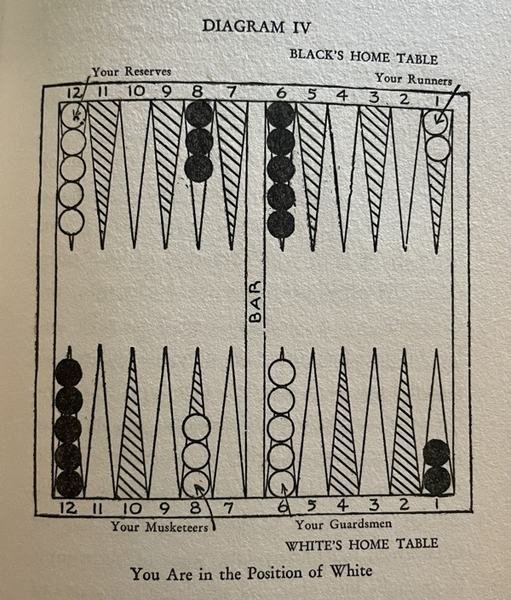
Image credit: Leila Hattersley. Public domain in the United States (book diagram published in 1930). Source: https://nebackgammon.org/index.php/1930s_chronology/. Licence: https://creativecommons.org/publicdomain/mark/1.0/. Display, thumbnail and enlargement resized without cropping and JPEG encoded; EXIF orientation applied. The packaged enlargement is 600 × 704 pixels. No AI edits.
A 1930 book explained taking an extra in chouette
Leila Hattersley explained a chouette disagreement that players still recognise. If a crew member refused a double that the captain wanted to accept, the captain had to take over that person’s financial share. Her September 1930 book described an early form of the practice now called taking an extra.
Image credit: Leila Hattersley. Public domain in the United States (book diagram published in 1930). Source: https://nebackgammon.org/index.php/1930s_chronology/. Licence: https://creativecommons.org/publicdomain/mark/1.0/. Display, thumbnail and enlargement resized without cropping and JPEG encoded; EXIF orientation applied. The packaged enlargement is 600 × 704 pixels. No AI edits.
Odd-numbered tournament matches appeared in a 1930 guide
The final page of Ralph Bond’s Beginner’s Book of Modern Backgammon specified progressively longer, odd-numbered matches for tournament play. Published on September 30, 1930, it is an early printed example of a format still familiar today, although some of its scoring customs differed from modern competition.
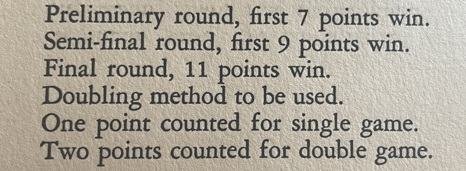
Image credit: Ralph A. Bond. Public domain in the United States (book page published in 1930). Source: https://nebackgammon.org/index.php/1930s_chronology/. Licence: https://creativecommons.org/publicdomain/mark/1.0/. Display, thumbnail and enlargement resized without cropping and JPEG encoded; EXIF orientation applied. The packaged enlargement is 466 × 171 pixels. No AI edits.
A 1930 problem book made readers play several rolls
Winning Backgammon by Grosvenor Nicholas and C. Wheaton Vaughan appeared on October 29, 1930. Its 23 chapters presented situations for experienced readers, with each problem specifying five to nine rolls to play through before studying the commentary. It taught recurring sequences rather than only one isolated move.
Image credit: Historical illustration in Alice Howard Cady’s 1895 book; scan via Internet Archive Book Images. Public domain; source marked no known copyright restrictions. Source: https://commons.wikimedia.org/wiki/File:Backgammon_(1895)_(14596242107).jpg. Licence: https://www.flickr.com/commons/usage/. Display, thumbnail and enlargement resized without cropping and JPEG encoded; EXIF orientation applied. Enlargement limited to 1400 pixels on its longest side, or source size if smaller. No AI edits.
Former chess players helped create pure style
Paul Magriel, Stan Tomchin, Chuck Papazian and Mike Senkiewicz entered the New York scene with backgrounds in chess. Robertie credits this group with developing an aggressive, complex approach called pure style, challenging the safer habits of earlier play.
Image credit: MBIHund. CC BY-SA 4.0. Source: https://commons.wikimedia.org/wiki/File:Karpow_1986_Dubai.jpeg. Licence: https://creativecommons.org/licenses/by-sa/4.0/. Display, thumbnail and enlargement resized without cropping and JPEG encoded; EXIF orientation applied. Enlargement limited to 1400 pixels on its longest side, or source size if smaller. No AI edits.
A cube decision includes more than the board
Phil Simborg's explanation of Woolsey's Law says to consider the position, match score and relative playing strength together. A board that looks identical can call for different cube action at another score. The cube measures the value of the whole contest, rather than checker placement alone.
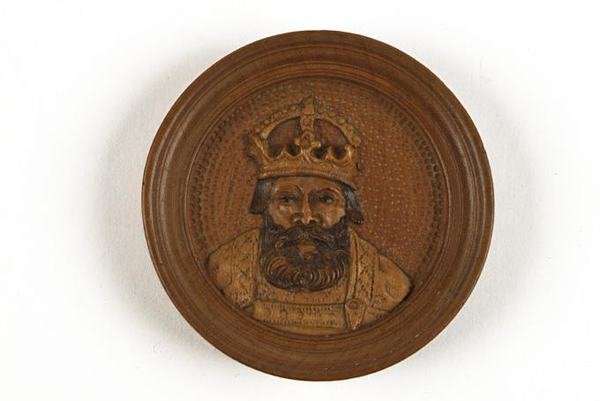
Image credit: Unknown seventeenth-century maker; photograph by Birmingham Museums and Art Gallery. CC BY 3.0. Source: https://commons.wikimedia.org/wiki/File:Backgammon_draught_in_Birmingham_Museums_and_Art_Gallery_4-obverse.jpg. Licence: https://creativecommons.org/licenses/by/3.0/deed.en. Display, thumbnail and enlargement resized without cropping and JPEG encoded; EXIF orientation applied. The packaged enlargement is 680 × 455 pixels. No AI edits.

Turning the cube gives the opponent a decision
A correctly timed double does more than raise the stake. It forces the opponent to choose between taking and passing, creating a chance for an error. Waiting automatically removes that opportunity. This is one reason active cube handling can separate otherwise similar checker players over many games.

Image credit: Unknown seventeenth-century maker; photograph by Birmingham Museums and Art Gallery. CC BY 3.0. Source: https://commons.wikimedia.org/wiki/File:Backgammon_draught_in_Birmingham_Museums_and_Art_Gallery_2-obverse.jpg. Licence: https://creativecommons.org/licenses/by/3.0/deed.en. Display, thumbnail and enlargement resized without cropping and JPEG encoded; EXIF orientation applied. The packaged enlargement is 680 × 455 pixels. No AI edits.

Two PRAT advantages can signal a double
Alan Webb describes Paul Lamford's guideline: an advantage in two of PRAT's three areas can indicate a double, while clear control of all three may leave the opponent with a pass. This is a rule of thumb, so unusual scores and gammon risks can change the answer.
Image credit: Zhou Fang (730–810). Public domain. Source: https://commons.wikimedia.org/wiki/File:Zhou_Fang._Court_Ladies_Playing_Double-sixes._Freer_Gallery_of_Art.jpg. Licence: https://creativecommons.org/publicdomain/mark/1.0/. Display, thumbnail and enlargement resized without cropping and JPEG encoded; EXIF orientation applied. The packaged enlargement is 960 × 434 pixels. No AI edits.
PRAT's three parts need not carry equal weight
Webb explains that he does not treat Position, Race and Threats as identical boxes. In some situations he gives the pip count more weight, and he also checks match score and gammon chances. A checklist helps the decision, but it does not replace judging how strongly each factor applies.

Image credit: Unknown seventeenth-century maker; photograph by Birmingham Museums and Art Gallery. CC BY 3.0. Source: https://commons.wikimedia.org/wiki/File:Backgammon_draught_in_Birmingham_Museums_and_Art_Gallery_3-reverse.jpg. Licence: https://creativecommons.org/licenses/by/3.0/deed.en. Display, thumbnail and enlargement resized without cropping and JPEG encoded; EXIF orientation applied. The packaged enlargement is 680 × 455 pixels. No AI edits.

Twenty-five passed cubes exposed overly cautious play
Kit Woolsey recalled watching a 15-point match reach 13–12 after twenty-five games, each ending with an initial double being passed. He first admired the caution, then concluded it showed cubes coming much too late. Correct cube play should often present the opponent with a genuine take.
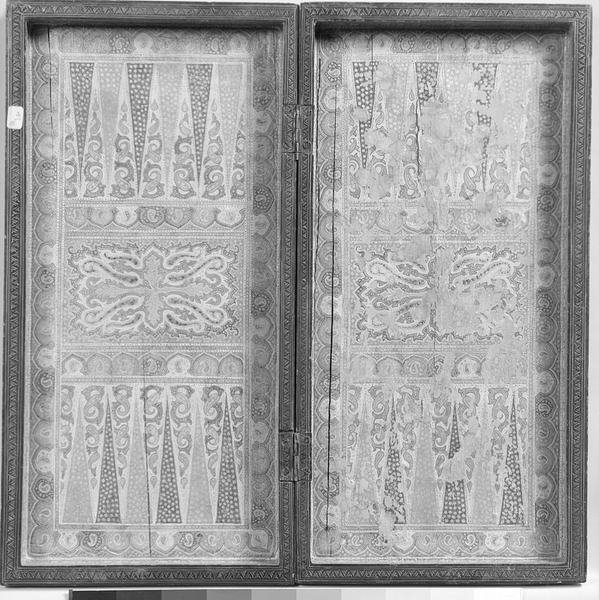
Image credit: Unknown historical maker; Metropolitan Museum of Art Open Access. CC0 1.0. Source: https://commons.wikimedia.org/wiki/File:Chess_and_backgammon_board_MET_223567.jpg. Licence: https://creativecommons.org/publicdomain/zero/1.0/. Display, thumbnail and enlargement resized without cropping and JPEG encoded; EXIF orientation applied. The packaged enlargement is 960 × 962 pixels. No AI edits.

A proper double is often still a take
Woolsey argued that many initial doubles should be accepted. If players wait until every cube is an obvious pass, they miss the profitable part of the doubling window. Strong cube play is therefore not simply cashing a nearly won game; it often raises the value while the opponent can continue.
Image credit: Christoffel Jacobsz van der Laemen (1606/1615–1651). Public domain. Source: https://commons.wikimedia.org/wiki/File:Christoffel_Jacobsz._van_der_Lamen_-_A_soldier_playing_tric-a-trac_with_peasants_in_a_tavern.jpg. Licence: https://creativecommons.org/publicdomain/mark/1.0/. Display, thumbnail and enlargement resized without cropping and JPEG encoded; EXIF orientation applied. The packaged enlargement is 960 × 708 pixels. No AI edits.
The take question can reveal the double
Instead of asking only whether a position feels strong enough to double, Woolsey recommends asking whether the opponent has a clear take. If the answer is uncertain, that uncertainty is evidence that the cube may already be correct. Looking from the other seat can expose missed doubles.
Image credit: Jan Sanders van Hemessen (1500–1556). Public domain. Source: https://commons.wikimedia.org/wiki/File:Jan_Sanders_van_Hemessen_-_Double_portrait_of_a_husband_and_wife_playing_trictrac.png. Licence: https://creativecommons.org/publicdomain/mark/1.0/. Display, thumbnail and enlargement resized without cropping and JPEG encoded; EXIF orientation applied. The packaged enlargement is 960 × 831 pixels. No AI edits.
Reference positions are landmarks, not answers
A reference position is a familiar benchmark whose cube action or equity is known. When a new position resembles it, a player can start there and adjust for the differences. This works like navigating from a landmark, saving the impossible task of calculating every position completely from scratch.

Image credit: Attributed to Jan Steen; Minneapolis Institute of Art. Public domain (PD-Art). Source: https://commons.wikimedia.org/wiki/File:Attributed_to_Jan_Steen_-_Trictrac_Players_-_64.37.3_-_Minneapolis_Institute_of_Arts.jpg. Licence: https://creativecommons.org/publicdomain/mark/1.0/. Display, thumbnail and enlargement resized without cropping and JPEG encoded; EXIF orientation applied. The packaged enlargement is 500 × 665 pixels. No AI edits.

A benchmark needs a sense of direction
Kit Woolsey warns that memorising a reference position is not enough. A player also needs to know how small changes help one side or the other. Moving a checker, strengthening a board or changing the race can shift the decision, even when the overall position still looks familiar.
Image credit: Ptkfgs / Chris Roddy; source image has a digitally removed background. Public domain (author dedication). Source: https://commons.wikimedia.org/wiki/File:Backgammon_DoublingCube.jpg. Licence: https://creativecommons.org/publicdomain/mark/1.0/. Display, thumbnail and enlargement resized without cropping and JPEG encoded; EXIF orientation applied. Enlargement limited to 1400 pixels on its longest side, or source size if smaller. No AI edits.
Common position families make useful study targets
Reference-position study works best with recurring position types, such as closing out one checker against a known number already borne off. Learning a few dependable families gives the mind something concrete to compare at the board. The method builds judgement through relationships rather than isolated answers.
Image credit: Ptkfgs / Chris Roddy; source image has a digitally removed background. Public domain (author dedication). Source: https://commons.wikimedia.org/wiki/File:Backgammon_DoublingCube.jpg. Licence: https://creativecommons.org/publicdomain/mark/1.0/. Display, thumbnail and enlargement resized without cropping and JPEG encoded; EXIF orientation applied. Enlargement limited to 1400 pixels on its longest side, or source size if smaller. No AI edits.
A last-roll position is decided by the next roll
In cube theory, last-roll does not mean the game has reached its final possible turn. It means the next roll will decide the winner. Such positions can occur in a bearoff or around a game-deciding shot, and their limited branches make the cube mathematics easier to demonstrate.
Image credit: Ptkfgs / Chris Roddy; source image has a digitally removed background. Public domain (author dedication). Source: https://commons.wikimedia.org/wiki/File:Backgammon_DoublingCube.jpg. Licence: https://creativecommons.org/publicdomain/mark/1.0/. Display, thumbnail and enlargement resized without cropping and JPEG encoded; EXIF orientation applied. Enlargement limited to 1400 pixels on its longest side, or source size if smaller. No AI edits.
A simple take can risk one unit to gain three
In a no-gammon last-roll example, passing loses one unit, while taking leads to either losing two or winning two. Compared with passing, the taker risks one extra unit for a possible three-unit improvement. That creates the familiar one-in-four break-even take point in this simplified case.
Image credit: Ptkfgs / Chris Roddy; source image has a digitally removed background. Public domain (author dedication). Source: https://commons.wikimedia.org/wiki/File:Backgammon_DoublingCube.jpg. Licence: https://creativecommons.org/publicdomain/mark/1.0/. Display, thumbnail and enlargement resized without cropping and JPEG encoded; EXIF orientation applied. Enlargement limited to 1400 pixels on its longest side, or source size if smaller. No AI edits.
Cube access has value of its own
After accepting a double, the taker owns the cube and may later redouble. Peter Bell describes this future option as cube access, which can make a take better than cubeless winning chances suggest. Giving away cube ownership can therefore cost value even before another checker moves.
Image credit: Ptkfgs / Chris Roddy; source image has a digitally removed background. Public domain (author dedication). Source: https://commons.wikimedia.org/wiki/File:Backgammon_DoublingCube.jpg. Licence: https://creativecommons.org/publicdomain/mark/1.0/. Display, thumbnail and enlargement resized without cropping and JPEG encoded; EXIF orientation applied. Enlargement limited to 1400 pixels on its longest side, or source size if smaller. No AI edits.
A continuous model placed the double at eighty percent
A 1975 mathematical paper by Emmet Keeler and Joel Spencer found an 80-percent doubling point in its continuous model of backgammon. The result belongs to that model, not every real board position. Real play includes jumps, gammons, cube ownership and match scores that can move the decision.
Image credit: Ptkfgs / Chris Roddy; source image has a digitally removed background. Public domain (author dedication). Source: https://commons.wikimedia.org/wiki/File:Backgammon_DoublingCube.jpg. Licence: https://creativecommons.org/publicdomain/mark/1.0/. Display, thumbnail and enlargement resized without cropping and JPEG encoded; EXIF orientation applied. Enlargement limited to 1400 pixels on its longest side, or source size if smaller. No AI edits.
Dynamic programming tackled a simulated endgame
Keeler and Spencer did more than analyse a smooth mathematical model. They also used dynamic programming to compute an optimal betting strategy for a simulated backgammon endgame. The contrast shows why models can teach principles while still needing adjustments for the game's discrete rolls and scoring.
Image credit: Ptkfgs / Chris Roddy; source image has a digitally removed background. Public domain (author dedication). Source: https://commons.wikimedia.org/wiki/File:Backgammon_DoublingCube.jpg. Licence: https://creativecommons.org/publicdomain/mark/1.0/. Display, thumbnail and enlargement resized without cropping and JPEG encoded; EXIF orientation applied. Enlargement limited to 1400 pixels on its longest side, or source size if smaller. No AI edits.
Random dice do not hide the full board state
The paper describes backgammon as a perfect-information game because both players can see the entire position and past moves. Dice make future events uncertain, but no checker or card is secret. Strategy therefore combines visible information with probabilities, rather than guessing what an opponent physically holds.
Image credit: Ptkfgs / Chris Roddy; source image has a digitally removed background. Public domain (author dedication). Source: https://commons.wikimedia.org/wiki/File:Backgammon_DoublingCube.jpg. Licence: https://creativecommons.org/publicdomain/mark/1.0/. Display, thumbnail and enlargement resized without cropping and JPEG encoded; EXIF orientation applied. Enlargement limited to 1400 pixels on its longest side, or source size if smaller. No AI edits.
The cube aims at long-run points, not bravado
Hank Youngerman explains that doubling is not mainly about ending a game, proving confidence or refusing to quit. Its purpose is to improve the player's long-run expected points. That perspective turns cube action into a value decision and removes some of the emotion from taking or dropping.
Image credit: Ptkfgs / Chris Roddy; source image has a digitally removed background. Public domain (author dedication). Source: https://commons.wikimedia.org/wiki/File:Backgammon_DoublingCube.jpg. Licence: https://creativecommons.org/publicdomain/mark/1.0/. Display, thumbnail and enlargement resized without cropping and JPEG encoded; EXIF orientation applied. Enlargement limited to 1400 pixels on its longest side, or source size if smaller. No AI edits.
Game equity combines every way a game can finish
Game equity converts possible results into one expected point value. A position with gammon wins, ordinary wins and losses cannot be described fully by win percentage alone. Each outcome is weighted by both its chance and its score, which is why gammon danger can alter a cube decision sharply.
Image credit: Ptkfgs / Chris Roddy; source image has a digitally removed background. Public domain (author dedication). Source: https://commons.wikimedia.org/wiki/File:Backgammon_DoublingCube.jpg. Licence: https://creativecommons.org/publicdomain/mark/1.0/. Display, thumbnail and enlargement resized without cropping and JPEG encoded; EXIF orientation applied. Enlargement limited to 1400 pixels on its longest side, or source size if smaller. No AI edits.
A market loser can make tomorrow's cube too late
A market loser is a two-roll sequence that changes a double-and-take position into one where the opponent should pass. If many likely sequences lose the market, waiting can forfeit value. Having one possible market loser is not enough by itself; its chance and the current advantage still matter.
Image credit: Ptkfgs / Chris Roddy; source image has a digitally removed background. Public domain (author dedication). Source: https://commons.wikimedia.org/wiki/File:Backgammon_DoublingCube.jpg. Licence: https://creativecommons.org/publicdomain/mark/1.0/. Display, thumbnail and enlargement resized without cropping and JPEG encoded; EXIF orientation applied. Enlargement limited to 1400 pixels on its longest side, or source size if smaller. No AI edits.
A high-anchor game has one side safely advanced
Bill Robertie defines a high-anchor game as one where a player has escaped the back checkers while the opponent holds the four-point or five-point anchor. The leader tries to clear safely; the defender keeps hitting chances and sometimes racing chances. That mix makes cube timing less obvious than a pure race.
Image credit: Alex Proimos. CC BY 2.0. Source: https://commons.wikimedia.org/wiki/File:Saturday_Afternoon_Backgammon_(6784476822).jpg. Licence: https://creativecommons.org/licenses/by/2.0/. Display, thumbnail and enlargement resized without cropping and JPEG encoded; EXIF orientation applied. Enlargement limited to 1400 pixels on its longest side, or source size if smaller. No AI edits.
Pip counting multiplies checkers by distance
Robertie's example shows the basic pip-count method: multiply the number of checkers on each point by that point's distance from bearing off, then add the products. Four checkers on the midpoint contribute fifty-two pips. The total measures remaining travel, although distribution and contact still matter.
Image credit: TZivyA. CC BY-SA 4.0. Source: https://commons.wikimedia.org/wiki/File:Backgammon12.jpg. Licence: https://creativecommons.org/licenses/by-sa/4.0/. Display, thumbnail and enlargement resized without cropping and JPEG encoded; EXIF orientation applied. Enlargement limited to 1400 pixels on its longest side, or source size if smaller. No AI edits.
A five-point anchor can preserve a take
In normal five-point holding games, Robertie gives a practical benchmark: the attacker may need roughly a fifteen-percent pip-count lead for a sound double, while the defender often still has an easy take. It is a reference guideline for that position family, not a universal percentage for all anchors.
Image credit: Alex Proimos. CC BY 2.0. Source: https://commons.wikimedia.org/wiki/File:Saturday_Afternoon_Backgammon_(6784476822).jpg. Licence: https://creativecommons.org/licenses/by/2.0/. Display, thumbnail and enlargement resized without cropping and JPEG encoded; EXIF orientation applied. Enlargement limited to 1400 pixels on its longest side, or source size if smaller. No AI edits.
Blitz positions can lose the market in one exchange
Kit Woolsey notes that blitzes are highly volatile. A single poor reply can turn a playable position into a clear pass, so the attacker may need to double earlier than the static equity seems to demand. Waiting for certainty can mean waiting until the profitable take has disappeared.
Image credit: madras91. CC BY 2.0. Source: https://commons.wikimedia.org/wiki/File:In_the_street_(50409818923).jpg. Licence: https://creativecommons.org/licenses/by/2.0/deed.en. Display, thumbnail and enlargement resized without cropping and JPEG encoded; EXIF orientation applied. Enlargement limited to 1400 pixels on its longest side, or source size if smaller. No AI edits.
The blitz take is harder than the blitz double
From the attacker's side, a plausible blitz double is often correct because the position can change quickly. The defender's take-or-pass decision is harder: overestimating the attack causes an early pass, while overestimating escape chances produces a costly take. Both errors can look reasonable over the board.
Image credit: madras91. CC BY 2.0. Source: https://commons.wikimedia.org/wiki/File:In_the_street_(50409818923).jpg. Licence: https://creativecommons.org/licenses/by/2.0/deed.en. Display, thumbnail and enlargement resized without cropping and JPEG encoded; EXIF orientation applied. Enlargement limited to 1400 pixels on its longest side, or source size if smaller. No AI edits.
No single yardstick measures every blitz
Woolsey says blitz cube decisions depend on many interacting features rather than one dependable measurement. Closed points, checkers on the bar, spare attackers, defensive anchors and escape chances all contribute. Comparing small changes to known positions can be more useful than searching for one magic percentage.
Image credit: madras91. CC BY 2.0. Source: https://commons.wikimedia.org/wiki/File:In_the_street_(50409818923).jpg. Licence: https://creativecommons.org/licenses/by/2.0/deed.en. Display, thumbnail and enlargement resized without cropping and JPEG encoded; EXIF orientation applied. Enlargement limited to 1400 pixels on its longest side, or source size if smaller. No AI edits.
Too good means the gammon chance beats cashing
A player who can double and collect a pass may sometimes play on instead. The position is called too good when the extra value of possible gammons outweighs the risk of losing the game. This is a cube decision about expected points, not a claim that victory is guaranteed.
Image credit: Ptkfgs / Chris Roddy; source image has a digitally removed background. Public domain (author dedication). Source: https://commons.wikimedia.org/wiki/File:Backgammon_DoublingCube.jpg. Licence: https://creativecommons.org/publicdomain/mark/1.0/. Display, thumbnail and enlargement resized without cropping and JPEG encoded; EXIF orientation applied. Enlargement limited to 1400 pixels on its longest side, or source size if smaller. No AI edits.
Money play gives a two-to-one too-good guide
Paul Lamford gives a general money-game rule: playing on rather than cashing needs about twice as many gammon wins as game losses. The ratio reflects the extra point gained by a gammon against the larger swing caused by turning a certain cash into a loss.
Image credit: Ptkfgs / Chris Roddy; source image has a digitally removed background. Public domain (author dedication). Source: https://commons.wikimedia.org/wiki/File:Backgammon_DoublingCube.jpg. Licence: https://creativecommons.org/publicdomain/mark/1.0/. Display, thumbnail and enlargement resized without cropping and JPEG encoded; EXIF orientation applied. Enlargement limited to 1400 pixels on its longest side, or source size if smaller. No AI edits.
The Jacoby rule changes initial too-good decisions
Under the Jacoby rule in money play, gammons and backgammons count only as single games until the cube has been turned. Lamford notes that this prevents being too good to make the initial double. The same logic does not automatically apply to a later redouble after the cube is active.
Image credit: Ptkfgs / Chris Roddy; source image has a digitally removed background. Public domain (author dedication). Source: https://commons.wikimedia.org/wiki/File:Backgammon_DoublingCube.jpg. Licence: https://creativecommons.org/publicdomain/mark/1.0/. Display, thumbnail and enlargement resized without cropping and JPEG encoded; EXIF orientation applied. Enlargement limited to 1400 pixels on its longest side, or source size if smaller. No AI edits.
Playing on begins with a clearly passing opponent
Kit Woolsey starts too-good analysis by requiring confidence that the opponent truly has a pass. If a take may be correct, doubling is safer; if the opponent might mistakenly take, doubling can be even more profitable. The possible extra gammon has to beat both of those cube values.
Image credit: Ptkfgs / Chris Roddy; source image has a digitally removed background. Public domain (author dedication). Source: https://commons.wikimedia.org/wiki/File:Backgammon_DoublingCube.jpg. Licence: https://creativecommons.org/publicdomain/mark/1.0/. Display, thumbnail and enlargement resized without cropping and JPEG encoded; EXIF orientation applied. Enlargement limited to 1400 pixels on its longest side, or source size if smaller. No AI edits.
Playing on for a gammon lays two-to-one odds
With a two-cube, cashing earns two points. Playing on and winning a gammon earns four, a gain of two; losing instead produces minus two, a swing of four below the cash. Woolsey describes this as laying two-to-one odds when choosing the gammon attempt.
Image credit: Ptkfgs / Chris Roddy; source image has a digitally removed background. Public domain (author dedication). Source: https://commons.wikimedia.org/wiki/File:Backgammon_DoublingCube.jpg. Licence: https://creativecommons.org/publicdomain/mark/1.0/. Display, thumbnail and enlargement resized without cropping and JPEG encoded; EXIF orientation applied. Enlargement limited to 1400 pixels on its longest side, or source size if smaller. No AI edits.
An opponent's cube mistake can outweigh a small theoretical gain
Even when playing on is slightly better against perfect decisions, an opponent who might take incorrectly changes the practical choice. An accepted bad cube can be worth more than the narrow gain from chasing a gammon. Good cube strategy considers the decision actually offered to the person across the board.
Image credit: Ptkfgs / Chris Roddy; source image has a digitally removed background. Public domain (author dedication). Source: https://commons.wikimedia.org/wiki/File:Backgammon_DoublingCube.jpg. Licence: https://creativecommons.org/publicdomain/mark/1.0/. Display, thumbnail and enlargement resized without cropping and JPEG encoded; EXIF orientation applied. Enlargement limited to 1400 pixels on its longest side, or source size if smaller. No AI edits.
The simplified money doubling window runs from fifty to seventy-five
In a simplified no-gammon money model, Kit Woolsey places the doubling window between roughly 50 and 75 percent winning chances. Below the first number the player is not favoured; above the second the opponent passes. Real gammons and recube rights shift these boundaries.
Image credit: Ptkfgs / Chris Roddy; source image has a digitally removed background. Public domain (author dedication). Source: https://commons.wikimedia.org/wiki/File:Backgammon_DoublingCube.jpg. Licence: https://creativecommons.org/publicdomain/mark/1.0/. Display, thumbnail and enlargement resized without cropping and JPEG encoded; EXIF orientation applied. Enlargement limited to 1400 pixels on its longest side, or source size if smaller. No AI edits.
Stable positions let a player wait longer
Near the low end of a doubling window, a player often waits if the position is stable. Most next exchanges will still leave a usable double and take. Turning the cube immediately gives away ownership without much danger that the chance to double profitably will vanish.
Image credit: Ptkfgs / Chris Roddy; source image has a digitally removed background. Public domain (author dedication). Source: https://commons.wikimedia.org/wiki/File:Backgammon_DoublingCube.jpg. Licence: https://creativecommons.org/publicdomain/mark/1.0/. Display, thumbnail and enlargement resized without cropping and JPEG encoded; EXIF orientation applied. Enlargement limited to 1400 pixels on its longest side, or source size if smaller. No AI edits.
Volatility measures how far the next exchange may swing
Volatility is the chance that equity changes sharply before the player next gets the cube. In a volatile position, several ordinary sequences may create a clear pass, so delaying can lose the market. It is about the size and likelihood of future swings, not simply today's lead.
Image credit: Ptkfgs / Chris Roddy; source image has a digitally removed background. Public domain (author dedication). Source: https://commons.wikimedia.org/wiki/File:Backgammon_DoublingCube.jpg. Licence: https://creativecommons.org/publicdomain/mark/1.0/. Display, thumbnail and enlargement resized without cropping and JPEG encoded; EXIF orientation applied. Enlargement limited to 1400 pixels on its longest side, or source size if smaller. No AI edits.
Half-crossovers divide the board into groups of three
Douglas Zare's counting method splits the board into triples such as points one-to-three and four-to-six. Moving from one triple to the next is a half-crossover. Counting these larger steps first turns many separate point distances into a smaller mental arithmetic problem.
Image credit: TZivyA. CC BY-SA 4.0. Source: https://commons.wikimedia.org/wiki/File:Backgammon12.jpg. Licence: https://creativecommons.org/licenses/by-sa/4.0/. Display, thumbnail and enlargement resized without cropping and JPEG encoded; EXIF orientation applied. Enlargement limited to 1400 pixels on its longest side, or source size if smaller. No AI edits.
A rough count can come before the exact count
The half-crossover method first estimates how far the checkers must travel to bear in. If the position requires precision, the player then adjusts for where each checker sits inside its three-point group. The same process can supply a quick answer or a refined one.
Image credit: TZivyA. CC BY-SA 4.0. Source: https://commons.wikimedia.org/wiki/File:Backgammon12.jpg. Licence: https://creativecommons.org/licenses/by-sa/4.0/. Display, thumbnail and enlargement resized without cropping and JPEG encoded; EXIF orientation applied. Enlargement limited to 1400 pixels on its longest side, or source size if smaller. No AI edits.
Approximate pip counts can still guide the game plan
Zare argues that an approximate count is often enough to decide whether to race or maintain contact. Exact counts become especially useful for close cube decisions. The lesson is practical: a fast, dependable estimate used regularly may help more than an exact method a player avoids.
Image credit: TZivyA. CC BY-SA 4.0. Source: https://commons.wikimedia.org/wiki/File:Backgammon12.jpg. Licence: https://creativecommons.org/licenses/by-sa/4.0/. Display, thumbnail and enlargement resized without cropping and JPEG encoded; EXIF orientation applied. Enlargement limited to 1400 pixels on its longest side, or source size if smaller. No AI edits.
Many positions need only the pip-count difference
Urquhart Colorless Counting starts from the observation that players often need to know who leads and by how much, rather than both complete totals. The difference can guide races, primes, backgames and contact timing. Calculating only the needed information can save substantial mental work.
Image credit: TZivyA. CC BY-SA 4.0. Source: https://commons.wikimedia.org/wiki/File:Backgammon12.jpg. Licence: https://creativecommons.org/licenses/by-sa/4.0/. Display, thumbnail and enlargement resized without cropping and JPEG encoded; EXIF orientation applied. Enlargement limited to 1400 pixels on its longest side, or source size if smaller. No AI edits.
Colorless counting temporarily ignores checker ownership
The method finds the fifteenth checker from one bearoff tray and treats the first fifteen checkers encountered as one group, regardless of their actual colours. The remaining fifteen form the other group. This surprising relabelling preserves the pip difference while simplifying the count.
Image credit: TZivyA. CC BY-SA 4.0. Source: https://commons.wikimedia.org/wiki/File:Backgammon12.jpg. Licence: https://creativecommons.org/licenses/by-sa/4.0/. Display, thumbnail and enlargement resized without cropping and JPEG encoded; EXIF orientation applied. Enlargement limited to 1400 pixels on its longest side, or source size if smaller. No AI edits.
A full crossover is worth six pips
Because each quadrant contains six points, moving one checker across a quadrant boundary changes the count by six pips. Urquhart's system counts these crossovers, then smaller three-pip and one-pip adjustments. Breaking the total into scales makes a large board position easier to process mentally.
Image credit: TZivyA. CC BY-SA 4.0. Source: https://commons.wikimedia.org/wiki/File:Backgammon12.jpg. Licence: https://creativecommons.org/licenses/by-sa/4.0/. Display, thumbnail and enlargement resized without cropping and JPEG encoded; EXIF orientation applied. Enlargement limited to 1400 pixels on its longest side, or source size if smaller. No AI edits.
Kangaroo Count grew from the half-crossover method
Nack Ballard's Kangaroo Count is a variation of Douglas Zare's half-crossover approach. It first makes a rough count based on board regions, then adjusts for checker locations within them. The name marks a different shortcut, while the underlying goal remains fast over-the-board pip counting.
Image credit: TZivyA. CC BY-SA 4.0. Source: https://commons.wikimedia.org/wiki/File:Backgammon12.jpg. Licence: https://creativecommons.org/licenses/by-sa/4.0/. Display, thumbnail and enlargement resized without cropping and JPEG encoded; EXIF orientation applied. Enlargement limited to 1400 pixels on its longest side, or source size if smaller. No AI edits.
Kangaroo Count begins with the far-side checkers
In Tom Keith's worked explanation, the counter starts by counting checkers on the far side of the board and multiplying that number by two. Later adjustments handle major diagonals and exact placement. The sequence replaces fifteen individual point multiplications with a patterned count.
Image credit: TZivyA. CC BY-SA 4.0. Source: https://commons.wikimedia.org/wiki/File:Backgammon12.jpg. Licence: https://creativecommons.org/licenses/by-sa/4.0/. Display, thumbnail and enlargement resized without cropping and JPEG encoded; EXIF orientation applied. Enlargement limited to 1400 pixels on its longest side, or source size if smaller. No AI edits.
The opening layout can test a counting system
Keith demonstrates Kangaroo Count on the standard starting position, whose known total is 167 pips. A familiar position acts as a built-in check while learning the steps. If the method does not return the known answer, the learner can find the missed adjustment before using it in play.
Image credit: Ptkfgs. Public domain. Source: https://commons.wikimedia.org/wiki/File:Backgammon_lg.jpg. Licence: https://creativecommons.org/publicdomain/mark/1.0/. Display, thumbnail and enlargement resized without cropping and JPEG encoded; EXIF orientation applied. Enlargement limited to 1400 pixels on its longest side, or source size if smaller. No AI edits. Source image has a digitally removed carpet background.
Quadrant counting starts with board crossings
Mark Driver's beginner method first counts how many quadrant crossings the checkers need to reach home. Since a quadrant spans six points, this provides a large-scale estimate quickly. The player then corrects for the checkers' exact positions inside their current quadrants.
Image credit: TZivyA. CC BY-SA 4.0. Source: https://commons.wikimedia.org/wiki/File:Backgammon12.jpg. Licence: https://creativecommons.org/licenses/by-sa/4.0/. Display, thumbnail and enlargement resized without cropping and JPEG encoded; EXIF orientation applied. Enlargement limited to 1400 pixels on its longest side, or source size if smaller. No AI edits.
Counting in stages reduces mental load
Instead of multiplying every stack by its point number in one pass, the quadrant method separates the task into a coarse count and smaller adjustments. This staged approach can be easier to check and remember under time pressure, even though it reaches the same final pip total.
Image credit: TZivyA. CC BY-SA 4.0. Source: https://commons.wikimedia.org/wiki/File:Backgammon12.jpg. Licence: https://creativecommons.org/licenses/by-sa/4.0/. Display, thumbnail and enlargement resized without cropping and JPEG encoded; EXIF orientation applied. Enlargement limited to 1400 pixels on its longest side, or source size if smaller. No AI edits.
Pip counting is a tool rather than a game plan
A count measures the remaining distance but does not value anchors, primes, blots or future contact. Driver's method helps produce the number; the player must still interpret it in the position. A small race lead may matter greatly in a clean race and less during an attack.
Image credit: TZivyA. CC BY-SA 4.0. Source: https://commons.wikimedia.org/wiki/File:Backgammon12.jpg. Licence: https://creativecommons.org/licenses/by-sa/4.0/. Display, thumbnail and enlargement resized without cropping and JPEG encoded; EXIF orientation applied. Enlargement limited to 1400 pixels on its longest side, or source size if smaller. No AI edits.
A match ends when one player reaches the target
In match play, players agree on a target such as five, seven or eleven points and continue through separate games until someone reaches it. Gammons, backgammons and cube values affect how quickly the score changes. The objective is winning the match, not collecting the largest raw total.
Image credit: Ptkfgs / Chris Roddy; source image has a digitally removed background. Public domain (author dedication). Source: https://commons.wikimedia.org/wiki/File:Backgammon_DoublingCube.jpg. Licence: https://creativecommons.org/publicdomain/mark/1.0/. Display, thumbnail and enlargement resized without cropping and JPEG encoded; EXIF orientation applied. Enlargement limited to 1400 pixels on its longest side, or source size if smaller. No AI edits.
Extra points beyond the match target do not add value
Once a player reaches the agreed match length, the contest is over. Winning by eight points when only seven were needed is no better than reaching seven exactly. This changes cube and gammon strategy near the finish because points that cannot affect the match result have no additional value.
Image credit: Ptkfgs / Chris Roddy; source image has a digitally removed background. Public domain (author dedication). Source: https://commons.wikimedia.org/wiki/File:Backgammon_DoublingCube.jpg. Licence: https://creativecommons.org/publicdomain/mark/1.0/. Display, thumbnail and enlargement resized without cropping and JPEG encoded; EXIF orientation applied. Enlargement limited to 1400 pixels on its longest side, or source size if smaller. No AI edits.
A match leader usually handles the cube more cautiously
Phil Simborg offers a practical match-play guideline: the player ahead should generally be more conservative with the cube. Giving cube ownership to the trailer can provide a powerful route back into the match. The exact position still matters, but the score changes the risk of escalation.
Image credit: Ptkfgs / Chris Roddy; source image has a digitally removed background. Public domain (author dedication). Source: https://commons.wikimedia.org/wiki/File:Backgammon_DoublingCube.jpg. Licence: https://creativecommons.org/publicdomain/mark/1.0/. Display, thumbnail and enlargement resized without cropping and JPEG encoded; EXIF orientation applied. Enlargement limited to 1400 pixels on its longest side, or source size if smaller. No AI edits.
The trailer often values a larger cube
A player behind in the match benefits when one game is worth more points, because a big result can erase the score gap quickly. The leader may prefer smaller swings. This difference explains why identical boards can produce different cube actions depending on who leads the match.
Image credit: Ptkfgs / Chris Roddy; source image has a digitally removed background. Public domain (author dedication). Source: https://commons.wikimedia.org/wiki/File:Backgammon_DoublingCube.jpg. Licence: https://creativecommons.org/publicdomain/mark/1.0/. Display, thumbnail and enlargement resized without cropping and JPEG encoded; EXIF orientation applied. Enlargement limited to 1400 pixels on its longest side, or source size if smaller. No AI edits.
Match score changes the price of a gammon
A gammon normally scores twice the cube value, but its practical value in a match depends on the points each player still needs. A gammon that reaches the target is decisive; surplus points are wasted. Checker play and cube action therefore respond to the score as well as the board.
Image credit: Ptkfgs / Chris Roddy; source image has a digitally removed background. Public domain (author dedication). Source: https://commons.wikimedia.org/wiki/File:Backgammon_DoublingCube.jpg. Licence: https://creativecommons.org/publicdomain/mark/1.0/. Display, thumbnail and enlargement resized without cropping and JPEG encoded; EXIF orientation applied. Enlargement limited to 1400 pixels on its longest side, or source size if smaller. No AI edits.
A Crawford score can reverse normal gammon priorities
Kit Woolsey shows that Crawford-game checker play is not automatically simple. At some scores a gammon adds little beyond an ordinary win, while a backgammon remains highly valuable; at others, saving a gammon dominates. The scoreboard can therefore justify moves that would look strange in money play.
Image credit: Ptkfgs / Chris Roddy; source image has a digitally removed background. Public domain (author dedication). Source: https://commons.wikimedia.org/wiki/File:Backgammon_DoublingCube.jpg. Licence: https://creativecommons.org/publicdomain/mark/1.0/. Display, thumbnail and enlargement resized without cropping and JPEG encoded; EXIF orientation applied. Enlargement limited to 1400 pixels on its longest side, or source size if smaller. No AI edits.
The same board can reward a hit at one score and a run at another
In Woolsey's examples, choosing whether to hit or race depends on what a gammon or loss changes in the match. A move with attractive money-game odds can be wrong when its extra points are useless. Match equity translates each possible game result into tournament value.
Image credit: Ptkfgs / Chris Roddy; source image has a digitally removed background. Public domain (author dedication). Source: https://commons.wikimedia.org/wiki/File:Backgammon_DoublingCube.jpg. Licence: https://creativecommons.org/publicdomain/mark/1.0/. Display, thumbnail and enlargement resized without cropping and JPEG encoded; EXIF orientation applied. Enlargement limited to 1400 pixels on its longest side, or source size if smaller. No AI edits.
Post-Crawford cube play has its own tactics
After the Crawford game, the cube returns if the match continues. The trailer often doubles early because losing an undoubled point already ends the match, while the leader may have special take-or-pass choices. These decisions come from the score, even before the board develops much.
Image credit: Ptkfgs / Chris Roddy; source image has a digitally removed background. Public domain (author dedication). Source: https://commons.wikimedia.org/wiki/File:Backgammon_DoublingCube.jpg. Licence: https://creativecommons.org/publicdomain/mark/1.0/. Display, thumbnail and enlargement resized without cropping and JPEG encoded; EXIF orientation applied. Enlargement limited to 1400 pixels on its longest side, or source size if smaller. No AI edits.
Equal pip counts can hide unequal races
A plain pip count totals distance but ignores how efficiently the checkers can use future rolls. A smooth distribution may bear off with less waste than checkers piled on low points. Two positions with equal literal counts can therefore have different winning chances and different cube actions.
Image credit: TZivyA. CC BY-SA 4.0. Source: https://commons.wikimedia.org/wiki/File:Backgammon12.jpg. Licence: https://creativecommons.org/licenses/by-sa/4.0/. Display, thumbnail and enlargement resized without cropping and JPEG encoded; EXIF orientation applied. Enlargement limited to 1400 pixels on its longest side, or source size if smaller. No AI edits.
Race formulas adjust the count for wastage
The cube-handling survey compares several adjusted counting systems, including Thorp, Keeler-Gillogly, Ward, Lamford-Gasquoine and Keith. Each tries to improve on a raw pip count by accounting for distribution and wasted movement. Their accuracy varies with race length and position shape.
Image credit: TZivyA. CC BY-SA 4.0. Source: https://commons.wikimedia.org/wiki/File:Backgammon12.jpg. Licence: https://creativecommons.org/licenses/by-sa/4.0/. Display, thumbnail and enlargement resized without cropping and JPEG encoded; EXIF orientation applied. Enlargement limited to 1400 pixels on its longest side, or source size if smaller. No AI edits.
Cubeless winning chances can still inform match cubes
Some race methods estimate the chance of winning without cube effects. That probability can then be combined with match equity information to account for the score. Separating the race estimate from the scoring decision lets one position calculation serve several match situations.
Image credit: Ptkfgs / Chris Roddy; source image has a digitally removed background. Public domain (author dedication). Source: https://commons.wikimedia.org/wiki/File:Backgammon_DoublingCube.jpg. Licence: https://creativecommons.org/publicdomain/mark/1.0/. Display, thumbnail and enlargement resized without cropping and JPEG encoded; EXIF orientation applied. Enlargement limited to 1400 pixels on its longest side, or source size if smaller. No AI edits.
Effective pip count adds expected wastage
Walter Trice's Effective Pip Count combines the literal distance with pips expected to be wasted during bearing off. A neatly distributed board may have a smaller effective count than a stacked board with the same literal total. This makes unlike race structures easier to compare.
Image credit: TZivyA. CC BY-SA 4.0. Source: https://commons.wikimedia.org/wiki/File:Backgammon12.jpg. Licence: https://creativecommons.org/licenses/by-sa/4.0/. Display, thumbnail and enlargement resized without cropping and JPEG encoded; EXIF orientation applied. Enlargement limited to 1400 pixels on its longest side, or source size if smaller. No AI edits.
Seven checkers on the ace point may take two, three or four rolls
Trice uses seven checkers stacked on the ace point to show that a tiny-looking pip count can conceal substantial time. Depending on the dice, bearing them off takes two, three or four rolls. Effective Pip Count converts that roll-based delay into a distance-like number.
Image credit: TZivyA. CC BY-SA 4.0. Source: https://commons.wikimedia.org/wiki/File:Backgammon12.jpg. Licence: https://creativecommons.org/licenses/by-sa/4.0/. Display, thumbnail and enlargement resized without cropping and JPEG encoded; EXIF orientation applied. Enlargement limited to 1400 pixels on its longest side, or source size if smaller. No AI edits.
A flat closed board wastes about ten pips
One of Trice's reference rules says that a flat position—two checkers on each of the six home-board points—wastes about ten pips. Smooth, top-heavy positions tend to waste somewhat less. Remembering a few such benchmarks can make unusual bearoff races easier to judge.
Image credit: TZivyA. CC BY-SA 4.0. Source: https://commons.wikimedia.org/wiki/File:Backgammon12.jpg. Licence: https://creativecommons.org/licenses/by-sa/4.0/. Display, thumbnail and enlargement resized without cropping and JPEG encoded; EXIF orientation applied. Enlargement limited to 1400 pixels on its longest side, or source size if smaller. No AI edits.
Short bearoffs can have five different cube categories
Bob Koca sorts small money-game bearoffs into five cube-action classes, ranging from positions too weak to double through redouble-and-pass positions. The middle cases distinguish initial doubles, redoubles, takes and beavers. A nearly empty board can still hold a surprisingly rich cube decision.
Image credit: Ptkfgs / Chris Roddy; source image has a digitally removed background. Public domain (author dedication). Source: https://commons.wikimedia.org/wiki/File:Backgammon_DoublingCube.jpg. Licence: https://creativecommons.org/publicdomain/mark/1.0/. Display, thumbnail and enlargement resized without cropping and JPEG encoded; EXIF orientation applied. Enlargement limited to 1400 pixels on its longest side, or source size if smaller. No AI edits.
Two-checker bearoffs are common enough to memorise
Games often reach a finish with one or two checkers remaining on each side. Koca argues that a compact table of these recurring positions is worth learning. Memorisation here is practical because the same small arrangements return frequently and have exact, checkable outcomes.
Image credit: TZivyA. CC BY-SA 4.0. Source: https://commons.wikimedia.org/wiki/File:Backgammon12.jpg. Licence: https://creativecommons.org/licenses/by-sa/4.0/. Display, thumbnail and enlargement resized without cropping and JPEG encoded; EXIF orientation applied. Enlargement limited to 1400 pixels on its longest side, or source size if smaller. No AI edits.
An initial double and a redouble need not share a threshold
Owning or giving away future cube access changes the value of a short bearoff. Koca's categories therefore separate positions good enough for an initial double from those good enough to redouble. The checker arrangement can be identical while cube ownership changes the correct action.
Image credit: Ptkfgs / Chris Roddy; source image has a digitally removed background. Public domain (author dedication). Source: https://commons.wikimedia.org/wiki/File:Backgammon_DoublingCube.jpg. Licence: https://creativecommons.org/publicdomain/mark/1.0/. Display, thumbnail and enlargement resized without cropping and JPEG encoded; EXIF orientation applied. Enlargement limited to 1400 pixels on its longest side, or source size if smaller. No AI edits.
Backgammon plans cannot predict an exact move sequence
Unlike chess analysis, a backgammon plan cannot assume which numbers will appear next. The dice restrict every future move. Kit Woolsey argues that planning still matters: it defines the position's goals, while leaving the exact route flexible enough to respond to new rolls.
Image credit: Jeroen Komen. CC BY-SA 2.0. Source: https://commons.wikimedia.org/wiki/File:Boardgames_in_Bucarest_%2810654287715%29.jpg. Licence: https://creativecommons.org/licenses/by-sa/2.0/. Display, thumbnail and enlargement resized without cropping and JPEG encoded; EXIF orientation applied. Enlargement limited to 1400 pixels on its longest side, or source size if smaller. No AI edits.
A game plan helps narrow candidate moves
Knowing whether the position calls for racing, attacking, priming or preserving contact gives a player a useful filter. Candidate moves can be judged by how well they serve that goal. Without a plan, several legal plays may look equally plausible even though they push in opposite directions.
Image credit: Onceinawhile. CC BY-SA 4.0. Source: https://commons.wikimedia.org/wiki/File:Damascene-style_inlaid_Backgammon_board,_Cairo,_Khan_el-Khalili.jpg. Licence: https://creativecommons.org/licenses/by-sa/4.0/deed.en. Display, thumbnail and enlargement resized without cropping and JPEG encoded; EXIF orientation applied. Enlargement limited to 1400 pixels on its longest side, or source size if smaller. No AI edits.
The dice can force a change of plan
A backgammon plan is temporary rather than a promise. A large double, a hit or a failed entry can transform the position in one exchange. Strong play includes recognising when yesterday's objective no longer fits, then choosing moves that support the new shape of the game.
Image credit: Matěj Baťha. CC BY-SA 3.0. Source: https://commons.wikimedia.org/wiki/File:Deskohran%C3%AD_2009_353.jpg. Licence: https://creativecommons.org/licenses/by-sa/3.0/deed.en. Display, thumbnail and enlargement resized without cropping and JPEG encoded; EXIF orientation applied. Enlargement limited to 1400 pixels on its longest side, or source size if smaller. No AI edits.
Breaking an anchor is a one-way commitment
Checkers cannot move backwards, so abandoning an anchor usually means it is gone unless a later hit sends checkers back. This makes the choice unusually committal. The player trades a secure foothold and possible shots for racing progress and freedom from being trapped.
Image credit: Alex Proimos. CC BY 2.0. Source: https://commons.wikimedia.org/wiki/File:Saturday_Afternoon_Backgammon_(6784476822).jpg. Licence: https://creativecommons.org/licenses/by/2.0/. Display, thumbnail and enlargement resized without cropping and JPEG encoded; EXIF orientation applied. Enlargement limited to 1400 pixels on its longest side, or source size if smaller. No AI edits.
Breaking too early can invite an attack
Leaving an anchor exposes separated checkers to hits and can start a blitz, increasing gammon danger. An anchor also provides a safe landing place for other checkers. Giving it up before the race or timing demands it may remove the defence while the opponent still has plenty of attacking material.
Image credit: Niko Kitsakis. CC BY 4.0. Source: https://commons.wikimedia.org/wiki/File:Tavli_Board_without_slots_%28traditional%29_B.jpg. Licence: https://creativecommons.org/licenses/by/4.0/. Display, thumbnail and enlargement resized without cropping and JPEG encoded; EXIF orientation applied. Enlargement limited to 1400 pixels on its longest side, or source size if smaller. No AI edits.
Holding an anchor too long can crush your board
An anchor must eventually be broken to bear off all fifteen checkers. Waiting too long can use up every flexible move elsewhere, forcing the home board to collapse while the anchored checkers remain trapped. Good timing balances the last useful shots against the cost of staying.
Image credit: Jeroen Komen. CC BY-SA 2.0. Source: https://commons.wikimedia.org/wiki/File:Boardgames_in_Bucarest_%2810654287715%29.jpg. Licence: https://creativecommons.org/licenses/by-sa/2.0/. Display, thumbnail and enlargement resized without cropping and JPEG encoded; EXIF orientation applied. Enlargement limited to 1400 pixels on its longest side, or source size if smaller. No AI edits.
Flexibility means many future rolls play comfortably
Kit Woolsey compares checker placement with a pool player's cue-ball control. The aim is not to predict one exact next roll, but to place checkers where many possible rolls have constructive uses. A flexible position reduces awkward forced plays and keeps several plans alive.
Image credit: Van Der Meulen Christofle. CC0 1.0. Source: https://commons.wikimedia.org/wiki/File:Backgammon_(1)_(Venise,_XIVe_siecle).jpg. Licence: https://creativecommons.org/publicdomain/zero/1.0/. Display, thumbnail and enlargement resized without cropping and JPEG encoded; EXIF orientation applied. Enlargement limited to 1400 pixels on its longest side, or source size if smaller. No AI edits.
Experts prepare future moves before the dice arrive
Top players can appear to move instantly because earlier decisions left their checkers in useful places. They consider what later rolls may need: builders, escape routes, landing points and spare checkers. Preparation makes the next decision easier even though the actual numbers remain unknown.
Image credit: Jeroen Komen. CC BY-SA 2.0. Source: https://commons.wikimedia.org/wiki/File:Boardgames_in_Bucarest_%2810654287715%29.jpg. Licence: https://creativecommons.org/licenses/by-sa/2.0/. Display, thumbnail and enlargement resized without cropping and JPEG encoded; EXIF orientation applied. Enlargement limited to 1400 pixels on its longest side, or source size if smaller. No AI edits.
A safe move can still create tomorrow's problem
Avoiding every immediate blot may look attractive, yet a rigid safe play can leave stacks and gaps that handle future rolls poorly. Cue-ball thinking asks where the checkers will work next. Short-term safety is one feature of a move, rather than the entire evaluation.
Image credit: Marcin Konsek / Wikimedia Commons. CC BY-SA 4.0. Source: https://commons.wikimedia.org/wiki/File:2014_Kutaisi%2C_M%C4%99%C5%BCczyzni_graj%C4%85cy_w_tryktraka.jpg. Licence: https://creativecommons.org/licenses/by-sa/4.0/. Display, thumbnail and enlargement resized without cropping and JPEG encoded; EXIF orientation applied. Enlargement limited to 1400 pixels on its longest side, or source size if smaller. No AI edits.
A Swedish diagram explains why every pip cannot be used
Edward Werner's verquere figure shows White rolling 5-2 while bearing pieces home from tongues 22 and 24. The caption says a seemingly larger sequence is illegal because it would reduce the total by four eyes instead of three. This is a rule illustration for verquere, not standard backgammon.
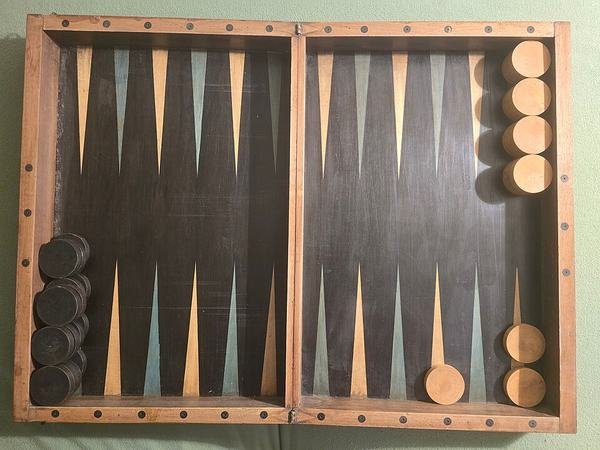
Image credit: Edward Werner. CC BY-SA 4.0. Source: https://commons.wikimedia.org/wiki/File:Verquere_fig2.jpg. Licence: https://creativecommons.org/licenses/by-sa/4.0/deed.en. Display, thumbnail and enlargement resized without cropping and JPEG encoded; EXIF orientation applied. The packaged enlargement is 960 × 720 pixels. No AI edits.

One diagram shows two checkers leaving on 6-4
Francesco De Lorenzo's Italian diagram illustrates a 6-4 roll removing two checkers from the board. Arrows connect the dice to the pieces that leave. The visual records one bearing-off example in modern backgammon, showing how instructional art can make a legal use of both dice easier to follow.
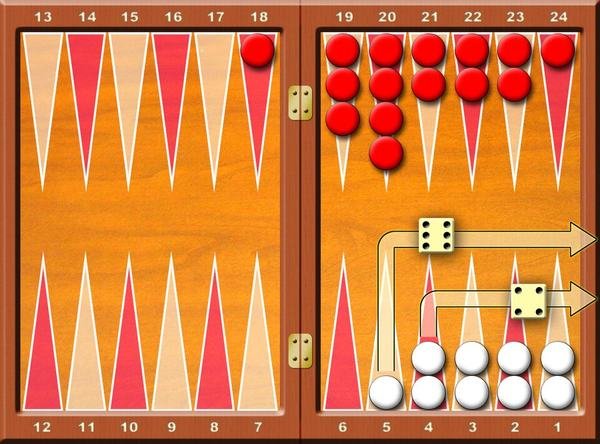
Image credit: Francesco De Lorenzo. CC BY-SA 3.0. Source: https://commons.wikimedia.org/wiki/File:Backgammon–Dadi_6e4-Due_pedine_tolte_dalla_tavola.jpg. Licence: https://creativecommons.org/licenses/by-sa/3.0/deed.en. Display, thumbnail and enlargement resized without cropping and JPEG encoded; EXIF orientation applied. The packaged enlargement is 960 × 711 pixels. No AI edits.

A 5-3 roll can forbid bearing off in verquere
Edward Werner's third verquere figure gives White a 5-3 but says no checker may be borne off. Instead, one checker moves from tongue 19 to 24 and another from 21 to 24. The diagram records verquere's exact position and terminology, not a general rule for modern backgammon.

Image credit: Edward Werner. CC BY-SA 4.0. Source: https://commons.wikimedia.org/wiki/File:Verquere_fig_3.jpg. Licence: https://creativecommons.org/licenses/by-sa/4.0/deed.en. Display, thumbnail and enlargement resized without cropping and JPEG encoded; EXIF orientation applied. The packaged enlargement is 960 × 720 pixels. No AI edits.

An Italian 4-3 diagram shows compulsory bearing off
This Italian backgammon diagram is titled compulsory move when bearing off with 4-3. Dice, numbered points and arrows turn the restriction into a visible example. The source title supports the specific teaching purpose, while the image should not be treated as a complete statement of every bearing-off rule.

Image credit: Francesco De Lorenzo. CC BY-SA 3.0. Source: https://commons.wikimedia.org/wiki/File:Backgammon–Dadi_4e3-Mossa_obbligata_nel_togliere_le_pedine.jpg. Licence: https://creativecommons.org/licenses/by-sa/3.0/deed.en. Display, thumbnail and enlargement resized without cropping and JPEG encoded; EXIF orientation applied. The packaged enlargement is 960 × 548 pixels. No AI edits.

Dice & Technology
234 facts in this subject.
Thirty-six rolls, twenty-one combinations
Two fair six-sided dice have 36 equally likely results if you keep track of which die shows which number. Group reversed pairs together, such as 3–5 and 5–3, and there are 21 combinations. A particular non-double is twice as likely as a particular double because it can appear in two ways.
For example, 3–5 and 5–3 both count as the same playable combination. Double five has only one version: 5–5. These small differences in probability help explain why experienced players think carefully about the rolls that could come next.
Image credit: Ptkfgs. Public domain (author dedication). Source: https://commons.wikimedia.org/wiki/File:Backgammon_PrecisionDice.jpg. Licence: https://creativecommons.org/publicdomain/mark/1.0/. Display, thumbnail and enlargement resized without cropping and JPEG encoded; EXIF orientation applied. Enlargement limited to 1400 pixels on its longest side, or source size if smaller. No AI edits.
A computer beat the champion in 1979
On 15 July 1979, Hans Berliner’s computer program BKG 9.8 beat newly crowned world champion Luigi Villa 7–1 in a backgammon exhibition. The winner-take-all prize was US$5,000. This happened long before today’s powerful game-playing AI.
The world title was not at stake. Berliner also noted that the computer had somewhat better dice, so one short match did not prove it was the stronger player. The picture shows a PDP-10 computer of the family used by the program, rather than the actual machine from that match.
Image credit: Joe Mabel. CC BY-SA 3.0. Source: https://commons.wikimedia.org/wiki/File:LCM_-_DEC_PDP-10_-_01.jpg. Licence: https://creativecommons.org/licenses/by-sa/3.0/. Display, thumbnail and enlargement resized without cropping and JPEG encoded; EXIF orientation applied. Enlargement limited to 1400 pixels on its longest side, or source size if smaller. No AI edits.
Doubles happen one time in six
With two fair, independent six-sided dice, there are 36 equally likely results. Six are doubles: 1–1, 2–2, 3–3, 4–4, 5–5, and 6–6. That gives doubles a probability of one in six on a normal two-dice roll.
That is an average, not a schedule. You might roll several doubles close together, then go many turns without one. The dice do not remember previous throws.
Image credit: Ptkfgs. Public domain (author dedication). Source: https://commons.wikimedia.org/wiki/File:Backgammon_PrecisionDice.jpg. Licence: https://creativecommons.org/publicdomain/mark/1.0/. Display, thumbnail and enlargement resized without cropping and JPEG encoded; EXIF orientation applied. Enlargement limited to 1400 pixels on its longest side, or source size if smaller. No AI edits.
An AI learned by playing itself
In the early 1990s, IBM researcher Gerald Tesauro developed TD-Gammon, a program that improved by playing backgammon against itself and learning from the results. It used a neural network, a system that adjusts numerical connections as it learns.
Tesauro’s 1993 research reported play close to the strongest humans after additional board features were supplied. The project became an important example of a computer learning a strategy through experience.
Image credit: Ptkfgs. Public domain. Source: https://commons.wikimedia.org/wiki/File:Backgammon_lg.jpg. Licence: https://creativecommons.org/publicdomain/mark/1.0/. Display, thumbnail and enlargement resized without cropping and JPEG encoded; EXIF orientation applied. Enlargement limited to 1400 pixels on its longest side, or source size if smaller. No AI edits. Source image has a digitally removed carpet background.
A backgammon variant removes dice rolls
NC-Backgammon replaces dice throws with choices of numbers. Players use indicators numbered one to six, then move their checkers using the resulting pair of numbers.
“NC” stands for “no chance.” Choices are restricted by the variant’s rules, so players cannot simply pick any favourite roll whenever they want. It turns the familiar board into a different strategic puzzle.
Image credit: Ptkfgs. Public domain. Source: https://commons.wikimedia.org/wiki/File:Backgammon_lg.jpg. Licence: https://creativecommons.org/publicdomain/mark/1.0/. Display, thumbnail and enlargement resized without cropping and JPEG encoded; EXIF orientation applied. Enlargement limited to 1400 pixels on its longest side, or source size if smaller. No AI edits. Source image has a digitally removed carpet background.
Seven is the most common dice total
With two fair, independent six-sided dice, seven can appear in six ways: 1–6, 2–5, 3–4, and their reversed orders. That makes seven the most likely total, with a probability of one in six.
Backgammon still treats the numbers as separate moves. A roll totalling seven does not mean you can move a checker seven spaces without a legal intermediate landing.
Image credit: Ptkfgs. Public domain (author dedication). Source: https://commons.wikimedia.org/wiki/File:Backgammon_PrecisionDice.jpg. Licence: https://creativecommons.org/publicdomain/mark/1.0/. Display, thumbnail and enlargement resized without cropping and JPEG encoded; EXIF orientation applied. Enlargement limited to 1400 pixels on its longest side, or source size if smaller. No AI edits.
Seeing at least one six is an eleven-in-thirty-six chance
On a normal two-dice roll, at least one six appears in eleven of the 36 equally likely results. There are six results with the first die showing six and six with the second, but double six belongs to both lists.
So the chance is 11 out of 36, or about 30.6%. Simply adding one-sixth and one-sixth would count double six twice.
Image credit: Ptkfgs. Public domain (author dedication). Source: https://commons.wikimedia.org/wiki/File:Backgammon_PrecisionDice.jpg. Licence: https://creativecommons.org/publicdomain/mark/1.0/. Display, thumbnail and enlargement resized without cropping and JPEG encoded; EXIF orientation applied. Enlargement limited to 1400 pixels on its longest side, or source size if smaller. No AI edits.
Domino Backgammon lets you choose the numbers
Domino Backgammon, invented by Matt Crispin, replaces dice with domino tiles. Removing the blank tiles from a standard double-six set leaves twenty-one combinations of numbers from one to six.
Players receive specified sets and choose an available tile to supply their move numbers. Used non-double tiles are turned over, and the sets are later exchanged. Because both players can see the available tiles, planning replaces much of the surprise of a dice roll.
Image credit: Ptkfgs. Public domain. Source: https://commons.wikimedia.org/wiki/File:Backgammon_lg.jpg. Licence: https://creativecommons.org/publicdomain/mark/1.0/. Display, thumbnail and enlargement resized without cropping and JPEG encoded; EXIF orientation applied. Enlargement limited to 1400 pixels on its longest side, or source size if smaller. No AI edits. Source image has a digitally removed carpet background.
Grasshopper uses fourteen checkers and no playing dice
Grasshopper is a racing game invented by Matt Crispin for a backgammon-style board. Each player normally uses fourteen checkers, and dice do not decide the moves during play.
Pieces move between the board’s quarters and can form two-checker walls. Those walls affect movement and are also used for scoring. It is a separate game built around the same board, rather than standard backgammon with an unlucky roll removed.
Image credit: Robertgombos. CC BY-SA 4.0. Source: https://commons.wikimedia.org/wiki/File:Backgammon_table.jpg. Licence: https://creativecommons.org/licenses/by-sa/4.0/. Display, thumbnail and enlargement resized without cropping and JPEG encoded; EXIF orientation applied. Enlargement limited to 1400 pixels on its longest side, or source size if smaller. No AI edits.
Two rolls give almost a one-in-three chance of a double
With fair dice, the chance of rolling at least one double in your next two ordinary turns is 11 out of 36, or about 30.6%. This is different from simply adding two one-in-six chances, because both rolls might be doubles.
To calculate it, find the chance of no doubles twice: five-sixths multiplied by five-sixths equals 25 out of 36. Subtract that from one to get 11 out of 36. The opening roll uses different rules and is excluded.
Image credit: Ptkfgs. Public domain (author dedication). Source: https://commons.wikimedia.org/wiki/File:Backgammon_PrecisionDice.jpg. Licence: https://creativecommons.org/publicdomain/mark/1.0/. Display, thumbnail and enlargement resized without cropping and JPEG encoded; EXIF orientation applied. Enlargement limited to 1400 pixels on its longest side, or source size if smaller. No AI edits.
The dice do not remember your last roll
After an ordinary double-six with fair, independent dice, the chance of another double-six on the next roll is still one out of 36. The previous result does not make the next pair “due” to be low.
Before either roll happens, two double-sixes in a row have a one-in-1,296 chance: 36 multiplied by 36. That smaller number describes the whole two-roll sequence, not the chance remaining after the first result is already known.
Image credit: Ptkfgs. Public domain (author dedication). Source: https://commons.wikimedia.org/wiki/File:Backgammon_PrecisionDice.jpg. Licence: https://creativecommons.org/publicdomain/mark/1.0/. Display, thumbnail and enlargement resized without cropping and JPEG encoded; EXIF orientation applied. Enlargement limited to 1400 pixels on its longest side, or source size if smaller. No AI edits.
Doubles push the average movement allowance above seven
Two fair dice have an average total of seven. But ordinary backgammon doubles are played four times, so the average potential movement allowance is about 8.17 pips per roll when you count that extra movement.
This is a calculation across all thirty-six equally likely dice results, not a prediction of how far your checkers will actually travel. Blocked moves and unused distance during bearing off can reduce the movement you get from a roll.
Image credit: Ptkfgs. Public domain (author dedication). Source: https://commons.wikimedia.org/wiki/File:Backgammon_PrecisionDice.jpg. Licence: https://creativecommons.org/publicdomain/mark/1.0/. Display, thumbnail and enlargement resized without cropping and JPEG encoded; EXIF orientation applied. Enlargement limited to 1400 pixels on its longest side, or source size if smaller. No AI edits.
Online backgammon was announced in July 1992
Andreas Schneider announced the First Internet Backgammon Server, or FIBS, on 19 July 1992. His original message explained how two people could connect, invite each other and play using typed commands.
The first version lacked ratings and complete match play, and Schneider listed these as features to add. This is a snapshot of online backgammon before today’s polished apps: the connection mattered more than the graphics.
Image credit: Joe Mabel. CC BY-SA 3.0. Source: https://commons.wikimedia.org/wiki/File:LCM_-_DEC_PDP-10_-_01.jpg. Licence: https://creativecommons.org/licenses/by-sa/3.0/. Display, thumbnail and enlargement resized without cropping and JPEG encoded; EXIF orientation applied. Enlargement limited to 1400 pixels on its longest side, or source size if smaller. No AI edits.
Motif brought a computer opponent into a 1996 browser
Tom Keith’s Motif backgammon program was created in 1996 as a Java applet, a small program that ran inside compatible web browsers. It examined possible board positions to choose checker moves and make doubling decisions.
Its published design notes also describe using repeated simulated games to help tune its evaluations. The old applet belongs to computing history; the browsers mentioned on its original pages should not be treated as current requirements.
Image credit: Ptkfgs. Public domain. Source: https://commons.wikimedia.org/wiki/File:Backgammon_lg.jpg. Licence: https://creativecommons.org/publicdomain/mark/1.0/. Display, thumbnail and enlargement resized without cropping and JPEG encoded; EXIF orientation applied. Enlargement limited to 1400 pixels on its longest side, or source size if smaller. No AI edits. Source image has a digitally removed carpet background.
Sources and licence: Source 1 · Source 2 · Source 3 · Source 4
Eight spaces can come from three dice patterns
An ordinary backgammon roll offers exactly eight spaces of movement with 2–6, 3–5 or 2–2. Unlike dice can arrive in either order, while the double is one result. That makes five of the 36 possible results. The double provides four twos, so it belongs in the eight-space count.
Image credit: Ptkfgs. Public domain (author dedication). Source: https://commons.wikimedia.org/wiki/File:Backgammon_PrecisionDice.jpg. Licence: https://creativecommons.org/publicdomain/mark/1.0/. Display, thumbnail and enlargement resized without cropping and JPEG encoded; EXIF orientation applied. Enlargement limited to 1400 pixels on its longest side, or source size if smaller. No AI edits.
Odd movement happens exactly half the time
On an ordinary roll, your total possible movement is odd exactly half the time. Unlike dice with one odd and one even number produce an odd total. Every double produces an even total because its number is used four times. This describes movement available before blocked points or bearing-off waste reduce it.
Image credit: Ptkfgs. Public domain (author dedication). Source: https://commons.wikimedia.org/wiki/File:Backgammon_PrecisionDice.jpg. Licence: https://creativecommons.org/publicdomain/mark/1.0/. Display, thumbnail and enlargement resized without cropping and JPEG encoded; EXIF orientation applied. Enlargement limited to 1400 pixels on its longest side, or source size if smaller. No AI edits.
The average opening roll is seven spaces
The standard opening excludes doubles, leaving 30 equally likely ordered results. Their average total is seven spaces, not the larger average for ordinary turns. The opening roll therefore has its own probability table. This calculation assumes ties are rerolled and no automatic doubling rule changes the start.
Image credit: Ptkfgs. Public domain (author dedication). Source: https://commons.wikimedia.org/wiki/File:Backgammon_PrecisionDice.jpg. Licence: https://creativecommons.org/publicdomain/mark/1.0/. Display, thumbnail and enlargement resized without cropping and JPEG encoded; EXIF orientation applied. Enlargement limited to 1400 pixels on its longest side, or source size if smaller. No AI edits.
Opening ties add a little waiting
When each player rolls one die to start, the chance of a tie is one in six. On average, it takes 1.2 attempts to get a winner, including the successful attempt. Two opening ties in a row happen once in 36 starts on average. A tie does not make the next attempt more likely to tie.
Image credit: Ptkfgs. Public domain (author dedication). Source: https://commons.wikimedia.org/wiki/File:Backgammon_PrecisionDice.jpg. Licence: https://creativecommons.org/publicdomain/mark/1.0/. Display, thumbnail and enlargement resized without cropping and JPEG encoded; EXIF orientation applied. Enlargement limited to 1400 pixels on its longest side, or source size if smaller. No AI edits.
Five points of movement never come from doubles
A total of five available spaces can come only from 1–4 or 2–3, in either order. That makes four results out of 36, or one in nine ordinary rolls. No double can produce five because doubles provide four copies of the same number.
Image credit: Ptkfgs. Public domain (author dedication). Source: https://commons.wikimedia.org/wiki/File:Backgammon_PrecisionDice.jpg. Licence: https://creativecommons.org/publicdomain/mark/1.0/. Display, thumbnail and enlargement resized without cropping and JPEG encoded; EXIF orientation applied. Enlargement limited to 1400 pixels on its longest side, or source size if smaller. No AI edits.
Twelve spaces have just one dice pattern
An ordinary backgammon roll offers exactly twelve spaces of movement only with 3–3. Three is played four times. A roll of 6–6 gives twenty-four, while the largest unlike-dice roll, 6–5, gives eleven. The chance of exactly twelve available spaces is one in 36.
Image credit: Ptkfgs. Public domain (author dedication). Source: https://commons.wikimedia.org/wiki/File:Backgammon_PrecisionDice.jpg. Licence: https://creativecommons.org/publicdomain/mark/1.0/. Display, thumbnail and enlargement resized without cropping and JPEG encoded; EXIF orientation applied. Enlargement limited to 1400 pixels on its longest side, or source size if smaller. No AI edits.
Sixteen spaces have just one source
The only ordinary roll that offers exactly sixteen spaces is 4–4. Four moves of four make sixteen. There is no unlike-dice roll that totals that much, since the largest is 6–5, worth eleven. This is why doubles can produce such sudden jumps in a race.
Image credit: Ptkfgs. Public domain (author dedication). Source: https://commons.wikimedia.org/wiki/File:Backgammon_PrecisionDice.jpg. Licence: https://creativecommons.org/publicdomain/mark/1.0/. Display, thumbnail and enlargement resized without cropping and JPEG encoded; EXIF orientation applied. Enlargement limited to 1400 pixels on its longest side, or source size if smaller. No AI edits.
Twenty spaces are rare but powerful
A roll of 5–5 offers twenty spaces of movement if all four fives can be played. Its chance is one in 36 on any ordinary turn. That is the same chance as the slower 1–1, which offers only four spaces. Equal likelihood does not mean equal usefulness.
Image credit: Ptkfgs. Public domain (author dedication). Source: https://commons.wikimedia.org/wiki/File:Backgammon_PrecisionDice.jpg. Licence: https://creativecommons.org/publicdomain/mark/1.0/. Display, thumbnail and enlargement resized without cropping and JPEG encoded; EXIF orientation applied. Enlargement limited to 1400 pixels on its longest side, or source size if smaller. No AI edits.
Most rolls offer eleven spaces or fewer
On an ordinary turn, 32 of the 36 results offer no more than eleven spaces of movement. Only 3–3, 4–4, 5–5 and 6–6 exceed eleven. So the chance of eleven spaces or fewer is eight in nine. A very large movement roll is exciting partly because it is unusual.
Image credit: Ptkfgs. Public domain (author dedication). Source: https://commons.wikimedia.org/wiki/File:Backgammon_PrecisionDice.jpg. Licence: https://creativecommons.org/publicdomain/mark/1.0/. Display, thumbnail and enlargement resized without cropping and JPEG encoded; EXIF orientation applied. Enlargement limited to 1400 pixels on its longest side, or source size if smaller. No AI edits.
Both dice odd is a one-in-four event
Each fair die has three odd faces: one, three and five. There are nine ordered results with both dice odd, out of 36 possible results. That is exactly one in four ordinary rolls. The chance is the same for both dice even, although their movement totals differ.
Image credit: Ptkfgs. Public domain (author dedication). Source: https://commons.wikimedia.org/wiki/File:Backgammon_PrecisionDice.jpg. Licence: https://creativecommons.org/publicdomain/mark/1.0/. Display, thumbnail and enlargement resized without cropping and JPEG encoded; EXIF orientation applied. Enlargement limited to 1400 pixels on its longest side, or source size if smaller. No AI edits.
A gap of five has only two results
The biggest possible difference between two six-sided dice is five. Only 1–6 and 6–1 have that gap, so it occurs once in 18 ordinary rolls on average. A particular number pattern can be unusual even when neither individual number is rare.
Image credit: Ptkfgs. Public domain (author dedication). Source: https://commons.wikimedia.org/wiki/File:Backgammon_PrecisionDice.jpg. Licence: https://creativecommons.org/publicdomain/mark/1.0/. Display, thumbnail and enlargement resized without cropping and JPEG encoded; EXIF orientation applied. Enlargement limited to 1400 pixels on its longest side, or source size if smaller. No AI edits.
Neighbouring dice numbers are fairly common
Ten of the 36 ordered results have dice numbers exactly one apart: 1–2, 2–3, 3–4, 4–5 and 5–6, each in either order. That is about 27.8% of ordinary rolls. This count concerns the printed numbers, before backgammon doubles or blocked points affect movement.
Image credit: Ptkfgs. Public domain (author dedication). Source: https://commons.wikimedia.org/wiki/File:Backgammon_PrecisionDice.jpg. Licence: https://creativecommons.org/publicdomain/mark/1.0/. Display, thumbnail and enlargement resized without cropping and JPEG encoded; EXIF orientation applied. Enlargement limited to 1400 pixels on its longest side, or source size if smaller. No AI edits.
Naming three exact doubles is a very long shot
If you name three particular doubles in order before three independent ordinary rolls, the chance of matching the complete prediction is one in 46,656. For example, predicting 4–4, then 2–2, then 5–5 requires three one-in-36 events. The chance is unchanged if you predict a different fixed sequence.
Image credit: Ptkfgs. Public domain (author dedication). Source: https://commons.wikimedia.org/wiki/File:Backgammon_PrecisionDice.jpg. Licence: https://creativecommons.org/publicdomain/mark/1.0/. Display, thumbnail and enlargement resized without cropping and JPEG encoded; EXIF orientation applied. Enlargement limited to 1400 pixels on its longest side, or source size if smaller. No AI edits.
Three rolls without a six are still possible
The chance that neither die shows six on one ordinary roll is 25 in 36. For three independent rolls, multiply that fraction three times: the chance is about 33.5%. A short run without sixes is quite normal and does not mean the dice owe you a six next time.
Image credit: Ptkfgs. Public domain (author dedication). Source: https://commons.wikimedia.org/wiki/File:Backgammon_PrecisionDice.jpg. Licence: https://creativecommons.org/publicdomain/mark/1.0/. Display, thumbnail and enlargement resized without cropping and JPEG encoded; EXIF orientation applied. Enlargement limited to 1400 pixels on its longest side, or source size if smaller. No AI edits.
At least one double in three turns
Over three independent ordinary rolls, the chance of seeing at least one double is about 42.1%. Calculate it by subtracting the chance of three non-double rolls, (5/6) cubed, from one. Although doubles help movement, fewer than half of three-roll runs include one.
Image credit: Ptkfgs. Public domain (author dedication). Source: https://commons.wikimedia.org/wiki/File:Backgammon_PrecisionDice.jpg. Licence: https://creativecommons.org/publicdomain/mark/1.0/. Display, thumbnail and enlargement resized without cropping and JPEG encoded; EXIF orientation applied. Enlargement limited to 1400 pixels on its longest side, or source size if smaller. No AI edits.
Three doubles in a row
The chance that three ordinary rolls are all doubles is one in 216. Each roll has a one-in-six chance of being a double, and the three chances multiply. The doubles need not match: 1–1 followed by 4–4 followed by 2–2 still counts.
Image credit: Ptkfgs. Public domain (author dedication). Source: https://commons.wikimedia.org/wiki/File:Backgammon_PrecisionDice.jpg. Licence: https://creativecommons.org/publicdomain/mark/1.0/. Display, thumbnail and enlargement resized without cropping and JPEG encoded; EXIF orientation applied. Enlargement limited to 1400 pixels on its longest side, or source size if smaller. No AI edits.
One closed entry point barely slows one checker
If you have exactly one checker on the bar and your opponent has only one closed home-board point, you can enter on 35 of the 36 ordinary rolls. Only the double matching that closed point prevents entry. This counts entering the checker, not whether you can then use the remaining moves.
Image credit: Ptkfgs. Public domain (author dedication). Source: https://commons.wikimedia.org/wiki/File:Backgammon_PrecisionDice.jpg. Licence: https://creativecommons.org/publicdomain/mark/1.0/. Display, thumbnail and enlargement resized without cropping and JPEG encoded; EXIF orientation applied. Enlargement limited to 1400 pixels on its longest side, or source size if smaller. No AI edits.
Three closed entry points give a one-in-four miss
With exactly one checker on the bar and three opposing home-board points closed, entry fails when both dice match blocked points. That is nine of 36 results, or one in four rolls. Which three points are closed does not change this entry probability for fair dice.
Image credit: Ptkfgs. Public domain (author dedication). Source: https://commons.wikimedia.org/wiki/File:Backgammon_PrecisionDice.jpg. Licence: https://creativecommons.org/publicdomain/mark/1.0/. Display, thumbnail and enlargement resized without cropping and JPEG encoded; EXIF orientation applied. Enlargement limited to 1400 pixels on its longest side, or source size if smaller. No AI edits.
A nearly closed board makes entry difficult
With exactly one checker on the bar and five opposing home-board points closed, only one entry number works. Eleven of the 36 ordinary results include that number. Your chance of entering is about 30.6%, while your chance of staying on the bar is about 69.4%.
Image credit: Ptkfgs. Public domain (author dedication). Source: https://commons.wikimedia.org/wiki/File:Backgammon_PrecisionDice.jpg. Licence: https://creativecommons.org/publicdomain/mark/1.0/. Display, thumbnail and enlargement resized without cropping and JPEG encoded; EXIF orientation applied. Enlargement limited to 1400 pixels on its longest side, or source size if smaller. No AI edits.
A direct six-away shot has eleven hitting rolls
If an exposed opposing checker is exactly six spaces from yours, eleven ordinary results contain a six and can offer a direct hit, subject to legal entry and other move requirements. That is about 30.6%. Other checkers and combination moves can create extra shots, so this is not a complete position evaluation.
Image credit: Ptkfgs. Public domain (author dedication). Source: https://commons.wikimedia.org/wiki/File:Backgammon_PrecisionDice.jpg. Licence: https://creativecommons.org/publicdomain/mark/1.0/. Display, thumbnail and enlargement resized without cropping and JPEG encoded; EXIF orientation applied. Enlargement limited to 1400 pixels on its longest side, or source size if smaller. No AI edits.
A rollout replays one position many times
A rollout is an experiment that plays the same starting position repeatedly, then collects the results. Different dice sequences show how a move behaves across many possible futures. Computers made large rollouts practical, but the quality of their play still matters. A simulation is stronger evidence when its player handles the position well.
Image credit: Joe Mabel. CC BY-SA 3.0. Source: https://commons.wikimedia.org/wiki/File:LCM_-_DEC_PDP-10_-_01.jpg. Licence: https://creativecommons.org/licenses/by-sa/3.0/. Display, thumbnail and enlargement resized without cropping and JPEG encoded; EXIF orientation applied. Enlargement limited to 1400 pixels on its longest side, or source size if smaller. No AI edits.
An early rollout briefly favoured the wrong opening
Kit Woolsey reported that a 1,296-game computer rollout once preferred bringing two builders down with opening 4–2 over making the four-point. A larger test of more than 5,000 games reversed the result. His example shows how random sampling can mislead, even when a rollout sounds large.
Image credit: Joe Mabel. CC BY-SA 3.0. Source: https://commons.wikimedia.org/wiki/File:LCM_-_DEC_PDP-10_-_01.jpg. Licence: https://creativecommons.org/licenses/by-sa/3.0/. Display, thumbnail and enlargement resized without cropping and JPEG encoded; EXIF orientation applied. Enlargement limited to 1400 pixels on its longest side, or source size if smaller. No AI edits.
JellyFish brought variance reduction to rollouts
David Montgomery’s historical account dates JellyFish 2.0 to early 1996. It included variance reduction, a method that helps rollout results fluctuate less because of dice luck. This made stronger but slower analysis more practical. The claim concerns that historical release, not a recommendation about which software to use today.
Image credit: Joe Mabel. CC BY-SA 3.0. Source: https://commons.wikimedia.org/wiki/File:LCM_-_DEC_PDP-10_-_01.jpg. Licence: https://creativecommons.org/licenses/by-sa/3.0/. Display, thumbnail and enlargement resized without cropping and JPEG encoded; EXIF orientation applied. Enlargement limited to 1400 pixels on its longest side, or source size if smaller. No AI edits.
A luck adjustment does not change the dice
Variance reduction adjusts the recorded result of a simulated game using estimates of how lucky its rolls were. It does not secretly replace inconvenient dice. The aim is to reduce random noise across the experiment. The result still depends on sound calculation and on how well the simulated players handle their moves.
Image credit: Ptkfgs. Public domain (author dedication). Source: https://commons.wikimedia.org/wiki/File:Backgammon_PrecisionDice.jpg. Licence: https://creativecommons.org/publicdomain/mark/1.0/. Display, thumbnail and enlargement resized without cropping and JPEG encoded; EXIF orientation applied. Enlargement limited to 1400 pixels on its longest side, or source size if smaller. No AI edits.
Halving sampling noise needs much more play
For ordinary independent rollout samples, random uncertainty typically shrinks with the square root of the number of trials. Roughly four times as many games are needed to halve it. Chuck Bower’s discussion explains why a close decision may need far more analysis than a clearly separated one.
Image credit: Ptkfgs. Public domain (author dedication). Source: https://commons.wikimedia.org/wiki/File:Backgammon_PrecisionDice.jpg. Licence: https://creativecommons.org/publicdomain/mark/1.0/. Display, thumbnail and enlargement resized without cropping and JPEG encoded; EXIF orientation applied. Enlargement limited to 1400 pixels on its longest side, or source size if smaller. No AI edits.
More trials do not cure a bad simulated player
A rollout can have two problems: random dice noise and repeated mistakes in how the position is played. More trials reduce the first, but do not automatically fix the second. A program that keeps choosing the wrong move can produce a very precise estimate of its own flawed play.
Image credit: Joe Mabel. CC BY-SA 3.0. Source: https://commons.wikimedia.org/wiki/File:LCM_-_DEC_PDP-10_-_01.jpg. Licence: https://creativecommons.org/licenses/by-sa/3.0/. Display, thumbnail and enlargement resized without cropping and JPEG encoded; EXIF orientation applied. Enlargement limited to 1400 pixels on its longest side, or source size if smaller. No AI edits.
A computer study saved the programs’ disagreements
In Michael Depreli’s 2005 study, Snowie and GNU Backgammon played a 500-game series. Positions where programs disagreed were saved for deeper analysis. The resulting set contained 626 positions. This approach concentrated effort on difficult decisions instead of assuming that the winner of the series must be the better analyst.
Image credit: Joe Mabel. CC BY-SA 3.0. Source: https://commons.wikimedia.org/wiki/File:LCM_-_DEC_PDP-10_-_01.jpg. Licence: https://creativecommons.org/licenses/by-sa/3.0/. Display, thumbnail and enlargement resized without cropping and JPEG encoded; EXIF orientation applied. Enlargement limited to 1400 pixels on its longest side, or source size if smaller. No AI edits.
A later bot comparison tested thousands of decisions
Depreli’s 2010 comparison again began with 500 games, then gathered 4,903 disputed checker plays and cube actions. Several programs analysed the positions. The larger set partly reflected different inclusion rules, so its size should not be read as proof that the later programs made more mistakes.
Image credit: Joe Mabel. CC BY-SA 3.0. Source: https://commons.wikimedia.org/wiki/File:LCM_-_DEC_PDP-10_-_01.jpg. Licence: https://creativecommons.org/licenses/by-sa/3.0/. Display, thumbnail and enlargement resized without cropping and JPEG encoded; EXIF orientation applied. Enlargement limited to 1400 pixels on its longest side, or source size if smaller. No AI edits.
Dice make a computer’s search tree grow quickly
Kit Woolsey and Kent Goulding’s 1982 discussion explains a challenge of programming backgammon: every candidate move can be followed by many dice rolls and many replies. Looking ahead therefore branches rapidly. Their article describes limits of early programs; it does not describe the capabilities of all modern game software.
Image credit: Joe Mabel. CC BY-SA 3.0. Source: https://commons.wikimedia.org/wiki/File:LCM_-_DEC_PDP-10_-_01.jpg. Licence: https://creativecommons.org/licenses/by-sa/3.0/. Display, thumbnail and enlargement resized without cropping and JPEG encoded; EXIF orientation applied. Enlargement limited to 1400 pixels on its longest side, or source size if smaller. No AI edits.
Early evaluators could reward the wrong-looking board
Early backgammon programs often ranked moves using hand-written criteria, such as closed points and exposed checkers. Woolsey and Goulding showed how a move could score well immediately yet create trouble on the next roll. Strong play needs to judge future consequences, not simply count attractive features in the current picture.
Image credit: Joe Mabel. CC BY-SA 3.0. Source: https://commons.wikimedia.org/wiki/File:LCM_-_DEC_PDP-10_-_01.jpg. Licence: https://creativecommons.org/licenses/by-sa/3.0/. Display, thumbnail and enlargement resized without cropping and JPEG encoded; EXIF orientation applied. Enlargement limited to 1400 pixels on its longest side, or source size if smaller. No AI edits.
A match table was built with 100,000 trials per score
Neil Kazaross reported using 100,000 rollout trials for each score in the directly tested nine-point portion of the Kazaross-XG2 match-equity table. Such a table estimates the chance of winning the match from different scores. Longer-score entries also use earlier results and extrapolation, rather than all being separately rolled out.
Image credit: Joe Mabel. CC BY-SA 3.0. Source: https://commons.wikimedia.org/wiki/File:LCM_-_DEC_PDP-10_-_01.jpg. Licence: https://creativecommons.org/licenses/by-sa/3.0/. Display, thumbnail and enlargement resized without cropping and JPEG encoded; EXIF orientation applied. Enlargement limited to 1400 pixels on its longest side, or source size if smaller. No AI edits.
Away scores make match tables easier to reuse
Match-equity tables commonly describe a score by how many points each player still needs. In an eleven-point match at 8–6, the players are three-away and five-away. The same labels can describe other match lengths. The table’s probabilities assume a particular model of play; they are not a guaranteed prediction for two individual players.
Image credit: Joe Mabel. CC BY-SA 3.0. Source: https://commons.wikimedia.org/wiki/File:LCM_-_DEC_PDP-10_-_01.jpg. Licence: https://creativecommons.org/licenses/by-sa/3.0/. Display, thumbnail and enlargement resized without cropping and JPEG encoded; EXIF orientation applied. Enlargement limited to 1400 pixels on its longest side, or source size if smaller. No AI edits.
A dice-tube test compared rolling time
In a 2011 equipment test, Chuck Bower measured 300 trials for a dice cup and 300 for a Meyer dice tube. Average times were 3.6 seconds and 1.7 seconds per roll respectively. These are results from his particular equipment and procedure, not a promise that every player or device will achieve those times.
Image credit: Ptkfgs. Public domain (author dedication). Source: https://commons.wikimedia.org/wiki/File:Backgammon_PrecisionDice.jpg. Licence: https://creativecommons.org/publicdomain/mark/1.0/. Display, thumbnail and enlargement resized without cropping and JPEG encoded; EXIF orientation applied. Enlargement limited to 1400 pixels on its longest side, or source size if smaller. No AI edits.
Even enclosed dice can finish cocked
Bower also recorded thirteen cocked rolls in a series of 999 dice-tube rolls. Most involved a die leaning; one involved dice caught in the internal baffles. A transparent enclosure therefore does not eliminate every unusable roll. The observation is specific to the tested device and does not establish a universal failure rate.
Image credit: Ptkfgs. Public domain (author dedication). Source: https://commons.wikimedia.org/wiki/File:Backgammon_PrecisionDice.jpg. Licence: https://creativecommons.org/publicdomain/mark/1.0/. Display, thumbnail and enlargement resized without cropping and JPEG encoded; EXIF orientation applied. Enlargement limited to 1400 pixels on its longest side, or source size if smaller. No AI edits.
Matches kept score before cubes took over
Vogue’s September 14, 1929 article described players recording higher stakes with matches rather than a numbered cube. It also explained multi-player chouette play. The account captures modern backgammon in transition: optional doubling was already fashionable, while the familiar six-sided doubling marker had not yet become standard equipment.

Image credit: Vogue; illustrator unidentified. Public domain in the United States (magazine illustration published in 1929). Source: https://nebackgammon.org/index.php/1930s_chronology/. Licence: https://creativecommons.org/publicdomain/mark/1.0/. Display, thumbnail and enlargement resized without cropping and JPEG encoded; EXIF orientation applied. The packaged enlargement is 600 × 645 pixels. No AI edits.
A numbered-cube picture appeared in a 1930 Chicago ad
A Marshall Field & Company advertisement in the Chicago Tribune on May 26, 1930 contains a printed depiction of numbered backgammon doubling cubes. The tiny drawing shows numbered cubes beside cups and dice, placing the device in a retail advertisement rather than an expert strategy book. It documents how backgammon equipment was being marketed to the public.
Image credit: Marshall Field & Company; advertisement artist unidentified. Public domain in the United States (newspaper advertisement published in 1930). Source: https://nebackgammon.org/index.php/early-doublers/. Licence: https://creativecommons.org/publicdomain/mark/1.0/. Display, thumbnail and enlargement resized without cropping and JPEG encoded; EXIF orientation applied. The packaged enlargement is 374 × 1200 pixels. No AI edits.
Bond treated the cube as normal equipment in July 1930
Ralph Bond’s July 1930 primer contains the earliest known book description and illustration of a doubling cube. He wrote as if a cube was the normal way to track game value. This appeared only weeks after Marshall Field advertised the device, making Chicago important in its early spread.
Image credit: Ptkfgs / Chris Roddy; source image has a digitally removed background. Public domain (author dedication). Source: https://commons.wikimedia.org/wiki/File:Backgammon_DoublingCube.jpg. Licence: https://creativecommons.org/publicdomain/mark/1.0/. Display, thumbnail and enlargement resized without cropping and JPEG encoded; EXIF orientation applied. Enlargement limited to 1400 pixels on its longest side, or source size if smaller. No AI edits.
Boyden’s new backgammon still used matchsticks
A chart from Elizabeth Clark Boyden’s 1930 book The New Backgammon explained automatic and optional doubles with matchsticks. It shows players increasing stakes and recording the changes with ordinary sticks rather than a numbered cube. The page preserves one practical way players tracked doubled values during a period of changing equipment.
Image credit: Elizabeth Clark Boyden. Public domain in the United States (book diagram published in 1930). Source: https://nebackgammon.org/index.php/1930s_chronology/. Licence: https://creativecommons.org/publicdomain/mark/1.0/. Display, thumbnail and enlargement resized without cropping and JPEG encoded; EXIF orientation applied. The packaged enlargement is 400 × 446 pixels. No AI edits.
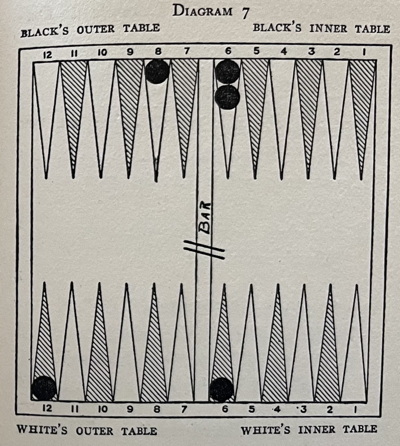
Stacks of scoring matches became a cord of wood
Ralph Bond’s Beginner’s Book of Modern Backgammon, published September 30, 1930, praised the cube for showing stakes at a glance. He dismissed matchstick scoring as outdated and joked that repeated doubles could leave a cord of wood stacked on the bar. The cube made the record compact.
Image credit: Ptkfgs / Chris Roddy; source image has a digitally removed background. Public domain (author dedication). Source: https://commons.wikimedia.org/wiki/File:Backgammon_DoublingCube.jpg. Licence: https://creativecommons.org/publicdomain/mark/1.0/. Display, thumbnail and enlargement resized without cropping and JPEG encoded; EXIF orientation applied. Enlargement limited to 1400 pixels on its longest side, or source size if smaller. No AI edits.
The dice product exceeds their sum two thirds of the time
Multiply and add the two printed faces for every ordered roll. The product is larger than the sum in 24 of 36 results, exactly two thirds. Examples begin with 2–3, where six exceeds five; rolls containing a one never qualify, and 2–2 ties instead of exceeding.

Image credit: Unknown seventeenth-century maker; photograph by Birmingham Museums and Art Gallery. CC BY 3.0. Source: https://commons.wikimedia.org/wiki/File:Backgammon_draught_in_Birmingham_Museums_and_Art_Gallery_3-obverse.jpg. Licence: https://creativecommons.org/licenses/by/3.0/deed.en. Display, thumbnail and enlargement resized without cropping and JPEG encoded; EXIF orientation applied. The packaged enlargement is 680 × 455 pixels. No AI edits.

The two extreme totals share one chance in eighteen
A printed total of two requires 1–1, while twelve requires 6–6. Together those two extremes occupy only two of the 36 ordered results, or one chance in eighteen. They are equally rare, although backgammon turns the two doubles into very different movement allowances: four pips and twenty-four pips.
Image credit: Ptkfgs. Public domain (author dedication). Source: https://commons.wikimedia.org/wiki/File:Backgammon_PrecisionDice.jpg. Licence: https://creativecommons.org/publicdomain/mark/1.0/. Display, thumbnail and enlargement resized without cropping and JPEG encoded; EXIF orientation applied. Enlargement limited to 1400 pixels on its longest side, or source size if smaller. No AI edits.
Totals of six or less fill five-twelfths of the roll table
Add the two printed dice without applying the doubles rule. Totals from two through six occupy fifteen of the 36 ordered results, which is five-twelfths. This is less than half because the triangular total distribution peaks at seven, leaving more combinations on the higher side of six.
Image credit: Ptkfgs. Public domain (author dedication). Source: https://commons.wikimedia.org/wiki/File:Backgammon_PrecisionDice.jpg. Licence: https://creativecommons.org/publicdomain/mark/1.0/. Display, thumbnail and enlargement resized without cropping and JPEG encoded; EXIF orientation applied. Enlargement limited to 1400 pixels on its longest side, or source size if smaller. No AI edits.
A total of nine or more appears five times in eighteen
Printed totals of nine, ten, eleven or twelve occupy ten of the 36 ordered dice results. That reduces to five chances in eighteen, about 27.8 percent. Backgammon still plays the dice separately, and a double uses four moves, so this total alone does not describe actual travel.
Image credit: Ptkfgs. Public domain (author dedication). Source: https://commons.wikimedia.org/wiki/File:Backgammon_PrecisionDice.jpg. Licence: https://creativecommons.org/publicdomain/mark/1.0/. Display, thumbnail and enlargement resized without cropping and JPEG encoded; EXIF orientation applied. Enlargement limited to 1400 pixels on its longest side, or source size if smaller. No AI edits.
Coprime dice faces occur on twenty-three rolls
Two numbers are coprime when their only shared factor is one. Exhaustive counting finds 23 of the 36 ordered dice results have coprime faces, including 1–1 because the greatest common divisor of one and one is one. The probability is 23/36, a little under two thirds.

Image credit: Unknown historical maker; Metropolitan Museum of Art Open Access. CC0 1.0. Source: https://commons.wikimedia.org/wiki/File:Draughtsmen_(30)_and_box-board_MET_LC-48_174_49-001.jpg. Licence: https://creativecommons.org/publicdomain/zero/1.0/. Display, thumbnail and enlargement resized without cropping and JPEG encoded; EXIF orientation applied. The packaged enlargement is 960 × 652 pixels. No AI edits.

The dice match parity on exactly half of rolls
Both dice are odd in nine ordered results and both are even in another nine. Therefore, the two dice have matching parity on eighteen of 36 rolls, exactly one half. The remaining half contains one odd and one even die and always produces an odd printed total.
Image credit: Ptkfgs. Public domain (author dedication). Source: https://commons.wikimedia.org/wiki/File:Backgammon_PrecisionDice.jpg. Licence: https://creativecommons.org/publicdomain/mark/1.0/. Display, thumbnail and enlargement resized without cropping and JPEG encoded; EXIF orientation applied. Enlargement limited to 1400 pixels on its longest side, or source size if smaller. No AI edits.
Three quarters of rolls show a prime-numbered face
Among the faces one through six, two, three and five are prime. A roll contains at least one of those faces in 27 of 36 ordered results, exactly three quarters. The complementary nine results use only one, four or six, showing how quickly several acceptable faces widen a roll's chances.
Image credit: Ptkfgs. Public domain (author dedication). Source: https://commons.wikimedia.org/wiki/File:Backgammon_PrecisionDice.jpg. Licence: https://creativecommons.org/publicdomain/mark/1.0/. Display, thumbnail and enlargement resized without cropping and JPEG encoded; EXIF orientation applied. Enlargement limited to 1400 pixels on its longest side, or source size if smaller. No AI edits.
Each side wins five-twelfths of an opening toss
On the opening toss, the 36 ordered results contain fifteen in which the first player’s die is higher, fifteen in which the second player’s is higher, and six ties that must be rerolled. Before any reroll, each player therefore has a 15/36, or five-twelfths, chance of moving first immediately.
Image credit: Ptkfgs. Public domain (author dedication). Source: https://commons.wikimedia.org/wiki/File:Backgammon_PrecisionDice.jpg. Licence: https://creativecommons.org/publicdomain/mark/1.0/. Display, thumbnail and enlargement resized without cropping and JPEG encoded; EXIF orientation applied. Enlargement limited to 1400 pixels on its longest side, or source size if smaller. No AI edits.
Only double two makes the dice sum equal their product
Across the 36 ordered results of two fair dice, only 2–2 has a sum equal to its product: two plus two and two times two both equal four. That makes the pattern a one-in-thirty-six event. It is a number property, not a special rule for moving checkers.
Image credit: Ptkfgs. Public domain (author dedication). Source: https://commons.wikimedia.org/wiki/File:Backgammon_PrecisionDice.jpg. Licence: https://creativecommons.org/publicdomain/mark/1.0/. Display, thumbnail and enlargement resized without cropping and JPEG encoded; EXIF orientation applied. Enlargement limited to 1400 pixels on its longest side, or source size if smaller. No AI edits.
Five ninths of dice products are divisible by three
A product is divisible by three whenever at least one die shows three or six. Twenty of the 36 ordered results meet that test, reducing to five ninths. Counting the complement is quickest: sixteen results use only one, two, four or five, so their products avoid three.
Image credit: Ptkfgs. Public domain (author dedication). Source: https://commons.wikimedia.org/wiki/File:Backgammon_PrecisionDice.jpg. Licence: https://creativecommons.org/publicdomain/mark/1.0/. Display, thumbnail and enlargement resized without cropping and JPEG encoded; EXIF orientation applied. Enlargement limited to 1400 pixels on its longest side, or source size if smaller. No AI edits.
Eight rolls make a perfect-square product
Eight of the 36 ordered results have a perfect-square product: 1–1, 1–4, 4–1, 2–2, 3–3, 4–4, 5–5 and 6–6. That is two ninths of all rolls. Six are doubles, while the two mixed results both multiply to four.
Image credit: Ptkfgs. Public domain (author dedication). Source: https://commons.wikimedia.org/wiki/File:Backgammon_PrecisionDice.jpg. Licence: https://creativecommons.org/publicdomain/mark/1.0/. Display, thumbnail and enlargement resized without cropping and JPEG encoded; EXIF orientation applied. Enlargement limited to 1400 pixels on its longest side, or source size if smaller. No AI edits.
The dice differ by at least three one third of the time
A gap of three, four or five between the dice occurs in twelve of the 36 ordered results. That is exactly one third. Large gaps matter because they offer two very different move sizes, but whether that variety helps depends on the open points and checkers in the position.
Image credit: Ptkfgs. Public domain (author dedication). Source: https://commons.wikimedia.org/wiki/File:Backgammon_PrecisionDice.jpg. Licence: https://creativecommons.org/publicdomain/mark/1.0/. Display, thumbnail and enlargement resized without cropping and JPEG encoded; EXIF orientation applied. Enlargement limited to 1400 pixels on its longest side, or source size if smaller. No AI edits.
Equal or neighbouring dice cover four ninths of rolls
Six doubles have equal faces, and ten ordered results have faces exactly one apart. Together they make sixteen of 36 results, or four ninths. The two groups play differently in backgammon because doubles provide four moves, even though their printed faces sit just as close together.
Image credit: Ptkfgs. Public domain (author dedication). Source: https://commons.wikimedia.org/wiki/File:Backgammon_PrecisionDice.jpg. Licence: https://creativecommons.org/publicdomain/mark/1.0/. Display, thumbnail and enlargement resized without cropping and JPEG encoded; EXIF orientation applied. Enlargement limited to 1400 pixels on its longest side, or source size if smaller. No AI edits.
Both dice stay at four or below four ninths of the time
Restrict each die to one, two, three or four and there are sixteen ordered pairs. Therefore both dice are four or below on four ninths of rolls. This simple grid count is useful whenever a position can use only low numbers, although board blocks may narrow the useful set further.
Image credit: Ptkfgs. Public domain (author dedication). Source: https://commons.wikimedia.org/wiki/File:Backgammon_PrecisionDice.jpg. Licence: https://creativecommons.org/publicdomain/mark/1.0/. Display, thumbnail and enlargement resized without cropping and JPEG encoded; EXIF orientation applied. Enlargement limited to 1400 pixels on its longest side, or source size if smaller. No AI edits.
Both dice are at least three four ninths of the time
Each die has four faces from three through six. Choosing from those faces produces sixteen of the 36 ordered results, so both dice are at least three on four ninths of rolls. The probability matches both dice being four or below because each condition offers four faces per die.
Image credit: Ptkfgs. Public domain (author dedication). Source: https://commons.wikimedia.org/wiki/File:Backgammon_PrecisionDice.jpg. Licence: https://creativecommons.org/publicdomain/mark/1.0/. Display, thumbnail and enlargement resized without cropping and JPEG encoded; EXIF orientation applied. Enlargement limited to 1400 pixels on its longest side, or source size if smaller. No AI edits.
Exactly one six appears five times in eighteen
Ten ordered results show exactly one six: the other die can be any of one through five, and the six can appear first or second. That is five chances in eighteen. The double 6–6 is excluded, which explains why this is slightly less likely than seeing at least one six.
Image credit: Ptkfgs. Public domain (author dedication). Source: https://commons.wikimedia.org/wiki/File:Backgammon_PrecisionDice.jpg. Licence: https://creativecommons.org/publicdomain/mark/1.0/. Display, thumbnail and enlargement resized without cropping and JPEG encoded; EXIF orientation applied. Enlargement limited to 1400 pixels on its longest side, or source size if smaller. No AI edits.
An endpoint face appears five times in nine
Call one and six the endpoint faces of a standard die. At least one endpoint appears in twenty of the 36 ordered results, or five ninths. Counting the complement is quick: both dice avoid the endpoints in sixteen results because each then has four available middle faces.
Image credit: Ptkfgs. Public domain (author dedication). Source: https://commons.wikimedia.org/wiki/File:Backgammon_PrecisionDice.jpg. Licence: https://creativecommons.org/publicdomain/mark/1.0/. Display, thumbnail and enlargement resized without cropping and JPEG encoded; EXIF orientation applied. Enlargement limited to 1400 pixels on its longest side, or source size if smaller. No AI edits.
One die is double the other on one roll in six
The ordered rolls 1–2, 2–1, 2–4, 4–2, 3–6 and 6–3 have one face exactly twice the other. Six results out of 36 give a probability of one in six. These rolls span totals from three to nine, so the relationship is different from a total-based pattern.
Image credit: Ptkfgs. Public domain (author dedication). Source: https://commons.wikimedia.org/wiki/File:Backgammon_PrecisionDice.jpg. Licence: https://creativecommons.org/publicdomain/mark/1.0/. Display, thumbnail and enlargement resized without cropping and JPEG encoded; EXIF orientation applied. Enlargement limited to 1400 pixels on its longest side, or source size if smaller. No AI edits.
Prime-numbered totals occur five times in twelve
The prime totals possible with two dice are two, three, five, seven and eleven. Together they occupy fifteen of 36 ordered results, or five twelfths. Seven supplies six of those results by itself, while the extreme prime total of two has only 1–1.
Image credit: Ptkfgs. Public domain (author dedication). Source: https://commons.wikimedia.org/wiki/File:Backgammon_PrecisionDice.jpg. Licence: https://creativecommons.org/publicdomain/mark/1.0/. Display, thumbnail and enlargement resized without cropping and JPEG encoded; EXIF orientation applied. Enlargement limited to 1400 pixels on its longest side, or source size if smaller. No AI edits.
One third of printed totals are divisible by three
Totals divisible by three are three, six, nine and twelve. They occupy two, five, four and one ordered results respectively, for twelve of 36 altogether. The probability is therefore one third. This pattern concerns the face total before doubles receive their extra two moves.
Image credit: Ptkfgs. Public domain (author dedication). Source: https://commons.wikimedia.org/wiki/File:Backgammon_PrecisionDice.jpg. Licence: https://creativecommons.org/publicdomain/mark/1.0/. Display, thumbnail and enlargement resized without cropping and JPEG encoded; EXIF orientation applied. Enlargement limited to 1400 pixels on its longest side, or source size if smaller. No AI edits.
Square totals take seven places in the roll table
Only four and nine are perfect squares within the possible two-dice totals. Four has three ordered combinations and nine has four, giving seven of 36 results altogether. A 2–2 belongs to the printed-total count for four, even though backgammon lets that double move eight pips.
Image credit: Ptkfgs. Public domain (author dedication). Source: https://commons.wikimedia.org/wiki/File:Backgammon_PrecisionDice.jpg. Licence: https://creativecommons.org/publicdomain/mark/1.0/. Display, thumbnail and enlargement resized without cropping and JPEG encoded; EXIF orientation applied. Enlargement limited to 1400 pixels on its longest side, or source size if smaller. No AI edits.
A two-point gap appears on two rolls in nine
The faces differ by exactly two in eight ordered results: 1–3, 2–4, 3–5 and 4–6, plus each reversed order. Eight out of 36 reduces to two ninths. This gap can offer useful flexibility because the two move sizes are related without being identical.
Image credit: Ptkfgs. Public domain (author dedication). Source: https://commons.wikimedia.org/wiki/File:Backgammon_PrecisionDice.jpg. Licence: https://creativecommons.org/publicdomain/mark/1.0/. Display, thumbnail and enlargement resized without cropping and JPEG encoded; EXIF orientation applied. Enlargement limited to 1400 pixels on its longest side, or source size if smaller. No AI edits.
Both dice land in the low half one quarter of the time
Treat one, two and three as the low half of a die. Both dice land there in nine of 36 ordered results, exactly one quarter. The same probability applies to both dice landing in the high half, because each half contains three equally likely faces.
Image credit: Ptkfgs. Public domain (author dedication). Source: https://commons.wikimedia.org/wiki/File:Backgammon_PrecisionDice.jpg. Licence: https://creativecommons.org/publicdomain/mark/1.0/. Display, thumbnail and enlargement resized without cropping and JPEG encoded; EXIF orientation applied. Enlargement limited to 1400 pixels on its longest side, or source size if smaller. No AI edits.
Only one roll in six has a product above twenty
Six ordered rolls have a face product greater than twenty: 4–6, 6–4, 5–5, 5–6, 6–5 and 6–6. Six out of 36 is one in six. The list is short because even fairly large-looking pairs such as 4–5 reach only twenty.
Image credit: Ptkfgs. Public domain (author dedication). Source: https://commons.wikimedia.org/wiki/File:Backgammon_PrecisionDice.jpg. Licence: https://creativecommons.org/publicdomain/mark/1.0/. Display, thumbnail and enlargement resized without cropping and JPEG encoded; EXIF orientation applied. Enlargement limited to 1400 pixels on its longest side, or source size if smaller. No AI edits.
A low die and a high die appear on half of rolls
One die lands from one through three while the other lands from four through six in eighteen ordered results. That is exactly half of all rolls. The mixed pair provides one smaller and one larger move, often giving more choice than two numbers from the same half.
Image credit: Ptkfgs. Public domain (author dedication). Source: https://commons.wikimedia.org/wiki/File:Backgammon_PrecisionDice.jpg. Licence: https://creativecommons.org/publicdomain/mark/1.0/. Display, thumbnail and enlargement resized without cropping and JPEG encoded; EXIF orientation applied. Enlargement limited to 1400 pixels on its longest side, or source size if smaller. No AI edits.
Both dice show an endpoint on one roll in nine
If the endpoint faces are one and six, both dice show endpoints in four ordered results: 1–1, 1–6, 6–1 and 6–6. Four out of 36 is one ninth. The set contains the smallest double, the largest double and both orders of the widest mixed roll.
Image credit: Ptkfgs. Public domain (author dedication). Source: https://commons.wikimedia.org/wiki/File:Backgammon_PrecisionDice.jpg. Licence: https://creativecommons.org/publicdomain/mark/1.0/. Display, thumbnail and enlargement resized without cropping and JPEG encoded; EXIF orientation applied. Enlargement limited to 1400 pixels on its longest side, or source size if smaller. No AI edits.
A prime dice product appears on one roll in six
A product of two dice is prime only when one die shows one and the other shows two, three or five. Both orders count, giving six of the 36 ordered results. The probability is one sixth, and no double qualifies because multiplying equal faces always makes a composite number or one.
Image credit: Ptkfgs. Public domain (author dedication). Source: https://commons.wikimedia.org/wiki/File:Backgammon_PrecisionDice.jpg. Licence: https://creativecommons.org/publicdomain/mark/1.0/. Display, thumbnail and enlargement resized without cropping and JPEG encoded; EXIF orientation applied. Enlargement limited to 1400 pixels on its longest side, or source size if smaller. No AI edits.
Three pips is the smallest potential movement allowance
The rolls 1–2 and 2–1 provide three pips of potential movement, the smallest allowance in ordinary backgammon. A double ace provides four moves of one, so it is larger. Only two of the 36 ordered results hit this minimum, giving a probability of one in eighteen.
Image credit: Ptkfgs. Public domain (author dedication). Source: https://commons.wikimedia.org/wiki/File:Backgammon_PrecisionDice.jpg. Licence: https://creativecommons.org/publicdomain/mark/1.0/. Display, thumbnail and enlargement resized without cropping and JPEG encoded; EXIF orientation applied. Enlargement limited to 1400 pixels on its longest side, or source size if smaller. No AI edits.
Twenty-four pips is the largest potential allowance
Only 6–6 offers twenty-four pips of potential movement: four moves of six. It appears once among the 36 ordered results. Legal blocks or bearing-off waste may prevent all twenty-four pips being used, so this is the roll's allowance rather than guaranteed checker travel.
Image credit: Ptkfgs. Public domain (author dedication). Source: https://commons.wikimedia.org/wiki/File:Backgammon_PrecisionDice.jpg. Licence: https://creativecommons.org/publicdomain/mark/1.0/. Display, thumbnail and enlargement resized without cropping and JPEG encoded; EXIF orientation applied. Enlargement limited to 1400 pixels on its longest side, or source size if smaller. No AI edits.
Four pips of movement can arrive three ways
Exactly four pips of potential movement come from 1–1, 1–3 or 3–1. Double aces supply four moves of one, while the mixed rolls supply one and three. Those three ordered results make the probability one in twelve, assuming every individual move is legal.
Image credit: Ptkfgs. Public domain (author dedication). Source: https://commons.wikimedia.org/wiki/File:Backgammon_PrecisionDice.jpg. Licence: https://creativecommons.org/publicdomain/mark/1.0/. Display, thumbnail and enlargement resized without cropping and JPEG encoded; EXIF orientation applied. Enlargement limited to 1400 pixels on its longest side, or source size if smaller. No AI edits.
Exactly six movement pips come from four ordered rolls
A six-pip movement allowance comes from 1–5, 5–1, 2–4 or 4–2. The roll 3–3 does not belong: doubles are played four times and therefore offer twelve pips. The correct count is four of 36 results, or one chance in nine.
Image credit: Ptkfgs. Public domain (author dedication). Source: https://commons.wikimedia.org/wiki/File:Backgammon_PrecisionDice.jpg. Licence: https://creativecommons.org/publicdomain/mark/1.0/. Display, thumbnail and enlargement resized without cropping and JPEG encoded; EXIF orientation applied. Enlargement limited to 1400 pixels on its longest side, or source size if smaller. No AI edits.
Ten movement pips have only two ordered sources
Exactly ten pips of potential movement come from 4–6 or 6–4. The printed double 5–5 does not count because it is played four times and offers twenty pips. Two ordered results out of 36 give a probability of one in eighteen.
Image credit: Ptkfgs. Public domain (author dedication). Source: https://commons.wikimedia.org/wiki/File:Backgammon_PrecisionDice.jpg. Licence: https://creativecommons.org/publicdomain/mark/1.0/. Display, thumbnail and enlargement resized without cropping and JPEG encoded; EXIF orientation applied. Enlargement limited to 1400 pixels on its longest side, or source size if smaller. No AI edits.
Eleven is the largest allowance from unlike dice
Only 5–6 and 6–5 provide exactly eleven pips, the greatest potential movement from two unlike dice. That is two of 36 ordered results, or one chance in eighteen. All larger allowances come from doubles, which turn one printed number into four separate moves.
Image credit: Ptkfgs. Public domain (author dedication). Source: https://commons.wikimedia.org/wiki/File:Backgammon_PrecisionDice.jpg. Licence: https://creativecommons.org/publicdomain/mark/1.0/. Display, thumbnail and enlargement resized without cropping and JPEG encoded; EXIF orientation applied. Enlargement limited to 1400 pixels on its longest side, or source size if smaller. No AI edits.
One third of rolls offer a multiple of four pips
Twelve of the 36 ordered rolls provide a movement allowance divisible by four. All six doubles qualify, along with the mixed rolls totalling four or eight. The probability is one third. This count assumes all moves can be played and does not subtract blocked or wasted pips.
Image credit: Ptkfgs. Public domain (author dedication). Source: https://commons.wikimedia.org/wiki/File:Backgammon_PrecisionDice.jpg. Licence: https://creativecommons.org/publicdomain/mark/1.0/. Display, thumbnail and enlargement resized without cropping and JPEG encoded; EXIF orientation applied. Enlargement limited to 1400 pixels on its longest side, or source size if smaller. No AI edits.
Only three rolls offer more than twelve movement pips
The only allowances above twelve come from 4–4, 5–5 and 6–6, worth sixteen, twenty and twenty-four pips. That is three of 36 ordered results, or one chance in twelve. Double 3–3 reaches twelve exactly and therefore sits outside this count.
Image credit: Ptkfgs. Public domain (author dedication). Source: https://commons.wikimedia.org/wiki/File:Backgammon_PrecisionDice.jpg. Licence: https://creativecommons.org/publicdomain/mark/1.0/. Display, thumbnail and enlargement resized without cropping and JPEG encoded; EXIF orientation applied. Enlargement limited to 1400 pixels on its longest side, or source size if smaller. No AI edits.
Two ninths of rolls offer at least ten movement pips
Eight ordered results provide ten or more potential pips: 4–6, 6–4, 5–6, 6–5 and the four doubles from 3–3 through 6–6. Eight out of 36 reduces to two ninths. This movement count treats doubles as four moves, as standard rules require.
Image credit: Ptkfgs. Public domain (author dedication). Source: https://commons.wikimedia.org/wiki/File:Backgammon_PrecisionDice.jpg. Licence: https://creativecommons.org/publicdomain/mark/1.0/. Display, thumbnail and enlargement resized without cropping and JPEG encoded; EXIF orientation applied. Enlargement limited to 1400 pixels on its longest side, or source size if smaller. No AI edits.
Thirteen rolls offer fewer than seven movement pips
Thirteen of the 36 ordered results provide fewer than seven potential movement pips once doubles are counted as four moves. That probability is about 36.1 percent. Double aces belongs because it offers four pips, while 2–2 does not because its four twos offer eight.
Image credit: Ptkfgs. Public domain (author dedication). Source: https://commons.wikimedia.org/wiki/File:Backgammon_PrecisionDice.jpg. Licence: https://creativecommons.org/publicdomain/mark/1.0/. Display, thumbnail and enlargement resized without cropping and JPEG encoded; EXIF orientation applied. Enlargement limited to 1400 pixels on its longest side, or source size if smaller. No AI edits.
Only four and eight can come from either roll type
Among movement allowances, only four and eight can be produced both by a double and by unlike dice. Four comes from 1–1 or 1–3; eight comes from 2–2, 2–6 or 3–5, including reversed mixed rolls. Every other allowance belongs exclusively to one roll type.
Image credit: Ptkfgs. Public domain (author dedication). Source: https://commons.wikimedia.org/wiki/File:Backgammon_PrecisionDice.jpg. Licence: https://creativecommons.org/publicdomain/mark/1.0/. Display, thumbnail and enlargement resized without cropping and JPEG encoded; EXIF orientation applied. Enlargement limited to 1400 pixels on its longest side, or source size if smaller. No AI edits.
Doubles supply two sevenths of expected movement
Doubles occur on only one sixth of rolls, yet they contribute 84 of the 294 potential movement pips across the complete 36-roll table. That is two sevenths, about 28.6 percent. Playing each double four times gives this small group of rolls an outsized share of expected movement.
Image credit: Ptkfgs. Public domain (author dedication). Source: https://commons.wikimedia.org/wiki/File:Backgammon_PrecisionDice.jpg. Licence: https://creativecommons.org/publicdomain/mark/1.0/. Display, thumbnail and enlargement resized without cropping and JPEG encoded; EXIF orientation applied. Enlargement limited to 1400 pixels on its longest side, or source size if smaller. No AI edits.
An ordinary roll averages seven-thirds separate moves
Unlike dice provide two separate moves and doubles provide four. Across all 36 ordered rolls, that totals 84 die-moves, producing an average of seven-thirds, or about 2.33 moves per turn. A blocked point may stop some moves, so this is the allowance before legality is applied.
Image credit: Ptkfgs. Public domain (author dedication). Source: https://commons.wikimedia.org/wiki/File:Backgammon_PrecisionDice.jpg. Licence: https://creativecommons.org/publicdomain/mark/1.0/. Display, thumbnail and enlargement resized without cropping and JPEG encoded; EXIF orientation applied. Enlargement limited to 1400 pixels on its longest side, or source size if smaller. No AI edits.
The median potential movement allowance is seven
Sort the 36 potential movement allowances from smallest to largest, counting doubles as four moves. The eighteenth and nineteenth values are both seven, so the median is seven pips. The mean is higher because the large double allowances pull the average upward more than low rolls pull it down.
Image credit: Ptkfgs. Public domain (author dedication). Source: https://commons.wikimedia.org/wiki/File:Backgammon_PrecisionDice.jpg. Licence: https://creativecommons.org/publicdomain/mark/1.0/. Display, thumbnail and enlargement resized without cropping and JPEG encoded; EXIF orientation applied. Enlargement limited to 1400 pixels on its longest side, or source size if smaller. No AI edits.
The exact ordered roll repeats with probability one in thirty-six
After any ordinary roll, the next roll matches both dice in the same order with probability one in 36. Across all 1,296 ordered two-roll sequences, 36 repeat exactly. If dice order is ignored, the repeat chance is higher because mixed rolls can return in reversed order.
Image credit: Ptkfgs. Public domain (author dedication). Source: https://commons.wikimedia.org/wiki/File:Backgammon_PrecisionDice.jpg. Licence: https://creativecommons.org/publicdomain/mark/1.0/. Display, thumbnail and enlargement resized without cropping and JPEG encoded; EXIF orientation applied. Enlargement limited to 1400 pixels on its longest side, or source size if smaller. No AI edits.
Ignoring order, a roll repeats about five percent of the time
Treat 2–5 and 5–2 as the same combination. Then 66 of the 1,296 possible two-roll sequences repeat the first combination, which reduces to eleven in 216, about 5.1 percent. Mixed combinations repeat more easily than doubles because either order can match them.
Image credit: Ptkfgs. Public domain (author dedication). Source: https://commons.wikimedia.org/wiki/File:Backgammon_PrecisionDice.jpg. Licence: https://creativecommons.org/publicdomain/mark/1.0/. Display, thumbnail and enlargement resized without cropping and JPEG encoded; EXIF orientation applied. Enlargement limited to 1400 pixels on its longest side, or source size if smaller. No AI edits.
Consecutive rolls share a printed total about eleven percent of the time
Across all 1,296 ordered pairs of rolls, 146 have the same printed total twice. That is 73 in 648, about 11.3 percent. Common totals such as six, seven and eight drive much of the repeat chance; matching totals need not mean matching individual dice.
Image credit: Ptkfgs. Public domain (author dedication). Source: https://commons.wikimedia.org/wiki/File:Backgammon_PrecisionDice.jpg. Licence: https://creativecommons.org/publicdomain/mark/1.0/. Display, thumbnail and enlargement resized without cropping and JPEG encoded; EXIF orientation applied. Enlargement limited to 1400 pixels on its longest side, or source size if smaller. No AI edits.
Four turns give a fifty-two-percent chance of a double
The chance of avoiding doubles on one roll is five sixths. Across four independent rolls, subtracting four straight non-doubles from one gives 671 in 1,296, about 51.8 percent, for at least one double. Four rolls therefore push the chance just beyond one half.
Image credit: Ptkfgs. Public domain (author dedication). Source: https://commons.wikimedia.org/wiki/File:Backgammon_PrecisionDice.jpg. Licence: https://creativecommons.org/publicdomain/mark/1.0/. Display, thumbnail and enlargement resized without cropping and JPEG encoded; EXIF orientation applied. Enlargement limited to 1400 pixels on its longest side, or source size if smaller. No AI edits.
Exactly one double appears in four rolls about thirty-nine percent of the time
There are four choices for which turn contains the double. Combining that with a one-sixth double chance and three five-sixths non-double chances gives 125 in 324, about 38.6 percent. This excludes sequences with two or more doubles, which belong to the broader at-least-one calculation.
Image credit: Ptkfgs. Public domain (author dedication). Source: https://commons.wikimedia.org/wiki/File:Backgammon_PrecisionDice.jpg. Licence: https://creativecommons.org/publicdomain/mark/1.0/. Display, thumbnail and enlargement resized without cropping and JPEG encoded; EXIF orientation applied. Enlargement limited to 1400 pixels on its longest side, or source size if smaller. No AI edits.
Six straight non-doubles are still a one-third chance
Avoiding a double has probability five sixths on each independent roll. Raising that chance to the sixth power gives 15,625 in 46,656, about 33.5 percent. A six-turn stretch without doubles is therefore ordinary enough that it provides no evidence of unfair dice by itself.
Image credit: Ptkfgs. Public domain (author dedication). Source: https://commons.wikimedia.org/wiki/File:Backgammon_PrecisionDice.jpg. Licence: https://creativecommons.org/publicdomain/mark/1.0/. Display, thumbnail and enlargement resized without cropping and JPEG encoded; EXIF orientation applied. Enlargement limited to 1400 pixels on its longest side, or source size if smaller. No AI edits.
A named double appears in thirty-six rolls only about sixty-four percent of the time
Choose one exact double, such as 4–4. The chance of seeing it at least once in 36 independent rolls is one minus 35/36 raised to the thirty-sixth power, about 63.7 percent. Even across 36 turns, missing one particular double remains quite plausible.
Image credit: Ptkfgs. Public domain (author dedication). Source: https://commons.wikimedia.org/wiki/File:Backgammon_PrecisionDice.jpg. Licence: https://creativecommons.org/publicdomain/mark/1.0/. Display, thumbnail and enlargement resized without cropping and JPEG encoded; EXIF orientation applied. Enlargement limited to 1400 pixels on its longest side, or source size if smaller. No AI edits.
Consecutive rolls share a face just over half the time
Compare two independent rolls and ask whether any printed number appears in both. Exactly 666 of the 1,296 ordered roll pairs share at least one face, reducing to 37 in 72, about 51.4 percent. A repeat such as 2–5 followed by 5–6 qualifies even though neither roll matches completely.
Image credit: Ptkfgs. Public domain (author dedication). Source: https://commons.wikimedia.org/wiki/File:Backgammon_PrecisionDice.jpg. Licence: https://creativecommons.org/publicdomain/mark/1.0/. Display, thumbnail and enlargement resized without cropping and JPEG encoded; EXIF orientation applied. Enlargement limited to 1400 pixels on its longest side, or source size if smaller. No AI edits.
Exactly two doubles in five rolls is about sixteen percent
Choose which two of five turns contain doubles, then require doubles on those turns and non-doubles on the other three. The result is 625 in 3,888, about 16.1 percent. It counts any double faces and excludes sequences containing a third, fourth or fifth double.
Image credit: Ptkfgs. Public domain (author dedication). Source: https://commons.wikimedia.org/wiki/File:Backgammon_PrecisionDice.jpg. Licence: https://creativecommons.org/publicdomain/mark/1.0/. Display, thumbnail and enlargement resized without cropping and JPEG encoded; EXIF orientation applied. Enlargement limited to 1400 pixels on its longest side, or source size if smaller. No AI edits.
Two rolls give a better-than-even chance of seeing a six
A single roll avoids six on both dice in 25 of 36 results. Across two independent rolls, the chance of at least one six is one minus 625/1,296, which equals 671/1,296, about 51.8 percent. This includes double six as well as mixed rolls.
Image credit: Ptkfgs. Public domain (author dedication). Source: https://commons.wikimedia.org/wiki/File:Backgammon_PrecisionDice.jpg. Licence: https://creativecommons.org/publicdomain/mark/1.0/. Display, thumbnail and enlargement resized without cropping and JPEG encoded; EXIF orientation applied. Enlargement limited to 1400 pixels on its longest side, or source size if smaller. No AI edits.
Three rolls find at least one ace about two thirds of the time
One roll avoids the ace face on both dice in 25 of 36 results. Over three independent rolls, the complement is 31,031 in 46,656, about 66.5 percent, for at least one ace. A double ace still counts as one successful roll in this calculation.
Image credit: Ptkfgs. Public domain (author dedication). Source: https://commons.wikimedia.org/wiki/File:Backgammon_PrecisionDice.jpg. Licence: https://creativecommons.org/publicdomain/mark/1.0/. Display, thumbnail and enlargement resized without cropping and JPEG encoded; EXIF orientation applied. Enlargement limited to 1400 pixels on its longest side, or source size if smaller. No AI edits.
One die divides the other on eleven rolls in eighteen
Count a roll when either printed face divides the other without a remainder. The six doubles qualify, every roll containing a one qualifies, and several pairs such as 2–4, 2–6 and 3–6 qualify too. Altogether 22 of 36 ordered results meet the rule, reducing to eleven eighteenths.
Image credit: Ptkfgs / Chris Roddy; source image has a digitally removed background. Public domain (author dedication). Source: https://commons.wikimedia.org/wiki/File:Backgammon_DoublingCube.jpg. Licence: https://creativecommons.org/publicdomain/mark/1.0/. Display, thumbnail and enlargement resized without cropping and JPEG encoded; EXIF orientation applied. Enlargement limited to 1400 pixels on its longest side, or source size if smaller. No AI edits.
One third of successful openings are decided by one pip
Once tied opening attempts are discarded, ten of the 30 ordered results differ by exactly one. So the right to start is decided by a one-pip margin one third of the time. These close results include 2–1 through 6–5, with either player able to hold the higher die.
Image credit: Ptkfgs. Public domain (author dedication). Source: https://commons.wikimedia.org/wiki/File:Backgammon_PrecisionDice.jpg. Licence: https://creativecommons.org/publicdomain/mark/1.0/. Display, thumbnail and enlargement resized without cropping and JPEG encoded; EXIF orientation applied. Enlargement limited to 1400 pixels on its longest side, or source size if smaller. No AI edits.
Two fifths of successful openings have a gap of at least three
Among the 30 non-tied ordered opening results, twelve have dice separated by three, four or five. That is two fifths of successful openings. A wide gap determines who begins just like a narrow one; it also gives the starter those two unequal numbers for the first move.
Image credit: Ptkfgs. Public domain (author dedication). Source: https://commons.wikimedia.org/wiki/File:Backgammon_PrecisionDice.jpg. Licence: https://creativecommons.org/publicdomain/mark/1.0/. Display, thumbnail and enlargement resized without cropping and JPEG encoded; EXIF orientation applied. Enlargement limited to 1400 pixels on its longest side, or source size if smaller. No AI edits.
The widest opening margin occurs once in fifteen starts
A five-pip opening gap happens only when one player rolls six and the other rolls one. Both player orders count, producing two of the 30 non-tied results. The conditional probability is therefore one in fifteen after ties are rerolled.
Image credit: Ptkfgs. Public domain (author dedication). Source: https://commons.wikimedia.org/wiki/File:Backgammon_PrecisionDice.jpg. Licence: https://creativecommons.org/publicdomain/mark/1.0/. Display, thumbnail and enlargement resized without cropping and JPEG encoded; EXIF orientation applied. Enlargement limited to 1400 pixels on its longest side, or source size if smaller. No AI edits.
The average successful opening margin is seven-thirds
Across the 30 non-tied ordered opening results, the absolute gaps add to seventy. Dividing gives an average winning margin of seven-thirds, about 2.33 pips. This describes the difference between the two opening dice, not the starter's eventual racing advantage after making the first move.
Image credit: Ptkfgs. Public domain (author dedication). Source: https://commons.wikimedia.org/wiki/File:Backgammon_PrecisionDice.jpg. Licence: https://creativecommons.org/publicdomain/mark/1.0/. Display, thumbnail and enlargement resized without cropping and JPEG encoded; EXIF orientation applied. Enlargement limited to 1400 pixels on its longest side, or source size if smaller. No AI edits.
Three fifths of successful openings pair a low die with a high die
Divide the faces into a low half, one through three, and a high half, four through six. Eighteen of the 30 non-tied opening results draw one die from each half. Conditional on a successful opening, that is three fifths, and none of these mixed-half attempts can tie.
Image credit: Ptkfgs. Public domain (author dedication). Source: https://commons.wikimedia.org/wiki/File:Backgammon_PrecisionDice.jpg. Licence: https://creativecommons.org/publicdomain/mark/1.0/. Display, thumbnail and enlargement resized without cropping and JPEG encoded; EXIF orientation applied. Enlargement limited to 1400 pixels on its longest side, or source size if smaller. No AI edits.
A tournament board needs landing room for dice
Phil Simborg's equipment guide says tournament boards should leave enough open space for dice to land properly. A beautiful set can still be awkward if the checkers crowd the playing surface. The practical test is whether normal rolls can settle flat without repeatedly striking checkers or the board's edge.

Image credit: Tim Reckmann from Hamm, Deutschland. CC BY 2.0. Source: https://commons.wikimedia.org/wiki/File:Backgammon_(12666371505).jpg. Licence: https://creativecommons.org/licenses/by/2.0/deed.en. Display, thumbnail and enlargement resized without cropping and JPEG encoded; EXIF orientation applied. The packaged enlargement is 960 × 640 pixels. No AI edits.

Heavy checkers can make play steadier
Good tournament checkers should fit their points, stand out clearly from the board, and feel thick enough to handle easily. Simborg says thick checkers reduce dice landing on top of them. Thick, heavy checkers are also less likely to slide if someone bumps the board or table.

Image credit: Tim Reckmann from Hamm, Deutschland. CC BY 2.0. Source: https://commons.wikimedia.org/wiki/File:Backgammon_(12666376575).jpg. Licence: https://creativecommons.org/licenses/by/2.0/deed.en. Display, thumbnail and enlargement resized without cropping and JPEG encoded; EXIF orientation applied. The packaged enlargement is 960 × 640 pixels. No AI edits.

Precision dice serve more than one purpose
Tournament players use precision dice because their rounded corners encourage rolling and the dice are made to be properly balanced. Clear dice also commonly carry an internal marking. Simborg explains that this marking can help players notice if someone has switched a different die into a money game or tournament match.
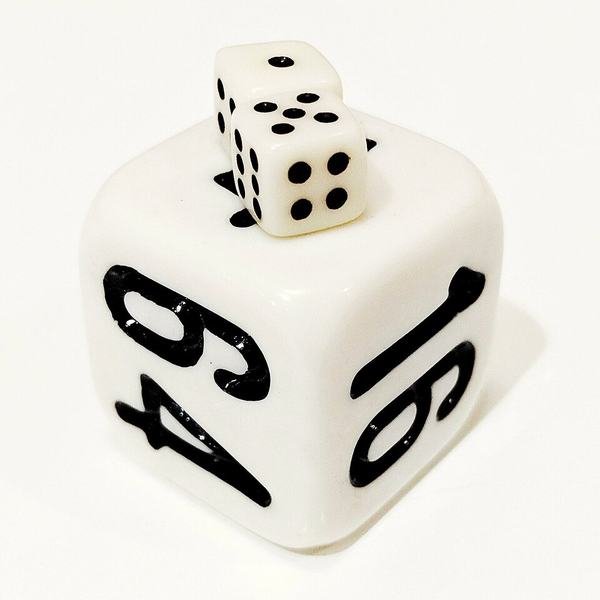
Image credit: AЯMEN from Vancouver BC. CC BY 2.0. Source: https://commons.wikimedia.org/wiki/File:Dice_(42899309020).jpg. Licence: https://creativecommons.org/licenses/by/2.0/deed.en. Display, thumbnail and enlargement resized without cropping and JPEG encoded; EXIF orientation applied. The packaged enlargement is 960 × 960 pixels. No AI edits.

A home-built board once cost less than thirty dollars
A 1981 construction article claimed that a sturdy wooden backgammon board could be built for under $30. Its shopping list used common materials: pine, a darker hardwood, plywood, wooden dowel, glue, sandpaper, stain, and varnish. The plan showed that a playable set did not require luxury materials.

Image credit: Internet Archive Book Images. Public domain. Source: https://commons.wikimedia.org/wiki/File:Backgammon_(1895)_(14779602481).jpg. Licence: https://creativecommons.org/publicdomain/mark/1.0/. Display, thumbnail and enlargement resized without cropping and JPEG encoded; EXIF orientation applied. The packaged enlargement is 960 × 963 pixels. No AI edits.

The homemade points were cut as wooden triangles
The 1981 do-it-yourself plan called for forty light pine triangles and twelve dark hardwood triangles. Each piece was eight inches long, one and a half inches wide at the base, and cut at a twelve-degree angle. Careful repeated cuts produced the board's familiar patterned playing area.
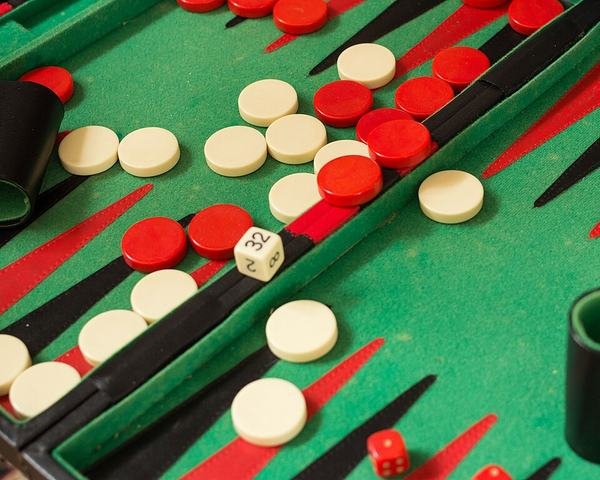
Image credit: Allan Sharp from Canberra, Australia. CC BY-SA 2.0. Source: https://commons.wikimedia.org/wiki/File:Game_over_(29383818486).jpg. Licence: https://creativecommons.org/licenses/by-sa/2.0/deed.en. Display, thumbnail and enlargement resized without cropping and JPEG encoded; EXIF orientation applied. The packaged enlargement is 960 × 768 pixels. No AI edits.

One dowel could become all thirty checkers
For checkers, the builder was told to slice a wooden dowel into thirty pieces, each three-eighths of an inch thick, then stain half of them. The finished board received six coats of spar varnish, with sanding between coats. That patient finish was meant to create a smooth, durable surface.

Image credit: alexkerhead. CC BY 2.0. Source: https://commons.wikimedia.org/wiki/File:Roll_of_the_Dice_(3571807903).jpg. Licence: https://creativecommons.org/licenses/by/2.0/deed.en. Display, thumbnail and enlargement resized without cropping and JPEG encoded; EXIF orientation applied. The packaged enlargement is 960 × 602 pixels. No AI edits.

Tournament rules recognize several randomizers
A tournament standards guide lists precision dice and lipped dice cups as approved equipment, but it also allows dice tubes and baffle boxes. All are meant to produce a fair, visible random result. The rule matters because tournaments can permit different devices without changing the basic requirement of an honest roll.
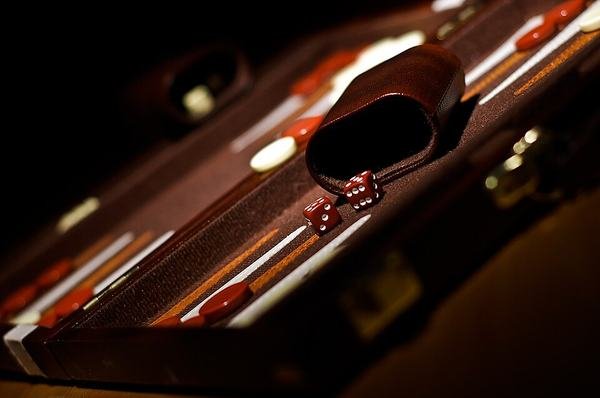
Image credit: Ryan Hyde from Ann Arbor, United States. CC BY-SA 2.0. Source: https://commons.wikimedia.org/wiki/File:Backgammon_3573.jpg. Licence: https://creativecommons.org/licenses/by-sa/2.0/deed.en. Display, thumbnail and enlargement resized without cropping and JPEG encoded; EXIF orientation applied. The packaged enlargement is 960 × 637 pixels. No AI edits.

A clocked match sets two of the four dice aside
The standards guide says that when a clock is used, players select two dice and put the other pair aside. If either player later asks for a change, all four return for a new selection. One shared pair suits clock play, where pressing the plunger ends a turn.
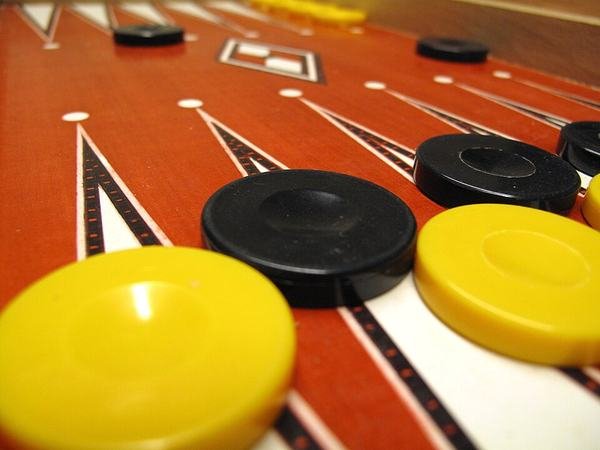
Image credit: Khairil Zhafri. CC BY 2.0. Source: https://commons.wikimedia.org/wiki/File:Backgammon_(4290210920).jpg. Licence: https://creativecommons.org/licenses/by/2.0/deed.en. Display, thumbnail and enlargement resized without cropping and JPEG encoded; EXIF orientation applied. The packaged enlargement is 960 × 720 pixels. No AI edits.

Tournament cup protocol calls for a real shake
The standards guide says dice in a cup should be shaken vigorously at least three times and released at least four inches above the surface. For a valid result, both dice must leave at about the same time and settle flat in the roller's right-hand board. The protocol separates good rolling technique from the validity test.

Image credit: Kyoku. CC BY-SA 3.0. Source: https://commons.wikimedia.org/wiki/File:Backgammon_DoublingCube_2.jpg. Licence: https://creativecommons.org/licenses/by-sa/3.0/deed.en. Display, thumbnail and enlargement resized without cropping and JPEG encoded; EXIF orientation applied. The packaged enlargement is 1200 × 1016 pixels. No AI edits.

Experienced players bring a board to tournaments
Chuck Rice's first-tournament guide recommends bringing a board, especially when driving to the event. He tells newcomers not to feel embarrassed by a small or ordinary travel set. In his experience, having a modest board available is far better than reaching a table where no board is ready at all.

Image credit: Martina Grosty. CC BY 2.0. Source: https://commons.wikimedia.org/wiki/File:Backgammon_(49543113023).jpg. Licence: https://creativecommons.org/licenses/by/2.0/deed.en. Display, thumbnail and enlargement resized without cropping and JPEG encoded; EXIF orientation applied. The packaged enlargement is 960 × 940 pixels. No AI edits.

A paper scorecard remains useful beside a scoreboard
Rice advises players to record the match score with pen and paper, even when a board-mounted scoreboard is present. A written record helps settle memory slips and makes it easier to confirm the score after interruptions. Simple backup methods can matter as much as expensive tournament equipment.

Image credit: Takasaki001. CC BY-SA 3.0. Source: https://commons.wikimedia.org/wiki/File:Doubling-Cube.jpg. Licence: https://creativecommons.org/licenses/by-sa/3.0/deed.en. Display, thumbnail and enlargement resized without cropping and JPEG encoded; EXIF orientation applied. The packaged enlargement is 512 × 384 pixels. No AI edits.

A camera can preserve difficult positions
Rice recommends keeping a camera ready at a tournament so an interesting position can be recorded before the checkers move. The photograph allows later analysis without depending on memory. Today a phone makes this easy, but the study habit remains the same: capture the board first, investigate afterward.

Image credit: Axelfoley12. CC BY-SA 4.0. Source: https://commons.wikimedia.org/wiki/File:Backgammon_probability.png. Licence: https://creativecommons.org/licenses/by-sa/4.0/deed.en. Display, thumbnail and enlargement resized without cropping and JPEG encoded; EXIF orientation applied. The packaged enlargement is 960 × 960 pixels. No AI edits.

A backgammon clock contains two linked timers
A chess-style clock has one timer for each player and two linked buttons. Pressing your button stops your timer and starts the opponent's. Backgammon can add a short delay before reserve time begins, giving each move a normal thinking allowance while still limiting the total time used in a match.
Image credit: MBIHund. CC BY-SA 4.0. Source: https://commons.wikimedia.org/wiki/File:Karpow_1986_Dubai.jpeg. Licence: https://creativecommons.org/licenses/by-sa/4.0/. Display, thumbnail and enlargement resized without cropping and JPEG encoded; EXIF orientation applied. Enlargement limited to 1400 pixels on its longest side, or source size if smaller. No AI edits.
Clock settings combine move time and reserve time
Kit Woolsey illustrated clocked backgammon with twelve seconds allowed for every move plus twenty-two minutes of reserve time for each player in an eleven-point match. Quick routine plays use only the delay, while hard decisions consume the reserve. This rewards steady play without forcing every decision to be rushed.
Image credit: MBIHund. CC BY-SA 4.0. Source: https://commons.wikimedia.org/wiki/File:Karpow_1986_Dubai.jpeg. Licence: https://creativecommons.org/licenses/by-sa/4.0/. Display, thumbnail and enlargement resized without cropping and JPEG encoded; EXIF orientation applied. Enlargement limited to 1400 pixels on its longest side, or source size if smaller. No AI edits.
Pressing the clock officially ends a move
Under Woolsey's clock procedure, a player completes a move by pressing the clock rather than lifting the dice. The shared dice remain on the board until the opponent picks them up for the next roll. This makes the end of a turn visible and reduces arguments over whether a move had actually been completed.
Image credit: Ptkfgs. Public domain (author dedication). Source: https://commons.wikimedia.org/wiki/File:Backgammon_PrecisionDice.jpg. Licence: https://creativecommons.org/publicdomain/mark/1.0/. Display, thumbnail and enlargement resized without cropping and JPEG encoded; EXIF orientation applied. Enlargement limited to 1400 pixels on its longest side, or source size if smaller. No AI edits.
The 1996 World Cup allowed sixty-five minutes each
At the 1996 World Cup, each player received sixty-five minutes for an eleven-point match. The experimental clock rule was meant to prevent a single slow match from delaying the entire tournament schedule. Players still controlled how to spend their time, but the day's timetable gained a firm outer limit.
Image credit: MBIHund. CC BY-SA 4.0. Source: https://commons.wikimedia.org/wiki/File:Karpow_1986_Dubai.jpeg. Licence: https://creativecommons.org/licenses/by-sa/4.0/. Display, thumbnail and enlargement resized without cropping and JPEG encoded; EXIF orientation applied. Enlargement limited to 1400 pixels on its longest side, or source size if smaller. No AI edits.
A fallen flag once carried a two-point penalty
In a 1996 World Cup match between Wilcox Snellings and James Colen, Snellings's clock expired near the finish. The rule then awarded Colen two points, enough to win the match. The episode showed organizers still experimenting with the fairest result when a player's allotted time ran out.
Image credit: MBIHund. CC BY-SA 4.0. Source: https://commons.wikimedia.org/wiki/File:Karpow_1986_Dubai.jpeg. Licence: https://creativecommons.org/licenses/by-sa/4.0/. Display, thumbnail and enlargement resized without cropping and JPEG encoded; EXIF orientation applied. Enlargement limited to 1400 pixels on its longest side, or source size if smaller. No AI edits.
A large time advantage can become part of strategy
Kit Woolsey described reaching 10–10 against Masayuki Shino with about twenty-five minutes remaining while Shino had under four. Woolsey deliberately chose complicated positions that demanded decisions from his opponent. He eventually won on time, showing that clock management can shape checker and cube choices near a match's end.
Image credit: MBIHund. CC BY-SA 4.0. Source: https://commons.wikimedia.org/wiki/File:Karpow_1986_Dubai.jpeg. Licence: https://creativecommons.org/licenses/by-sa/4.0/. Display, thumbnail and enlargement resized without cropping and JPEG encoded; EXIF orientation applied. Enlargement limited to 1400 pixels on its longest side, or source size if smaller. No AI edits.
Dublin used clocks to keep rounds together
A historical survey reported that clocked matches at a Dublin tournament helped rounds finish at roughly the same time. That benefit is organizational: pairings for the next round do not have to wait for one unusually slow table. The clock can therefore improve an event's schedule even when no player loses on time.
Image credit: MBIHund. CC BY-SA 4.0. Source: https://commons.wikimedia.org/wiki/File:Karpow_1986_Dubai.jpeg. Licence: https://creativecommons.org/licenses/by-sa/4.0/. Display, thumbnail and enlargement resized without cropping and JPEG encoded; EXIF orientation applied. Enlargement limited to 1400 pixels on its longest side, or source size if smaller. No AI edits.
Early tournaments tested very different time limits
Clock experiments were far from standardized. The Paris tournament allowed fifty-five minutes per player, the World Cup used sixty-five, and a Japanese event allowed thirty-five minutes for a five-point match. These different settings helped organizers learn how much thinking time a competitive match really needed.
Image credit: MBIHund. CC BY-SA 4.0. Source: https://commons.wikimedia.org/wiki/File:Karpow_1986_Dubai.jpeg. Licence: https://creativecommons.org/licenses/by-sa/4.0/. Display, thumbnail and enlargement resized without cropping and JPEG encoded; EXIF orientation applied. Enlargement limited to 1400 pixels on its longest side, or source size if smaller. No AI edits.
One nineteen-point match lasted through the night
Robertie's clock survey recalled a nineteen-point match that began around 10 p.m. and ended at 6 a.m. Another seventeen-point match in Paris reportedly lasted seven hours. Extreme examples like these explain why tournament directors wanted clocks: one table could otherwise hold an event hostage for most of a day.
Image credit: MBIHund. CC BY-SA 4.0. Source: https://commons.wikimedia.org/wiki/File:Karpow_1986_Dubai.jpeg. Licence: https://creativecommons.org/licenses/by-sa/4.0/. Display, thumbnail and enlargement resized without cropping and JPEG encoded; EXIF orientation applied. Enlargement limited to 1400 pixels on its longest side, or source size if smaller. No AI edits.
A clock study followed 179 seven-point matches
Chuck Bower recorded 179 seven-point matches played between November 2002 and April 2005. Players received twelve seconds per move plus fifteen minutes of reserve time. By studying actual club play rather than guessing, he could test whether those settings allowed normal thought while keeping matches within a practical schedule.
Image credit: MBIHund. CC BY-SA 4.0. Source: https://commons.wikimedia.org/wiki/File:Karpow_1986_Dubai.jpeg. Licence: https://creativecommons.org/licenses/by-sa/4.0/. Display, thumbnail and enlargement resized without cropping and JPEG encoded; EXIF orientation applied. Enlargement limited to 1400 pixels on its longest side, or source size if smaller. No AI edits.
Players used almost ten seconds of free time per move
In Bower's clock experiment, the two sides averaged 9.66 and 9.72 seconds of the twelve-second delay on each move. That close result suggests both groups used the free allowance in similar ways. Reserve time was saved for the harder positions rather than spent evenly on every turn.
Image credit: MBIHund. CC BY-SA 4.0. Source: https://commons.wikimedia.org/wiki/File:Karpow_1986_Dubai.jpeg. Licence: https://creativecommons.org/licenses/by-sa/4.0/. Display, thumbnail and enlargement resized without cropping and JPEG encoded; EXIF orientation applied. Enlargement limited to 1400 pixels on its longest side, or source size if smaller. No AI edits.
Recorded match times can predict a whole bracket
Bower used the measured match lengths to simulate a sixteen-player knockout tournament. Half the simulated events finished within about five hours and four minutes, and most finished within five and a half hours. Real timing data let directors estimate schedules instead of relying only on personal impressions.
Image credit: MBIHund. CC BY-SA 4.0. Source: https://commons.wikimedia.org/wiki/File:Karpow_1986_Dubai.jpeg. Licence: https://creativecommons.org/licenses/by-sa/4.0/. Display, thumbnail and enlargement resized without cropping and JPEG encoded; EXIF orientation applied. Enlargement limited to 1400 pixels on its longest side, or source size if smaller. No AI edits.
A new FIBS player began at 1500
The First Internet Backgammon Server assigned a new player a rating of 1500. After each rated match, the number rose for a win and fell for a loss. The system used the opponent's strength, match length, and each player's experience, so not every victory or defeat changed the rating equally.
Image credit: Joe Mabel. CC BY-SA 3.0. Source: https://commons.wikimedia.org/wiki/File:LCM_-_DEC_PDP-10_-_01.jpg. Licence: https://creativecommons.org/licenses/by-sa/3.0/. Display, thumbnail and enlargement resized without cropping and JPEG encoded; EXIF orientation applied. Enlargement limited to 1400 pixels on its longest side, or source size if smaller. No AI edits.
Longer matches changed ratings by a square-root scale
FIBS did not make a ten-point match count ten times as much as a one-point match. Its rating formula scaled the effect by the square root of match length. Longer contests still mattered more because luck has more time to even out, but their weight increased gradually rather than directly.
Image credit: Joe Mabel. CC BY-SA 3.0. Source: https://commons.wikimedia.org/wiki/File:LCM_-_DEC_PDP-10_-_01.jpg. Licence: https://creativecommons.org/licenses/by-sa/3.0/. Display, thumbnail and enlargement resized without cropping and JPEG encoded; EXIF orientation applied. Enlargement limited to 1400 pixels on its longest side, or source size if smaller. No AI edits.
Early FIBS ratings moved faster
FIBS measured experience as the total length of rated matches a player had completed. Until that experience reached 400, the rating was deliberately more responsive. A newcomer's number could therefore find an appropriate level quickly, while an established player's rating changed less sharply after one unusual result.
Image credit: Joe Mabel. CC BY-SA 3.0. Source: https://commons.wikimedia.org/wiki/File:LCM_-_DEC_PDP-10_-_01.jpg. Licence: https://creativecommons.org/licenses/by-sa/3.0/. Display, thumbnail and enlargement resized without cropping and JPEG encoded; EXIF orientation applied. Enlargement limited to 1400 pixels on its longest side, or source size if smaller. No AI edits.
A rating formula estimates the favorite's winning chance
A backgammon rating gap becomes more meaningful when match length is included. Zare and Stocks explained that the same two ratings imply different winning chances in a short match and a long one. A useful rating system therefore converts both the gap and the distance of the match into an expected result.
Image credit: Axelfoley12. CC BY-SA 4.0. Source: https://commons.wikimedia.org/wiki/File:Backgammon_probability.png. Licence: https://creativecommons.org/licenses/by-sa/4.0/deed.en. Display, thumbnail and enlargement resized without cropping and JPEG encoded; EXIF orientation applied. The packaged enlargement is 960 × 960 pixels. No AI edits.
Rating history has a kind of half-life
Zare and Stocks described a rating's half-life as the amount of new experience needed for old results to lose half their influence. Their estimates put normal FIBS ratings around 600 to 650 experience points. The idea helps explain why a rating remembers recent performance more strongly than distant matches.
Image credit: Joe Mabel. CC BY-SA 3.0. Source: https://commons.wikimedia.org/wiki/File:LCM_-_DEC_PDP-10_-_01.jpg. Licence: https://creativecommons.org/licenses/by-sa/3.0/. Display, thumbnail and enlargement resized without cropping and JPEG encoded; EXIF orientation applied. Enlargement limited to 1400 pixels on its longest side, or source size if smaller. No AI edits.
A stable rating can still swing by nearly one hundred points
Even after a player's strength stops changing, luck keeps the displayed rating moving. Zare and Stocks estimated that roughly the outer one percent of normal FIBS rating results could lie about ninety-seven points above or below the player's long-term level. A single peak rating can therefore exaggerate true strength.
Image credit: Joe Mabel. CC BY-SA 3.0. Source: https://commons.wikimedia.org/wiki/File:LCM_-_DEC_PDP-10_-_01.jpg. Licence: https://creativecommons.org/licenses/by-sa/3.0/. Display, thumbnail and enlargement resized without cropping and JPEG encoded; EXIF orientation applied. Enlargement limited to 1400 pixels on its longest side, or source size if smaller. No AI edits.
Ratings can fall even while master points rise
An early tournament rating proposal contrasted ratings with cumulative master points. Master points usually increase whenever a player earns more awards, but a performance rating can rise or fall after every result. That makes ratings better at describing current form, while lifetime points reward a long record of achievement.
Image credit: MBIHund. CC BY-SA 4.0. Source: https://commons.wikimedia.org/wiki/File:Karpow_1986_Dubai.jpeg. Licence: https://creativecommons.org/licenses/by-sa/4.0/. Display, thumbnail and enlargement resized without cropping and JPEG encoded; EXIF orientation applied. Enlargement limited to 1400 pixels on its longest side, or source size if smaller. No AI edits.
A 1984 system gave an upset extra weight
In a published 1984 example for players with under 100 experience points, a 1500-rated player facing a 1600-rated opponent in a fifteen-point match would gain 46 points for winning but lose 29 for losing. The large changes included the five-times newcomer multiplier as well as the upset.
Image credit: MBIHund. CC BY-SA 4.0. Source: https://commons.wikimedia.org/wiki/File:Karpow_1986_Dubai.jpeg. Licence: https://creativecommons.org/licenses/by-sa/4.0/. Display, thumbnail and enlargement resized without cropping and JPEG encoded; EXIF orientation applied. Enlargement limited to 1400 pixels on its longest side, or source size if smaller. No AI edits.
Newcomers once received an experience multiplier
The 1984 rating method multiplied changes by five for players with under 100 experience points, then reduced that factor until it reached one at 400. This made early ratings settle faster. Most players began at 1500, so the multiplier helped the list separate different skill levels after only a few events.
Image credit: MBIHund. CC BY-SA 4.0. Source: https://commons.wikimedia.org/wiki/File:Karpow_1986_Dubai.jpeg. Licence: https://creativecommons.org/licenses/by-sa/4.0/. Display, thumbnail and enlargement resized without cropping and JPEG encoded; EXIF orientation applied. Enlargement limited to 1400 pixels on its longest side, or source size if smaller. No AI edits.
A ranking tells order; a rating estimates distance
A ranking says who is first, second, or third, but it does not show how far apart those players are. Chuck Bower explained that a numerical rating tries to measure the gap. That extra information can be used to estimate match odds and compare performances across many results.
Image credit: Joe Mabel. CC BY-SA 3.0. Source: https://commons.wikimedia.org/wiki/File:LCM_-_DEC_PDP-10_-_01.jpg. Licence: https://creativecommons.org/licenses/by-sa/3.0/. Display, thumbnail and enlargement resized without cropping and JPEG encoded; EXIF orientation applied. Enlargement limited to 1400 pixels on its longest side, or source size if smaller. No AI edits.
Identical ratings on different servers may not match
Online rating pools are usually closed: players gain points from other members of the same service. Bower warned that a 1700 rating on one server need not mean the same skill as 1700 elsewhere. Different player groups, formulas, match habits, and starting values can shift the scale.
Image credit: Joe Mabel. CC BY-SA 3.0. Source: https://commons.wikimedia.org/wiki/File:LCM_-_DEC_PDP-10_-_01.jpg. Licence: https://creativecommons.org/licenses/by-sa/3.0/. Display, thumbnail and enlargement resized without cropping and JPEG encoded; EXIF orientation applied. Enlargement limited to 1400 pixels on its longest side, or source size if smaller. No AI edits.
Even an established rating remains noisy
Bower noted that ratings often need roughly 500 to 1,000 experience points before settling near equilibrium. Dice can still produce swings of 50 to 100 points after that. A rating is best read as an estimate built from many matches, rather than a permanent label or exact measurement.
Image credit: Joe Mabel. CC BY-SA 3.0. Source: https://commons.wikimedia.org/wiki/File:LCM_-_DEC_PDP-10_-_01.jpg. Licence: https://creativecommons.org/licenses/by-sa/3.0/. Display, thumbnail and enlargement resized without cropping and JPEG encoded; EXIF orientation applied. Enlargement limited to 1400 pixels on its longest side, or source size if smaller. No AI edits.
A 1995 FAQ appeared around the thirteenth each month
Tom Damish's Internet backgammon FAQ was posted monthly around the thirteenth, a playful choice linked to the strong opening roll 3-1. The December 1995 edition documents an early online community that relied on newsgroups, file servers, email, and plain-text instructions rather than today's always-updated websites.
Image credit: Joe Mabel. CC BY-SA 3.0. Source: https://commons.wikimedia.org/wiki/File:LCM_-_DEC_PDP-10_-_01.jpg. Licence: https://creativecommons.org/licenses/by-sa/3.0/. Display, thumbnail and enlargement resized without cropping and JPEG encoded; EXIF orientation applied. Enlargement limited to 1400 pixels on its longest side, or source size if smaller. No AI edits.
One FAQ had text, HTML, and update files
The 1995 FAQ was available as plain ASCII text and as HTML, with the HTML serving as the source document used to make the ASCII edition. A separate difference file showed changes between successive releases. Several formats made the same information useful on different computers and network connections.
Image credit: Joe Mabel. CC BY-SA 3.0. Source: https://commons.wikimedia.org/wiki/File:LCM_-_DEC_PDP-10_-_01.jpg. Licence: https://creativecommons.org/licenses/by-sa/3.0/. Display, thumbnail and enlargement resized without cropping and JPEG encoded; EXIF orientation applied. Enlargement limited to 1400 pixels on its longest side, or source size if smaller. No AI edits.
Early FIBS users chose among many interface programs
The FAQ listed several ways to reach FIBS, including TinyFugue, xFIBS, MacFIBS, TkFibs, FIBS/W, and xibc. The server and the screen program were separate, so volunteers could design different interfaces for Unix, Macintosh, and Windows users while everyone met in the same playing community.
Image credit: Joe Mabel. CC BY-SA 3.0. Source: https://commons.wikimedia.org/wiki/File:LCM_-_DEC_PDP-10_-_01.jpg. Licence: https://creativecommons.org/licenses/by-sa/3.0/. Display, thumbnail and enlargement resized without cropping and JPEG encoded; EXIF orientation applied. Enlargement limited to 1400 pixels on its longest side, or source size if smaller. No AI edits.
Online chouettes once shared positions through chat
An early online chouette guide told everyone to switch on the server's board notation. When the captain wanted advice, the proposed move could be typed into chat before the checkers were moved. A separate monitor tracked scores and cube ownership, adapting ordinary two-player software for a group game.
Image credit: Joe Mabel. CC BY-SA 3.0. Source: https://commons.wikimedia.org/wiki/File:LCM_-_DEC_PDP-10_-_01.jpg. Licence: https://creativecommons.org/licenses/by-sa/3.0/. Display, thumbnail and enlargement resized without cropping and JPEG encoded; EXIF orientation applied. Enlargement limited to 1400 pixels on its longest side, or source size if smaller. No AI edits.
The normal online double button could end the wrong game
An online chouette guide warned players not to use the server's ordinary double button. That command assumed a two-player game and could end the board when one opponent passed. Chouettes needed independent cubes, because one teammate might drop while another accepted and continued playing.
Image credit: Joe Mabel. CC BY-SA 3.0. Source: https://commons.wikimedia.org/wiki/File:LCM_-_DEC_PDP-10_-_01.jpg. Licence: https://creativecommons.org/licenses/by-sa/3.0/. Display, thumbnail and enlargement resized without cropping and JPEG encoded; EXIF orientation applied. Enlargement limited to 1400 pixels on its longest side, or source size if smaller. No AI edits.
A player who passed could remain at the virtual table
In the improvised online chouette, someone who dropped a cube still stayed seated on the server while another teammate played on. The remaining taker became the new captain and directed checker play. Software built for two players therefore required social rules to represent several separate money decisions.
Image credit: Joe Mabel. CC BY-SA 3.0. Source: https://commons.wikimedia.org/wiki/File:LCM_-_DEC_PDP-10_-_01.jpg. Licence: https://creativecommons.org/licenses/by-sa/3.0/. Display, thumbnail and enlargement resized without cropping and JPEG encoded; EXIF orientation applied. Enlargement limited to 1400 pixels on its longest side, or source size if smaller. No AI edits.
A 1981 newsletter described an Aristotle computer
The Hoosier Backgammon Club newsletter archive reports that a machine called Aristotle was masterminded by Paul Magriel and produced by Kim Brand in Indianapolis. A May 1981 note said it was entering production while its doubling and general strategy were being improved, showing another early attempt to build a dedicated backgammon computer.
Image credit: Joe Mabel. CC BY-SA 3.0. Source: https://commons.wikimedia.org/wiki/File:LCM_-_DEC_PDP-10_-_01.jpg. Licence: https://creativecommons.org/licenses/by-sa/3.0/. Display, thumbnail and enlargement resized without cropping and JPEG encoded; EXIF orientation applied. Enlargement limited to 1400 pixels on its longest side, or source size if smaller. No AI edits.
A club newsletter taught scorekeeping notation in 1984
The Hoosier archive lists a March 1984 article devoted to backgammon notation and scorekeeping. Long before phone cameras made board recording easy, players needed a compact written system to preserve a match. Club publications helped spread those methods so positions could be replayed, analyzed, and discussed later.
Image credit: Historical illustration in Alice Howard Cady’s 1895 book; scan via Internet Archive Book Images. Public domain; source marked no known copyright restrictions. Source: https://commons.wikimedia.org/wiki/File:Backgammon_(1895)_(14596242107).jpg. Licence: https://www.flickr.com/commons/usage/. Display, thumbnail and enlargement resized without cropping and JPEG encoded; EXIF orientation applied. Enlargement limited to 1400 pixels on its longest side, or source size if smaller. No AI edits.
A bearoff contest was checked by simulation
In August 1985, Hoosier club members submitted solutions to a bearoff contest. The newsletter says the results were determined with a Backgammon Bearoff Simulator rollout. That is an early example of local players using computer sampling to judge positions whose best play was difficult to settle by discussion alone.
Image credit: Joe Mabel. CC BY-SA 3.0. Source: https://commons.wikimedia.org/wiki/File:LCM_-_DEC_PDP-10_-_01.jpg. Licence: https://creativecommons.org/licenses/by-sa/3.0/. Display, thumbnail and enlargement resized without cropping and JPEG encoded; EXIF orientation applied. Enlargement limited to 1400 pixels on its longest side, or source size if smaller. No AI edits.
Analysis software should review every decision
Mary Hickey's study guide recommends having strong software analyze an entire recorded game, not only the moments that felt difficult. Players often overlook their own routine mistakes. A full review can uncover checker or cube decisions that seemed obvious during play but were actually costing equity.
Image credit: Joe Mabel. CC BY-SA 3.0. Source: https://commons.wikimedia.org/wiki/File:LCM_-_DEC_PDP-10_-_01.jpg. Licence: https://creativecommons.org/licenses/by-sa/3.0/. Display, thumbnail and enlargement resized without cropping and JPEG encoded; EXIF orientation applied. Enlargement limited to 1400 pixels on its longest side, or source size if smaller. No AI edits.
A lucky guess still deserves study
Hickey advises saving a position even when you chose the computer's preferred move if you were unsure and merely guessed correctly. The score sheet records only the answer, not the reasoning. Revisiting the position turns accidental success into knowledge that can be used in a similar game later.
Image credit: Historical illustration in Alice Howard Cady’s 1895 book; scan via Internet Archive Book Images. Public domain; source marked no known copyright restrictions. Source: https://commons.wikimedia.org/wiki/File:Backgammon_(1895)_(14596242107).jpg. Licence: https://www.flickr.com/commons/usage/. Display, thumbnail and enlargement resized without cropping and JPEG encoded; EXIF orientation applied. Enlargement limited to 1400 pixels on its longest side, or source size if smaller. No AI edits.
Large concept errors deserve a later review
Hickey recommends printing major concept errors and returning to them three to six months later with other collected examples. Waiting tests whether the lesson has lasted beyond the first correction. She separates these mistakes from careless slips, matters of style, and small differences between nearly equal plays.
Image credit: Historical illustration in Alice Howard Cady’s 1895 book; scan via Internet Archive Book Images. Public domain; source marked no known copyright restrictions. Source: https://commons.wikimedia.org/wiki/File:Backgammon_(1895)_(14596242107).jpg. Licence: https://www.flickr.com/commons/usage/. Display, thumbnail and enlargement resized without cropping and JPEG encoded; EXIF orientation applied. Enlargement limited to 1400 pixels on its longest side, or source size if smaller. No AI edits.
Recorded match moves were rare before 1973
Chris Bray's book survey says that complete moves from major matches did not begin appearing in print until 1973. Once games could be replayed move by move, readers gained evidence rather than only advice. Annotated match records let players examine real decisions, compare alternatives, and challenge an author's conclusions.
Image credit: Unknown historical illustrator; scan via Wikimedia Commons. Public domain (PD-Art). Source: https://commons.wikimedia.org/wiki/File:The_complete_gamester.gif. Licence: https://creativecommons.org/publicdomain/mark/1.0/. Display, thumbnail and enlargement resized without cropping and JPEG encoded; EXIF orientation applied. Enlargement limited to 1400 pixels on its longest side, or source size if smaller. No AI edits.
Backgammon publishing fell quiet for two decades
Bray's survey describes a burst of backgammon books in the 1930s, followed by a long quiet period from 1939 into the early 1960s while the world faced more serious events. Books returned around the international tournament boom, leaving a new generation of authors to rebuild modern instruction.
Image credit: Unknown historical illustrator; scan via Wikimedia Commons. Public domain (PD-Art). Source: https://commons.wikimedia.org/wiki/File:The_complete_gamester.gif. Licence: https://creativecommons.org/publicdomain/mark/1.0/. Display, thumbnail and enlargement resized without cropping and JPEG encoded; EXIF orientation applied. Enlargement limited to 1400 pixels on its longest side, or source size if smaller. No AI edits.
Neural-network programs changed what books could claim
Bray notes that 1990s neural-network programs forced authors to reconsider accepted theory. Computers could test positions through evaluation and rollouts, sometimes overturning famous advice. New books increasingly reported computer evidence, while readers learned that even respected classic texts could contain checker-play and cube errors.
Image credit: Joe Mabel. CC BY-SA 3.0. Source: https://commons.wikimedia.org/wiki/File:LCM_-_DEC_PDP-10_-_01.jpg. Licence: https://creativecommons.org/licenses/by-sa/3.0/. Display, thumbnail and enlargement resized without cropping and JPEG encoded; EXIF orientation applied. Enlargement limited to 1400 pixels on its longest side, or source size if smaller. No AI edits.
One book rechecked 120 classic mistakes
Classic Backgammon Revisited examined 120 positions that its author believed were errors in five respected older books. The project used Snowie 3 analysis to revisit the advice. Its purpose was not to dismiss the classics, but to show how computer tools could sharpen the lessons they contained.
Image credit: Unknown historical illustrator; scan via Wikimedia Commons. Public domain (PD-Art). Source: https://commons.wikimedia.org/wiki/File:The_complete_gamester.gif. Licence: https://creativecommons.org/publicdomain/mark/1.0/. Display, thumbnail and enlargement resized without cropping and JPEG encoded; EXIF orientation applied. Enlargement limited to 1400 pixels on its longest side, or source size if smaller. No AI edits.
Five famous books went back under the microscope
Jeremy Bagai drew positions from five influential works by Jacoby and Crawford, Joe Dwek, Paul Magriel, Barclay Cooke, and Bill Robertie. Collecting the disputed plays in one volume made changing theory visible. Readers could see that expert knowledge advances by retesting specific positions rather than simply replacing old authors.
Image credit: Unknown historical illustrator; scan via Wikimedia Commons. Public domain (PD-Art). Source: https://commons.wikimedia.org/wiki/File:The_complete_gamester.gif. Licence: https://creativecommons.org/publicdomain/mark/1.0/. Display, thumbnail and enlargement resized without cropping and JPEG encoded; EXIF orientation applied. Enlargement limited to 1400 pixels on its longest side, or source size if smaller. No AI edits.
The revisited positions kept their paper trail
The review praised Classic Backgammon Revisited for identifying where each original position came from and explaining when a setup had been modified. Those citations matter because readers can compare the old claim with the new analysis. Good backgammon research depends on a position's exact details and score.
Image credit: Historical illustration in Alice Howard Cady’s 1895 book; scan via Internet Archive Book Images. Public domain; source marked no known copyright restrictions. Source: https://commons.wikimedia.org/wiki/File:Backgammon_(1895)_(14596242107).jpg. Licence: https://www.flickr.com/commons/usage/. Display, thumbnail and enlargement resized without cropping and JPEG encoded; EXIF orientation applied. Enlargement limited to 1400 pixels on its longest side, or source size if smaller. No AI edits.
Vision Laughs at Counting filled two volumes
Danny Kleinman's 1980 Vision Laughs at Counting appeared as a two-volume set totaling 438 pages. That size allowed it to range far beyond basic rules. The books mixed practical backgammon instruction, mathematical methods, humor, letters, and problems in a style closely associated with Kleinman's writing.
Image credit: Unknown historical illustrator; scan via Wikimedia Commons. Public domain (PD-Art). Source: https://commons.wikimedia.org/wiki/File:The_complete_gamester.gif. Licence: https://creativecommons.org/publicdomain/mark/1.0/. Display, thumbnail and enlargement resized without cropping and JPEG encoded; EXIF orientation applied. Enlargement limited to 1400 pixels on its longest side, or source size if smaller. No AI edits.
The two volumes divided their subjects
The first volume covered topics such as chouettes, visual judgment, counting, racing, and gammons. The second moved into doubling, tournament play, mathematics, rules, humorous material, and quizzes. Splitting the work let readers study both everyday play and specialized questions without treating backgammon as one simple topic.
Image credit: Historical illustration in Alice Howard Cady’s 1895 book; scan via Internet Archive Book Images. Public domain; source marked no known copyright restrictions. Source: https://commons.wikimedia.org/wiki/File:Backgammon_(1895)_(14596242107).jpg. Licence: https://www.flickr.com/commons/usage/. Display, thumbnail and enlargement resized without cropping and JPEG encoded; EXIF orientation applied. Enlargement limited to 1400 pixels on its longest side, or source size if smaller. No AI edits.
Miss Lonely Blots answered players' problems
Vision Laughs at Counting included a comic advice feature called Miss Lonely Blots. Fictional letters from backgammon stereotypes and playful answers gave the technical book a magazine-like voice. Kleinman used jokes and characters to make demanding material less formal, helping probability, cube action, and psychological questions feel approachable.
Image credit: Unknown historical illustrator; scan via Wikimedia Commons. Public domain (PD-Art). Source: https://commons.wikimedia.org/wiki/File:The_complete_gamester.gif. Licence: https://creativecommons.org/publicdomain/mark/1.0/. Display, thumbnail and enlargement resized without cropping and JPEG encoded; EXIF orientation applied. Enlargement limited to 1400 pixels on its longest side, or source size if smaller. No AI edits.
A father-and-son team faced two British stars
At London's Clermont Club, Barclay Cooke and his son Walter represented the United States in a forty-game Inter-Atlantic challenge. Britain fielded Joe Dwek and Phillip Martyn. Championship Backgammon preserved the contest, giving a printed record of four noted players testing their decisions in one unusual team event.
Image credit: Ptkfgs. Public domain (author dedication). Source: https://commons.wikimedia.org/wiki/File:Backgammon_PrecisionDice.jpg. Licence: https://creativecommons.org/publicdomain/mark/1.0/. Display, thumbnail and enlargement resized without cropping and JPEG encoded; EXIF orientation applied. Enlargement limited to 1400 pixels on its longest side, or source size if smaller. No AI edits.
The book analyzed sixteen games from a forty-game contest
The Inter-Atlantic match contained forty money games, but Championship Backgammon focused on the first sixteen. Its 338 pages could therefore examine individual checker and cube decisions closely. Selecting part of the contest traded complete coverage for deeper commentary on the games readers did receive.
Image credit: Unknown historical illustrator; scan via Wikimedia Commons. Public domain (PD-Art). Source: https://commons.wikimedia.org/wiki/File:The_complete_gamester.gif. Licence: https://creativecommons.org/publicdomain/mark/1.0/. Display, thumbnail and enlargement resized without cropping and JPEG encoded; EXIF orientation applied. Enlargement limited to 1400 pixels on its longest side, or source size if smaller. No AI edits.
Color diagrams came with a compact code
Championship Backgammon used three-color board diagrams and a short notation such as R5 and W5 to track rolls and sides. The reviewer found the code unusual, but it saved space. Printed match books had to balance readable diagrams against page limits long before digital boards could animate every move.
Image credit: Historical illustration in Alice Howard Cady’s 1895 book; scan via Internet Archive Book Images. Public domain; source marked no known copyright restrictions. Source: https://commons.wikimedia.org/wiki/File:Backgammon_(1895)_(14596242107).jpg. Licence: https://www.flickr.com/commons/usage/. Display, thumbnail and enlargement resized without cropping and JPEG encoded; EXIF orientation applied. Enlargement limited to 1400 pixels on its longest side, or source size if smaller. No AI edits.
Every chapter in Starting Out ended with a quiz
Paul Lamford's Starting Out in Backgammon organized beginner material into twelve chapters. Each chapter closed with questions that tested the ideas just introduced. This structure turned reading into active practice, giving newcomers a quick way to discover whether they understood a position or only recognized the explanation.
Image credit: Unknown historical illustrator; scan via Wikimedia Commons. Public domain (PD-Art). Source: https://commons.wikimedia.org/wiki/File:The_complete_gamester.gif. Licence: https://creativecommons.org/publicdomain/mark/1.0/. Display, thumbnail and enlargement resized without cropping and JPEG encoded; EXIF orientation applied. Enlargement limited to 1400 pixels on its longest side, or source size if smaller. No AI edits.
A beginner book used modern notation and rollouts
Starting Out presented standard move notation and supported many judgments with computer rollouts. That combination taught beginners both how players write positions and how modern authors test them. It also meant the book could explain simple concepts without relying entirely on tradition or an expert's unsupported opinion.
Image credit: Joe Mabel. CC BY-SA 3.0. Source: https://commons.wikimedia.org/wiki/File:LCM_-_DEC_PDP-10_-_01.jpg. Licence: https://creativecommons.org/licenses/by-sa/3.0/. Display, thumbnail and enlargement resized without cropping and JPEG encoded; EXIF orientation applied. Enlargement limited to 1400 pixels on its longest side, or source size if smaller. No AI edits.
The appendices extended the beginner course
After its main lessons, Starting Out included probability tables, a glossary, a bibliography, and sections on Internet play and computer programs. The cube received a shorter introduction, including the practical PRAT guideline. These extras gave new players paths toward study beyond the book's twelve chapters.
Image credit: Unknown historical illustrator; scan via Wikimedia Commons. Public domain (PD-Art). Source: https://commons.wikimedia.org/wiki/File:The_complete_gamester.gif. Licence: https://creativecommons.org/publicdomain/mark/1.0/. Display, thumbnail and enlargement resized without cropping and JPEG encoded; EXIF orientation applied. Enlargement limited to 1400 pixels on its longest side, or source size if smaller. No AI edits.
Fascinating Backgammon built lessons from fifty problems
Fascinating Backgammon presented fifty numbered problems containing about one hundred positions. The selection ranged across money games, match play, endgames, and doubling decisions. Problem collections let a reader pause before seeing the answer, turning a book into a quiet opponent that tests judgment one position at a time.
Image credit: Historical illustration in Alice Howard Cady’s 1895 book; scan via Internet Archive Book Images. Public domain; source marked no known copyright restrictions. Source: https://commons.wikimedia.org/wiki/File:Backgammon_(1895)_(14596242107).jpg. Licence: https://www.flickr.com/commons/usage/. Display, thumbnail and enlargement resized without cropping and JPEG encoded; EXIF orientation applied. Enlargement limited to 1400 pixels on its longest side, or source size if smaller. No AI edits.
The analysis mixed rollouts with bearoff databases
The book's conclusions drew on computer rollouts, bearoff programs, and match-equity calculations. Those tools answer different questions: rollouts sample complete play, bearoff databases solve reduced endgames, and equity tables account for the score. Combining them gave the author more evidence than any one method alone.
Image credit: Joe Mabel. CC BY-SA 3.0. Source: https://commons.wikimedia.org/wiki/File:LCM_-_DEC_PDP-10_-_01.jpg. Licence: https://creativecommons.org/licenses/by-sa/3.0/. Display, thumbnail and enlargement resized without cropping and JPEG encoded; EXIF orientation applied. Enlargement limited to 1400 pixels on its longest side, or source size if smaller. No AI edits.
Its English edition added two expert reviewers
For the English-language edition of Fascinating Backgammon, Danny Kleinman edited the text and Neil Kazaross reviewed the analysis. Their involvement gave the translated book additional technical checking. Backgammon publishing often combines an author's positions with editors and testers who verify notation, language, and conclusions.
Image credit: Unknown historical illustrator; scan via Wikimedia Commons. Public domain (PD-Art). Source: https://commons.wikimedia.org/wiki/File:The_complete_gamester.gif. Licence: https://creativecommons.org/publicdomain/mark/1.0/. Display, thumbnail and enlargement resized without cropping and JPEG encoded; EXIF orientation applied. Enlargement limited to 1400 pixels on its longest side, or source size if smaller. No AI edits.
Backgammon Boot Camp began as sixty columns
Walter Trice's Backgammon Boot Camp grew from sixty instructional columns first published by Gammon Village. Jeremy Bagai edited the material into a connected book. Turning a serial feature into one volume allowed related ideas to be reordered, expanded, and read as a course rather than separate monthly lessons.
Image credit: Unknown historical illustrator; scan via Wikimedia Commons. Public domain (PD-Art). Source: https://commons.wikimedia.org/wiki/File:The_complete_gamester.gif. Licence: https://creativecommons.org/publicdomain/mark/1.0/. Display, thumbnail and enlargement resized without cropping and JPEG encoded; EXIF orientation applied. Enlargement limited to 1400 pixels on its longest side, or source size if smaller. No AI edits.
Its fifty-seven chapters climbed in difficulty
The finished Boot Camp ran about 350 pages across fifty-seven chapters. The first ten established basic tools, while later sections demanded more advanced reasoning. That gradual climb made the book useful beyond absolute beginners: early chapters supplied foundations and later ones showed how the same tools handle difficult positions.
Image credit: Historical illustration in Alice Howard Cady’s 1895 book; scan via Internet Archive Book Images. Public domain; source marked no known copyright restrictions. Source: https://commons.wikimedia.org/wiki/File:Backgammon_(1895)_(14596242107).jpg. Licence: https://www.flickr.com/commons/usage/. Display, thumbnail and enlargement resized without cropping and JPEG encoded; EXIF orientation applied. Enlargement limited to 1400 pixels on its longest side, or source size if smaller. No AI edits.
Boot Camp ended with a final exam
Trice closed the book with a set of test questions described as a final exam. Earlier chapters also revisited positions from Bill Robertie's 1981 book about the Lee Genud–Joe Dwek match. The structure encouraged readers to measure progress by applying ideas, rather than merely reaching the last page.
Image credit: Historical illustration in Alice Howard Cady’s 1895 book; scan via Internet Archive Book Images. Public domain; source marked no known copyright restrictions. Source: https://commons.wikimedia.org/wiki/File:Backgammon_(1895)_(14596242107).jpg. Licence: https://www.flickr.com/commons/usage/. Display, thumbnail and enlargement resized without cropping and JPEG encoded; EXIF orientation applied. Enlargement limited to 1400 pixels on its longest side, or source size if smaller. No AI edits.
New Ideas studied errors from real tournaments
Kit Woolsey and Hal Heinrich built New Ideas in Backgammon around mistakes made in tournament play. JellyFish analysis helped test the alternatives after the event. Real errors gave the book practical tension: each position had fooled a capable person when the clock, score, and pressure were genuine.
Image credit: Joe Mabel. CC BY-SA 3.0. Source: https://commons.wikimedia.org/wiki/File:LCM_-_DEC_PDP-10_-_01.jpg. Licence: https://creativecommons.org/licenses/by-sa/3.0/. Display, thumbnail and enlargement resized without cropping and JPEG encoded; EXIF orientation applied. Enlargement limited to 1400 pixels on its longest side, or source size if smaller. No AI edits.
Eight experts formed the book's human panel
The authors asked eight leading players to choose moves before revealing the computer-supported analysis. Their answers showed where strong human judgment agreed and where it split. A panel makes a problem more informative because readers can compare not only best and worst moves, but several believable expert choices.
Image credit: MBIHund. CC BY-SA 4.0. Source: https://commons.wikimedia.org/wiki/File:Karpow_1986_Dubai.jpeg. Licence: https://creativecommons.org/licenses/by-sa/4.0/. Display, thumbnail and enlargement resized without cropping and JPEG encoded; EXIF orientation applied. Enlargement limited to 1400 pixels on its longest side, or source size if smaller. No AI edits.
Most positions had to fool most of the panel
New Ideas did not collect ordinary textbook examples. A position generally qualified only if most of the expert panel missed the best play. The filter concentrated the book on deceptive situations where familiar rules of thumb break down, giving readers evidence about the limits of even expert intuition.
Image credit: Historical illustration in Alice Howard Cady’s 1895 book; scan via Internet Archive Book Images. Public domain; source marked no known copyright restrictions. Source: https://commons.wikimedia.org/wiki/File:Backgammon_(1895)_(14596242107).jpg. Licence: https://www.flickr.com/commons/usage/. Display, thumbnail and enlargement resized without cropping and JPEG encoded; EXIF orientation applied. Enlargement limited to 1400 pixels on its longest side, or source size if smaller. No AI edits.
Boards, Blots and Double Shots offered 129 problems
Norm Wiggins's Boards, Blots and Double Shots contained 129 problems supported by JellyFish rollouts. Danny Kleinman edited the self-published 2001 volume. The compact 136-page book focused on repeated decision practice, letting readers choose a play and then compare it with rollout evidence.
Image credit: Joe Mabel. CC BY-SA 3.0. Source: https://commons.wikimedia.org/wiki/File:LCM_-_DEC_PDP-10_-_01.jpg. Licence: https://creativecommons.org/licenses/by-sa/3.0/. Display, thumbnail and enlargement resized without cropping and JPEG encoded; EXIF orientation applied. Enlargement limited to 1400 pixels on its longest side, or source size if smaller. No AI edits.
One problem book deliberately left the cube out
Boards, Blots and Double Shots concentrated on checker play and did not test doubling decisions. Limiting the subject let the author examine movement choices in more detail. It also made the book a specialized training tool for readers who wanted to improve how they used their rolls.
Image credit: Ptkfgs. Public domain (author dedication). Source: https://commons.wikimedia.org/wiki/File:Backgammon_PrecisionDice.jpg. Licence: https://creativecommons.org/publicdomain/mark/1.0/. Display, thumbnail and enlargement resized without cropping and JPEG encoded; EXIF orientation applied. Enlargement limited to 1400 pixels on its longest side, or source size if smaller. No AI edits.
Its 129 problems had no thematic order
The reviewer praised many of the problems but criticized their sequence. Positions were not grouped by common ideas or stages of the game, and the book lacked a normal roadmap of chapters and headings. That made it a valuable problem collection, but harder to use as a structured course.
Image credit: Historical illustration in Alice Howard Cady’s 1895 book; scan via Internet Archive Book Images. Public domain; source marked no known copyright restrictions. Source: https://commons.wikimedia.org/wiki/File:Backgammon_(1895)_(14596242107).jpg. Licence: https://www.flickr.com/commons/usage/. Display, thumbnail and enlargement resized without cropping and JPEG encoded; EXIF orientation applied. Enlargement limited to 1400 pixels on its longest side, or source size if smaller. No AI edits.
A 1994 final became a complete match book
Costa Rica 1994 recorded the Cariari Masters final between Mike Senkiewicz and Mike Svobodny, as presented by authors Antonio Ortega and Mario Madrigal with Danny Kleinman. Publishing a single final in depth preserved its changing score, cube decisions, and checker play as one connected contest.
Image credit: MBIHund. CC BY-SA 4.0. Source: https://commons.wikimedia.org/wiki/File:Karpow_1986_Dubai.jpeg. Licence: https://creativecommons.org/licenses/by-sa/4.0/. Display, thumbnail and enlargement resized without cropping and JPEG encoded; EXIF orientation applied. Enlargement limited to 1400 pixels on its longest side, or source size if smaller. No AI edits.
Manual rollouts and JellyFish shared the analysis
The Costa Rica match book used both hand-run rollouts and JellyFish computer analysis. The two methods reflect a transition in backgammon study: people could compare traditional sampling with fast software evaluation. The authors also examined cube decisions and possible market-losing sequences, not only checker moves.
Image credit: Joe Mabel. CC BY-SA 3.0. Source: https://commons.wikimedia.org/wiki/File:LCM_-_DEC_PDP-10_-_01.jpg. Licence: https://creativecommons.org/licenses/by-sa/3.0/. Display, thumbnail and enlargement resized without cropping and JPEG encoded; EXIF orientation applied. Enlargement limited to 1400 pixels on its longest side, or source size if smaller. No AI edits.
Videotape supplied the players' thinking times
Because the 1994 final had been videotaped, the book could report how long players spent on important decisions. That timing adds context: a mistake made after seconds differs from one made after a long struggle. Video preserved information that a written move list alone could never show.
Image credit: MBIHund. CC BY-SA 4.0. Source: https://commons.wikimedia.org/wiki/File:Karpow_1986_Dubai.jpeg. Licence: https://creativecommons.org/licenses/by-sa/4.0/. Display, thumbnail and enlargement resized without cropping and JPEG encoded; EXIF orientation applied. Enlargement limited to 1400 pixels on its longest side, or source size if smaller. No AI edits.
A world-final book devoted most pages to the moves
Bill Robertie's book on the 1981 Lee Genud–Joe Dwek world final used about twenty pages for tables and cube strategy, then roughly 150 pages for the match itself. The balance shows how deeply a single high-level contest could be annotated before computer analysis became routine.
Image credit: Unknown historical illustrator; scan via Wikimedia Commons. Public domain (PD-Art). Source: https://commons.wikimedia.org/wiki/File:The_complete_gamester.gif. Licence: https://creativecommons.org/publicdomain/mark/1.0/. Display, thumbnail and enlargement resized without cropping and JPEG encoded; EXIF orientation applied. Enlargement limited to 1400 pixels on its longest side, or source size if smaller. No AI edits.
Some 1981 positions received hundreds of hand trials
The Genud–Dwek match analysis used manual rollouts, sometimes playing a position hundreds of times to compare alternatives. Each trial required people to roll dice and complete the game. Modern software performs far more trials quickly, but these labor-intensive experiments brought evidence to difficult cube and checker decisions.
Image credit: Ptkfgs. Public domain (author dedication). Source: https://commons.wikimedia.org/wiki/File:Backgammon_PrecisionDice.jpg. Licence: https://creativecommons.org/publicdomain/mark/1.0/. Display, thumbnail and enlargement resized without cropping and JPEG encoded; EXIF orientation applied. Enlargement limited to 1400 pixels on its longest side, or source size if smaller. No AI edits.
Winning Is More Fun collected seventy-five columns
Jeff Ward's 1982 Winning Is More Fun gathered seventy-five articles, most previously published as syndicated newspaper columns. Each article centered on one position, making the material easy to read in short sessions. The collection preserved work that might otherwise remain scattered across individual newspapers.
Image credit: Unknown historical illustrator; scan via Wikimedia Commons. Public domain (PD-Art). Source: https://commons.wikimedia.org/wiki/File:The_complete_gamester.gif. Licence: https://creativecommons.org/publicdomain/mark/1.0/. Display, thumbnail and enlargement resized without cropping and JPEG encoded; EXIF orientation applied. Enlargement limited to 1400 pixels on its longest side, or source size if smaller. No AI edits.
The columns used positions from actual competition
Many positions in Winning Is More Fun came from real tournament games. Ward used them to teach practical rules such as the rule of seven and zone counting. Real play gave each lesson a believable setting, while the one-position format kept the explanation short enough for a newspaper audience.
Image credit: Historical illustration in Alice Howard Cady’s 1895 book; scan via Internet Archive Book Images. Public domain; source marked no known copyright restrictions. Source: https://commons.wikimedia.org/wiki/File:Backgammon_(1895)_(14596242107).jpg. Licence: https://www.flickr.com/commons/usage/. Display, thumbnail and enlargement resized without cropping and JPEG encoded; EXIF orientation applied. Enlargement limited to 1400 pixels on its longest side, or source size if smaller. No AI edits.
A 1983 book planned an entire cube series
The Doubling Cube by Jeff Ward was presented as the first volume in a planned series. Its 186 pages introduced cube rules, basic mathematics, gammons, and six chapters of example positions. Treating the cube as a subject large enough for several books showed how central doubling had become to modern play.
Image credit: Kyoku. CC BY-SA 3.0. Source: https://commons.wikimedia.org/wiki/File:Backgammon_DoublingCube_2.jpg. Licence: https://creativecommons.org/licenses/by-sa/3.0/deed.en. Display, thumbnail and enlargement resized without cropping and JPEG encoded; EXIF orientation applied. The packaged enlargement is 1200 × 1016 pixels. No AI edits.
Later cube volumes were meant to cover psychology
Ward's proposed follow-up volumes would have addressed psychological cube play, the Jacoby rule, tournament situations, and chouettes. The plan separated technical and social uses of the cube. Even though the review discussed only the first volume, the outline reveals how many different decisions hide inside one small object.
Image credit: Takasaki001. CC BY-SA 3.0. Source: https://commons.wikimedia.org/wiki/File:Doubling-Cube.jpg. Licence: https://creativecommons.org/licenses/by-sa/3.0/deed.en. Display, thumbnail and enlargement resized without cropping and JPEG encoded; EXIF orientation applied. The packaged enlargement is 512 × 384 pixels. No AI edits.
Backgammon Master Games combined games and problems
Bill Kennedy and Chuck Papazian's Backgammon Master Games presented sixty-four expert games and forty additional problem positions. The game records showed decisions in sequence, while the problems isolated moments for testing. Combining both formats let readers study long-term plans and then practice the sharp choices that decide individual turns.
Image credit: Unknown historical illustrator; scan via Wikimedia Commons. Public domain (PD-Art). Source: https://commons.wikimedia.org/wiki/File:The_complete_gamester.gif. Licence: https://creativecommons.org/publicdomain/mark/1.0/. Display, thumbnail and enlargement resized without cropping and JPEG encoded; EXIF orientation applied. Enlargement limited to 1400 pixels on its longest side, or source size if smaller. No AI edits.
Seven themes organized the master games
The sixty-four games were divided among seven strategic themes rather than simply printed by date. Papazian annotated the expert play and omitted dull endings when their lesson was finished. Editing the record this way made each game serve a teaching purpose instead of acting as a complete transcript.
Image credit: Historical illustration in Alice Howard Cady’s 1895 book; scan via Internet Archive Book Images. Public domain; source marked no known copyright restrictions. Source: https://commons.wikimedia.org/wiki/File:Backgammon_(1895)_(14596242107).jpg. Licence: https://www.flickr.com/commons/usage/. Display, thumbnail and enlargement resized without cropping and JPEG encoded; EXIF orientation applied. Enlargement limited to 1400 pixels on its longest side, or source size if smaller. No AI edits.
Alpha Backgammon changed subjects after page 154
Alpha Backgammon devoted its first 154 pages to the game, then used pages 155 through 209 for the author's ideas about mind control, extrasensory perception, and related claims. The unusual split makes the book a period curiosity: conventional instruction and speculative material appeared inside one volume.
Image credit: Unknown historical illustrator; scan via Wikimedia Commons. Public domain (PD-Art). Source: https://commons.wikimedia.org/wiki/File:The_complete_gamester.gif. Licence: https://creativecommons.org/publicdomain/mark/1.0/. Display, thumbnail and enlargement resized without cropping and JPEG encoded; EXIF orientation applied. Enlargement limited to 1400 pixels on its longest side, or source size if smaller. No AI edits.
A plain two-color design carried an unusual title
The 1980 Alpha Backgammon used black-and-gray printing with about two diagrams per page. Its title borrowed terminology from a Jose Silva mind-control course that author Vernon Ball had taken, rather than from a standard backgammon concept. The conventional format carried a name that signaled the book's unusual second subject.
Image credit: Historical illustration in Alice Howard Cady’s 1895 book; scan via Internet Archive Book Images. Public domain; source marked no known copyright restrictions. Source: https://commons.wikimedia.org/wiki/File:Backgammon_(1895)_(14596242107).jpg. Licence: https://www.flickr.com/commons/usage/. Display, thumbnail and enlargement resized without cropping and JPEG encoded; EXIF orientation applied. Enlargement limited to 1400 pixels on its longest side, or source size if smaller. No AI edits.
BKG began as an intermediate player
Hans Berliner’s 1977 paper described BKG as a generally competent intermediate player. It solved many book problems, yet its cube skill had a major boundary: the program offered and accepted doubles only after both sides had disengaged into a running game.
Image credit: Joe Mabel. CC BY-SA 3.0. Source: https://commons.wikimedia.org/wiki/File:LCM_-_DEC_PDP-10_-_01.jpg. Licence: https://creativecommons.org/licenses/by-sa/3.0/. Display, thumbnail and enlargement resized without cropping and JPEG encoded; EXIF orientation applied. Enlargement limited to 1400 pixels on its longest side, or source size if smaller. No AI edits.
BKG checked every legal candidate
On its turn, BKG generated a complete list of legal plays for the roll. It sent the resulting positions to its evaluation procedure one at a time, then chose the highest-rated candidate. The same legal-move list also let it reject an illegal move entered by a human opponent.
Image credit: Joe Mabel. CC BY-SA 3.0. Source: https://commons.wikimedia.org/wiki/File:LCM_-_DEC_PDP-10_-_01.jpg. Licence: https://creativecommons.org/licenses/by-sa/3.0/. Display, thumbnail and enlargement resized without cropping and JPEG encoded; EXIF orientation applied. Enlargement limited to 1400 pixels on its longest side, or source size if smaller. No AI edits.
Eighty pages of BLISS powered BKG
Berliner reported that BKG contained more than 80 pages of BLISS code. It ran under TOPS-10 on Carnegie Mellon’s PDP-10 computers, using 19K 36-bit words of core memory plus 11K of tables on secondary storage.
Image credit: Joe Mabel. CC BY-SA 3.0. Source: https://commons.wikimedia.org/wiki/File:LCM_-_DEC_PDP-10_-_01.jpg. Licence: https://creativecommons.org/licenses/by-sa/3.0/. Display, thumbnail and enlargement resized without cropping and JPEG encoded; EXIF orientation applied. Enlargement limited to 1400 pixels on its longest side, or source size if smaller. No AI edits.
A satellite linked BKG to Monte Carlo
During the 1979 exhibition, BKG 9.8 ran on a PDP-10 at Carnegie Mellon while a satellite link connected it to the Gammonoid robot in Monte Carlo. The flashy robot was mainly the tournament symbol; the serious calculations still happened on the distant university computer.
Image credit: Joe Mabel. CC BY-SA 3.0. Source: https://commons.wikimedia.org/wiki/File:LCM_-_DEC_PDP-10_-_01.jpg. Licence: https://creativecommons.org/licenses/by-sa/3.0/. Display, thumbnail and enlargement resized without cropping and JPEG encoded; EXIF orientation applied. Enlargement limited to 1400 pixels on its longest side, or source size if smaller. No AI edits.
A human rolled the computer’s dice
To reassure spectators that BKG’s rolls were honest, the tournament director assigned an assistant to roll for the program. The match was also shown by closed-circuit television to a room seating 200, where Paul Magriel was ready to explain the play.
Image credit: Ptkfgs. Public domain (author dedication). Source: https://commons.wikimedia.org/wiki/File:Backgammon_PrecisionDice.jpg. Licence: https://creativecommons.org/publicdomain/mark/1.0/. Display, thumbnail and enlargement resized without cropping and JPEG encoded; EXIF orientation applied. Enlargement limited to 1400 pixels on its longest side, or source size if smaller. No AI edits.
BKG’s 5-1 surprised its makers
Late in the final game, BKG played 13/8 and 3/2 with a 5-1. Berliner called the move sensational: it partly broke the program’s defense but created two different ways to win. The watching experts judged the risky, double-edged idea correct.
Image credit: Joe Mabel. CC BY-SA 3.0. Source: https://commons.wikimedia.org/wiki/File:LCM_-_DEC_PDP-10_-_01.jpg. Licence: https://creativecommons.org/licenses/by-sa/3.0/. Display, thumbnail and enlargement resized without cropping and JPEG encoded; EXIF orientation applied. Enlargement limited to 1400 pixels on its longest side, or source size if smaller. No AI edits.
Neurogammon divided play among seven networks
Neurogammon used six neural networks for checker moves in different game phases and a seventh for doubling. Each had one hidden layer and learned from expert examples, so separate specialists handled different backgammon jobs efficiently.
Image credit: Ptkfgs. Public domain. Source: https://commons.wikimedia.org/wiki/File:Backgammon_lg.jpg. Licence: https://creativecommons.org/publicdomain/mark/1.0/. Display, thumbnail and enlargement resized without cropping and JPEG encoded; EXIF orientation applied. Enlargement limited to 1400 pixels on its longest side, or source size if smaller. No AI edits. Source image has a digitally removed carpet background.
Sixty-four games taught the doubling network
Tesauro built Neurogammon’s doubling data from about 3,000 positions in 64 expert games. Each received one of nine labels for doubling strength. The project reserved 225 positions for testing and trained on the rest.
Image credit: Ptkfgs. Public domain. Source: https://commons.wikimedia.org/wiki/File:Backgammon_lg.jpg. Licence: https://creativecommons.org/publicdomain/mark/1.0/. Display, thumbnail and enlargement resized without cropping and JPEG encoded; EXIF orientation applied. Enlargement limited to 1400 pixels on its longest side, or source size if smaller. No AI edits. Source image has a digitally removed carpet background.
Neurogammon swept its computer tournament
At the first Computer Olympiad in London, Neurogammon won all five games. Tesauro’s paper called it the first learning program to win any tournament. Its 5–0 result showed that training from expert examples could beat conventional game programs.
Image credit: Ptkfgs. Public domain. Source: https://commons.wikimedia.org/wiki/File:Backgammon_lg.jpg. Licence: https://creativecommons.org/publicdomain/mark/1.0/. Display, thumbnail and enlargement resized without cropping and JPEG encoded; EXIF orientation applied. Enlargement limited to 1400 pixels on its longest side, or source size if smaller. No AI edits. Source image has a digitally removed carpet background.
Neurogammon learned preferences without scores
An early method asked experts to give moves numerical scores, creating inconsistent and incomplete data. Neurogammon instead compared two possible resulting boards and learned which one an expert preferred. It no longer needed an exact value for every move.
Image credit: Ptkfgs. Public domain. Source: https://commons.wikimedia.org/wiki/File:Backgammon_lg.jpg. Licence: https://creativecommons.org/publicdomain/mark/1.0/. Display, thumbnail and enlargement resized without cropping and JPEG encoded; EXIF orientation applied. Enlargement limited to 1400 pixels on its longest side, or source size if smaller. No AI edits. Source image has a digitally removed carpet background.
Raw board data taught strong play
One TD-Gammon experiment received only the numbers of black and white checkers at each location, without precomputed ideas such as blockade strength or hit probability. After self-play training, this knowledge-free version reached a strong intermediate level roughly equal to Neurogammon.
Image credit: Ptkfgs. Public domain. Source: https://commons.wikimedia.org/wiki/File:Backgammon_lg.jpg. Licence: https://creativecommons.org/publicdomain/mark/1.0/. Display, thumbnail and enlargement resized without cropping and JPEG encoded; EXIF orientation applied. Enlargement limited to 1400 pixels on its longest side, or source size if smaller. No AI edits. Source image has a digitally removed carpet background.
TD-Gammon met champions at the 1992 World Cup
TD-Gammon 2.0 made a public appearance at the 1992 World Cup after 800,000 training games. Across 38 exhibition games against leading players including Kit Woolsey, Kent Goulding and former champions Joe Sylvester and Joe Russell, it lost only seven points overall.
Image credit: Ptkfgs. Public domain. Source: https://commons.wikimedia.org/wiki/File:Backgammon_lg.jpg. Licence: https://creativecommons.org/publicdomain/mark/1.0/. Display, thumbnail and enlargement resized without cropping and JPEG encoded; EXIF orientation applied. Enlargement limited to 1400 pixels on its longest side, or source size if smaller. No AI edits. Source image has a digitally removed carpet background.
Training millions nearly caught Robertie
TD-Gammon’s reported training grew from 300,000 games for version 1.0 to 800,000 for 2.0 and 1.5 million for 2.1. In a 40-game test, version 2.1 finished only one point behind Bill Robertie, losing by a score of 40–39.
Image credit: Ptkfgs. Public domain. Source: https://commons.wikimedia.org/wiki/File:Backgammon_lg.jpg. Licence: https://creativecommons.org/publicdomain/mark/1.0/. Display, thumbnail and enlargement resized without cropping and JPEG encoded; EXIF orientation applied. Enlargement limited to 1400 pixels on its longest side, or source size if smaller. No AI edits. Source image has a digitally removed carpet background.
Four numbers described TD-Gammon’s future
TD-Gammon’s output was a four-part prediction: the chances of White or Black winning either normally or by gammon. Backgammon wins worth triple were left out because they were extremely rare. Those four estimates let the network compare candidate moves by likely game results.
Image credit: Ptkfgs. Public domain. Source: https://commons.wikimedia.org/wiki/File:Backgammon_lg.jpg. Licence: https://creativecommons.org/publicdomain/mark/1.0/. Display, thumbnail and enlargement resized without cropping and JPEG encoded; EXIF orientation applied. Enlargement limited to 1400 pixels on its longest side, or source size if smaller. No AI edits. Source image has a digitally removed carpet background.
TD-Gammon learned checkers before the cube
The doubling cube was not part of TD-Gammon’s self-play training. Tesauro added a doubling algorithm afterward. It used the network’s equity estimates with established formulas from the 1970s, showing that the program’s learned checker skill and cube decisions came from different methods.
Image credit: Ptkfgs. Public domain. Source: https://commons.wikimedia.org/wiki/File:Backgammon_lg.jpg. Licence: https://creativecommons.org/publicdomain/mark/1.0/. Display, thumbnail and enlargement resized without cropping and JPEG encoded; EXIF orientation applied. Enlargement limited to 1400 pixels on its longest side, or source size if smaller. No AI edits. Source image has a digitally removed carpet background.
Supercomputers improved TD-Gammon at decision time
A 1996 study by Gerald Tesauro and Gregory Galperin simulated each available action before choosing. It ran in parallel on IBM SP1 and SP2 supercomputers. Across starting players from random to TD-Gammon, the method cut the base player’s error rate by as much as fivefold.
Image credit: Ptkfgs. Public domain. Source: https://commons.wikimedia.org/wiki/File:Backgammon_lg.jpg. Licence: https://creativecommons.org/publicdomain/mark/1.0/. Display, thumbnail and enlargement resized without cropping and JPEG encoded; EXIF orientation applied. Enlargement limited to 1400 pixels on its longest side, or source size if smaller. No AI edits. Source image has a digitally removed carpet background.
Motif logged more than three million dice rolls
Motif's published statistics cover 100,289 games played from June through October 1996. Together, human players and the program made 3,237,166 rolls containing 26,427,521 pips. Recording that much play let readers inspect the dice instead of relying on a short streak.
Image credit: Ptkfgs. Public domain. Source: https://commons.wikimedia.org/wiki/File:Backgammon_lg.jpg. Licence: https://creativecommons.org/publicdomain/mark/1.0/. Display, thumbnail and enlargement resized without cropping and JPEG encoded; EXIF orientation applied. Enlargement limited to 1400 pixels on its longest side, or source size if smaller. No AI edits. Source image has a digitally removed carpet background.
Human and Motif dice averages nearly matched
Across Motif's first 100,289 recorded games, human players averaged 8.164 pips per roll and Motif averaged 8.163. The page gives 8.167 as the random expectation, so both observed averages sat very close to the theoretical value.
Image credit: Ptkfgs. Public domain. Source: https://commons.wikimedia.org/wiki/File:Backgammon_lg.jpg. Licence: https://creativecommons.org/publicdomain/mark/1.0/. Display, thumbnail and enlargement resized without cropping and JPEG encoded; EXIF orientation applied. Enlargement limited to 1400 pixels on its longest side, or source size if smaller. No AI edits. Source image has a digitally removed carpet background.
Motif assigned the human player the white checkers
Motif's play instructions assigned White to the human and Red to the program. The applet rolled for both sides at the start, sent the higher roller first and asked the human to move checkers by dragging them with a mouse.
Image credit: Ptkfgs. Public domain. Source: https://commons.wikimedia.org/wiki/File:Backgammon_lg.jpg. Licence: https://creativecommons.org/publicdomain/mark/1.0/. Display, thumbnail and enlargement resized without cropping and JPEG encoded; EXIF orientation applied. Enlargement limited to 1400 pixels on its longest side, or source size if smaller. No AI edits. Source image has a digitally removed carpet background.
Motif's homepage answered doubts about its dice
Motif's homepage said its dice were fair and random, then pointed skeptical players to statistics from the first 100,000 games. Publishing the roll record turned a common complaint about computer backgammon into something visitors could check with data.
Image credit: Ptkfgs. Public domain. Source: https://commons.wikimedia.org/wiki/File:Backgammon_lg.jpg. Licence: https://creativecommons.org/publicdomain/mark/1.0/. Display, thumbnail and enlargement resized without cropping and JPEG encoded; EXIF orientation applied. Enlargement limited to 1400 pixels on its longest side, or source size if smaller. No AI edits. Source image has a digitally removed carpet background.
A seed can replay the same dice
Computer dice often use pseudorandom numbers. The generator begins with a seed, then produces a fixed sequence. Starting again with the same seed gives the same rolls in the same order. That repeatability can help users test whether software changes dice after seeing a move.
Image credit: Ptkfgs. Public domain (author dedication). Source: https://commons.wikimedia.org/wiki/File:Backgammon_PrecisionDice.jpg. Licence: https://creativecommons.org/publicdomain/mark/1.0/. Display, thumbnail and enlargement resized without cropping and JPEG encoded; EXIF orientation applied. Enlargement limited to 1400 pixels on its longest side, or source size if smaller. No AI edits.
JellyFish repeated ten rolls exactly
Bill Robertie recorded JellyFish’s first ten rolls, reset its seed and counter, then replayed while deliberately choosing different checker moves. All ten rolls appeared again in the same order. The test showed that the program followed its preset sequence instead of changing rolls to answer his choices.
Image credit: Ptkfgs. Public domain (author dedication). Source: https://commons.wikimedia.org/wiki/File:Backgammon_PrecisionDice.jpg. Licence: https://creativecommons.org/publicdomain/mark/1.0/. Display, thumbnail and enlargement resized without cropping and JPEG encoded; EXIF orientation applied. Enlargement limited to 1400 pixels on its longest side, or source size if smaller. No AI edits.
A pen exposed a dice-recording bias
Hank Youngerman thought he failed to enter from the bar 33 percent of the time against a three-point board, above the expected 25 percent. He restarted the study and required the pen to be in his hand before every roll. The recorded rate then became 25 percent.
Image credit: Ptkfgs. Public domain (author dedication). Source: https://commons.wikimedia.org/wiki/File:Backgammon_PrecisionDice.jpg. Licence: https://creativecommons.org/publicdomain/mark/1.0/. Display, thumbnail and enlargement resized without cropping and JPEG encoded; EXIF orientation applied. Enlargement limited to 1400 pixels on its longest side, or source size if smaller. No AI edits.
Snowie counted more futures at deeper plies
In Snowie’s terminology, 1-ply used the current position and its neural network without following dice sequences. At 2-ply it examined the opponent’s 36 ordered reply rolls and how it would play each. A full 3-ply added the original player’s responses, requiring much more time.
Image credit: Ptkfgs. Public domain. Source: https://commons.wikimedia.org/wiki/File:Backgammon_lg.jpg. Licence: https://creativecommons.org/publicdomain/mark/1.0/. Display, thumbnail and enlargement resized without cropping and JPEG encoded; EXIF orientation applied. Enlargement limited to 1400 pixels on its longest side, or source size if smaller. No AI edits. Source image has a digitally removed carpet background.
Truncation traded rollout time for risk
Snowie could stop each simulated game after a chosen number of rolls, evaluate the unfinished position, and begin the next trial. This truncation saved time, but the result still depended on Snowie’s imperfect evaluator. Full rollouts were slower and generally more dependable for difficult cube decisions.
Image credit: Ptkfgs. Public domain. Source: https://commons.wikimedia.org/wiki/File:Backgammon_lg.jpg. Licence: https://creativecommons.org/publicdomain/mark/1.0/. Display, thumbnail and enlargement resized without cropping and JPEG encoded; EXIF orientation applied. Enlargement limited to 1400 pixels on its longest side, or source size if smaller. No AI edits. Source image has a digitally removed carpet background.
Live-cube rollouts tracked more than checkers
Snowie’s live-cube rollouts did all the work of a cubeless rollout and also followed doubles, takes and passes. That made them slower. For money play, users could cap the cube level so a few games with enormous cube values would not dominate the result.
Image credit: Ptkfgs. Public domain. Source: https://commons.wikimedia.org/wiki/File:Backgammon_lg.jpg. Licence: https://creativecommons.org/publicdomain/mark/1.0/. Display, thumbnail and enlargement resized without cropping and JPEG encoded; EXIF orientation applied. Enlargement limited to 1400 pixels on its longest side, or source size if smaller. No AI edits. Source image has a digitally removed carpet background.
New software overturned an old rollout
A 1,296-trial JellyFish rollout of a 1996 World Cup position ranked one play first. Snowie 4’s later 3-ply analysis ranked that same play worst of three, about 0.05 equity behind its favorite. The disagreement showed that a large rollout could still depend on the strength of the software playing it.
Image credit: Ptkfgs. Public domain. Source: https://commons.wikimedia.org/wiki/File:Backgammon_lg.jpg. Licence: https://creativecommons.org/publicdomain/mark/1.0/. Display, thumbnail and enlargement resized without cropping and JPEG encoded; EXIF orientation applied. Enlargement limited to 1400 pixels on its longest side, or source size if smaller. No AI edits. Source image has a digitally removed carpet background.
GNU Backgammon offered text and graphics
GNU Backgammon’s official project page describes both a command-line interface with an ASCII board and a GTK graphical interface with 2D and 3D views. The same program can play or analyze money games and matches, evaluate positions, and run rollouts.
Image credit: Ptkfgs. Public domain. Source: https://commons.wikimedia.org/wiki/File:Backgammon_lg.jpg. Licence: https://creativecommons.org/publicdomain/mark/1.0/. Display, thumbnail and enlargement resized without cropping and JPEG encoded; EXIF orientation applied. Enlargement limited to 1400 pixels on its longest side, or source size if smaller. No AI edits. Source image has a digitally removed carpet background.
Python scripts could extend GNU Backgammon
The GNU project made its backgammon program extensible through Python scripting. Its official page also lists many import and export formats and publishes the source code through a public Git repository. That combination lets users automate analysis and connect the engine with other tools.
Image credit: Ptkfgs. Public domain. Source: https://commons.wikimedia.org/wiki/File:Backgammon_lg.jpg. Licence: https://creativecommons.org/publicdomain/mark/1.0/. Display, thumbnail and enlargement resized without cropping and JPEG encoded; EXIF orientation applied. Enlargement limited to 1400 pixels on its longest side, or source size if smaller. No AI edits. Source image has a digitally removed carpet background.
GNU split positions among three neural nets
An early GNU Backgammon guide described three specialized neural networks. The contact net handled most middle games, the crashed net handled jammed formations, and the race net covered play after contact ended. Each specialist judged a different game phase.
Image credit: Ptkfgs. Public domain. Source: https://commons.wikimedia.org/wiki/File:Backgammon_lg.jpg. Licence: https://creativecommons.org/publicdomain/mark/1.0/. Display, thumbnail and enlargement resized without cropping and JPEG encoded; EXIF orientation applied. Enlargement limited to 1400 pixels on its longest side, or source size if smaller. No AI edits. Source image has a digitally removed carpet background.
A GNU-powered raccoon reached 2165
The guide reported that GGRaccoon, a GamesGrid bot, used the GNU Backgammon 0.13 engine. Set weaker so it could move instantly, the bot still reached a reported 2165 rating and became a popular practice opponent.
Image credit: Ptkfgs. Public domain. Source: https://commons.wikimedia.org/wiki/File:Backgammon_lg.jpg. Licence: https://creativecommons.org/publicdomain/mark/1.0/. Display, thumbnail and enlargement resized without cropping and JPEG encoded; EXIF orientation applied. Enlargement limited to 1400 pixels on its longest side, or source size if smaller. No AI edits. Source image has a digitally removed carpet background.
GNU gathered matches from rival services
The guide listed GNU Backgammon imports for FIBS, GamesGrid and TrueMoneyGames, including GamesGrid comments. It exported games and positions as diagrammed text, PDF, HTML and PNG images. Online matches could therefore move into a separate analysis workflow.
Image credit: Ptkfgs. Public domain. Source: https://commons.wikimedia.org/wiki/File:Backgammon_lg.jpg. Licence: https://creativecommons.org/publicdomain/mark/1.0/. Display, thumbnail and enlargement resized without cropping and JPEG encoded; EXIF orientation applied. Enlargement limited to 1400 pixels on its longest side, or source size if smaller. No AI edits. Source image has a digitally removed carpet background.
GNU let players swap match-equity tables
GNU Backgammon’s guide offered at least twelve match-equity tables, including ones associated with Woolsey, Snowie, Trice and Jacobs, plus a custom option. Changing the table altered how the program valued match scores, not the board’s legal moves.
Image credit: Ptkfgs. Public domain. Source: https://commons.wikimedia.org/wiki/File:Backgammon_lg.jpg. Licence: https://creativecommons.org/publicdomain/mark/1.0/. Display, thumbnail and enlargement resized without cropping and JPEG encoded; EXIF orientation applied. Enlargement limited to 1400 pixels on its longest side, or source size if smaller. No AI edits. Source image has a digitally removed carpet background.
Stratification cycles through the opening rolls
Rollout stratification reduces early dice luck by rotating the first roll through every ordered result: one copy of each double and two orders of each mixed roll, totaling 36 trials. Covering every ordered pair of the first two rolls requires 1,296 trials.
Image credit: Ptkfgs. Public domain (author dedication). Source: https://commons.wikimedia.org/wiki/File:Backgammon_PrecisionDice.jpg. Licence: https://creativecommons.org/publicdomain/mark/1.0/. Display, thumbnail and enlargement resized without cropping and JPEG encoded; EXIF orientation applied. Enlargement limited to 1400 pixels on its longest side, or source size if smaller. No AI edits.
Rollouts existed before powerful bots
In 1984, Dan Heisman explained how players could simulate a position by hand. He recommended equal-quality play for both sides, cycling through all 36 dice results, and at least three 36-game sets for close questions. Modern software automates work that serious students once performed manually.
Image credit: Ptkfgs. Public domain (author dedication). Source: https://commons.wikimedia.org/wiki/File:Backgammon_PrecisionDice.jpg. Licence: https://creativecommons.org/publicdomain/mark/1.0/. Display, thumbnail and enlargement resized without cropping and JPEG encoded; EXIF orientation applied. Enlargement limited to 1400 pixels on its longest side, or source size if smaller. No AI edits.